
March 18, 2024
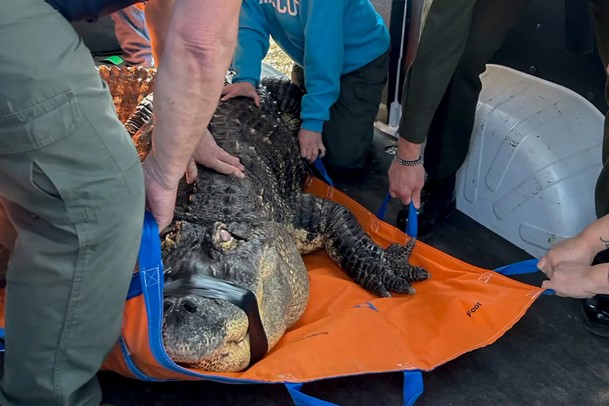
Yesterday’s NY Times newsfeed ran an article about a pet named Albert that had been removed from his owner’s home. The New York State Department of Environmental Conservation (DEC) removed Albert on Wednesday after it determined that he was being kept there illegally. The department said the pet owner had built an addition to his house where Albert lived in an in-ground swimming pool. The agency said the owner had allowed people, including children, to be in the pool with Albert, who is blind in both eyes and has spinal injuries. Albert was 11 feet (3.4 m) long, 750 pounds (340 kg) and 34 years old. Until this week, Albert had lived in the pool house in Hamburg, NY, about 13 miles south of Buffalo. According to the department, it is illegal to own an alligator in New York unless you have a license, and those licenses are for “scientific, educational, exhibition, zoological, or propagation purposes”. The alligator’s name was Albert Edward.
When I looked online, I found an alligator, or a gator, is a large reptile in the genus Alligator of the family Alligatoridae of the order Crocodilia. The only two extant species are the American alligator (Alligator mississippiensis) and the Chinese alligator (Alligator sinensis), although several extinct species of alligator are known from fossil remains. Alligators first appeared during the Oligocene epoch about 37 million years ago. The name “alligator” is likely an anglicized form of the Spanish term for “the lizard” (el lagarto) which early Spanish explorers in Florida called the alligator. An average adult American alligator’s weight is 790 pounds (360 kg) and length is 13 feet (4 m), but they sometimes grow to 14 feet (4.4 m) and weigh over 990 pounds (450 kg). The largest alligator ever recorded was found in Louisiana and measured 19.2 feet (5.84 m). The Chinese alligator is smaller, rarely exceeding 7 feet (2.1 m) and males rarely weigh over 100 pounds (45 kg). The average lifespan for an alligator has never been measured, but one of the oldest recorded alligators was Saturn, who was hatched in 1936 in Mississippi and spent a decade in Germany before being transferred to the Moscow Zoo. Saturn died at the age of 84 on 22 May 2020.
The DEC said Albert’s owner, Tony Cavallaro, had a license for the alligator that expired in 2021. Cavallaro said that while visitors to his home did sometimes take pictures with Albert, they never swam with him or rode him. “I did everything by the book the whole time,” Cavallaro said. “They changed the rules, and I should be grandfathered in.” The DEC adopted new regulations for owning alligators and other dangerous animals in 2020 and informed Cavallaro of the changes and required updates to the alligator’s enclosure. Cavallaro said that he would have had to spend $15,000 for a fence around his yard and even more for zoo insurance when Albert was already covered by his personal insurance. Cavallaro sent paperwork to the department, but the agency said it was not sufficient. The 750-pound alligator was taken to a licensed caretaker until he could be transported to a permanent facility. Cavallaro filed a petition to bring Albert home which has drawn more than 100,000 signatures. The petition claimed the DEC “brought at least 20 or more agents to my house in full body armor and guns treating me like a criminal.” “He was scared,” Cavallaro said.
THOUGHTS: Cavallaro is a reptile enthusiast and bought the newborn alligator at a reptile show in 1990. At one point he owned over 100 reptiles, but caring for them became too much work and he gave up the last of his snakes 16 years ago. Since then, it has just been him and Albert, until now. I think it may not be Albert who is scared. While Cavallaro’s love for an alligator may not be the norm, the DEC’s reaction of changing the rules and enforcing compliance is. Acting different should not be treated as aberrant. Act for all. Change is coming and it starts with you.
 A travelers odyssey