
March 20, 2024
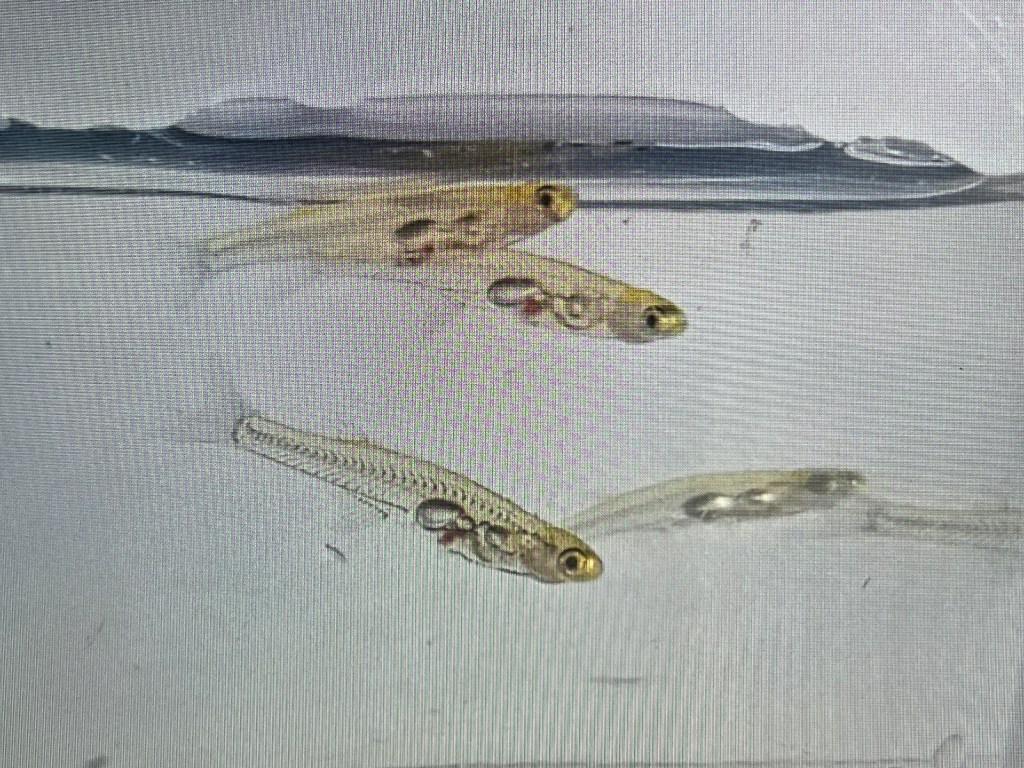
On the back page of the front section of my local newspaper last week I found a USA Today article on a tiny fish that roars. While being one of the smallest fish, it can produce sounds as loud as a jet engine, a new study says. The species was only discovered three years ago and live in shallow streams in Myanmar. They are no more than 12 millimeters long and have a “unique sound-generating” organ that can make noises of more than 140 decibels, an international research team said in a news release Tuesday. The researchers used high-speed video recordings, microcomputed tomography, and gene expression analysis to show that males of the species have a “special sound-generating apparatus” that includes a drumming cartilage, a specialized rib, and a fatigue-resistant muscle. To make noise, the fish hits the drumming cartilage against its swim bladder (gas-filled cavity used to control buoyancy) to produce a rapid pulse in high and low frequencies. The study’s author Ralf Britz, an ichthyologist at the Senckenberg Natural History Collections in Dresden, Germany, said, “We assume that the competition between the males in this visually restrictive environment contributed to the development of the special mechanism for acoustic communication.” According to the study, Danionella cerebrum is the only fish using repeated unilateral muscle contractions for sound production.
When I looked online, I found Danionella cerebrum is a cyprinid (carps and minnows) fish species first reported in 2021 from low altitude streams on the southern and eastern slopes of the Bago Yoma Mountain range in Myanmar. It was erroneously identified as Danionella translucida due to the close resemblance and similar geographical distribution of the two species. Adult fish of the species measure only 1/2 inch (10 to 13.5 mm) in size and have a brain volume of just 0.6 mm3, the smallest known adult vertebrate brain. Because of its miniature size, wide behavioral repertoire, and optical translucency that persists into adulthood, the cerebrum holds great promise for non-invasive whole-brain imaging analyses with single cell resolution in an adult vertebrate. This is beginning to emerge as a novel important model system in current neuroscience research.
Although large animals are generally more capable of making louder noises than small animals, certain small species can be unexpectedly noisy. The three species of Elephant (African bush, Loxodonta Africana; African forest, Loxodonta cyclotis; and Asian, Elephas maximus), can produce noise of up to 125 decibels with their trunks, but the tiny snapping shrimp (family, Alpheidae) uses its claws to generate a popping sound of up to 250 decibels. Other small animals capable of loud noises are the flightless kakapo (Strigops habroptila), whose mating calls can reach 130 decibels, and the male plainfin midshipman fish (Porichthys notatus), which can attract females with an “audible vibrato” of about 100 hertz and 130 decibels. Fish are generally considered to be relatively quiet members of the animal kingdom. Danionella cerebrum is the exception to the rule.
THOUGHTS: Danionella cerebrum makes noise to help them find each other. As a boy I was always told I had to be quiet when I was fishing, or I would scare the fish away. I was skeptical but would move several yards down the shore from the adult I was fishing with if I wanted to make noise. It turns out fish do hear sounds underwater, but depending on what those sounds are can be either attracted or scared off by the noise. Case in point are the many poppers and rattlers that prove deadly attracting and enticing fish to bite. While above surface conversation may seem to travel, especially at night, they do not disseminate well below the surface. I still try and be quiet even as an adult. Part of fishing is the solitude. Act for all. Change is coming and it starts with you.
 A travelers odyssey