
March 28, 2024
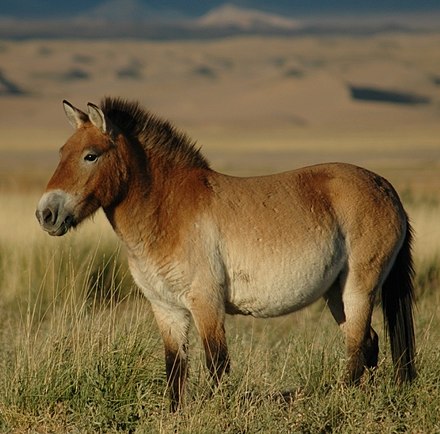
One of the scrolling feeds on my Edge browser highlighted the return of a wild horse found only in Mongolia. The horses are known to Mongolians as “takhi” and are the only equine breed to have never been domesticated. The Guardian reports while they were hunted to extinction in the 1960’s, there are now 1,000 horses spread over three sites in Mongolia, with more in China and Kazakhstan. The reintroduction started during the early 1970’s with gene-mapping of the last surviving animals in captivity to find the strongest and most genetically diverse individuals. Dashpurev Tserendeleg, who runs Hustai National Park, said the successful reintroduction and the horse’s twice-downgraded risk status by the International Union for Conservation of Nature were a huge achievement. “Horses are central to our culture. Everyone is glad to have them back.” Tserendeleg said. “Nobody believed we could save this species.” Outside of Mongolia the horses are called Przewalski’s horse.
When I looked online, I found the Przewalski’s horse (Equus ferus przewalskii or Equus przewalskii), also called the takhi, is a rare and endangered horse originally native to the steppes of Central Asia. It is named after the Russian geographer and explorer Nikolay Przhevalsky. The Przewalski’s horse is stockily built, smaller, and shorter than domestic horses, with a height of 12–14 hands (48–56 inches, 122–142 cm), and weight around 660 pounds (300 kg). They have a dun coat with pale hair around the eyes, muzzle, and underside of the body (pangaré features). The breed was extinct in the wild but was reintroduced in the 1990’s to its native habitat in Mongolia, as well as several other locales in Central Asia and Eastern Europe. Several genetic characteristics of Przewalski’s horse differ from what is seen in modern domestic horses indicating neither is an ancestor of the other. The Przewalski has 33 pairs of chromosomes compared to 32 for the domestic horse. Their lineages split from a common ancestor between 160,000 and 38,000 years ago, long before the domestication of the horse. Przewalski’s horse was long considered the only remaining truly wild horse, as the American mustang and the Australian brumby are feral horses descended from domestic stock. Some taxonomists treat Przewalski’s horse as a species (Equine przewalskii), others as a subspecies of wild horse (Equine ferus przewalskii), or a variety of the domesticated horse (Equine caballus).
Hustai National Park has rebounding populations of marmots, deer, and gazelles, but this success contrasts with the rest of the country. Hunting for survival, booming cattle populations overgrazing vital grasslands, and the Earth’s rising temperature all contribute to the crisis. The Mongolian government launched initiatives to help with conservation and in 1998 pledged to protect 30% of its territory by 2030. Last year the president launched a drive to plant 1 billion trees by the same date, although these are struggling with a lack of funding. The principles of success rely on long-term international partnerships, decades of scientific research, and rangers who collect data and evict livestock. Przewalski’s horse’s reintroduction is a worldwide example of how to save a large mammal. Efforts are well underway globally to bring back other species like wild bison, the red wolf, and others. Conservationists hope the park can serve as a model for other areas.
THOUGHTS: One difficulty of reintroducing species into the wild is obtaining enough viable individuals. Early attempts by individual zoos resulted in inbreeding and reduced fertility until several American zoos began a collaborative breeding-exchange program. Advances in equine reproductive science have also been used to preserve and expand the gene pool, including a successful reversal of a vasectomy (2007), artificial insemination (2013), and cloning (2020), increasing the genetic variation of the species. Sustaining the earth’s ecosystems requires tradeoffs. We need to make the right ones. Act for all. Change is coming and it starts with you.
 A travelers odyssey