
April 12, 2024
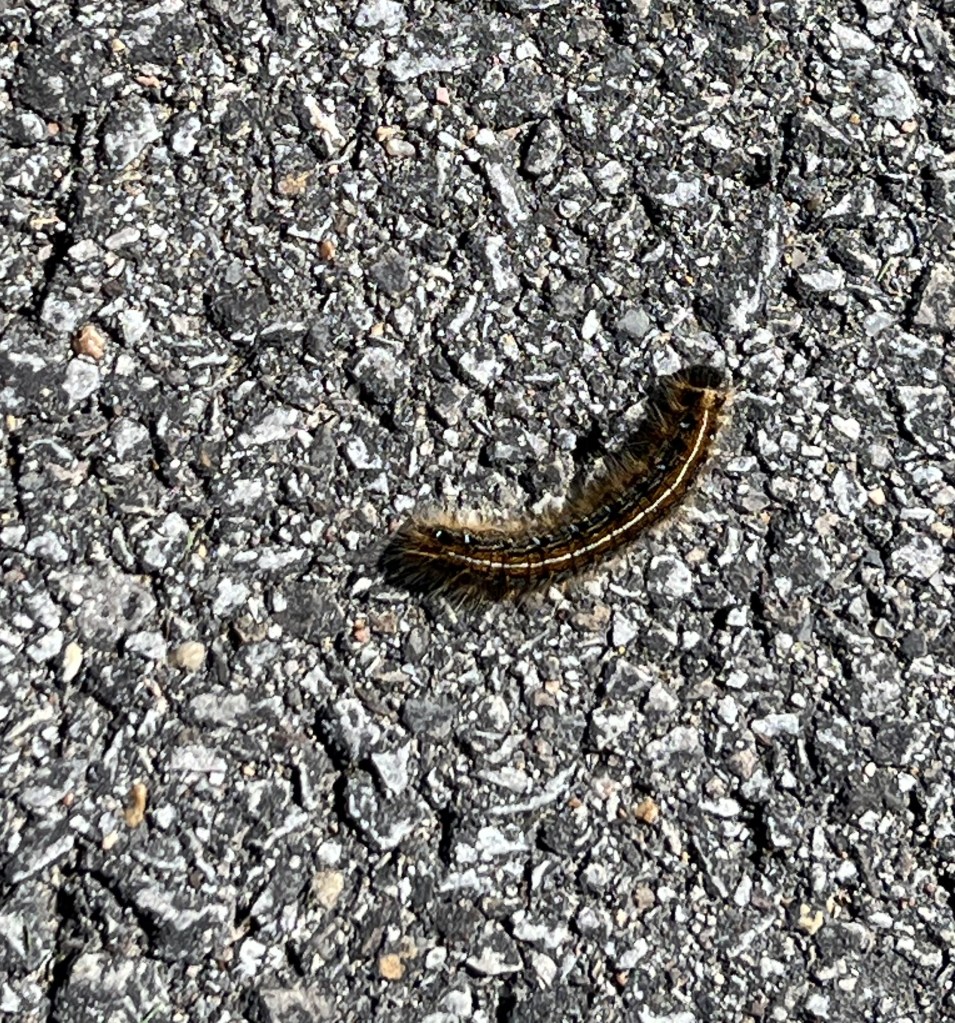
The weather is warming, my hügelkultur beds are installed, and the 50 seedlings that survived are anxious to get into the ground. Between the rain and my focus on preparing my beds for planting I have been neglecting taking the kids for a walk. I justified this thinking the side yard provides running room (which it does), but I also know how much they enjoy these ventures so yesterday we went outside for a walk. Last March I blogged about the coming of spring and the explosion of flowers that accompany this transitional time of year. When we were walking, I was reminded that animals also become active as the temperatures rise and spring approaches. On the way to the park, we passed an alligator snapping turtle (Macrochelys temminckii) scurrying across the road from one side ditch to the other. He was not the monster from the camp in Kansas but was still over 1 foot (30.5 cm) in length. Then on the walk along the park route, we passed an eastern tent caterpillar (Malacosoma americanum) crawling along the road on its way to some unknown destination. It seemed like we were not the only ones to be happy to be taking a walk.
When I looked online, I found Eastern tent caterpillars are among the earliest caterpillars to appear in the spring. Because the early spring weather is often cold, the caterpillars rely on the heat of the sun to elevate their body temperatures to levels that allow them to digest their food. Studies show these caterpillars are unable to process the food in their guts when temperatures are below 59F (15C). The early stages (instars) are black, and their bodies readily absorb heat. When basking, they typically pack together tightly, reducing heat loss due to convective currents. The caterpillars may aggregate on the surface of the tent or within it, which acts as a miniature greenhouse and traps the heat of the morning sun. An aggregation of basking caterpillars can easily overheat, so the aggregation splits up when they reach a satisfactory temperature. The one we spotted had clearly gone off for a walk on its own as it continued its journey to maturity as a moth.
The alligator snapper will often walk from water source to water source to find a mate. The snapper reaches maturity around 12 years of age and mating takes place yearly, in early spring in the southern part of its geographic range (Arkansas), and in later spring in the northern part. About two months later, the female builds a nest and lays a clutch of 10–50 eggs. Some females lay eggs every year and some females lay eggs every other year. As with all turtles, the sex of the young depends on the temperature at which the eggs are incubated (temperature dependent sex determination). For the alligator snapper, higher temperatures produce more males while lower temperatures produce more females in the clutch. Nests are typically excavated at least 50 yards from the water’s edge to prevent them from being flooded and drowned. Incubation takes from 100 to 140 days, and hatchlings emerge in the early fall. The snapper’s potential lifespan in the wild is unknown but it is believed to be capable of living to 200 years of age, but 80 to 120 is more likely. In captivity, it typically lives between 20 and 70 years. The snapper relies on its walk to find the best mate to continue its species.
THOUGHTS: Many will walk for exercise (including me) but there are many other reasons to walk. The caterpillar was out for a walk to find a new place to build a cocoon. The turtle was out for a walk to find a mate. The kids were out for a walk to encounter the new smells along the trail. When humans go outside for a walk it can bring us closer to nature. When we view nature’s diversity and embrace its beauty, we realize how amazing our world is. We are the world’s stewards, not its overlord. Act for all. Change is coming and it starts with you.
 A travelers odyssey