
April 24, 2024
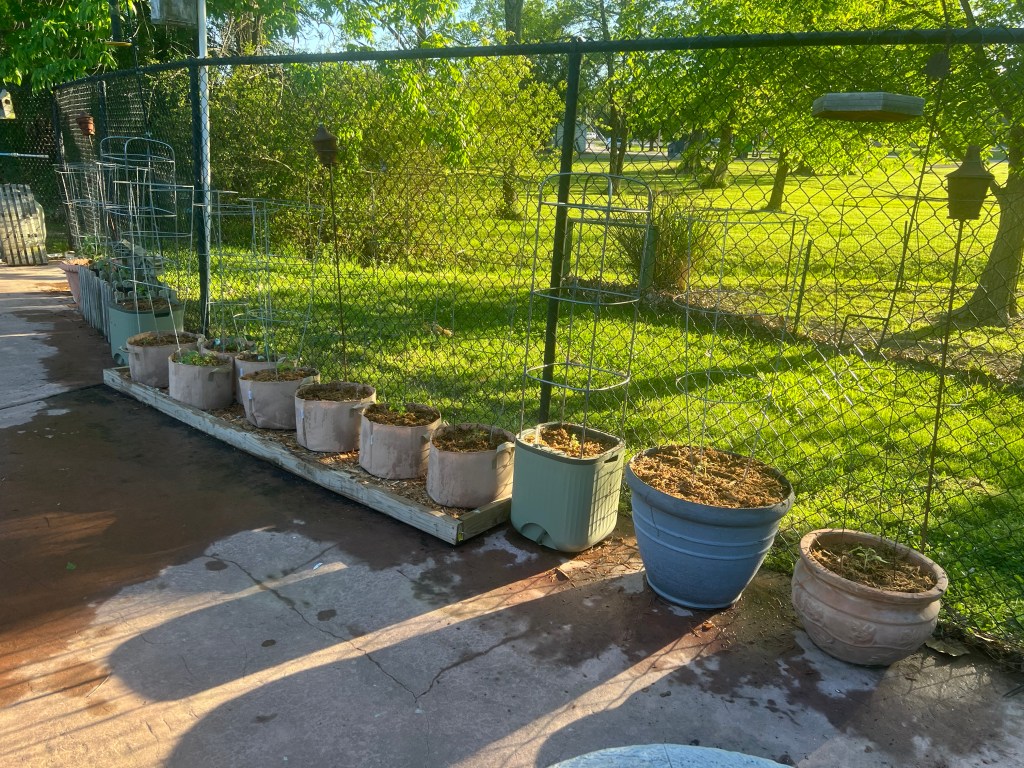
It has been an up and down week as far as my garden is concerned. I was overjoyed to finally get the tomatoes and peppers into the ground on Sunday. I spent the entire afternoon working on the project. I had four varieties of peppers (Capsicum annuum) with 2 jalapenos along with one each of green, yellow, and red bell peppers. There were four varieties of tomato (Solanum lycopersicum) with 4 San Marzano (for sauce), 4 beefsteak (for Pico), 2 Cherokee purple (for eating), and 2 Juliet grape (for salad) tomatoes. I also used a variety of planting methods. The tomatoes were planted in growbags (5), new self-watering containers (2), my old containers (4). The peppers were in two formats, with growbags (2) and old containers (4). Lastly, I added cilantro in a growbag (1) to use in my various tomato concoctions. I hoped these different varieties and techniques would help me decide what to plant next year. I was feeling pretty good about my work and mulched and watered all the plants in for the night. When I got up the next morning, I noticed Loki had gotten into the containers and destroyed four of the tomatoes. I had grown most of the plants through germination.
When I looked online, I found Germination usually refers to the growth of a plant contained within a seed resulting in the formation of the seedling. The seed of a vascular plant (land plants that have lignified tissues (xylem) for conducting water and minerals throughout the plant) is a small package produced in a fruit or cone after the union of male and female reproductive cells. All fully developed seeds contain an embryo and, in most plant species some store of food reserves, wrapped in a seed coat. Dormant seeds are viable seeds that require specific internal or environmental stimuli to germinate and resume growth. Seed germination depends on both internal and external conditions. The most important external factors for any germination are the right temperature, water, air, and sometimes light or darkness. Different plants require different variables for germination, and these are often closely linked to the ecological conditions of a plant’s natural habitat.
I had spent time and energy bringing my plants to germination, so I felt it was worth the time to spend half a day researching how to Loki-proof my tomatoes and peppers. It turned out there are two ways the pundits said work best. One is to put a fence around the plants and the second is to use smells (like cayenne pepper and vinegar) to keep him away. I put up a fence to keep Loki bask from the plants and then sprayed vinegar in the soil around the small plants. I decided to wait on the cayenne as it was forecast to rain and that would dilute the effect. The next morning Melissa watched as Loki again got into the containers. She also noticed he was not attracted by the plants themselves. It was the small white tags I used to mark what was being grown (Loki is a chewer). Melissa moved the tags to the rear of the containers and beyond his reach through the fence. This will no doubt become a constant vigil.
THOUGHTS: After redoing the tomatoes and peppers I got the rest of my plants in the hügelkultur beds yesterday. These were a mixture of plants grown from germination and other seeds planted directly into the soil. While I have planted most of my beds, I need to soak the corn seed overnight to help germination of the “three sisters”. I have checked all of the nurseries in my area, and none are yet selling potatoes. I made a big commitment this year in preparing the beds, readying the seed for germination, and planning placement in the beds. There is still the watering and weeding, but I am again hopeful for significant crops. The more time I spend the more I realize how much I still need to learn. Like most things we do, to do it well takes a lifetime of learning. Act for all. Change is coming and it starts with you.
 A travelers odyssey