
April 27, 2024
One of the things I enjoy about being outside in my garden is watching the antics of the animals I encounter. As I walked out my front door to check my hügelkultur beds I noticed an American Robin (Turdus migratorius) pull a six inch (15 cm) earthworm (Lumbricus terrestris) from the front lawn. It had just rained, and the robin was taking advantage of the worms coming to the surface. I startled the bird, and he flew off, dropping the worm in the mulch around the beds used to keep the weeds out. The bird tried to regrip the worm but flew off in frustration as I approached. After I passed the worm, the robin landed a little way off and began to walk sideways toward the worm, always keeping one eye on me. I stood still and waited to see how far he would come. Over the next minute the bird went back and forth, always advancing. I stood still as I continued to watch to see how close he would come. He seemed to reach his limit at about 15 feet (4.5 m) away and still 5 feet (1.5) m) from the worm and flew away to another part of the yard. His behavior seemed to say it was easier to get a new worm than to risk the unknown behavior of the human watching him.
When I looked online, I found animal behavior is the way animals interact with other members of their species, with organisms of other species, and with their environment. Behavior can also be narrowly defined as a change in the activity of an organism in response to a stimulus, an external or internal cue, or a combination of cues. Both external and internal stimuli can cause animal behavior. External information could be threats from other animals, sounds, smells, or weather, and internal information could be hunger or fear. An understanding of how genes and the environment come together to shape animal behavior is also an important basis for the field. While genes capture the evolutionary responses of prior populations to selection on behavior, environmental flexibility gives animals the opportunity to adjust to changes during their own lifetime. Scientists are drawn to the study of animal behavior for a variety of reasons ranging from how it sheds light on human behavior to environmental concerns. Understanding why some animals help others at the potential cost of their own survival and reproduction gives us insight into their behavior but could potentially help us understand the human ideas of altruism and sacrifice.
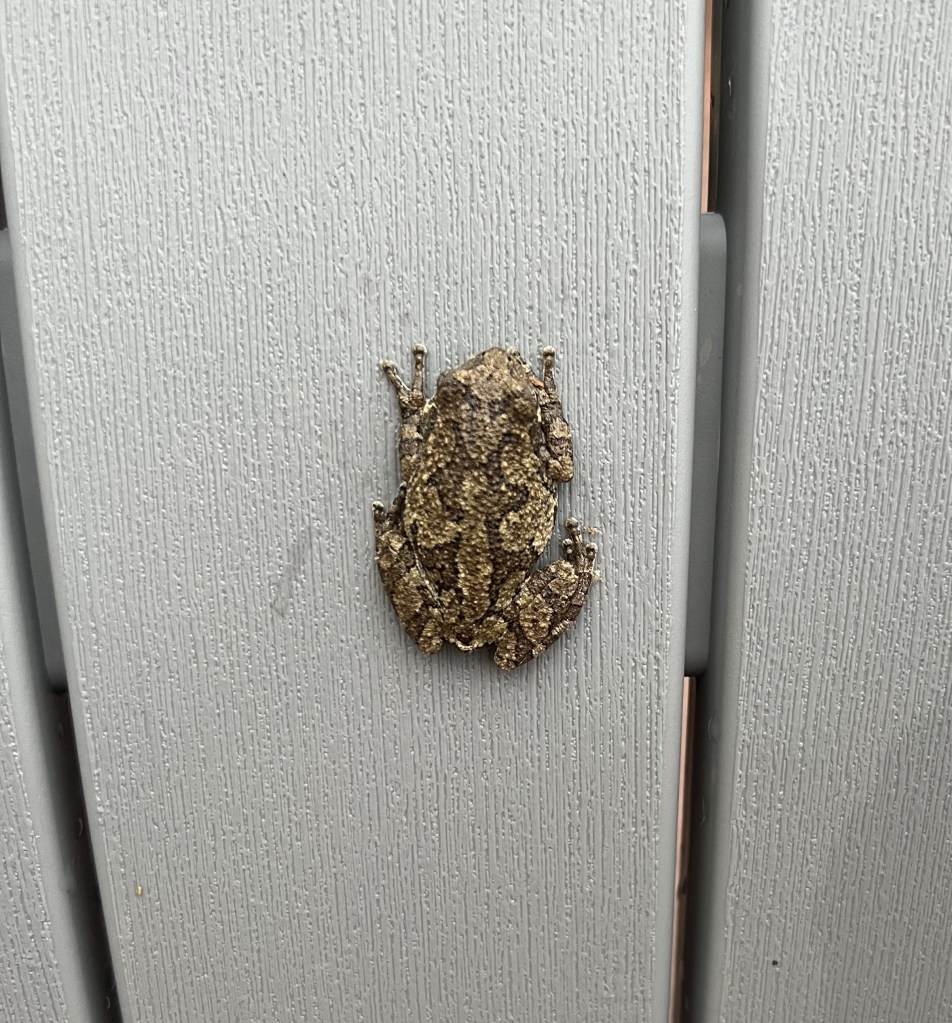
Another observation is how the gray tree frogs (Hyla versicolor) have been performing their mating calls in the trees around our pool/pond every night. One of frogs came down from the trees and has taken up residence under the patio chair cushions. I lifted the pad on one of the chairs and was surprised to see the frog motionless on the seat. I do not know how to differentiate between a male and female frog but assumed this was a female who came from the trees to lay her eggs in the water. I left her there but was curious to see if she would still be there the next day. She was not but moved to the next chair. I again covered her with the pad but set it on its side to drain the rain. When I came out later the frog had moved up inside the pad and was crouching on the back of the chair. I suppose she felt this was better protection. Regardless, she is not getting any closer to the trees.
THOUGHTS: I was always told earthworms escape to the surface to keep from drowning. Then I learned they can breathe underwater and will survive being submerged for over two weeks. Since drowning is a myth, why do they surface? The most likely explanation is that it is easier to travel across the surface to find food or a mate. They need to stay moist, so this is their best opportunity on the surface. Birds exploit this behavior by mimicking rain by hitting the ground with their feet to encourage earthworms to rise and be eaten. Behavior can be inherited or learned by animals. Humans are not confined by the behavior of our culture or even families. We can choose to change for the good of our species and environment. Act for all. Change is coming and it starts with you.
 A travelers odyssey