
May 03, 2024
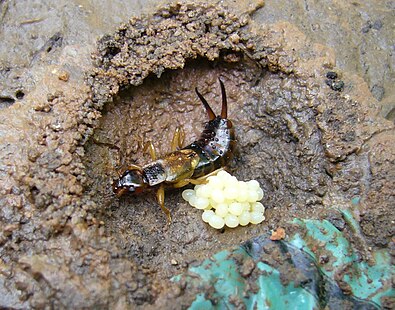
On rare occasions I have found a small bug called an earwig crawling on the wall in our house. I say this as while scrolling my Edge start page I saw a segment that asked if earwigs are dangerous to humans. I was intrigued (which is why the article was there) and clicked to find out. The site said the earwig gets its name from an old European myth that says that the bugs crawl into people’s ears and tunnel into their brains while they sleep, causing fever and insanity. Other versions of the myth say they crawl into human ears to lay their eggs, and the hatchlings then tunnel their way into the brain. The term earwig is derived from Old English word “ēare,” which means ear, and “wicga,” which means insect. There is no scientific basis for claims about an earwig seeking out human ears and causing insanity or other damage. However, emergency rooms do see patients with a bug in their ear, so the presence of any small bug in the ear canal is not unique to the earwig. When an earwig is found in a person’s ear, it is likely it has wandered there by chance. While it does not bite, the earwig can use its pincers to pinch if it is picked up and disturbed. The earwig is mostly harmless to people.
When I looked online, I found the European earwig (Forficula auricularia) or common earwig is an omnivorous (eats plants and animals) insect belonging to the family Forficulidae. The common name (actually) comes from the look of the hindwings which resemble a human ear when unfolded. The species name (auricularia) is a specific reference to this feature. The earwig is a pincher bug that ranges in size from one-fourth to 1 inch (0.6 to 2.5 cm). It has six legs and an antenna that measures about half its size. The earwig is reddish-brown in color with a flattened elongated body and slender beaded antennae with a pair of pincers (forceps) at the tip of the flexible abdomen. While both sexes have pincers, in males they are large and curved, while in females they are straight. Nymphs are similar to adults in appearance, though their wings are either absent or small. The European earwig, which is the most common variety, was brought to North America from Europe around 1907 and rapidly spread across the US. The insect survives in a variety of environments and is a common household pest because they tend to invade homes and consume pantry foods.
Common earwig females typically show maternal care through guarding and tending to their eggs and nymphs. The female cares for her young by shifting the eggs and continuously cleaning them with her mouth and forceps to avoid fungal growth and pathogens. She protects the eggs by staying close to the nest, fiercely defending against predators, applying chemical protection against drying (desiccation) through egg grooming, and relocating the entire clutch under stress. After the eggs hatch the mother continues to care for the nymphs and provides food and protection until they reach maturity (one month). In many species, kin bias prevents parents from investing care and energy for foreign offspring to allow them to invest in their own offspring and ensuring their own genes are passed on. Common earwig mothers will not eliminate foreign eggs and treat them as her own. This is thought to be a result of the family specific bouquet of cuticular hydrocarbons she applies to the surface of the eggs. If it smells like me, it must be cared for like mine.
THOUGHTS: While maternal care dramatically increases the survival and development of the young earwig, it can be costly. The relationship between parents and offspring is shaped by an intersection of selfish and altruistic tendencies that reflect a compromise of evolutionary interests. Researchers have found that in groups, selfish individuals beat altruistic individuals, but groups of altruistic individuals beat groups of selfish individuals. That means we are stronger when we work together to support others than when we try to only take care of ourselves. Act for all. Change is coming and it starts with you.
 A travelers odyssey