
May 29, 2024
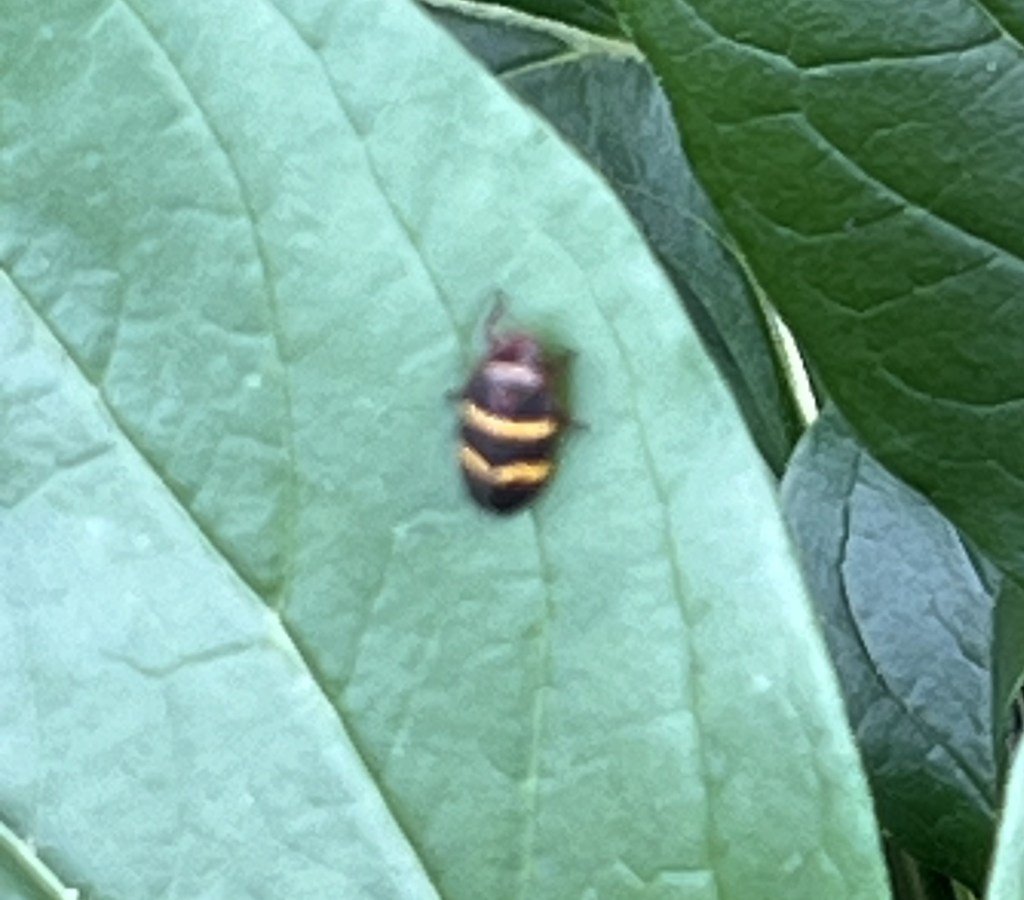
Today I went to my raised beds to check on them and give them a drink. I knew I needed to thin the radishes (Raphanus sativus) and carrots (Daucus carota). The seeds of both had been tiny (pen point) and had tumbled out of the packet as I carefully tried to space them in the one inch (2.5 cm) furrow. They were now massed together and would never provide enough room for the root vegetables to grow. While the carrots remained clustered, the radishes had grown and bullied the other plants aside and pushed out of the soil. I thinned the carrots and thinned the radishes by harvesting eight radishes that were around 1-1/2 inched across (3.75 cm). On my way back to the house I noticed a small beetle crawling along a leaf of the Garden Phlox (Phlox paniculata) my mother-in-law had planted in the front flower bed. I assumed it was a type of ladybug (Family, Coccinellidae) that I was unaware of. When I checked on my phone ID, I found it was actually a spittlebug.
When I looked online, I found the two-lined spittlebug (Prosapia bicincta) is a species of insect in the family Cercopidae that is widespread in the eastern half of the US. Adults are black with two red or orange lines crossing the wings and reach a length of 0.3 to 0.4 inches (8 to 10 mm). Nymphs feed on various grasses, including centipedegrass (Eremochloa ophiuroides, bermudagrass (Cynodon dactylon) both common in lawns, and corn (Zea mays). Nymphs progress through five instars where they feed from within foam (consisting of their own spittle, hence the name) produced from juices of their host plant. Adults feed on the leaves of both native and introduced species of holly, as well as on the leaves of the eastern redbud tree. Spittlebug is a pest of forage (pasture) and turf (lawn) grasses and consumption of these plants causes economic damage throughout the southeastern US.
While I had been happy to see a ladybug on my phlox, my mood changed when I identified this as a spittlebug. Ladybugs have been valued in biological pest control (they prey on agricultural pests like aphids and scale insects) as far back as 1814 in England. Several species have been introduced to areas outside their native range, beginning with the vedalia beetle (Novius cardinalis) introduced to California in 1887 from Australia to protect citrus trees. Ladybugs have been used in 29 countries with great success due to their high prey specificity, fast development, multiple generations each year, efficient discovery of host patches, and larval development completed on a single host insect. The two-lined spittlebug is just the opposite. Both the nymph and adult spittlebug use their needle-like stylet mouthparts to penetrate the plant tissue and suck out sap. Adult feeding can cause ‘froghopper burn’ (phytotexemia) of the plant tissue. Turfgrasses with froghopper burn will gradually wilt, followed by the blade turning brown and dying. Turfgrass damage is usually sporadic and patchy, and the infestations more often causes aesthetic damage in the US mainland.
THOUGHTS: While my one spittlebug is not a problem, an infestation like what happened on the pastures on the island of Hawaiʻi in 2022 is. Spittlebug infestation reached more than 172,973 acres (70,000 ha) and caused serious, long-term damage to large areas of the island’s rangelands and pastures. There are no known natural predators in the eastern US, much less when the species is introduced into a new environment. Invasive species control is imperative if we are to preserve the natural ecosystems to also help ensure human survival. Act for all. Change is coming and it starts with you.
 A travelers odyssey