
June 05, 2024
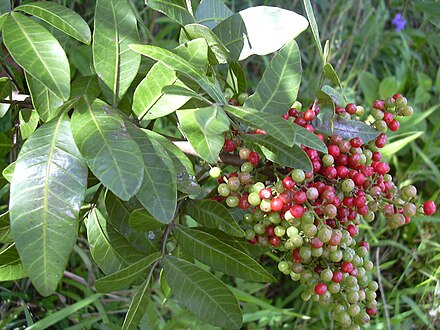
In the middle of the back section of my local newspaper I found a USA Today article reporting how Artificial Intelligence (AI) is being used to fight invasive plants in the Florida Everglades. The changing climate has produced stronger and more frequent hurricanes which can open areas of the dense everglades foliage and allows invaders to take control. Researchers at the University of Florida are using AI to gather data combining ground-level research with hyperspectral sensing. The study is focused on two of the Everglades worst invaders, the Old World climbing fern (Lygodium microphyllum) and the Brazilian pepper. The pepper is particularly abundant along the fringes of the Mangrove swamps (biome associated with various salt-water tolerant species). The team plans to examine post-hurricane conditions with remotely sensed data and map the distribution of invasive plants in an effort to help identify and eradicate them.
When I looked online, I found the Brazilian pepper (Schinus terebinthifolia) is a species of flowering plant in the cashew family (Anacardiaceae) that is native to subtropical and tropical South America. The plant is a sprawling shrub or small tree with a shallow root system that may reach heights of 23 to 33 feet (7 to 10 m). The branches can be upright, reclining, or nearly vine-like, all on the same plant, and its plastic morphology allows it to thrive in all kinds of ecosystems. In swamps the pepper grows as a semi-aquatic plant. The leaves are alternate, 3.9 to 8.7 inches (10 to 22 cm) long, pinnately compound with 5 to 15 roughly oval leaflets that are 1.2 to 2.4 inches (3 to 6 cm) long and 0.79 to 1.38 inches (2 to 3.5 cm) broad. The leaflets have finely toothed margins, an acute to rounded apex and yellowish veins. The plant has separate male and female reproductive organs in different individuals (dioecious) and produces abundant small white flowers in clusters. The seeds are a stone fruit (drupe) 0.16 to 0.20 inches (4 to 5 mm) in diameter and carried in dense clusters of hundreds. The pepper tree was introduced as an ornamental outside its native range and is now considered an invasive species, including the US states of California, Texas, Hawaii, Arizona, Nevada, Louisiana, and Florida. It is another one that got away.
Violent storms can shape plant invasions in two ways. The storms can make the landscape more receptive to invasion by killing native plants communities and allowing more sunlight for invaders to capitalize on. Storms can also spread invasive seeds and spores to new areas. If resources can be allocated before or right after a storm the invasions can be managed more efficiently, and that is where AI comes to play. According to researcher Susan Meerdink, a method called “multitarget multiple-instance spectral match filter” (MTMI-SMF) is a machine learning approach that can detect invaders using multispectral imagery. “Our study demonstrates that remote sensing technologies and multiple-instance learning algorithms can provide managers with critical tools.” Data is collected using a remote flyover, like a drone, helicopter, or satellite. Some invasive species give off a unique and detectable spectral (light) signal different than native species. AI can in turn plot their presence.
THOUGHTS: The researchers describing the use of AI to detect the presence of Brazilian Pepper appear caught in technospeak. Technospeak is an informal term for a prose style used by high-technology industries, their associated media, and the marketing and publicity groups around them. Many outsiders consider it a nonsense language consisting of buzzwords, esoteric words, and technical jargon. The style does give clear meaning while reducing the words otherwise needed to make your point. While this can make communication concise, it creates also US vs THEM. If you do not understand, I am not talking to you anyway. If you want to be understood, you need to speak to others in a way they can understand. Act for all. Change is coming and it starts with you.
 A travelers odyssey