
June 25, 2024
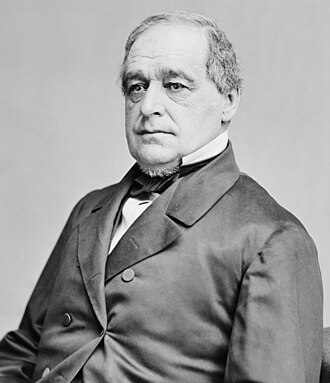
Sunday was a rainy afternoon in Maine and my sister decided to take us on a tour. We climbed into the car and drove along the winding roads through lush trees and Cape Cod style cottages. I grew up in the homesteader state of Kansas where everything is both (relatively) flat and the roads are laid out in grids that divide the 180-acre homesteads available for anyone willing to brave the Great American Desert. That means I am used to seeing where I am going, and the miles are marked by (some sort of) road every mile telling my mind how far I have driven and how far I have yet to go. Another Maine feature is passing through towns named for the countries or cities the initial populous had immigrated from. We broke into a settled area and drove up the hill toward the Paris Hill Historic District, an area that encompasses the historic 19th century village of Paris Hill in Paris, Maine. On the bluff with views of the White Mountains to the west sat the Hannibal Hamlin house.
When I looked online, I found Hannibal Hamlin (August 27, 1809 – July 4, 1891) was an American attorney and politician who served as the 15th Vice President of the US from 1861 to 1865. He was the first Republican Vice President during President Abraham Lincoln’s first term. Hamlin began his political career as a Democrat in Maine’s House of Representatives and was later elected twice to the US House of Representatives, and then to the US Senate. Hamlin had strong abolitionist views and left the Democratic Party for the newly formed Republican Party in 1856. Hamlin was selected as Lincoln’s running mate in the 1860 general election to balance the ticket, as Hamlin was from New England while Lincoln was from the Northwest. Although not a close friend, Hamlin supported Lincoln’s key projects like the Emancipation Proclamation. After leaving the Vice Presidency, Hamlin was elected to two more terms in the US Senate, and finally served as US Minister to Spain before retiring in 1882. On July 4, 1891, Hamlin collapsed while playing cards at the Tarratine Club he had founded in Bangor, Maine, and died a few hours later at the age of 81. Hamlin was the third US Vice President to die on Independence Day.
Hamlin was replaced as vice-presidential nominee in the 1864 presidential election. The Republicans and War Democrats joined to form the National Union Party in June 1864 and while Lincoln was renominated, War Democrat Andrew Johnson of Tennessee was named to replace Hamlin. Lincoln was seeking to broaden his base of support and was looking ahead to Southern Reconstruction. Johnson had proven himself an adept military governor in the Union occupied state of Tennessee. Hamlin was an ally of the Northern “Radical Republicans” (who impeached Johnson). Lincoln and Johnson were elected in November 1864 and Hamlin’s term expired on March 4, 1865. Hamlin swore Johnson in as Vice President, who was drunk and proceeded to give an incoherent acceptance speech. Hamlin narrowly missed becoming the 16th president, as Lincoln was shot on April 14, 1865, five days after the Union victory at the Battle of Appomattox Courthouse. Hamlin’s vice presidency ushered in a half-century of sustained national influence for the Maine Republican Party in national politics that is unmatched by any subsequent Maine political delegations.
THOUGHTS: The Hamlin estate and Paris Hill Historic District reminded me of the eight years I worked for the Division of State History documenting historic buildings and sites for the National Register of Historic Places. While this seems a lifetime ago, I still like seeing architectural styles and researching history. America is a young (European) nation with sites dating back to the 1600’s, but they pale compared to the ancient structures of Europe and Asia. History gives a new perspective on one’s place in the greater world. Much can be learned from the past, and from the descendants that still thrive amid that history. Act for all. Change is coming and it starts with you.
 A travelers odyssey