
June 27, 2024
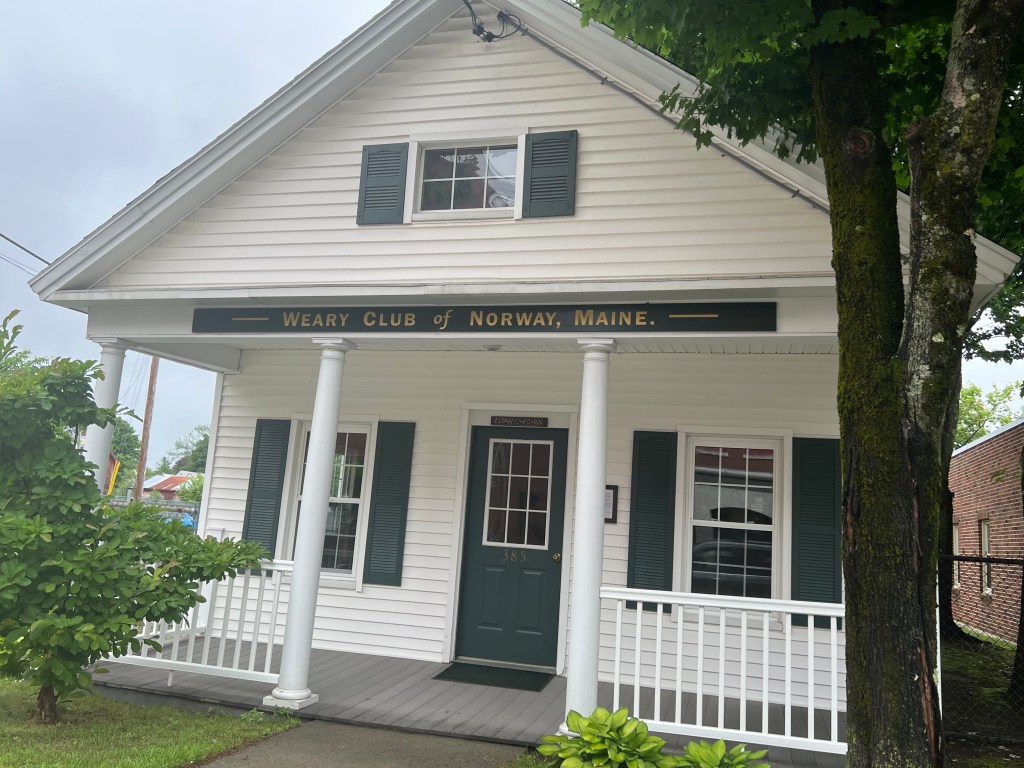
During our Sunday tour we came across another New England staple still operating today. The Weary Club was founded in the Norway community in 1923 by Advertiser Democrat (newspaper) owner and publisher Fred Sanborn. Sanborn rented a vacant store on Main Street where a group of like-minded friends and businessmen could meet and share pastimes, such as playing cribbage, smoking, chewing tobacco, and conversation. By 1926 the group had christened itself the Weary Club, built a clubhouse, established a board of officers and directors, and established a set of by-laws. Gambling and drinking were not allowed, but local gossip was permitted. No more than 200 members were allowed, and applicants might have to wait for a member to die before they were approved to join. A lifetime membership cost US$25 (currently US$50) and was granted to those who could whittle a “shaving light enough to float.” The requirement was later dropped as whittling became passe. Ben Tucker, longtime member and historian said, “The main function of our club now is that one Saturday morning a month from 8 to 9:30 we share coffee and doughnuts”, along with conversation. The Weary Club is a continuing example of the early era social clubs established for sharing political wisdom and Yankee philosophy.
When I looked online, I found a social club is an organized group of individuals (or the place they meet) who come together to engage in shared interests, activities, or causes. The clubs serve various purposes, including fostering social interactions, providing recreational opportunities, and supporting community initiatives. The primary objectives of social clubs are to create a sense of belonging, and members benefit from a structured environment where they can pursue their interests, develop new skills, and contribute to their communities. The origins of social clubs can be traced back to ancient civilizations where people gathered in informal groups to discuss politics, philosophy, and social issues. In medieval Europe, guilds and fraternities formed among tradespeople and artisans to provide mutual support and camaraderie. Social clubs became more formalized during the 18th and 19th centuries, particularly in Europe and North America. Gentlemen’s clubs, literary societies, and scientific associations offered intellectual and social engagement for their members. The Industrial Revolution and urbanization spurred the growth of social clubs as people sought community and connection in rapidly growing cities. Today’s social clubs include a variety of interests and activities and often incorporate technology and virtual events to connect members.
Researching community interaction in a Utah smelter town I realized the early 20th century saloons and the town’s church both served as social clubs. The saloon was a place to relax after work with a drink and a meal. The saloon would cash the checks from the local smelters and hold accounts like a bank. The workers only had access to their beds for 8 hours a day (yes, three shifts for the same bed) and the saloon was a place to socialize until your bed was available. The church (Ward House) served a similar purpose (without alcohol) as a community gathering spot. The farmers would gather on Sunday for day long services and events, while individual groups of men or men would come to socialize during the week. The church provided financial support for the poor and destitute who were part of the social group.
THOUGHTS: I always wanted to write a paper on this obvious comparison (unless you were in one of the two social groups) to present to my own social group of historians. I wondered if it would have been accepted by either of the two factions (or my own). Most social clubs think of themselves as serving the “unique desires of their members”. Social interaction is a need we all have but cannot allow it to separate the “us” and “them”. Act for all. Change is coming and it starts with you.
 A travelers odyssey