
June 28, 2024
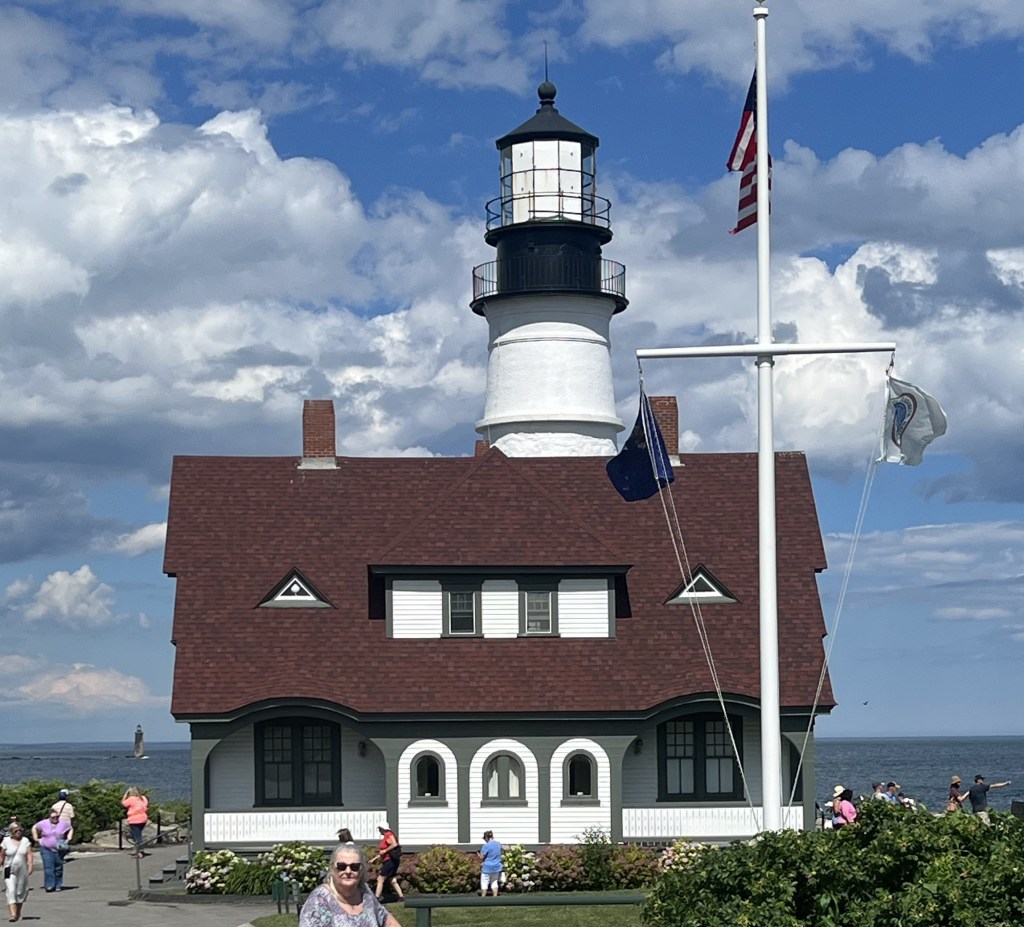
Yesterday we decided to tour some of the lighthouses located around Portland harbor. We started off with Two Lights (1828), a double tower lighthouse located on Cape Elizabeth. Next it was off to Spring Point Ledge Lighthouse (1897), the only caisson-style light station in the United States that visitors can walk to. Then it was off to the Portland Breakwater Light (also called Bug Light) first built here in 1855 as a wooden structure. The breakwater was extended, and a new lighthouse was constructed at the end of it in 1875 made of curved cast-iron plates whose seams are disguised by six decorative Corinthian columns. Portland Head Light is a historic lighthouse south of Portland on a head of land at the entrance of the primary shipping channel into Portland Harbor. Construction of Head Light began in 1787 at the direction of George Washington and was completed on January 10, 1791. The final lighthouse was the Rams Island Light located just offshore of Ram Island marking the eastern entrance to Boothbay Harbor. The lighthouse was built in 1883 and automated in 1965.
When I looked online, I found a list of lighthouses in the state of Maine as identified by the United States Coast Guard. There are fifty-seven active lights in the state, two of which are maintained as private aids, nine are standing but inactive, three have been destroyed, and one has been replaced by a skeleton tower. Two of the stations were originally twin towers. In both cases both towers survive but only one of each pair is active. The Portland Head Light is the oldest light in the state and was the first US lighthouse completed after American independence. The second Whitlocks Mill Light is the last lighthouse in the state and was first lit in 1910. Whitlocks Mill is also the most northerly light in the state as well as on the US Atlantic Coast. The West Quoddy Head Light sits on the easternmost point of the continental US. The Boon Island Light tallest tower is 137 ft (42 m), although the Seguin Light is the highest in the state at 180 ft (55 m).
Lighthouse preservation in Maine has been facilitated by the Maine Lighthouse Program (MLP). The MPL came about in the aftermath of the Rockland-based Island Institute’s (1986) successful but protracted negotiations to acquire the keeper’s house of the Heron Neck Light Station. A program for facilitating transfers was proposed by Peter Ralston of the institute, and legislation was introduced by George J. Mitchell. A later bill introduced by Olympia Snowe in 1995 met with greater success and was signed into law late in 1996 as part of the coast guard authorization act. Under the program, thirty-six light stations were offered to qualified preservation and historical groups and local governments. Applications for transfer were reviewed by a board set up at the state level, headed by Richard I. Rybacki, a retired USCG rear admiral. Four lights were to be transferred to the US Fish and Wildlife and twenty-eight other lights were transferred in the summer of 1998. Prior to this program, some lights in the state had already been sold to individuals following deactivation in the 1930’s. The most notable of these is the Tenants Harbor Light, bought by Andrew Wyeth in 1978.
THOUGHTS: The modern era of lighthouses began at the turn of the 18th century, as lighthouse construction boomed along with increasing levels of transatlantic commerce. The advances in structural engineering and lighting equipment allowed for the creation of more powerful lighthouses, including ones exposed to the sea. The function of lighthouses shifted toward the provision of a visible warning against shipping hazards, such as rocks or reefs. There is a reason for all the lighthouses in and around Portland, Maine. The Port of Portland is the 2nd largest tonnage seaport in New England as well as one of the largest oil ports on the East Coast. The port also docked 100 cruise ships in 2019 making it Maine’s second-largest cruise ship port behind Bar Harbor. That is a lot of traffic guided by the many lighthouses. Act for all. Change is coming and it starts with you.
 A travelers odyssey