
July 09, 2024
When we got back from our Maine vacation, I was anxious to see how my vegetables had faired. I was surprised to find only a few tomatoes ripe on the vine but figured my watering crew had helped themselves to the ripe fruit (I was right). The cantaloupe I was waiting on to ripen was missing for the same reason, but four green ones had replaced it, so it was just a matter of time. The beets (Beta vulgaris) had continued to mature, and the rutabaga (Brassica napus) was ready to harvest. I thinned the larger beets and then went ahead and harvested the rutabagas. I love pickled beets and enjoy the radish like taste of rutabaga in salads and on their own. I chopped the tops off and trimmed and washed the root tubers. Rather than throwing away the tops of the beets and rutabagas (as I had done many times) I saved them. That left me with a large “mess o’ greens” for a Southern style meal.
When I looked online, I found a mess o’ greens are a time-honored tradition in southern kitchens. Greens have held an important place on the southern table for well over a century and there is no other vegetable that is quite so unique to the region. Greens can refer to any sort of cabbage in which the green leaves do not form a compact head. They are most often made from kale, collards, turnip, spinach, mustard greens (all varieties of Brassica oleracea), and even my beets. Collard greens are vegetables that are members of the cabbage family but are a close relative to kale. Although collard greens are available year-round, they are at their best from January through April. In the Southern states, a large quantity of greens to serve a family is commonly referred to as a “mess o’ greens.” The exact quantity that constitutes a “mess” varies with the size of the family. A traditional Southern meal may include pan-fried chicken, field peas (such as black-eyed peas; Vigna unguiculata), greens (such as collard greens, mustard greens, turnip greens, or poke sallet), mashed potatoes, cornbread or corn pone, sweet tea, and dessert, typically pie (sweet potato, chess, shoofly, pecan, or peach), or cobbler (peach, blackberry, or sometimes apple in Appalachia).
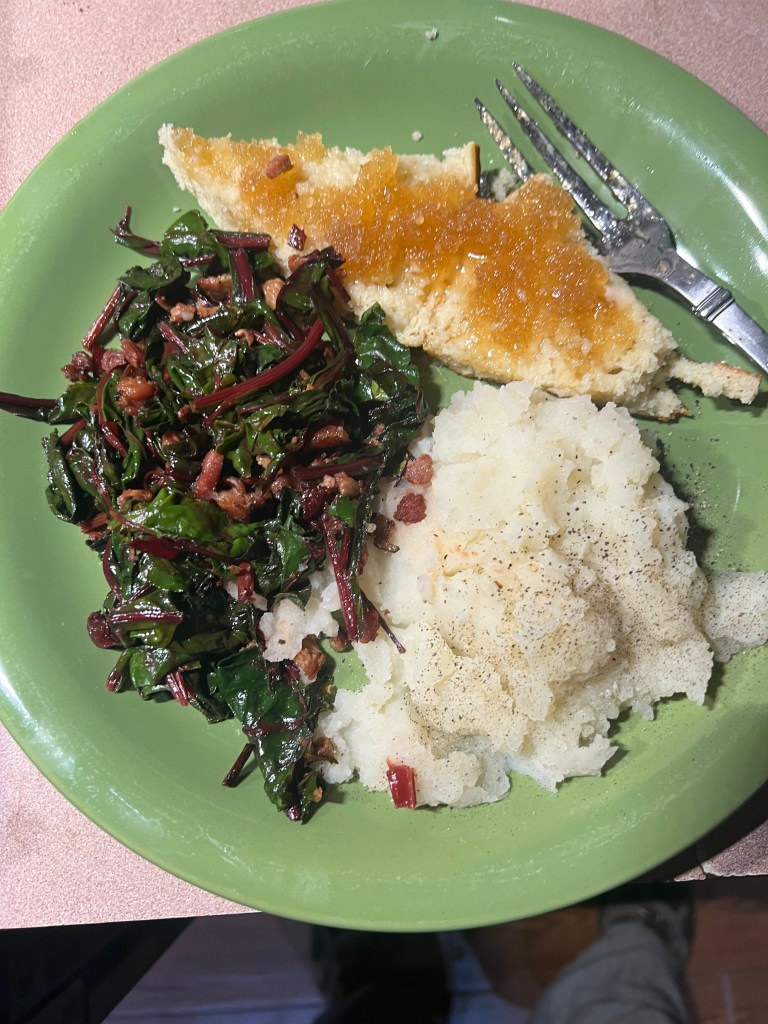
Having not grown up in the South, I had never eaten anywhere near to a mess o’ greens in my life. The closest I had ever come was when my mom (occasionally) served canned spinach (sorry popeye, not to my liking). I decided to turn to the southern chef I had married to find out what I had been missing. The meal we ate was meatless (as is common) with the exception to the bacon fat and bits used to sauté the greens. Melissa made cornbread baked in an iron skillet and then served with honey. Next came the buttery mashed potatoes served without gravy (a rarity for me). The final treat was the mess o’ greens. I learned that the stems were cut from the leaves, chopped, and sautéed with garlic and onion. This mixture was later added to the leafy greens and sautéed together. While this was not the “meat and potatoes” I had grown up with in the Midwest, it was good.
THOUGHTS: Many of the recipes I found for a mess o’ greens suggested using several varieties of greens to create a nuisance of flavors. I was also able to use the sauteed stems as a pasta topping and plan to use the remaining greens in lieu of spinach in a breakfast casserole. One result of my attempt to create subsistence gardening is I am eating more vegetables (and in a wider variety of ways) than before. That is probably a good thing. Learning to cook with the vegetables I grow is interesting and satisfying. It also gives me suggestions on what to grow (and how much) next year. This is another way to decrease my carbon footprint. Act for all. Change is coming and it starts with you.
 A travelers odyssey