
July 10, 2024
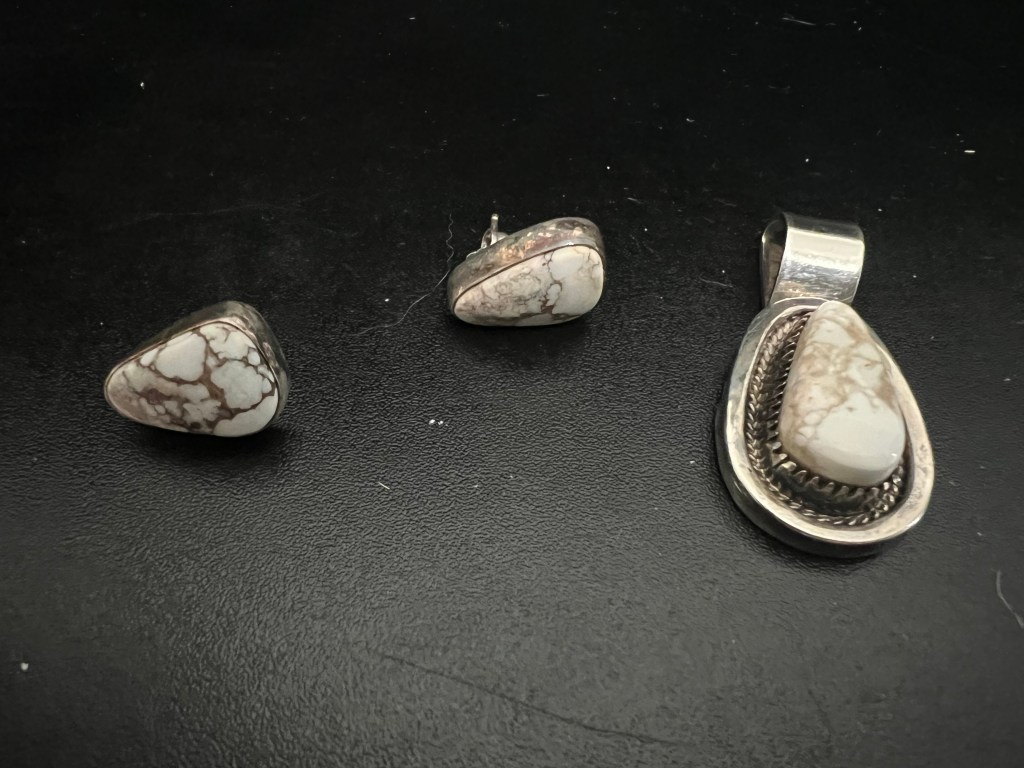
Mom had given most of her possessions away to family when she downsized prior to moving into assisted care. She also took care to give a special necklace from her collection to each of the great grandkids who visited in hospice care, along with the story of its acquisition. That still left dozens of pairs of earrings, necklaces, and bracelets representing “special times” in her life. None of us knew what to do with the remaining collection, but since Melissa was also a jewelry collector, she was given the remainder to sort through and distribute “as you will”. When our family got together in Maine these last weeks it brought up questions about mom’s jewelry and wondering if select pieces were still available as they held a memory or attachment. When we got home, Melissa and I perused the collection to see if we could find the cherished items. My sister had asked about a pendant and earrings mom had purchased while on vacation in the American southwest. The stones were from a mineral called white buffalo turquoise.
When I looked online, I found white buffalo turquoise (howlite), is a calcium borosilicate hydroxide (Ca2B5SiO9(OH)5) mineral found in water-soluble sedimentary mineral deposits (evaporite). Howlite was first discovered near Windsor, Nova Scotia, in 1868 by the Canadian mineralogist Henry How who had been alerted to the unknown mineral by miners in a gypsum quarry. How called the mineral silico-boro-calcite, but it was quickly renamed howlite by the American geologist James Dwight Dana. The rare howlite crystals are small (1/3rd inch or1cm in maximum size), and are only found in a few places in the world. The most common form is irregular nodules resembling cauliflower. The nodules are white with fine grey or black veins in an erratic web-like pattern. Howlite is commonly used to make decorative objects such as small carvings or jewelry components, and because of its porous nature is often dyed to imitate other minerals, especially turquoise. In its natural state, howlite is sold under the trade names of “white turquoise” or “white buffalo turquoise” and is used to produce jewelry similar to the blue to green turquoise (CuAl6(PO4)4(OH)8·4H2O) associated with the jewelry of the American southwest.
Varieties of the unrelated gemstone turquoise which are white instead of the typical blue or green color have been mined in the US states of Arizona and Nevada and are marketed as “white buffalo turquoise”. The blue turquoise is found in only a few places on earth, and the world’s largest turquoise-producing region is the southwest United States. Turquoise is prized for its attractive color, often an intense medium or greenish blue, and its ancient heritage. While turquoise is used in a number of styles, it is closely associated with southwest and Native American jewelry. Some turquoise contains a matrix of dark brown markings, providing a contrast to the gemstone’s bright blue. Most of the white varieties of turquoise are chalk-like with a Mohs hardness of 1 and are not as hard or durable as howlite and require stabilization in order to be used in jewelry. This has resulted in white buffalo turquoise (howlite) being more popular in jewelry than the artificially stabilized white turquoise.
THOUGHTS: Native Americans in the Southwest used turquoise for personal adornment reflecting the cultural diversity and history of its makers. Native American tribes and artisans continue to develop distinct aesthetics rooted in their personal artistic visions and cultural traditions of their tribes. Adornment became an important element of Indigenous communication and conveyed many levels of information. Later, jewelry was used as a signal for resistance to assimilation. Today, it remains a statement of tribal and individual identity. Indigenous peoples around the world create jewelry to stay connected with their past. Act for all. Change is coming and it starts with you.
 A travelers odyssey