
July 14, 2024
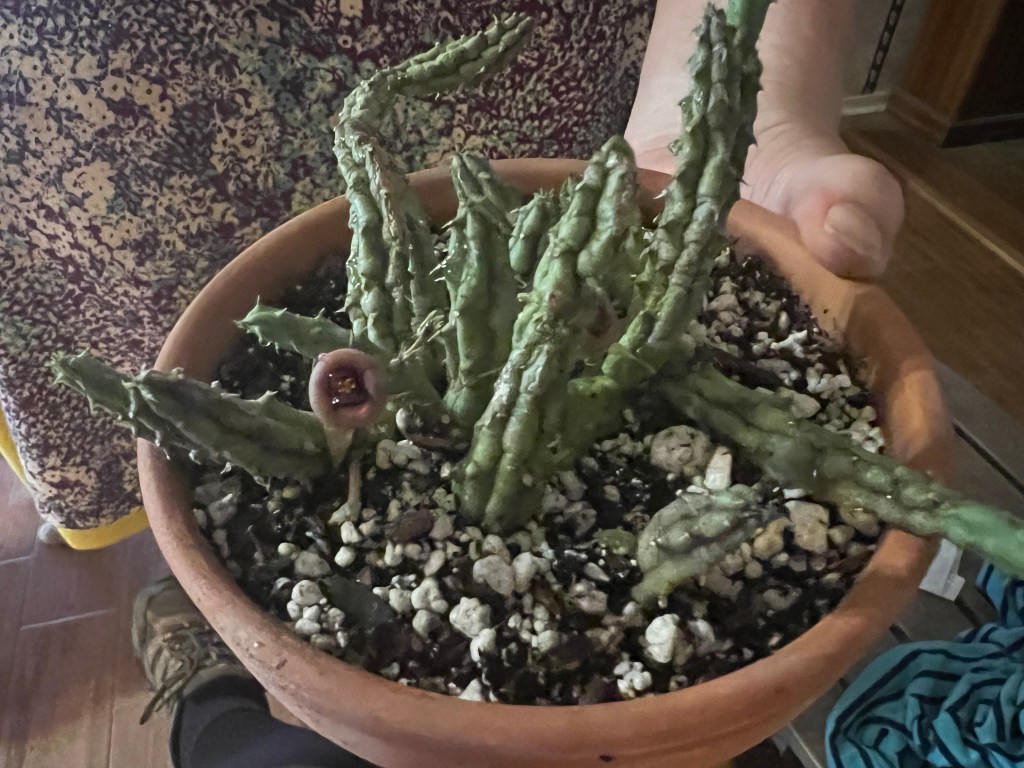
I was working in my office yesterday when Melissa brought in one of her succulents. This was from a stem cutting she had obtained from a grower friend in California two years ago. She had replanted and cared for it, moving it from the house to the porch to shield it from the extremes of Arkansas’ heat and cold. Melissa was excited because it had a star-shaped bloom on one of the new stems that had grown from the original cutting. She mentioned it usually takes two to three years for flowers to form on cuttings from the original. The friend’s plant had grown to a large amorphous mass. The succulent is easy to grow but is not common in the US as it is native to Africa. The common name for this succulent is the African starfish flower.
When I looked online, I found the African starfish flower (Piaranthus decipiens), also known as carrion flowers locally, is a succulent native to Namibia, Botswana, and South Africa. The plant gets its common name from the flower that grows in the appearance of a marine starfish (class, Asteroidea). The plant grows in sandy and rocky soil, and usually under small bushes around the northern and eastern edges of the driest parts of the Kalahari Desert. The starfish has horizontal (decumbent) stems with tubercles mainly joined into four angles along the stems and forms diffuse mats that may reach a diameter of 3.3 feet (1 m). The stems are dull green to grey and are often mottled with purple. They have a distinctly narrow base and grow up to 6 inches (15 cm) long and 0.8 inches (2 cm) thick. Each tubercle is initially tipped with a small, narrowly deltoid (triangular) leaf rudiment that dries out and persists for a while as a whitish husk. Flowers are produced in small numbers towards the tips of the younger stems and open simultaneously or with long intervals in late summer or fall. They are up to 1.2 inches (3 cm) in diameter, usually brown becoming paler in the tube and with low rounded nipple-like structure (papillae), each with a small bristle. The scientific name for the starfish flower was formerly Huerniopsis decipiens after the genus (Huerniopsis) was created with this flower as the single species by N. E. Brown in 1878. Another species was later transferred to Huerniopsis in 1937, and both were distinguished by their absence of an outer corona on the flowers. Both species were revised in 1994 as part of the genus Piaranthus.
More interesting than the scientific back and forth naming of the starfish flower is the origin of the locally (southern Africa) common name of carrion flower. The flowers emit a very sweetish-nauseous odor that locals describe as having the smell of rotting meat. The corona-lobes secrete a sweet fluid copiously upon their backs and sides. The cultivators of the flower found this smell is strongest during the evening, and by the next morning it had almost disappeared, leading to the assumption the plant is fertilized by a late evening flying insect in the wild. The flowers may open at the same time or with long intervals in late Summer or Autumn. The starfish on our porch found the right conditions in the heat of mid-summer, but that might resemble the cool of the Kalahari.
THOUGHTS: The starfish flower lives on the edge of one of the driest deserts in the world. The harsh desert environment has resulted in adaptation by the plants that thrive there. Plants use a lot of energy and reserves producing flowers for pollination and in a desert environment where water is scarce. Pollinating insects (bees, ants, moths) are in short supply, so plants produce colorful flowers to attract the scarce pollinators. The starfish flower blooms and then quickly dies to reserve energy. The carrion smell entices flies not normally associated with pollination. Everything in nature is designed to propagate the species and not the individual. While that is also the design for humans, it is sometimes ignored. Act for all. Change is coming and it starts with you.
 A travelers odyssey