
July 18, 2024
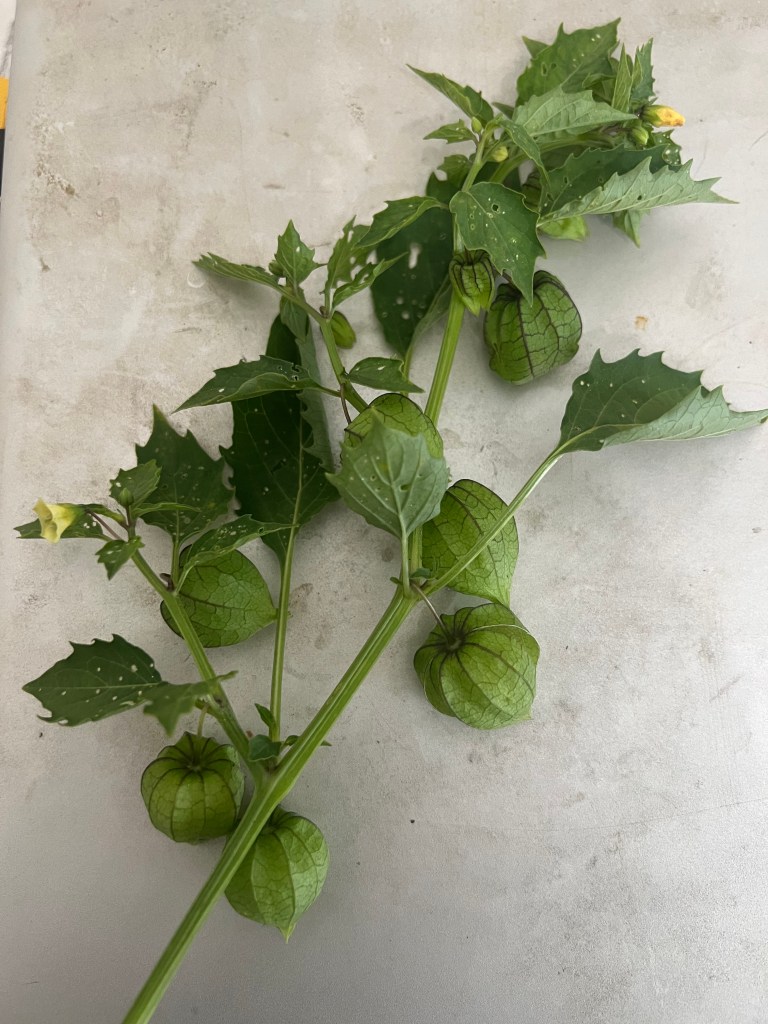
I have been baffled for weeks concerning what bush I had growing in my raised beds. I have three of these bushes that took off in the location where I had planted Brussel sprouts (Brassica oleracea). As the plants began to mature, they overtook whatever I had planted next to them, growing to over 2 feet (60 cm) high and bushing out over 2-1/2 feet (76 cm). When the fruit began to appear, I saw it was wrapped in a thin papery husk much like a tomatillo (Physalis ixocarpa). The problem was, I had not planted any tomatillo and now I had three of these large plants growing in my beds. I tried several plant identification methods, and none got me any closer to identifying the plant. I was desperate and reached out to my Arkansas Gardening Facebook group. The immediate response was for a tomatillo or variety of gooseberry (Physalis peruviana), but again I had planted neither. This morning Melissa went out to harvest some of the okra (Abelmoschus esculentus) I had planted for her and on return told me she had identified my unknown plant as a variety of ground cherry.
When I looked online, I found the cutleaf ground cherry (Physalis angulata) is a member of the Physalis genus, which includes the tomatillo that is commonly grown in Arkansas. Both tomatillos and ground cherries originated in Central and South America. The cultivar is now widely distributed and naturalized in tropical and subtropical regions worldwide. The ground cherry fruit is encased in a thin, papery husk just like a tomatillo that splits when ripe, then falls to the ground. Ground cherries have been grown in North America since the mid 1800’s and were popular additions in Pennsylvania Dutch cuisine. The plant’s edible fruit can be eaten raw, cooked, or jammed, but all other parts of the plant are poisonous. Unripe raw fruits, flowers, leaves, and stems of the plant contain solanine and solanidine alkaloids that may cause poisoning if ingested by humans, cattle (bovine) or horses (equine). The typical ground cherry fruit is similar to a firm tomato in texture, and like a sweet, tangy grape in flavor. I picked one of the ripe berries and it was quite tasty.
Having found the ground cherry, tomatillo, and gooseberry are all similar, I looked to find out how they are different. Ground cherries and tomatillos have similar features, and the nomenclature can be confusing because tomatillos are often referred to as Mexican husk tomatoes whereas ground cherries are called husk tomatoes. They are both part of the same genus, and their fruits both grow in papery husks, but ground cherries are typically smaller than tomatillos. They are also yellow or orange when mature while tomatillos remain green. Another member of the Physalis genus is the cape gooseberry, also known as the goldenberry. The botanical name indicates their origin, and like ground cherries they are native to the Americas. Cape gooseberries are unrelated to European gooseberries (Ribes uva-crispa) but are very similar to ground cherries (the names are often used interchangeably). The stems of the plant are stiffer than those of the ground cherry and are not prostrate and sprawling but instead more upright.
THOUGHTS: I found several sites that spoke of the conditions of temperature, light, soil, and water that allow ground cherry plants thrive. I chuckled as my ground cherry had been propagated by birds and without any special attention. Several times I came close to throwing them on the mulch pile, but I wanted to find out what these intruders were. Ground cherry is often propagated by birds who drop the seeds in disturbed soil where it takes off on its own. Even though it is not native to the US it was widely embraced after migrating to America. Human immigrants bring the same diversity and have sparked cultural adaptations earlier European immigrants now claim as their own. Embracing immigrants along with their foods and culture provides the diversity that can keep America strong. Act for all. Change is coming and it starts with you.
 A travelers odyssey