
July 19, 2024
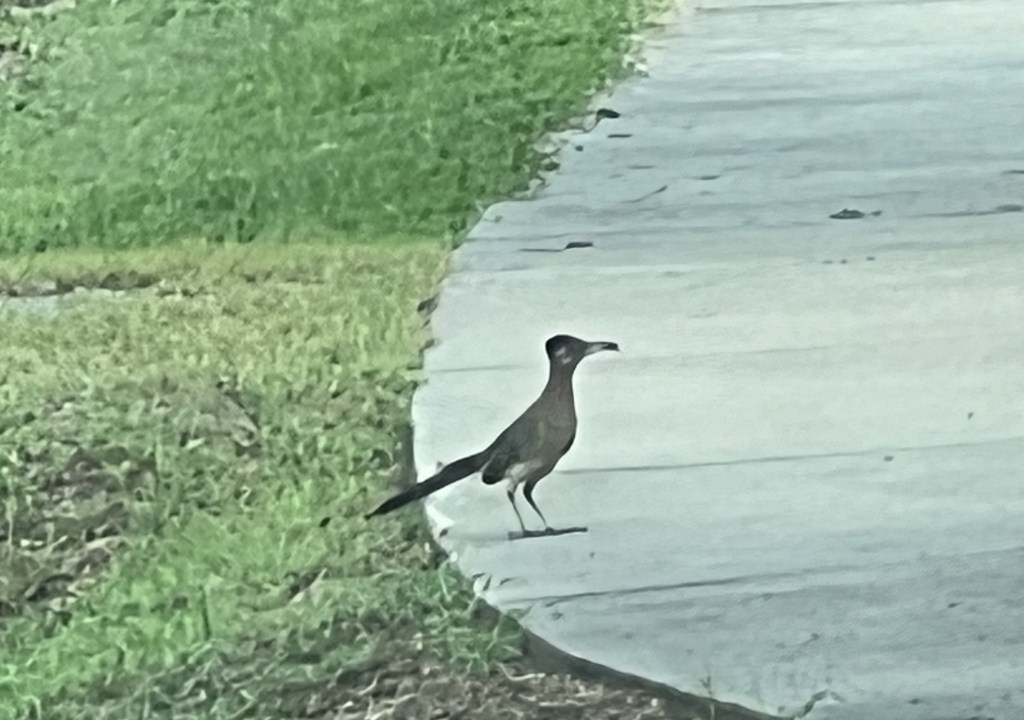
As I approached the park for the kids walk in May a bird ran across the road in front of my Jeep. I had seen this species running in the brush in 2020 when I had stopped at Fort Smith Reservoir for some fishing and birding. I returned several times and in different seasons but never saw the bird again. When I started walking the two dogs together, I switched the walk to a lake outside of town rather than the park. After we returned from vacation it was too hot (100F+/37.7C+ heat index) to walk them comfortably on the treeless lake path. It has been cooler this week (90F/33.2C) and I decided to try walking in the park again. The park has trees for shade and a walking trail for my convenience. The first day was when the bird ran across the road as we neared the park. The next day I tried to get a picture, but it was too fast and scurried out of sight. Yesterday, the roadrunner decided to stop as we approached and allowed me to take its picture.
When I looked online, I found roadrunners (genus Geococcyx), also known as chaparral birds or chaparral cocks, are two species of fast-running ground cuckoos with long tails and crests. The bird I saw was a greater roadrunner (Geococcyx californianus) which ranges from central California to southeastern Missouri and south to central Mexico. The lesser roadrunner (Geococcyx velox) is indigenous to Mexico and central America. Both species live in arid lowland or mountainous shrubland or woodland. The roadrunner generally ranges in size from 22 to 24 inches (56 to 61 cm) from tail to beak. With an average weight of 8 to 15 ounces (230 to 430 g). They are large, slender, black-brown and white-streaked ground birds with a distinctive head crest, long legs, strong feet, and an oversized dark bill. The tail is broad with white tips on the three outer tail feathers. The bird has a bare patch of skin behind each eye that is shaded blue anterior to red posterior. The lesser is similar to the greater roadrunner but is slightly smaller, not as streaky, and has a smaller bill. Roadrunners are non-migratory and stay in their breeding area year-round. The greater roadrunner is not currently considered threatened in the US but is habitat limited.
Roadrunners and other members of the cuckoo family have zygodactyl feet, meaning two toes face forward and two face backwards. This leaves distinctive “X” track marks appearing as if they are travelling in both directions. The Hopi and other Pueblo tribes believed roadrunners were medicine birds, capable of warding off evil spirits, and the X-shaped footprints were seen as sacred symbols, believed to confuse evil spirits by concealing the bird’s direction of travel. Stylized roadrunner tracks have been found in the rock art of ancestral Southwestern tribes. Roadrunner feathers were used to decorate Pueblo cradleboards for spiritual protection. The roadrunner is considered good luck by the indigenous tribes of its range. While some revered the roadrunner and never killed it, most used its meat as a folk remedy for illness or to boost stamina and strength. The word for roadrunner in the O’odham language (an Uto-Aztecan language of southern Arizona and northern Sonora, Mexico) is taḏai, and the O’odham tradition credited the roadrunner with bringing fire to the people.
THOUGHTS: Although capable of flight, the roadrunner generally runs away from predators. The bird was made popular by the Warner Bros. cartoon characters Wile E. Coyote and the Road Runner, created in 1949. In each episode, the cunning Wile E. Coyote unsuccessfully tries to catch the Road Runner but is never successful. The cartoons rely on a misconception that a roadrunner is faster than a coyote. In fact, a coyote can sprint 40 mph (64 km/h), which is twice the roadrunner at 20 mph (32 km/h). I always felt bad that for Wile E. and hoped he would catch him. Seems nature was on my side. Act for all. Change is coming and it starts with you.
 A travelers odyssey