
July 24, 2024
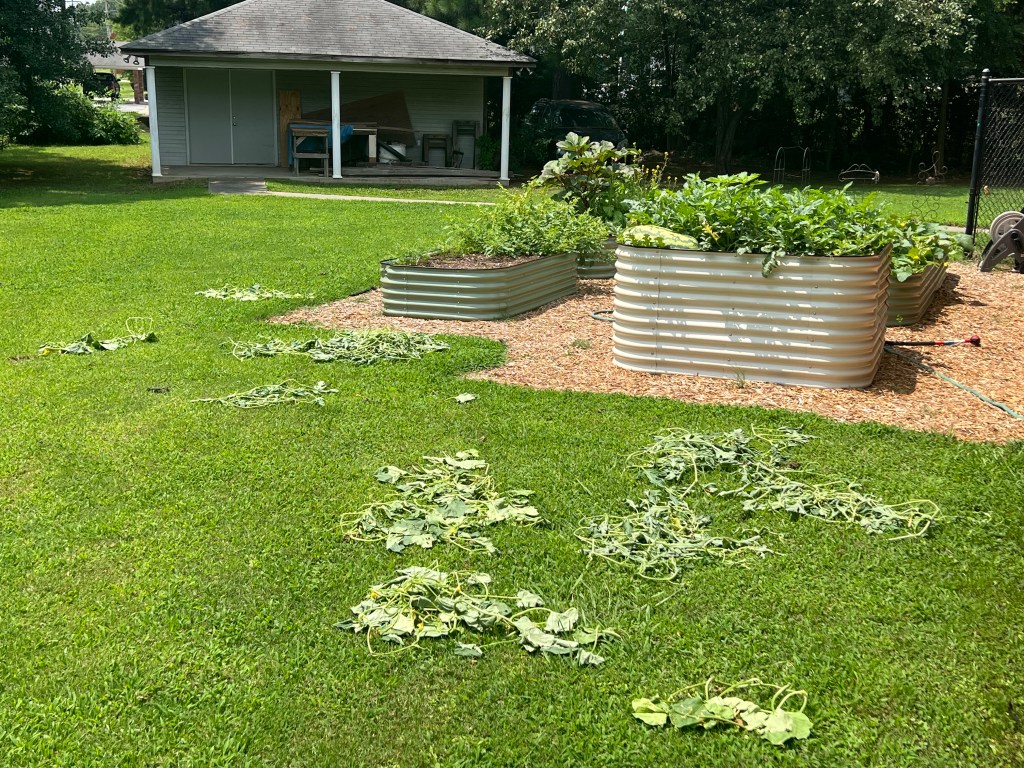
The weather has been perfect for the vegetables growing in my raised beds. It has been cooler (10F/5.5C) than normal for the last week along with several soaking rains. The vines have taken off and overflowed their raised beds. I tried to plan ahead concerning the placement of the vines in my beds. The taller raised bed is dedicated to the three rattlesnake watermelon seeds and one wing of the u-shaped bed is dedicated to the three cantaloupe seeds (both as suggested). I had not been as discriminating with the cucumbers, but I had planted them the suggested 2 feet (0.6 m) apart. The vines have grown beyond my expectation. I had already scooped the vines of all three overspilling on the ground and placed them back in the bed. The overflow has also enticed a small eastern cottontail rabbit (Sylvilagus floridanus) to visit my beds, and I see it scurrying away most mornings when I water. Today I decided I would prune the vines to help keep them in the beds.
When I looked online, I found watermelons (Citrullus lanatus) require significant space not only for the vines but also for the fruit. The vines reach 30 feet (9 m) and the fruit itself can weigh as much as 200 pounds (91 kg). To curtail the size of both the vine and the fruit, the vines can be trimmed. Pruning watermelons promotes healthier vines and may increase fruit size. Irregular or rotting fruit should be pruned to enable the plant to focus energy towards growing bigger, healthier melons. The downside to watermelon trimming is that it may affect pollination as the plant needs both male and female flowers to set the fruit and cutting back the vines may reduce the female flowers, which are fewer than the male in a 1:7 ratio. Cutting back cantaloupe (Cucumis melo) plants is generally not necessary, and the more leaves that remain on the vine the sweeter the fruit. Still, pruning cantaloupe plants has some benefits and results in fewer fruit which enables the plant to put all of its energy into fewer fruits which will become larger melons. Another reason to prune cantaloupe vines is to make them easier to trellis, either using a net trellis or string and vine clips. Although I did not trellis my melons, it seems like my decision to prune was (possibly) a good one.
The next question was the best way to prune the different vines. Pruning watermelons can be done simply with a good pair of gardening shears to remove any dead, diseased, yellowing, or infested leaves or shoots at the joint where they connect to the main stem. Also, remove any secondary vines that are not bearing blooms or look scrawny. Do not prune the vines while wet as watermelons are prone to parasites and diseases and damp pruning will encourage their growth and spread. If you prune your cantaloupe to produce larger melons, you should retain the primary stem. The idea is to retain the primary vine, remove the first lateral, and reduce the size of all the additional secondary branches. This probably would have been good information to have before I pruned. I just cut off the vines that were overhanging and pushed the others back onto the beds. Unknowingly, that also meant I cut off several large cucumbers that were close to being ripe. We will see.
THOUGHTS: While I knew the vines of the different melons and cucumbers would spread, I was not prepared for the extent of their spread. I had tried to grow both types of melons in the ground bed where I now have the three sisters and neither of them took off to the extent of the raised beds. That is probably because I had amended the soil before planting rather than just placing them in the ground and seeing what happens. Every year I find raising vegetables is a combination of what I know and reaching out to others to augment what I do not. Pushing ahead to “see what happens” rarely creates a positive result. The same is true when interacting with different groups of humans. Listening to find common ground is always the best way to achieve positive results. Act for all. Change is coming and it starts with you.
 A travelers odyssey