
August 06, 2024
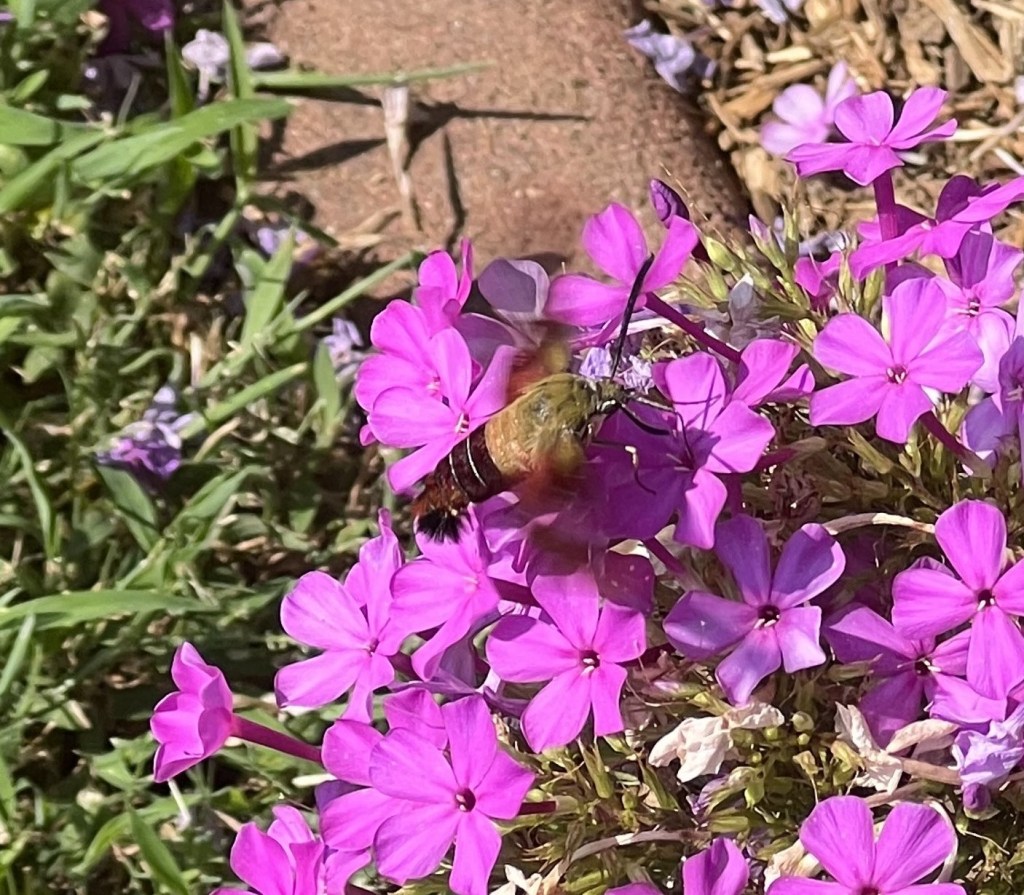
Everything began to die off in my front flower bed with the hot summer temperatures (95F+/– or 35C+/–) while we were on vacation. I had contracted the neighbor kids to water my vegetables, but the flowers were on their own. When we returned, I decided to begin watering the beds to try and maintain the garden phlox (Phlox paniculata), elephant ears (Philodendron giganteum), and hasta (Hosta plantaginea) we had planted there. Now they are all doing well in spite of the summer heat. When I went out to water the raised beds this morning, I noticed something flitting from flower to flower on the phlox. It was moving so fast it was hard to get a good look at it, but it was clearly collecting nectar from the flowers that are now in full bloom. On closer inspection I knew I had seen this creature before. It was a hummingbird clearwing moth.
When I looked online, I found the Hummingbird Clearwing (Hemaris thysbe) is a moth of the hawkmoth family (Sphingidae). Coloration of the clearwing varies between individuals, but typically the moth is olive green and burgundy on its back, and white or yellow and burgundy on the underside. Its wings are transparent (i.e., “clearwing”) with a reddish-brown border. Its legs are light-colored, which combined with the lack of striping on the underside is a diagnostic for the species. The clearwing range extends from Alaska to Oregon in the west and from Newfoundland to Florida in the east. It is a migratory species and is most common in the eastern US and southern Ontario, Canada. The moth beats its wings quite rapidly and has a wingspan of 1.6 to 2.2 inches (4 to 5.5 cm). The clearwing has two broods a year in the southern portion of its range, but only one in the north. The clearwing lives in second-growth forest, in meadows, and is commonly found in the cultivated gardens of suburbia (like mine). It has minimal economic impact to humans, being neither a crop pollinator nor pest. The moth does pollinate several cultivated flowers and is the primary pollinator for some species of orchid. The species is not endangered or threatened.
The Hummingbird Clearwing has often been mistakenly identified as multiple distinct species for its color variation. The species was first described by Johan Christian Fabricius in 1775 as Sesia thysbe in his Systema Entomologiae. The species name (thysbe) is likely a reference to Thisbe, half of a pair of ill-fated lovers in Ovid’s Metamorphoses and associates the blood-stained scarf of Thisbe to the reddish-brown coloration of the moth. Due to the variable coloration and wing patterning of the clearwing, it and other members of Hermaris were described as different species during the 1800’s. The various forms of clearwing were examined in detail by entomologist Ronald Hodges in 1971. He dissected a number of specimens representing the range of coloration and geographic scope and found no differences in their reproductive organs and concluded the many variations represent a single species. The nine defined species were all collapsed into the single species of clearwing.
THOUGHTS: The common name for the Hummingbird clearwing comes as it closely resembles a hummingbird as they hover over flowers, sipping nectar with their long proboscis during the heat of the day. The clearwing also resembles several species of bumblebee (genus, Bombus) in both appearance and behavior. This is an example of convergent evolution where analogous structures are established that have similar form or function in different species but were not present in the last common ancestor of either group. Analogous traits arise when different species live in similar ways and/or a similar environment. When occupying similar ecological niches similar problems can lead to similar solutions. This can explain why dispersed human cultures come up with similar stories and technological solutions. It does not have to be the result of alien contact. Act for all. Change is coming and it starts with you.
 A travelers odyssey