
August 07, 2024
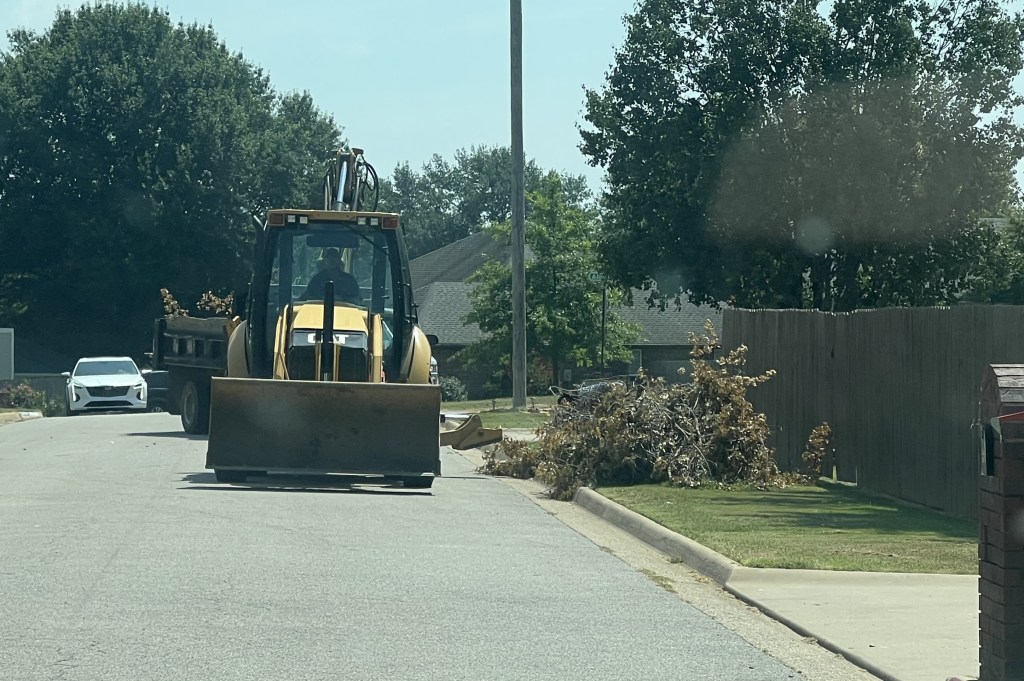
Last year I blogged how our city’s street department picked up limbs and yard waste on the first Tuesday of the month. They have guidelines governing length, diameter of limbs, and placement, but the service is free. At the time I suggested reducing the amount of waste by composting or mulching your grass clippings to keep them out of the overtaxed landfills. Limbs are a different challenge. One reason I opted for hügelkultur to fill my raised beds this year was because I had two trees that needed serious pruning. The raised beds took care of most of the pruning debris, and I stacked the remainder by the curb as I had done the year before. While I am not actively pruning the trees in my yard this summer, branches do fall or get in the way (i.e., grow) and I stack them by the curb and wait for them to disappear. I had always wondered about the process for removing the tree limbs but assumed they were collected along with the trash. As the kids and I returned from our walk this morning I found I was wrong. A backhoe loader was parked along the curb picking up the limbs from my neighbor’s yard and loading them onto two dump trucks.
When I looked online, I found a backhoe loader, also called a loader/tractor excavator, or just a backhoe, is a heavy equipment vehicle that consists of a tractor-like unit fitted with a loader-style shovel/bucket on the front and a backhoe on the back. It’s relatively small size and versatility allow the backhoe to be used in urban engineering and small construction projects. The machine is similar to a Tractor-Loader-Backhoe (TLB), which is a larger agricultural tractor fitted with a front loader and rear backhoe attachment. The development of the backhoe began with the inventors at the Wain-Roy Corporation of Hubbardston, Massachusetts. Wain-Roy developed and tested the first backhoes in 1947. In April 1948 Wain-Roy sold the first all-hydraulic backhoe, mounted to a Ford Model 8N tractor, to the Connecticut Light and Power Company for US$705. Digging while on tires causes the machine to rock and the swinging weight of the backhoe could cause the vehicle to tip, so most use hydraulic outriggers or stabilizers at the rear when digging and lower the loader bucket for additional stability. Raising and lowering the outriggers to change position reduces efficiency and many offer small, tracked excavators (skids). These sacrifice the loader function but increase digging efficiency.
When the kids and I pulled off the main street one of the city trucks was leaving full of tree limbs. When we pulled into our subdivision the backhoe was parked along the curb picking up limbs and depositing them in the back of another truck in the lane beside it. The backhoe had its stabilizers down, so I knew there was no way it was moving. The workers continued to load the limbs. I thought about going around to the other entrance to the subdivision, but I was in no hurry and watched them work. Shortly after, the backhoe stopped loading, and the dump truck backed out of the lane to let us pass. As I pulled into the other lane, I noticed there was another car stopped and waiting on the other side of the workers. Technically he had the right-of-way, but I had not seen him before I proceeded. I waved thanks as I drove through the work zone, but everyone ignored me. I guess I was just another obstacle in their day’s work.
THOUGHTS: I had the opportunity to watch a backhoe when I was director of a camp in Kansas. We had bought a used tractor with bucket and mower attachments which we used often. A volunteer owned a newer small tractor equipped with a backhoe. He brought it out and quickly dug a trench and replaced the culvert under the road between two of our small ponds, something we had been unable to do. Having the right tool for the job makes a tremendous difference. The secret is knowing what you can do and doing it well. Act for all. Change is coming and it starts with you.
 A travelers odyssey