
August 11, 2024
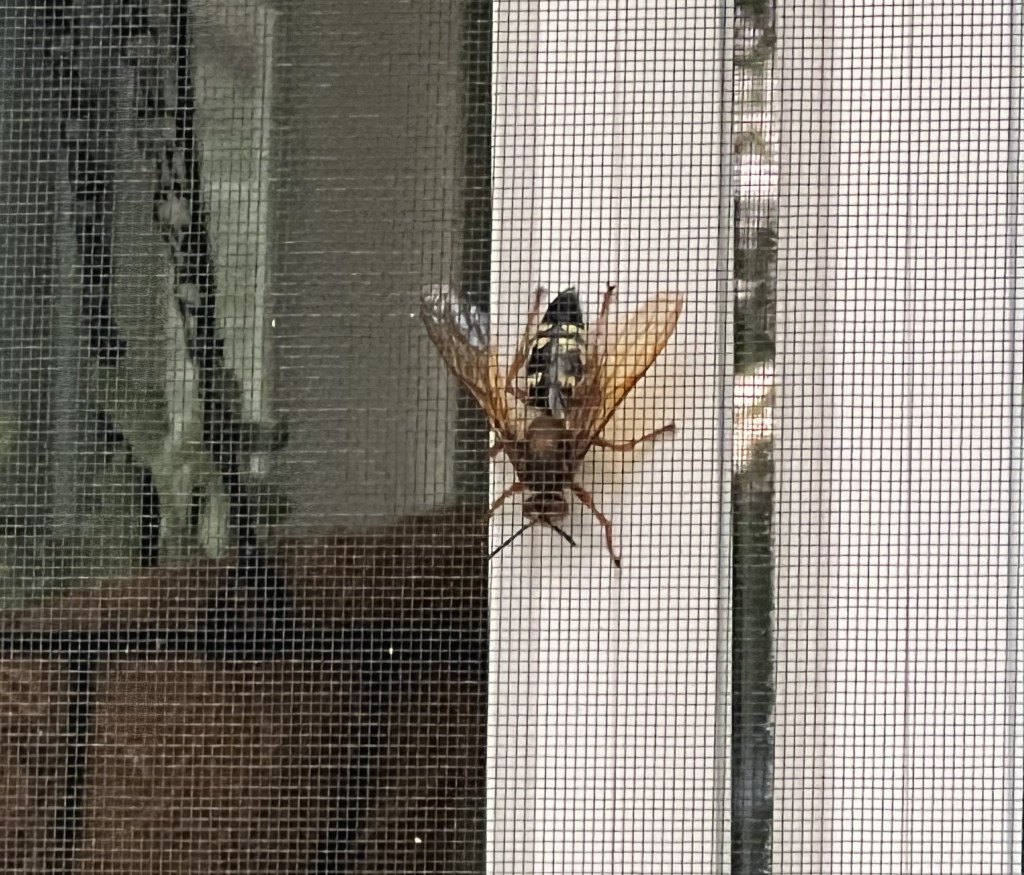
When I took the kids out for their constitutional after feeding this evening, I noticed a large insect on the inside of the porch nestled between the window and screen. I have recently been battling the paper wasps (Polistes major) and the black and yellow mud daubers (Sceliphron caementarium) that nest under the eaves or in secluded places and I was not pleased to see this larger version inside the porch window. I tried to slide the window back to allow the wasp to escape but it just moved back to resist the sliding glass. This wasp intrigued me as it was three times the size of any of the wasps I had been battling. I googled a picture of the insect and found out this was an eastern cicada killer.
When I looked online, I found the eastern cicada killer (Sphecius speciosus), or the cicada hawk, is a large, solitary digger wasp species in the family Crabronidae. The name cicada killer may be applied to any species of crabronid that preys on cicadas, but in North America it is typically applied to this species. It is called the eastern cicada killer to further differentiate it from the multiple examples of related wasp species. The species can be found in the Eastern and Midwest US and southwards into Mexico and Central America. Adult wasps are large (0.6 to 2.0 inches/1.5 to 5.0 cm) and robust with hairy, reddish, and black areas on their middle parts (thoraces), and black to reddish brown rear (abdominal) segments that are marked with light yellow stripes, and with brownish wings, somewhat resembling yellowjacket and hornet species. The females are a little larger than the males, and both are among the largest wasps in the Eastern US. The males are smaller because they are not given as much larval food. Since females carry the cicada prey to the nesting burrow, they benefit from being larger. Cicada killers exert a measure of natural control on cicada populations and may directly benefit the deciduous trees on which the cicadas feed.
The eastern cicada killer is a solitary wasp and had very different behavior from the social wasps such as hornets (genus, Vespa), eastern yellowjacket (Vespula maculifrons), or paper wasps. Cicada killer females use their stings to paralyze their prey (cicadas) rather than to defend their nests. While social wasps and bees will sting to protect their nests, the cicada killer does sting humans unless it is handled roughly. While the larva feeds on the cicada carcass, adults feed on flower nectar and other plant sap exudates. While males will aggressively defend the areas around nesting sites against rival males, they have no stinger. Although they appear to attack anything that moves in their territories, males are actually investigating anything that might be a female cicada killer ready to mate. They are generally not aggressive towards humans and usually fly away when swatted at, rather than attacking. Although I do not mind the cicadas, I am glad I did not whack the cicada killer wasp.
THOUGHTS: It is interesting that while I have yet to find any appreciable numbers of cicadas (genus, Magicicada) during this super hatch, I did find a cicada killer. While the insect appeared to be a massive wasp (which it is) it will rarely sting humans. I was wary of approaching the aggressive looking wasp until I read it was fairly docile. Even knowing it would not attack, I still kept my distance to allow the wasp to go about its day. Looks are often deceiving, and we instinctively see a scarry personae (yellowjacket) to avoid confrontation. Humans are known to do the same with our own projections, trying to look scarry so others may leave us alone. It is only when we move beneath the projection that we are able to understand the worth (and reasons) behind the projections. Act for all. Change is coming and it starts with you.
 A travelers odyssey