
August 29, 2024
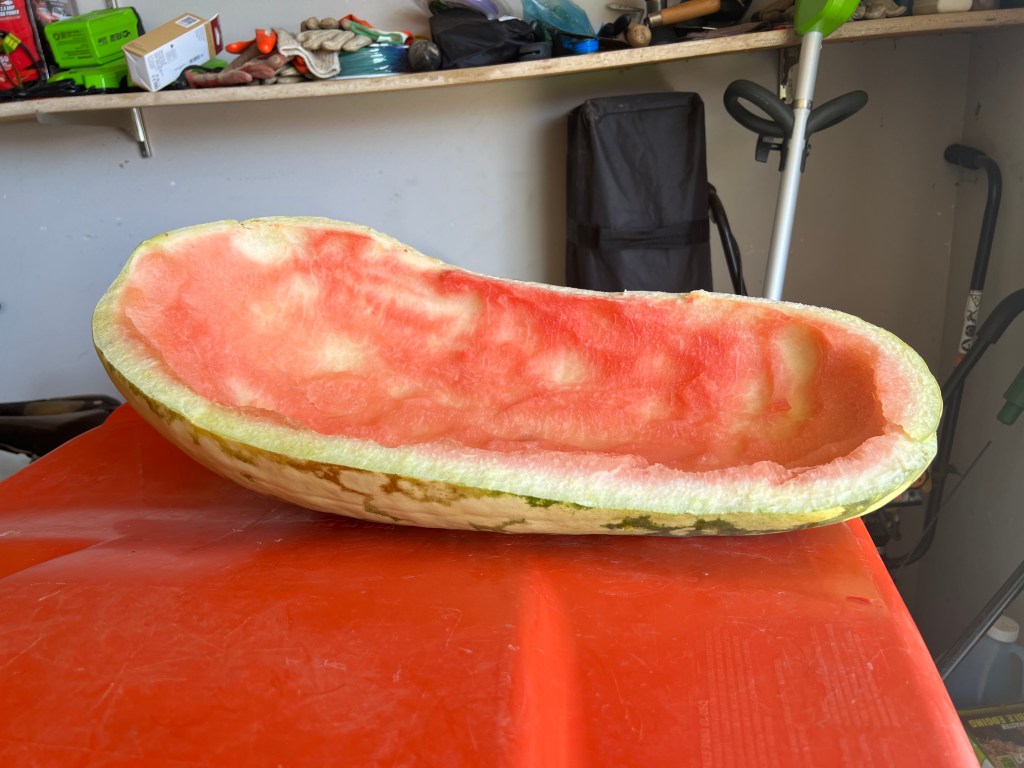
I have tried to grow various types of melons over the last several years without much success. The last two years I have lost both watermelons and cantaloupes to the nine-banded armadillo (Dasypus novemcinctus) that would sneak into the back bed where I now have my 3 sisters planted. He would make his presence known by gnawing a hole in the melons and leaving them to rot. I caught him last year in the evening as he was scurrying across the cement pool deck. While I rarely got any fruit (except one stunted melon that did not mature) I did learn of the prodigious output of vines. That is why I decided to plant my melons in the raised beds to keep them out of reach of any critters. I planted the honey melon cantaloupe (Cucumis melo) in one end of the u-shaped bed and reserved the large 4.5 foot (1.4 m) square bed solely for my Georgia rattlesnake watermelon.
When I looked online, I found the Watermelon (Citrullus lanatus) is a flowering plant species of the Cucurbitaceae family and the name of its edible fruit. The plant produces a scrambling and trailing vine with more than 1,000 varieties cultivated for its fruit worldwide, including Georgia rattlesnake watermelon heirloom. The sweet, juicy flesh of the watermelon is usually deep red to pink, with many black seeds, although seedless varieties exist. Colonists first brought watermelon to North America during the 1500’s and eventually new varieties began to appear. One of these was the Georgia Rattlesnake watermelon, which was introduced around 1870, making it one of the oldest heirloom varieties. Heirloom watermelons are usually left to ripen on the vine to ensure they reach their peak sugar level. The name comes from the light and dark green strips which form a unique pattern similar to the skin of a rattlesnake. The tough rind and oblong shape make this watermelon easily stackable and great for shipping. The fruit is usually at least two feet (.60 m) long and weighs between 25 to 30 pounds (11 to 13.6 kg), but 40-pounders (18 kg) are not unheard of.
I hired the two high school age sisters next door to water my vegetables when we were on vacation. When I returned their mom told me their younger brother had helped and became enamored by the thought of having his own garden. He has approached me several times since our return and asked about being able to help me with watering. More than that, he has kept an eye on the watermelon in the raised bed. One in particular has really taken off and dominates the corner of the bed. The boy brought friends by to look at it and I had a maintenance person stop and take a picture. I finally decided it was time to harvest the watermelon before something happened and it went bad. It easily popped off the vine (a good sign). I struggled to lift it from the bed and hauled it into the kitchen. When I weighed it (on our bathroom digital scale) it was 50 pounds 3 ounces (22.8 kg) and 22 inches (.79 m) long. While the boy was away for the week, I split the beast with the family and hopefully he will get a share of their 25 pounds (11.3 kg) of watermelon. There are three smaller watermelons on the vine, along with flowers and starter melons. This is one harvest crop that has produced.
THOUGHTS: At 25 pounds, half a watermelon was more than I could handle at one time, so I needed a way to store it. I seeded, balled, and flash froze half of the fruit to be enjoyed later. I put the other half of watermelon balls in the refrigerator to be eaten this week. That left about a quart of juice that had leaked out during processing and had pooled in the bottom of the rind. I am saving this to be made into “something”. Even though this is the fourth year for my container garden, the vegetables continue to be on and off. Still, I have canned, pickled, frozen, and fresh produce that we will enjoy this winter. Most of my expenses were incurred this year for the beds, seed starters, and seed. Now I just need to hone my expertise. As always, that seems to be the biggest obstacle. Act for all. Change is coming and it starts with you.
 A travelers odyssey