
September 05, 2024
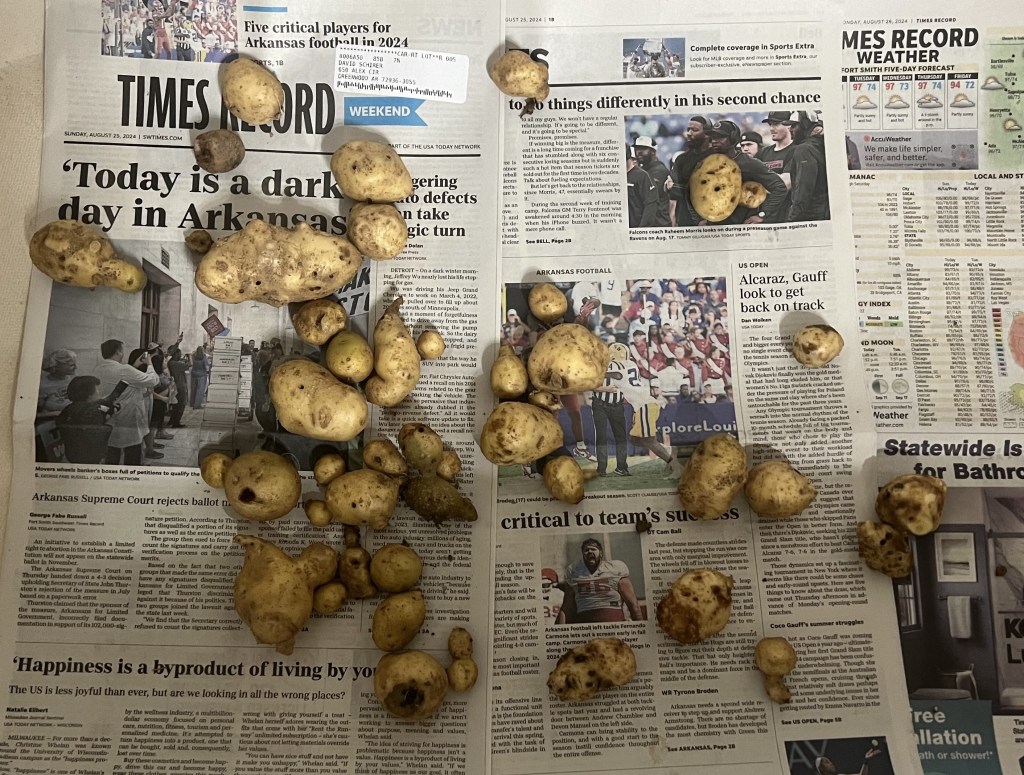
I mentioned in May my struggles to get any potatoes into the ground. I planted late because I could not find any seed potatoes (of any variety) in the stores or co-op in my area. I made a last ditch effort late in the planting season and found the co-op had ordered tons (literally) of several types of seed potatoes (they were “in the back”) and were now trying to get rid of the remaining crates. When the man saw I only wanted to buy 12 potatoes, he gave them to me for free. I planted the 12 hills in the two beds beside the back door leading to the patio. When I planted these beds two years ago, I got a good crop of Russet potatoes. Last year I planted Yukon Gold and Russet, and they all turned to mush. This year’s crop started well, with the vines overflowing and even producing flowers, so I had high expectations. Last week I noticed the tops of the potato plants were starting to wilt. I stopped watering them over the weekend to let the plants die and the tubers harden. Today I harvested what I hoped to be a bumper crop of Yukon Gold.
When I looked online, I found Yukon Gold is a large cultivar of potato (Solanum tuberosum) most characterized by its thin, smooth, eye-free skin and yellow-tinged flesh. This potato was developed in the 1960’s by Garnet Johnston in Guelph, Ontario, Canada, with help from Geoff Rowberry at the University of Guelph. The official cross bred strain was made in 1966, and ‘Yukon Gold’ was finally released onto the market in 1980. The early name for the new cultivar was “Yukon”, for the Yukon River involved in the Klondike Gold Rush in Northern Canada. “Gold” was added later to describe the color and appearance of the tuber. A University publication states, “Yukon Gold was the first Canadian-bred potato variety to be promoted, packaged and marketed with its name right on the pack”. The variety was initially met with overwhelming success but sales in Canada dropped 30% between 2004 and 2014 as other varieties became increasingly popular. Yukon Gold potatoes are susceptible to seed decay, blackleg, early blight, late blight, early dying, PVY, soft rot, dry rot, leak, pink rot, silver scurf, and black scurf (other than that . . .). They do taste good, and the creamy texture makes them great for mashing.
I first took down the fencing I had placed around the beds to keep Loki from snuffling. Then I removed the first of the 11 cages (one had died early) around my potato hills. I wiped back the straw and was encouraged as several small potatoes came to the surface. When I scratched the ground there were only a few small (1/2 inch – 1.25 cm) potatoes to be found. Not to worry, this was only the first hill. In fact, I should have worried because this was a harbinger of what was to come. I opened hill after hill to one or two medium sized (3 inches/7.5 cm) potatoes and several tiny ones (less than 1 inch/2.5 cm). After I had harvested, I washed and dried them and placed them on newspaper in the guest bathroom. I guess no one will be able to visit as long as I have my Yukon Gold potatoes in the tub. Then again, it should not take too long to finish them off.
THOUGHTS: At least I have the advantage that Ukon Gold is resistant to bruising and has good dormancy so does not sprout a lot. It is important that the dark spots on the skin (lenticels) of the potatoes are not swollen and that the skin is not bruised, as this can lead to rot. The one thing that has produced prodigiously is the red burgundy okra (Abelmoschus esculentus). Too bad I do not like okra and only grew it for Melissa. Forest Gump said, “Life is like a box of chocolates. You never know what you will get.” While that may be true, I would like to get either a nougat or pecan praline at some point. I will keep hoping and trying. Act for all. Change is coming and it starts with you.
 A travelers odyssey