
September 12, 2024
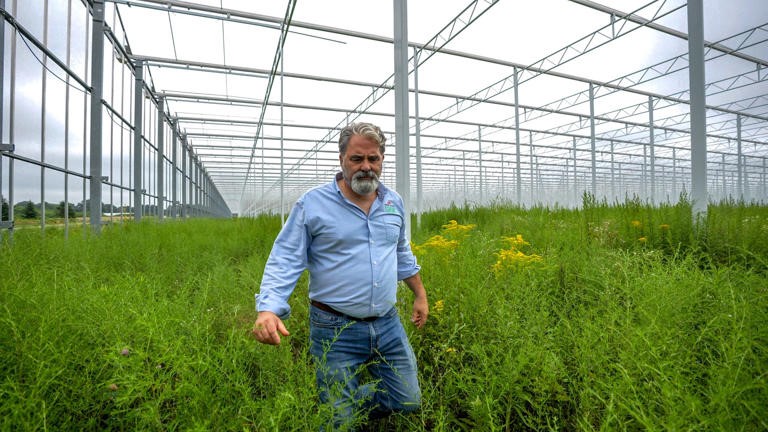
In today’s Business section of our local newspaper, I found an article on a mall-sized greenhouse approved for construction in a rural Rhode Island town. The town Planning Board of Exeter voted unanimously last week to accept Tim Schartner’s plans for his $80 million venture into the future of agriculture. Like any government action, it came with stipulations, including tweaking the internal design to meet fire safety concerns, purchasing one of the three lots the project will sit on (under agreement), and obtaining an air permit for the gas-fired electrical generators from the Rhode Island Department of Environmental Management. Schartner joined with relatives and other partners to form Rhode Island Grows, LLC, and hopes to have the greenhouse’s 25 acre (10 ha) glass framework completed this winter. The hope is to eventually produce 42,000 pounds (19,051 kg) of tomatoes a day. Final completion of the greenhouse to allow year-round use will take months longer.
When I looked online, I found a greenhouse is a special structure designed to regulate temperature and humidity of the inside environment. There are different types of greenhouses, but they all have large areas covered with transparent materials that let sunlight pass and block it as heat. Common materials used in the walls and roofs of a modern greenhouse are rigid plastic polycarbonate, plastic polyethylene film, or glass panes. When the inside of a greenhouse is exposed to sunlight, the temperature increases, providing a sheltered environment for plants to grow in cold weather. Around 30 CE, the Roman’s built the first recorded greenhouse. Emperor Tiberius’s physicians advised he eat one cucumber a day because of his declining health, but cucumbers did not grow year-round. An artificial environment was designed where cucumbers were planted in wheeled carts put in the sun daily, then taken inside to keep warm at night. According to Pliny the Elder, the cucumbers were stored under frames glazed with oiled cloth (specularia) or with sheets of selenite (lapis specularis).
Schartner’s greenhouse project exemplifies the challenges and competing interests facing many rural communities. Town Planer William DePasquale said, “You got a rural community that wants to stay rural, but you’ve got to give these farmers some ability to have some kind of versatility in income to stay rural, otherwise they will go to [selling land for] housing.” The Planning Board’s conditional approval was necessary to reassure investors the project could move forward after years of being stymied by zoning and planning issues and local opposition. Schartner’s family has farmed along Route 2 for generations and broke ground on what would be Rhode Island’s largest example of “controlled-environment agriculture” (read, greenhouse) in June 2021. Town officials said the project needed zoning and planning review first, while Schartner argued greenhouses were purely agricultural structures and exempt from such review. The town issued a “cease and desist” order in October 2021 that was upheld by a Superior Court judge. Schartner said, “It’s on the rails now, moving forward.”
THOUGHTS: I have mentioned the pool-pond we have on our back patio. The pool was abandoned while Melissa and I lived in Kansas. We returned to Arkansas with my expectation of hours in the pool during the summer. When we returned it was filled with leaves and the remains of a glass table. We contacted several pool repair companies and cannot get anyone willing to deal with us. I drained the pool this summer and scooped out the leaves and debris (and glass) and found the fiberglass liner does not leak, although two of the lines back-fill when the water table is high. Perhaps there is still hope. One of the alternatives we considered was to cut out the liner, fill the pool with dirt, and create a greenhouse to grow succulents or vegetables. Ours would be smaller than the Exeter greenhouse but would be another constructive use of space. Act for all. Change is coming and it starts with you.
 A travelers odyssey