
September 19, 2024
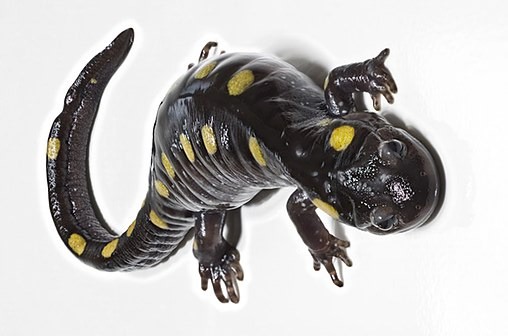
Tucked inside this quarter’s issue of Sierra magazine was an article on a solar powered vertebrate. The adult salamander females lay eggs in the temporary spring pools that are filled with algae called Oophila amblystomatis (“salamander egg lover”). The cells of this algae make their way into the embryo’s egg sac (osmosis) making the sac turn fluorescent green. The algae cells are also infused into the salamander’s own cells giving the embryo a dual power source. The mitochondria of the salamander embryos convert oxygen and a sugar byproduct into molecules that store energy (as do all salamanders) but it can also use the energy generated through photosynthesis from the algae to create additional oxygen and (research suggests) carbohydrates the salamander can use. A symbiotic relationship is completed when the algae receive a boost from the nitrogen waste produced by the salamander. The yellow-spotted salamander is the only known case of this use of solar power.
When I looked online, I found the spotted salamander (Ambystoma maculatum) or yellow-spotted salamander is a mole salamander common in eastern United States and Canada. Individuals of the Ambystoma genus are called mole salamanders because they are nocturnal and spend the day in leaf litter or in burrows on the forest floor. The scientific name comes from Ambystoma (amblys, Greek for blunt) and stoma (Greek meaning mouth); or anabystoma (New Latin, meaning ‘to cram into the mouth’) and maculatum (macula, Latin for spot or maculosus, Latin for spotted). The species ranges from Nova Scotia to Lake Superior, to southern Georgia and Texas. The spotted salamander is the state amphibian of Ohio and South Carolina. The spotted salamander is about 5.9 to 9.8 inches (15 to 25 cm) long, with females larger than males. They are stout and have wide snouts. The main color is black, but it can be a blueish-black, dark gray, dark green, or even dark brown. Two uneven rows of yellowish-orange spots run from the top of the head (near the eyes) to the tip of the tail (dorso-lateral ranging). The spotted salamander’s spots near the top of its head are more orange, while the spots on the rest of its body are more yellow. The underside of the spotted salamander is slate gray and pink. The physical difference (sexual dimorphism) between males and females is the larger females have brighter spots. Males will have a larger portion of their dorsal surface covered in duller spots. The salamander typically lives around 20 years, but some have lived up to 30 years.
This dual-power symbiosis is not known to happen in other vertebrates as most animals have immune systems designed to block foreign cells. Salamanders have notably less reactive immune systems than other vertebrates. It is hypothesized the looser cellular definition of self-verses-other not only allows the infusion of the algae into the salamander cells but also is part of what enables the species to regenerate limbs lost to predators. The solar power adaptation shuts off when the salamander hatches from the eggs and leave the algae filled pools. Although the bright yellow spots may stand out, the salamander spends most of its life hiding in the leaf litter on the forest floor.
THOUGHTS: The yellow-spotted salamander is an excellent example of how little humans know about the life cycles and ecosystems of the flora (plants) and fauna (animals) with which we coexist. While we have spent centuries focused on the lifeways and gene patterns of domesticated species, most non-domesticates have been relatively ignored until the last 300 years. Even then attention was focused on classification rather than observation. Taking time to study the details is now providing insights not only on these species, but their implications for human adaptation and well-being. The same could be said for most indigenous cultures. If they were different, they were passed off as inconsequential. This attitude precludes the larger understanding of what it means to be human and how this knowledge can aide all humanity. Act for all. Change is coming and it starts with you.
 A travelers odyssey