
September 20, 2024
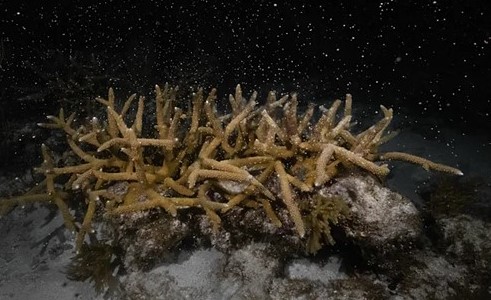
In the middle of the front section of today’s newspaper was an article on attempts to restore Florida’s reefs by breeding and growing coral in an aqueous gene bank. The corals were grown to maturity at Mote Marine Laboratory’s International Coral Gene Bank, and successfully spawned just 22 months after they were produced by corals from the Florida Reef Tract Rescue Project in March 2022. This species of coral will not contribute a lot of mass to the coral reefs, but it does offer shelter to smaller dwellers of the lowest (benthic) ocean levels. Cody Engelsma, senior coral reproduction biologist at the gene bank said, “These corals, they grow these little branches and the branches are very closely knit together so they create a very good environment for baby fish, brittle stars – all the things we naturally see when we bring these corals in. A lot of invertebrates can hide and find safety in these little cavities.” Smooth flower corals are only one of the corals Mote biologists are inducing to spawn at the gene bank where coral care is managed to mirror conditions experienced in the ocean.
When I looked online, I found the smooth flower coral (Eusmilia fastigiate) is a stony coral found on reefs in the Caribbean Sea. Eusmilia is a monotypic genus represented by a single species. Smooth flower coral is a colonial species that grows to about 20 inches (50 cm) across. It forms a low mound of stony calcium carbonate, the surface of which is covered with tubular projections (corallites) in groups of one to three. Mound colors range from cream, to yellow, or pale brown and often have a green or pink tinge. The polyps protrude from these projections and are either round or oval, with the oval form being more common at moderate depths. Smooth flower corals are large and widely spaced and are connected by an extracellular matrix (mesoglea) forming a layer of translucent, jelly-like tissue (coenosarc) which covers the surface of the carbonate skeleton. The corallites have large smooth-edged ridges (septa) and the polyps have corresponding grooves at their base. During the day the polyps retract into the cup-shaped corallites. At night, the polyps stretch out their translucent white tentacles to feed, making the coral appear to “flower”. Smooth flower coral is found at depths down to about 200 feet (60 m) though it is most common between 16 to 98 feet (5 to 30 m). Smooth flower coral is listed as critically endangered by the IUCN Red List of Threatened Species.
The Mote International Coral Gene Bank was established about four years ago at the 200-acre Mote Aquaculture Park in the Florida Keys. Mote’s gene bank is one of the largest of its type in the world and serves as a refuge for thousands of coral genotypes from the Florida Reef Tract and Caribbean. There are at least 25 other species of coral along with the smooth flower coral, all stored in triplicate, and there are plans to expand and house corals from Indo-Pacific waters as well. The gene bank consists of four 1,500-gallon tanks and sump pumps, along with four spawning systems that each have four 150-gallon tanks, and a quarantine system for newly arrived corals of eight different 150-gallon tanks. Mote is staffed with four full-time scientists and several interns to care for the corals.
THOUGHTS: The smooth flower coral represents another species which has formed a symbiotic relationship with plants. While the yellow-spotted salamander (Ambystoma maculatum) partners with fresh-water algae (Oophila amblystomatis), these corals form a relationship with a marine plankton (eukaryotes) which live within the skin covering of the corallites (coenenchyma) and produce nutrients by photosynthesis. The coral benefits from the carbohydrates produced and the algae use the coral’s nitrogenous waste products. If non-sentient (?) plants and animals can find ways to coexist and support each other, you would think humans might be able to do the same. Act for all. Change is coming and it starts with you.
 A travelers odyssey