
September 23, 2024
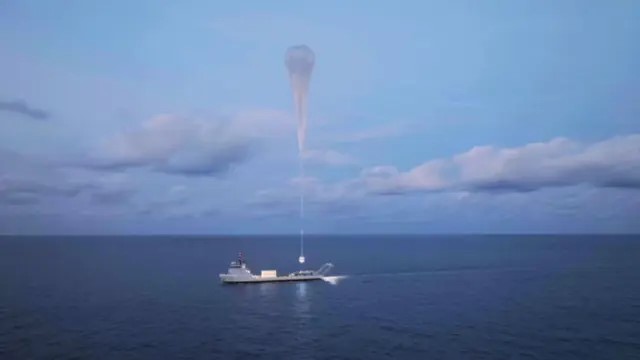
Toward the back of the front section of my local newspaper I came across an article about the continuing quest for space tourism as Space Perspective successfully completed a second uncrewed test flight of the spaceship Neptune Excelsior. The flight boosts the company’s mission to provide distinctive and accessible space travel experiences. The test flight was launched from the Marine Spaceport Voyager near Florida on 15 September 2024 and showed the spacecraft’s capability to perform an entire flight sequence. Jane Poynter, founder of Space Perspective said, “This flight successfully demonstrated the extraordinary accessibility of Spaceship Neptune’s spaceflight experience with its gentle ascent, descent and splashdown, a critical step in opening space up to more people than ever before possible.” During the flight, Neptune reached an altitude of 100,000 feet, approaching the boundary of space and redefining the idea of space tourism.
When I looked online, I found Space Perspective is a high-altitude flight tourism company, founded and incorporated in 2019 by Jane Poynter and Taber MacCallum. The space tourism company plans to launch its nine-person Spaceship Neptune crewed balloon from NASA Kennedy Space Center. On 18 June 2020, Space Perspective announced plans to balloon passengers to nearly 100,000 feet (30,000 m; 30 km) above the Earth. On 2 December 2020, Space Perspective closed its seed funding round, having gathered US$7 million. The company planned the first uncrewed test flight in the first half of 2021 and crewed operational flights by end of 2024. SpaceX charges US$55 million for a 3 day orbit along with three other crewmates. Blue Origin charges from US$200,000 to US$300,000, but the actual price depends on who you are and the publicity you can generate. Virgin Galactic offers a 90 minute suborbital (164,040 feet/50 km) with up to 4 passengers for US$450,000. Tickets for Neptune are a mere US$125,000 per seat with a total of 8 passengers.
A significant feature of last week’s test flight was the deployment of a new four-roller system to elevate the company’s SpaceBalloon. This mechanism enables spaceflights from marine locations worldwide, enhancing operational flexibility and allowing for year-round launches regardless of weather conditions. The spaceship capsule for Neptune exceeded performance expectations by maintaining optimal cabin pressure and stability throughout its journey, even at its highest point in the upper atmosphere. The advanced thermal control system successfully managed the extreme temperature fluctuations of high-altitude flights, ensuring comfort and safety. SpaceBalloon is an eco-friendly and pioneering lifting technology central to the spacecraft and proved its reliability during the test flight. The technology uses hydrogen gas for ascent and enabled the spacecraft to reach its maximum altitude, provided a well-controlled descent, and demonstrating the company’s commitment to sustainable space exploration. The Space Perspective Mission Control team managed the test flight from their ground base using proprietary software and communication systems. The spacecraft was retrieved after a successful splashdown by employing a jet boat and a crane. The company intends to crew test flights in 2025, with the launch of commercial spaceflights in 2026.
THOUGHTS: While the Neptune Excelsior reached the impressive altitude of 100,000 feet (30 km), the Karman line is frequently cited as the boundary of space at 62 miles (300,000 feet/90 km). The Federal Aviation Administration regulates spaceflight and has defined Neptune as a spacecraft. The craft went above 99% of the Earth’s atmosphere. Still, this offers an impressive perspective (and view) of the Earth. Even more than flying at 35,000 feet (10.5 km) in an airplane, the world appears as a united single entity, beyond divisions and barriers. This is a perspective world leaders would be good to emulate. Act for all. Change is coming and it starts with you.
 A travelers odyssey