
October 15, 2024
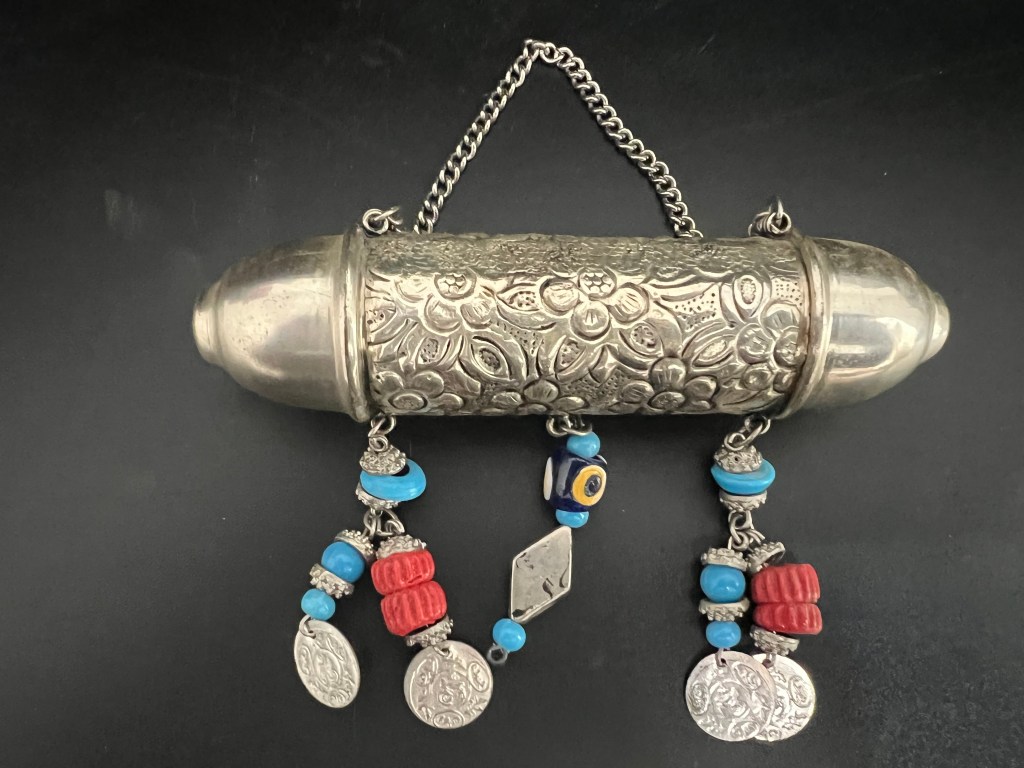
I finally got around to going through the items placed in “my bag” when we were clearing out mom’s belongings last year. These were the items that had “made the cut” when my sister helped her downsize from her two bedroom condo to the one bedroom apartment. We did not have a lot of time to be out of the apartment, so things were not always carefully distributed. One particular small basket contained a number of photos of me when I was a child along with something I had no idea what was. It was an elongated cylinder about 5 inches (12.5 cm) long with three beaded chains hanging beneath it that each held several small charms. While I did not know what it was, it had obviously held some significance to mom. Rather than boxing it up for my son to deal with as part of my estate, I decided to post a picture on our sib feed (messenger) and see if anyone knew what it was. My sister immediately responded this was an amulet to bring good luck to the household given to my parents by the Turkish foreign exchange student they had sponsored.
When I looked online, I found an amulet, also known as a good luck charm, is believed to confer protection upon its possessor. The word “amulet” comes from the Latin word “amuletum”, or an object that protects a person from trouble. While I could not find my amulet, I did find several traditional charms popular in Turkish households, including an eye bead or naẓar (Arabic, meaning ‘sight’ or ‘attention’), an eye-shaped amulet believed to protect against the evil eye. A typical nazar is made of handmade glass featuring concentric circles or teardrop shapes in dark blue, white, light blue and black, occasionally with a yellow/gold edge. The bead is a mixture of molten glass, iron, copper, water, and salt, all ingredients thought to shield people from evil. According to Turkish belief, the blue acts as a shield against evil and absorbs negativity. Blue eyed humans are relatively rare in the Middle East and the Mediterranean, so the ancients believed people with light eyes (particularly blue) could curse someone with just one look. The Assyrians had turquoise and blue-eye amulets used during the 2nd millennium BCE.
Two years ago (almost to the day) we were in Breisach, Germany, and the Black Forrest. I had commented at the time on how this forest (and its tales and superstitions) was popularized by the fairy tales of the brothers Grimm. The quaint towns and villages we passed seemed to be untouched by time, with their cobblestoned streets and traditional half-timbered houses. As we wound through the countryside, our guide explained how every farmstead carved out among the vales had its own tiny chapel, how crucifix shrines dotted the countryside, and that charms were placed above many doorsills as deterrents for the witches said to proliferate the area. Winter isolation gave time for stories and the dark foreboding forest gave rise to the imagination. A trusted amulet or charm was needed by people and houses alike.
THOUGHTS: An amulet is said to derive its properties and powers from magic, whereas a religious amulet is believed to have no power of their own without faith in Jesus and being blessed by a clergyman. Amulets are sometimes confused with pendants, or small aesthetic objects that hang from necklaces. Any pendant may be an amulet, with the difference being that it is believed to protect its holder from danger. The fear of the unknown is instinctual for humans as we do not possess the fangs of a lion or the claws of a bear. Feeling safe, we can overcome more powerful things than ourselves. A modern human amulet is often money or a weapon, but the best protection is still found within the herd. Act for all. Change is coming and it starts with you.
 A travelers odyssey