
February 14, 2025
When Santorini was canceled the cruise substituted the site of Olympia on the west coast of the Peloponnese peninsula. Although this was not the bucket list site I had hoped for, it was cool to see the original site of the ancient Olympics, and the location where the Olympic flame is still lit every 2 years (summer and winter). From there we sailed to Nafplio, a well-preserved coastal town on the eastern coast of the Peloponnese peninsula. I knew we were going to Mycenae for our extension, so I choose the 19th century fortress of Palamidia and the theater at the site of Epidaurus as our day’s shore excursion. However, when today’s extension excursion left this morning, the first site we visited was the theater of Epidaurus. This was a Classical site rather than Mycenean, one I had already seen, and nowhere near the tomb of Agamemnon I was looking forward to. I guess this is where my manipulations and planning finally caught up with me.
When I looked online, I found Mycenaean Greece (or the Mycenaean civilization) was the last phase of the Bronze Age in ancient Greece, spanning the period from approximately 1750 to 1050 BCE. This period represents the first advanced and distinctively Greek civilization in mainland Greece, and included palatial estates, urban organization, works of art, and a writing system. The Mycenaeans were mainland Greek peoples who were likely stimulated by their contact with Minoan Crete and other Mediterranean cultures to develop a more sophisticated sociopolitical culture of their own. The most prominent site was Mycenae, after which the culture of this era is named. Other centers of power included Pylos, Tiryns, and Midea in the Peloponnese, Orchomenos, Thebes, and Athens in Central Greece, and at Iolcos, in Thessaly. Mycenaean settlements also appeared on the islands of the Aegean Sea at Epirus and Macedonia in Asia Minor, and on Cyprus. Mycenaean-influenced sites also appeared in Italy and the Levant (Palestine).
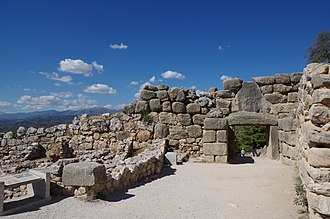
It turned out our time at Epidaurus was far from wasted. I had hiked to the theater on my previous visit and this was not something that interested Melissa. Instead, we explored the ruins of the city of Epidaurus. I had previously rushed through this site to make it back to the bus on time. This time we were able to have a leisurely exploration. Then it was on to Mycenae, the capital of the Mycenaean kingdom. Our first stop was the beehive tomb thought to belong to King Agamemnon himself. Then it was on to the acropolis that loomed high above the tomb. I entered through the city’s massive walls at the Lion Gate and proceeded to the royal palace at the top of the hill. The ancient Greeks found this fortress so formable they believed the walls had been built by the mythical one-eyed giants called Cyclops. Mycenae was among the numerous Aegean sites destroyed as part of the Bronze Age Collapse around 1200 BCE. Unlike many other sites, Mycenae was partly rebuilt after this destruction. The site remained sparsely populated until the Hellenistic era. The site was impressive.
THOUGHTS: The cause of the Mycenaean destruction is unknown. Suggested explanations include enemy attack, internal strife, and natural disasters (earthquakes). The massive walls at Mycenae did prevent the fall of the city until late in the age. Each successive chronological age is marked by the improvement of defensive fortifications. Most also end with destruction layers as new peoples wielding advanced weapons or strategies bring the kingdoms down. The atomic age saw the rise of weapons that have the potential to annihilate every living thing on the planet (if not the planet itself). Perhaps the time of war should be replaced with cooperation and peace. Act for all. Change is coming and it starts with you.
 A travelers odyssey