
February 16, 2025
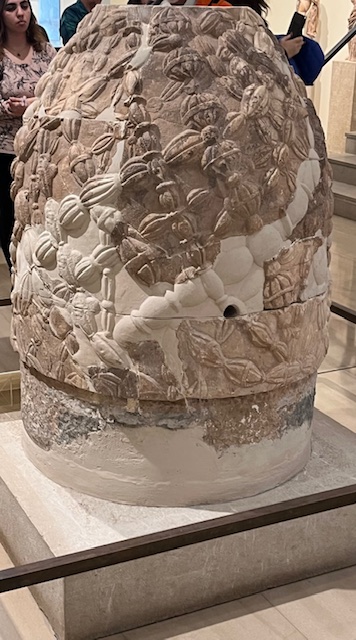
Yesterday I was able to check off another bucket list site with my visit to Delphi. We left on the bus from Athens and wound 2-1/2 hours through the countryside. This included navigating the narrow streets of the ski town near the Mainalon ski center. I was excited to see the site towering 1,640 feet (500 m) above us as we disembarked the bus. The guide told us we would have a tour for an hour, and then another hour to explore on our own. The lower third of the tour followed the sacred way, where a series of temples and shrines (Greek and Roman) flanked the path. This culminated at an insignificant looking bell-shaped reproduction of the Omphalos of Delphi, which had been housed in a small temple of Apoll. From here we were cut loose to explore. I had always thought the oracle was housed in a cave, and there was none at the site so far. I was determined to hike to the top of Delphi and find what I knew to be the original location of the oracle.
When I looked online, I found the Oracle of Delphi (Greek: Δελφοί) in legend previously called Pytho (Πυθώ), was an ancient sacred precinct and the seat of Pythia. The major oracle was consulted about important decisions throughout the ancient classical world. The ancient Greeks considered Delphi to be the center of the world, marked by the stone monument known as the Omphalos of Delphi (navel). According to the Suda, Delphi took its name from the Delphyne, the she-serpent (drakaina) who lived there and was killed by the god Apollo. In other accounts the serpent was the male serpent (drakon) Python. The sacred precinct occupies a delineated region on the south-western slope of Mount Parnassus. The area is now an extensive archaeological site, and since 1938 a part of Parnassos National Park. The precinct is recognized by UNESCO as a World Heritage Site in having had a great influence in the ancient world, as evidenced by the various monuments built there by most of the important ancient Greek city-states, demonstrating their fundamental Hellenic unity.
The guide mentioned Delphi had three significant features that drew crowds. The first (and most important) was the sacred way leading to the oracle, the second was the walkway leading up to the (5000 person) theater, and the third was the large stadium situated at the top of the hill. I trudged my way up the path and finally reached the theater. I figured the stadium could not be much farther, so I kept going. The path to the stadium wound back and forth across the face of the hill, and I noticed the crowds from below had diminished greatly. I kept going, telling myself it had to be “just around the next bend”. I was wrong. By the time I reached the stadium I was exhausted, and my legs had begun to quiver. I had expected a cave at the top, but realized the temple ruin at the end of the sacred way was where the Oracle of Delphi had stood. The stadium was nice, and I now had a story to share, but I still needed to get back down the hill and walk a quarter mile (400 m) to the museum and bus. At this point perseverance set in.
THOUGHTS: It would have taken great perseverance to traverse the countryside to this remote site to have your questions answered. A woman of blameless life was chosen from the peasants of the area to serve as the spokesperson for Apollo (Pythia). She sat alone in an enclosed inner sanctum on a tripod seat over an opening in the earth (the “chasm”). According to legend, when Apollo slew Python its body fell into this fissure and fumes arose from its decomposing body. Intoxicated by the vapors, the sibyl would fall into a trance, allowing Apollo to possess her spirit, and giving her the ability to prophesy. King Leonides had visited Delphi prior to facing the Persians at the Battle of Thermopylae, and was told he would fall. He went anyway, to preserve the rest of the Greek city-states. Sometimes you need to persevere. Act for all. Change is coming and it starts with you.
 A travelers odyssey