
May 20, 2025
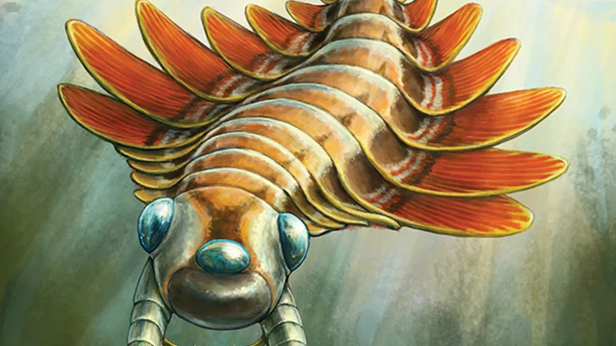
Danielle Dufault/Royal Ontario Museum
Inside the front section of my local newspaper was a USA Today article about a predator that roamed the seas during the Cambrian period (500 million BP). The fossilized remains were found in the Burgess Shale of Canadian Rockies, presenting researchers with new insight into animal life in the Cambrian period, according to a paper published this week in the journal Royal Society Open Science. According to researchers, the discovery revealed the creature was more complex than other radiodont fossils suggested. Rather than the simple abdomen-like area, this creature’s body included 16 segments lined with gills, like modern arthropods. The well-preserved fossil showed an open circulatory system, consisting of a heart that pumped blood into large body cavities (lacunae). The species is called Mosura fentoni, or commonly, the sea moth.
When I went online, I found Mosura fentoni is an extinct species of hurdiid radiodont (marine arthropod) from the Cambrian Burgess Shale in British Columbia, Canada. This is the only species in the genus Mosura, and is known from sixty specimens collected between 1990 and 2022. The specimens were discovered in the Raymond Quarry and Marble Canyon localities, with the majority being placed in the invertebrate paleontology collection of the Royal Ontario Museum (ROMIP). The specimens range from 0.59 to 2.40 inches (1.5 to 6.1 cm), making this one of the smallest radiodonts known. The head has three eyes with two on short stalks and a third on the head between them. The 26 body segments comprise the head, the four-segmented neck, and the trunk. Like other radiodonts, the body bears pairs of swimming flaps, which are considerably larger on the anterior (mesotrunk) than on the posterior (posterotrunk). The gills are very large compared to body size. The specific name (fentoni) honors Peter E. Fenton and his work at the ROMIP. The generic name is from the Japanese name of Mothra (Mosura), the fictional moth-like kaiju monster featured in films by the Japanese company Toho and references the animal’s moth-like appearance.
Mothra (Japanese: Mosura) is a fictional monster (kaiju) that first appeared in the 1961 film of the same name. Mothra has appeared in several Toho tokusatsu (live action) films and as a recurring monster in the Godzilla franchise. She is typically portrayed as a colossal sentient larva (caterpillar) or imago, accompanied by two miniature fairies speaking on her behalf. Mothra is a largely heroic character, having been variously portrayed as a protector of her own island culture, the Earth, and Japan. Mothra’s design is influenced by silkworms, their caterpillars (imagos), and those of giant silk moths in the family Saturniidae. The character is often depicted hatching offspring when it nears death, a nod to the Saṃsāra doctrine of numerous Indian religions. Although Mothra is generally portrayed as female, male individuals have also been featured in the franchise, and a male Mothra larva appears alongside his non-identical twin sister in Godzilla: Tokyo S.O.S. Mothra is one of Toho’s most popular monsters and second only to Godzilla in her total number of film appearances.
THOUGHTS: Mosura is a heroic counterpart to the destruction of Godzilla. The 1954 Japanese film presented Godzilla as a metaphor for the devastation and fear caused by nuclear weapons and atomic testing. It symbolized the atomic bombings of Hiroshima and Nagasaki and the aftereffects of nuclear devastation. The film reflected the anxieties and traumas of the Japanese people during the American occupation in the post-war era. Mosura is not created by atomics and provides safety to the Earth and Japan. Cultures often present images of strong male beings running roughshod over others, along with gentile female beings offering solace and nurture. While that is the stereotype, all humans can choose to be strong, nurturing, or both. It is a choice that needs to be made. Act for all. Change is coming and it starts with you.
 A travelers odyssey