
June 13
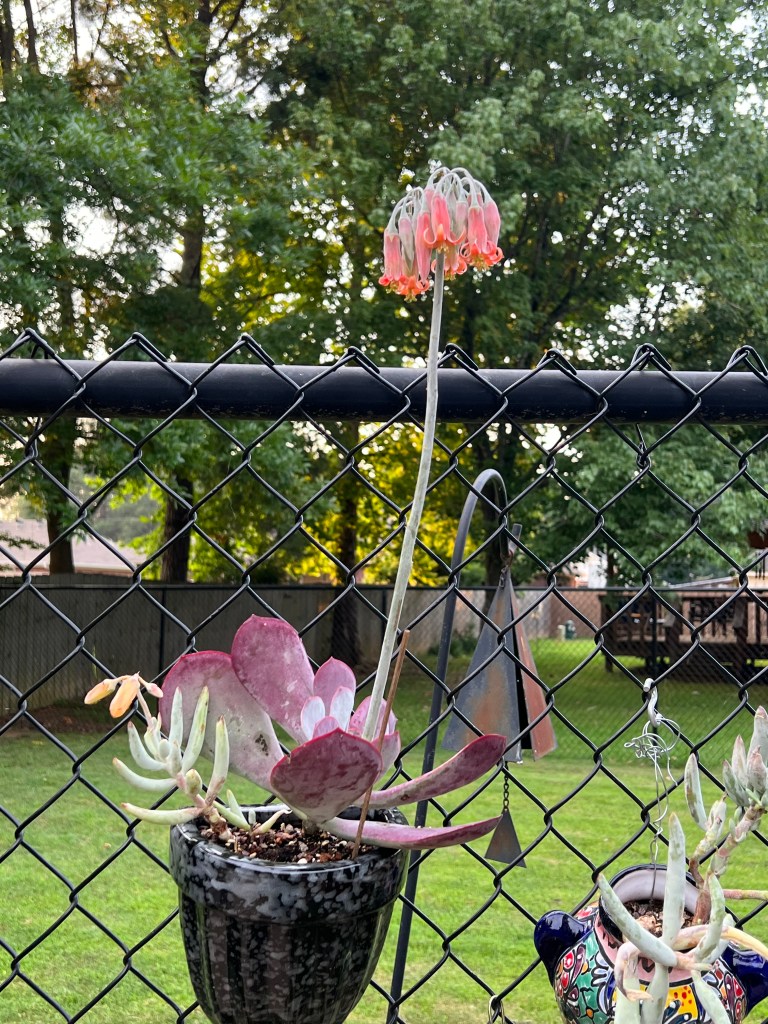
As the weather has warmed Melissa has been moving her summer succulents out of the sunroom and onto the patio. We moved the two glass-topped tables that were in our entry way onto the patio to provide the plants with more light. Melissa also bought several Talavera Mexican Pottery wall hangers. Talavera Pottery are works of art handcrafted using techniques that have been passed down generation to generation since the 16th century and produced in the Mexican state of Puebla, and Dolores Hidalgo. Each piece is hand molded clay or a poured ceramic. While there was no room for them inside, they were perfect for hanging high on the patio fence. These became a nice arraignment next to the gate leading to the side yard. The succulents Melissa chose to plant in these hangers were all small but ones that would send shoots for the flower clusters when they bloom. One of these early bloomers was a pig’s ear.
When I went online, I found the pig’s ear (Cotyledon orbiculate), also known as round-leafed navel-wort, is a South African succulent belonging to the genus Cotyledon. The common name comes from the shape of the leaves resembling a pig’s ear. Pig’s ear is an extremely variable species but grows to around 4.3 feet (1.3 m) in height. It has gray-green leaves up to 5.1 by 2.8 inches (13 by 7 cm) which naturally develop a white, powdery substance (farina) on their surfaces. The farina helps reflect sunlight and conserve water. If the leaf area is brushed against or disturbed the farina will become noticeably smudged. The farina will not regenerate if disturbed, but this is not detrimental and rarely unsightly. Water (dew, marine fog, mist, rain, or even garden hose) does not seem to wash the powdery farina off and it reappears as the leaves dry. The bell-shaped flowers are usually a blood orange-red or a paler salmon-orange, but yellow varieties also exist. Cotyledon produces tubular, upside-down bells which are small, usually less than 1.2 inches (3 cm) in length. They hang and droop from the top of a 24-inch (60 cm) stalk.
While pig’s ear is native to South Africa, it is popular in gardens in many countries. In the wild it grows naturally in rocky outcrops in grassy shrubland and the Karoo region. In New Zealand, it is considered an invasive plant and is listed on the National Pest Plant Accord. Pig’s ear has several medicinal uses. The fleshy part of the leaf is applied to warts and corns in South Africa and heated leaves are used as poultices for boils and other inflammations. Single leaves may be eaten to expel parasitic worms (vermifuge) and the juice has been used to treat epilepsy. However, the leaves contain a bufanolide called cotyledon toxin, which is toxic to sheep, goats, horses, cattle, poultry, and dogs, causing a condition known as cotyledonosis. Lucky this is high on the fence and Loki will not be able to chew on it.
THOUGHTS: In their native country of South Africa pig’s ear generally bloom in the winter. It is interesting that in Arkansas this plant has chosen to bloom in the summer. Since the plant was imported, perhaps it is confused and thinks it is still in the southern hemisphere. The Talavera planter is not frost or freeze proof, so we will need to move it indoors during the winter. Neither does the pottery like to sit in water, wet mulch, or be subjected to the extreme humidity of a growing green house. That makes hanging on the fence the perfect location. Imported plants (and people) are forced to adapt to their new location. However, their preference is to stay the same. Finding a comfort level is what creates the Barrios and ethnic neighborhoods that make up most larger cities in all countries. Adaptation is often a long process. Act for all. Change is coming and it starts with you.
 A travelers odyssey