
July 12, 2025
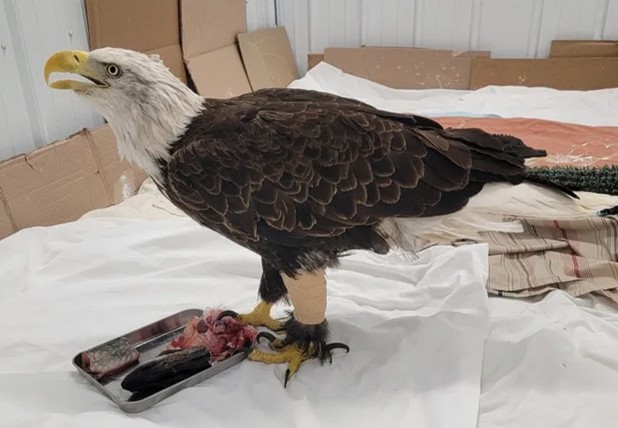
In Wednesday’s local paper I found a USA Today article about a badly injured bald eagle (Haliaeetus leucocephalus) who was treated by veterinarians and released just in time for the 4th of July. The bird was near death when volunteers brought her to the Winged Freedom Raptor Hospital (WFRH) in northern Wisconsin last August. Her leg was ripped open from knee to ankle, and maggots and bacteria had filled the dried-out wound. However, the bird was standing on its leg and its talons were still working. Veterinarian Kim Ammann, reached out to an Icelandic company which transplants the skin of North Atlantic cod (Gadus morhua) to help heal human wounds and support tissue regeneration. The treatment had never been used on a species of raptor before. The company reached back almost immediately and offered the descaled, medical fish skin free of charge to the all-volunteer veterinary hospital. Within weeks, Ammann gave Kere (named in honor of the company) the first of two successful surgical skin grafts. Her recovery included 10 months of grueling wound care, bandage changes, and a mini vacation in the hospital’s Eagle flyway rehabilitation enclosure. By June 22, the wild bald eagle was ready to soar free again thanks to the medical technology developed by Kerecis.
When I went online, I found Kerecis is an Icelandic company that uses fish skins to treat wounds. The decellularized skin of the Atlantic cod is used as a graft, which increases the elasticity, tensile strength, and compressibility of the wound. In 2009 Fertram Sigurjonsson observed that the skin of the fish had qualities like human skin and could expedite skin regeneration and founded Kereceis in 2013. Kerecis Omega-3 fish skin was first marketed in Europe in 2012 and cleared for use in the US for the treatment of wounds by the FDA in 2016. In 2021, the FDA approved Kerecis Omega3 SurgiBind fish-skin for surgical use in plastic and reconstructive surgery. The company was valued at more than 100 million euros in 2021. Kereceis also works on medical research with the US Armed Forces and provides the grafts to branches of the military. Kerecis was sold to the Danish company Coloplast in July 2023 for US$1.2 billion.
The skin grafts provided by Kerecis allowed for the June release of Kere. The date was more about ensuring Kere had “the majority of the summer months” to reacclimate with being wild again than the holiday, but the symbolism of releasing a bald eagle so close to the 4th of July was not lost on Ammann. A group of about a hundred viewers gathered to watch Kere take flight. Amann said the day was “magical.” The eagle population began plummeting in the late 1800’s due to habitat destruction and took another loss from DDT following WWII. Bald eagles hit an all-time low in the 1960’s with just 417 nesting pairs in the continental US. The use of DDT was banned in 1972 and The Endangered Species Act of 1973 helped protect quickly disappearing species like the bald eagle. Today, there are an estimated 316,000 bald eagles in the US lower 48 states, and they became the US national bird in 2024.
THOUGHTS: Even though the process developed by Kerecis is relatively new, skin grafting has been practiced by the Egyptians and Greeks since ancient times and modern skin grafting was described in the mid to late 19th century. Xenotransplants (non-human organs) have been around since the first two decades of the 20th century but have been subject to tissue rejection as well as controversy over morality and animal rights. Xenogeneic grafts where the donor and recipient are of different species (like bovine cartilage or pig skin) are now common. Kerecis’ groundbreaking research and the innovative application by WFRH have taken the process to a new level. Act for all. Change is coming and it starts with you.
 A travelers odyssey