
July 30, 2025
Today’s MSN browser had an article about a discovery that has resolved a 70-year debate. A team of chemists and archaeologists used cutting-edge analysis techniques to test the pasty residue found in the bottom of bronze jars found in the sixth-century BCE city of Paestum in southern Italy. The researchers published their findings today (July 30) in the Journal of the American Chemical Society. The 8 bronze jars were discovered in an underground shrine in 1954. Honey and honeybees were important in ancient Greek and Roman medicine, rituals, cosmetics, and food, so it was assumed the substance was remains of ancient honeycomb offered as a symbol of immortality. Despite at least four attempts over seven decades to confirm the presence of honey, no evidence of sugars was ever found. Lead author Luciana da Costa Carvalho, a chemist at the University of Oxford, England, and colleagues decided to take advantage of recent advances in chemical analysis techniques and reopen the question of the substance’s origin. Using mass spectrometry to identify the different molecules and compounds, researchers were able to identify intact hexose sugars in the ancient jar residue for the first time, confirming the jars originally contained honeycomb.
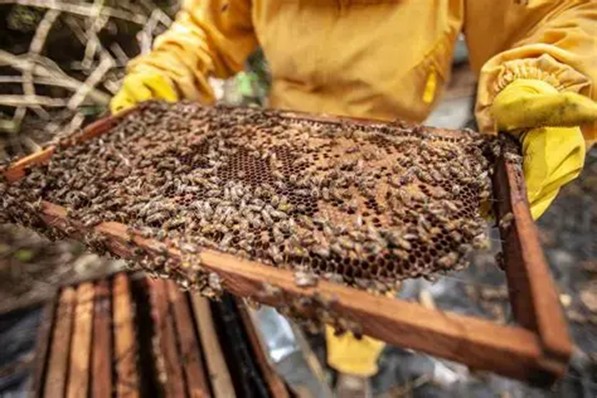
When I went online, I found a honeycomb is a mass of 6-sided (hexagonal) prismatic cells built from beeswax by honeybees (genus, apis) to contain their brood (eggs, larvae, and pupae) and stores of honey and pollen. Honeybees consume about 8.4 pounds (3.8 kg) of honey to secrete 1 pound (450 g) of wax so beekeepers may return the wax to the hive after harvesting the honey, leaving the comb intact to improve honey output. The honey is extracted by uncapping and spinning in a centrifugal honey extractor. If the honeycomb is too worn out, the bees can reuse wax by making sheets of comb foundation with a hexagonal pattern. These foundation sheets allow the bees to build the comb with less effort, and the hexagonal pattern of worker-sized cell bases discourages the bees from building the larger drone cells. New honeycomb is sometimes sold and used intact, especially if the honey is spread on bread rather than used in cooking or as a sweetener. The brood comb becomes dark over time (travel stain) due to empty cocoons and shed larval skins embedded in the cells, along with being walked over constantly by other bees. Honeycomb in the hive boxes (supers) that is not used for brood stays light-colored.
The research presents the first direct molecular evidence supporting the presence of honey, which was likely offered as honeycomb. Analysis of the goop can help archaeologists better understand ancient rituals and shrines. The jars were found in an underground shrine (heroon) that included a large, wooden table with wool-wrapped iron rods placed on top. The offering may have been made to Is of Helice, the mythical founder of the ancient Greek city of Sybaris, located in what today is the arch of Italy’s boot. When Sybaris was destroyed in the sixth century BCE, its inhabitants fled and founded a city called Poseidonia. When the Romans took the city in the third century BCE, they renamed the city Paestum. The new study shows that “there is merit in reanalyzing museum collections because analytical techniques continue to develop,” according to Carvalho.
THOUGHTS: I have always preferred eating honeycomb over straight honey. Most of what I ate growing up was based on texture rather than taste, and I enjoyed the honey squishing out of the cells when I comped down on the waxy comb. Raw honey and beeswax are the two main components of honeycomb. Raw honey is rich in enzymes and antioxidants, while beeswax contains long-chain fatty acids and alcohols, all of which may benefit your health. As I have aged my eating habits have changed (I will not say refined). Texture is important, but taste also decides my diet. Is must have felt the same way about his offerings. Act for all. Change is coming and it starts with you.
 A travelers odyssey