Collapse

December 10, 2020

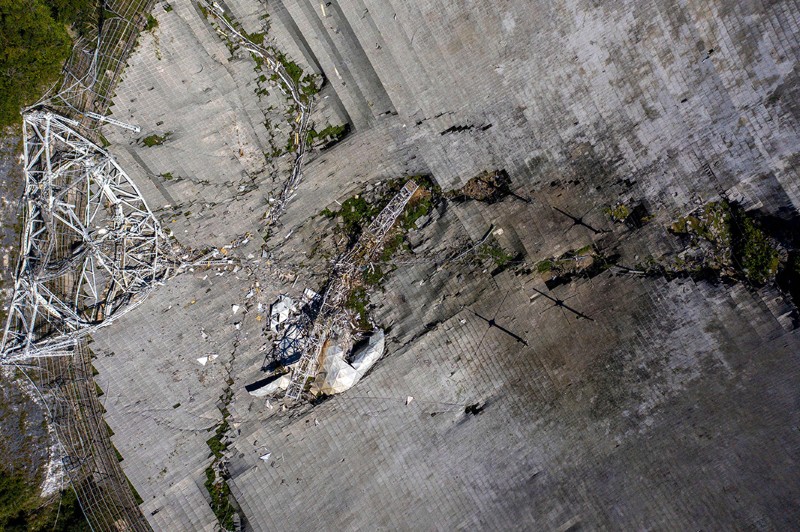
On December 1, 2020, the iconic radio telescope at the Arecibo Observatory in Puerto Rico collapsed.  Engineers had warned that the 900-ton platform suspended above the telescope’s 305-meter-wide dish could fall at any moment, as one of the main cables supporting it had snapped in early November.  Last month, the US National Science Foundation (NSF), which owns the observatory, had announced it would shut down the telescope permanently, citing safety concerns over its instability, and damage too extensive to repair.  The final collapse happened just before 8 a.m. local time.  No one was injured.

The cable that failed in November dated back to the observatory’s construction in 1963.  Since construction, scientists using the Arecibo Observatory have made amazing discoveries.  The first extrasolar planets around the pulsar B1257+12 were found in 1992.  Detailed radar maps were made of the surface of Venus and Mercury and these showed that Mercury rotated every 59 days instead of 88 days, proving the planet did not always show the same face to the Sun.  American astronomers Russell Hulse and Joseph H. Taylor, Jr., used Arecibo to discover the first binary pulsar, and showed it was losing energy through gravitational radiation at the rate predicted by physicist Albert Einstein’s theory of general relativity.  They won the Nobel Prize for Physics in 1993 for their discovery.  The iconic structure was also used as a movie set for filming Golden Eye, Contact, and Species, among others.

The NSF intends to continue paying staff at the observatory to carry on the science at smaller facilities on site.  It is unclear whether the dish will be demolished, rebuilt, or left in ruins.  Observatory director Francisco Córdova told reporters that officials would investigate ways of establishing similar or even better scientific capabilities, perhaps at or near the site.  This would depend on the US Congress allocating money to replace the Arecibo dish.  Given the speed Congress has used to respond to the pandemic, this may take a while.

Thoughts:  One of the responses to the collapse in the article’s comments section was to say that with everything else that has gone on this year, it was a fitting end to 2020.  While there seems to be a general feeling that “if we can only get of 2020,” the reality is little will change.  The new year will bring what it always brings, expectation and hope for the future.  What makes a difference is not the passage of time but learning from what has happened during that time.  This too is the same every year.  The coming year can achieve great advances if we decide to do what has been proven to work, with or without the vaccine.  Follow the science.  Change is coming and it starts with you

Shot

December 9, 2020

(Photo by WANG ZHAO / AFP) (Photo by WANG ZHAO/AFP via Getty Images)

On the morning of April 19, 1775, hundreds of British troops set faced off against 70 colonial militia men on the village green of Lexington, Massachusetts.  While it is uncertain who fired the first shot, it was fired, and the brief skirmish left eight Americans dead and at least an equal number injured.  One British soldier was wounded.  The British marched on to nearby Concord and encountered another armed group at the town’s North Bridge.  This time the gunfire was purposeful, leaving two colonists and three British dead.  The British retreated to Boston, skirmishing with colonial militiamen along the way and suffering numerous casualties.  The Revolutionary War had begun.  The incident at the North Bridge was memorialized by Ralph Waldo Emerson in his 1837 poem “Concord Hymn.”  It is here we find the phrase, “And fired the shot heard round the world.”

I found it fitting that Britain is the setting for the latest shot, called by the media “a shot watched round the world.”  The first person to get vaccinated against covid-19 was 90-year-old Margaret Keenan.  Fittingly, the second was 89-year-old William Shakespeare.  Britain’s vaccination plan is like that proposed in the U.S., giving priority to those most vulnerable to the virus (i.e., the aged, the US adds healthcare workers).   Britain’s shot will then be administered by age groups as the vaccine becomes available, starting with the oldest.  When the plan was presented, one reporter noted that Queen Elizabeth II was 94 and Prince Phillip was 99.  Foreign Secretary Dominic Raab was said to be nonplussed answering, “like any family, they would have felt the pressures and all the worries that surround this pandemic as well.”

As I read about the British vaccination plan, I was intrigued by the wording of the story.  “The U.K. is the first Western country to deliver a broadly tested and independently reviewed vaccine to the general public.”  That made me check online to see if there had been earlier vaccinations, and indeed NPR said there were.  In early November, China’s two biggest vaccine companies had already begun inoculating hundreds of thousands of mostly state workers in a bid to get a head start.  Outside scientists warned of possible bad outcomes and a sense of invincibility that is not warranted and could help spread the virus.  As it is now five weeks later, I can only assume that did not happen.

Thoughts:  The NPR article reported that while Westerners were skeptical, the unorthodox approach of giving its workers preferential access to the experimental vaccine was a sign of China’s strength.  First in controlling a coronavirus epidemic, then in its ability to potentially protect its workers.  My search found the report on China’s vaccinations dated November 12.  If it was reported on other Media, I must have missed it.  The two approaches on when to give and to whom to give the vaccine represent opposite views of what is safe and who is essential.  Most choices we make are in part arbitrary and highlight our priorities.  Our course of action often only makes sense when the priorities are known.  Follow the science.  Change is coming and it starts with you.

Infamous

December 8, 2020

Yesterday was the anniversary of the attack on Pearl Harbor.  While there were plenty of ignored warnings of the pending attack, including sightings of two minisubs in the Bay and the squadrons of planes advancing on radar blips, the Pacific Fleet was caught completely by surprise.  The attack commenced at 7:48 a.m. Hawaiian Time.  The base was attacked by 353 Imperial Japanese aircraft (including fighters, level and dive bombers, and torpedo bombers) in two waves, launched from six aircraft carriers.  Of the eight U.S. Navy battleships present, four were sunk and all were damaged.  The Japanese also sank or damaged three cruisers, three destroyers, an anti-aircraft training ship, and one minelayer.  The delayed declaration of war did not arrive in Washington until later that day.  President Franklin D. Roosevelt proclaimed December 7, 1941, “a date which will live in infamy”, because the attack happened without a declaration of war and without explicit warning.

The response by America was both swift and brutal.  War was declared in both the Pacific and Atlantic theaters.  America joined the rest of the world who had been at war since September 1, 1939.  The other response was Executive Order No. 9066.  While this did not identify Japanese Americans specifically, it resulted in the forced relocation and detainment of about 120,000 people of Japanese ancestry.  While many parents had their property confiscated and their family jailed, their sons of age served honorably in the European Theater.  More than 112,000 Japanese Americans living on the West Coast were forced into interior camps. However, in Hawaii, where over 150,000 Japanese Americans composed over one-third of the population, only 1,200 to 1,800 were interned.

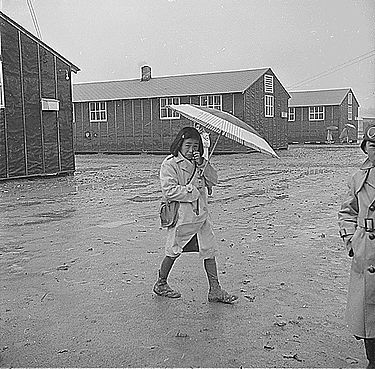
When I worked for the State of Utah, I visited one of the Japanese Internment Camps at Topaz, Utah.  The camp closed on October 31, 1945.  Topaz was named for the Topaz Mountain which overlooks the camp 9 miles (14.5 km) away.  While this is listed as a National Register Site, there was little left.  It was built in the Utah desert where building supplies were scare.  After closure, the local farmers stripped the camp of anything salvageable.  The only thing left were the concrete slabs and outlines of the buildings.  Eerily, there were also outlines of the rock gardens and Koi ponds the interred families created to provide a sense of place.  It left me with a haunting feeling.  

Thoughts:  When I moved to Berkeley, I became friends with a Japanese man who owned the grounds keeping company which took care of the grounds where I lived.  I had spoken with him on many occasions when somehow the topic of Topaz came up.  I believe I mentioned that I had visited the site.  He responded he had been imprisoned there during the war.  My mind went back to the cramped quarters and attempts to make a life in the desert with little resources, a fact still evident at the abandoned camp.  I found myself empathizing with him for what he had endured.  I realized when we get to know others and their circumstances, it can change your understanding of what is infamous.  Do the work.  Change is coming and it starts with you.

Oldies

December 7, 2020

I noticed last week that my car radio had switch from Prime Country (1980’s and 1990’s music) to Country Christmas.  Since Melissa has been listening to Christmas music at home and she had taken the Jeep, I assumed she had switched channels.  I asked her about it on our Sunday drive and she said she had not changed the channel.  Instead, the channel itself had changed.  She had noticed this happened with her smooth Jazz channel as well.  It was now playing jazz versions of Christmas songs.  I guess we get Christmas regardless.

Most of the playlist was country renditions of songs from the Classical or Big Band eras of music.  I checked online and found that this was indeed true.  Most long-time Christmas classics are from prior to the Rock era, and still dominate the holiday charts. I have also noticed a lot of the classics were recorded around World War II.  This was a major period of transition.  Many of the favorite Christmas movies are from this same era, while most of the classic animated movies come from the 1960’s (the Boomer children of Builder parents).  While a few other songs have made the list (e.g., “All I Want for Christmas Is You” by Mariah Carey and Walter Afanasieff, “Wonderful Christmastime” by Paul McCartney, and “Last Christmas” by George Michael), it is still the oldies that command the airwaves.

When I took a Music History course thirty years ago, I learned the importance of music in our daily lives.  I have a hearing difficulty and music never was a big deal for me.  Even today I rarely listen to music unless I am driving in a car.  Even then it is more for the distraction than the pleasure.  There are few songs I know the words to because I have never been able to hear them, instead I am attracted by the tunes.  Even so, I still attribute certain songs to times in my life.  That is why I listen to Country Prime, and why I still like the Carols at Christmas.  I guess there are many people like me.

Thoughts:  It seems a rite of passage in any genre of music is that when you make it big, you record a Christmas album.  Melissa is a musician and avid listener and she told me you can find Christmas songs in every (nearly every?) genre.  I joked about listening to “Rocking Around the Mosh Pit.”  When I checked, Melissa was right.  Popular Punk songs held tiles like, “I Won’t Be Home For Christmas” and “There Ain’t No Sanity Clause.”  I also found several groups who had recorded “White Christmas,” with the original lyrics.  If music can cross boundaries, why do the rest of us stay apart?  Do the work.  Change is coming and it starts with you.

Special

December 5, 2020

Like most this year, our anniversary fell amid the pandemic.  We were excited about going to one of our “fancy” (read expensive) restaurants for a special meal.  The date came as the cases soared and the Governor recommended restaurants drop to 25% capacity.  We have tried to be diligent and avoid going out unless needed.  This seemed like a bad time to go sit unmasked in an enclosed indoor space with other people.  We were both disappointed but decided to do the right thing and stay at home.

When we married 11 years ago, I made plans to make the day special.  Melissa was still in Arkansas, and said I could plan everything, as long as it was not a big deal  Since Melissa was a runner, I thought it would be fun to have a family 5K followed by breakfast.  This was the Saturday of the community Christmas parade that I helped plan and had participated in for five years, so that was next.  Then we were to be married in the afternoon.  That sounded like a lot to Melissa, but she agreed that would be fine.  Several friends worked with local media and they got wind of what we planned for our special day.  They ended up interviewing us for a local TV station and a spot in the newspaper.  Melissa asked if I understood what “a big deal” meant.

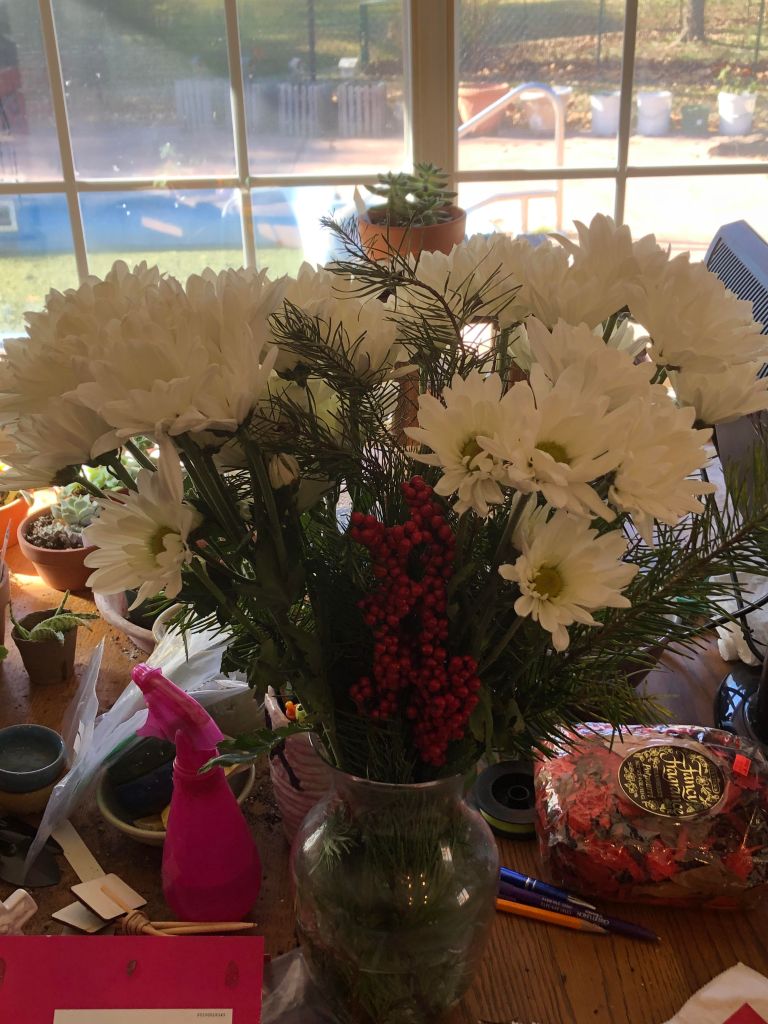
When we talked about how to make the day special early in the week, Melissa told me she did not want to do a meal at home.  This was too much like what we do every day.  I was resigned to this as well.  That is when I thought we should think outside the box.  Even though it might be similar, how could we do something to make it feel different?  It ended up we were both on the same wavelength.  Melissa surprised me with an early gift, and I surprised her with flowers and a special meal.  Then we did something we had never done before.  We binge watched Star Trek Discovery.  It was a special day.

Thoughts:  One of the good things I found amid the pandemic is been being forced to think about what we have always done.  So many things are done because we have always done them, and often without thinking about why.  Like our special day, we are now pressed to do things differently.  Sometimes we realize what we have always done is no longer important.  Sometimes we create new ways to celebrate.  And sometimes, we do the same thing in new ways to make it special.  Regardless of which way we go, the day becomes special because we know why and what we are doing.  That is what ultimately makes it special.  Follow the science.  Change is coming and it starts with you.

Defense

December 4, 2020

One of the feared traditions of graduate school is the “Writtens”, followed by the Oral Defense.  This generally occurs at the end of the second year of the program and after the course work is complete.  The purpose is to test the knowledge of the student and to see if they were ready to enter their Thesis or Dissertation research.  I took three of these tests, in three different fields.  I failed the first one miserably and passed the others with ease.  The difference was what I learned from the first failure allowed me success on my later defense.  The key was knowing the test was not designed to trick me or cause me to fail.  I was able to ask what would be on the test in advance and (generally) was told.  When I understood the rules and asked, I passed.

When I was in grad school, I had a friend who had a Garfield cartoon pinned to his cubicle wall.  Underneath each picture he had written his own caption.  The strip began with Odie looking at a tree full of apples (choosing a dissertation topic).  The next cel found Odie shaking the tree until an apple fell to the ground (researching your topic).  Garfield then swooped in and stole the apple that fell (professor steals your topic).  The next cel found Odie and Garfield locked in a fight (dissertation defense).  The final cel depicted Odie alone, beaten up but proudly holding his apple (graduation).  While I did not fully understand the truth of this observation at the time, I thought it was funny.  It became clearer when I went through the process.

Another learning I gleaned was the oral defense is often more about the opposing views of the professors than you.  I have sat in on the defenses of friends and listened as obscure and contradictory questions were asked, only to have the candidate’s major professor jump to the students’ defense.  While this is not always the case, it is when there are competing views within the department.  I have seen (and experienced) this in Archeology, History and Religion.  It is difficult to mount an effective defense when others will not listen.

Thoughts:  There have been times when I have been forced to defend my views outside of academia.  Here again, it is because I have said something another disagrees with.  They believe they are right, so I must be wrong.  When I have taken time to step back from my adversarial position, I have often been able to understand the other’s point.  Even if I do not agree with it.  It is only when we find common ground that we can be united.  Or at least not at war with each other.  This ultimately requires both sides to step back and listen, but it can begin with you.  Do the work.  Change is coming and it starts with you.

Withered

December 2, 2020

The hard freeze we have been expecting for the last week finally arrived.  We have been cautious about our in-ground succulents.  I have mentioned that we covered them with greenhouse netting last week before we got the initial freeze.  They have done well and even taken on a little color due to being stressed by the cold.  Melissa was afraid they might not survive the hard freeze even with the cloth covering.  She waivered back and forth about putting a layer of plastic over them.  Finally, after dark and with the temperature falling, she decided they needed to be covered.  Rather than the plastic, we covered them with old afghans we had in the closet.  We went to bed as the temperatures dropped.

Melissa purchased a digital weather station originally intended to replace the thermometer we use to track the temperature on the porch.  This displays both temperature and humidity and has a memory setting that will display the maximum and minimum temps over the last 24 hours.  While it is easy to check the porch temp, it is more difficult to go outside and read the gauge under the mess netting.  That is especially true at night as the temperatures drop.  Several days ago, I figured out how to set the device up (relatively easy) and put it on the outside bed as a test.  The temperatures dropped to 26F, but the mesh kept the plants at 29F.  Still cold but doable.

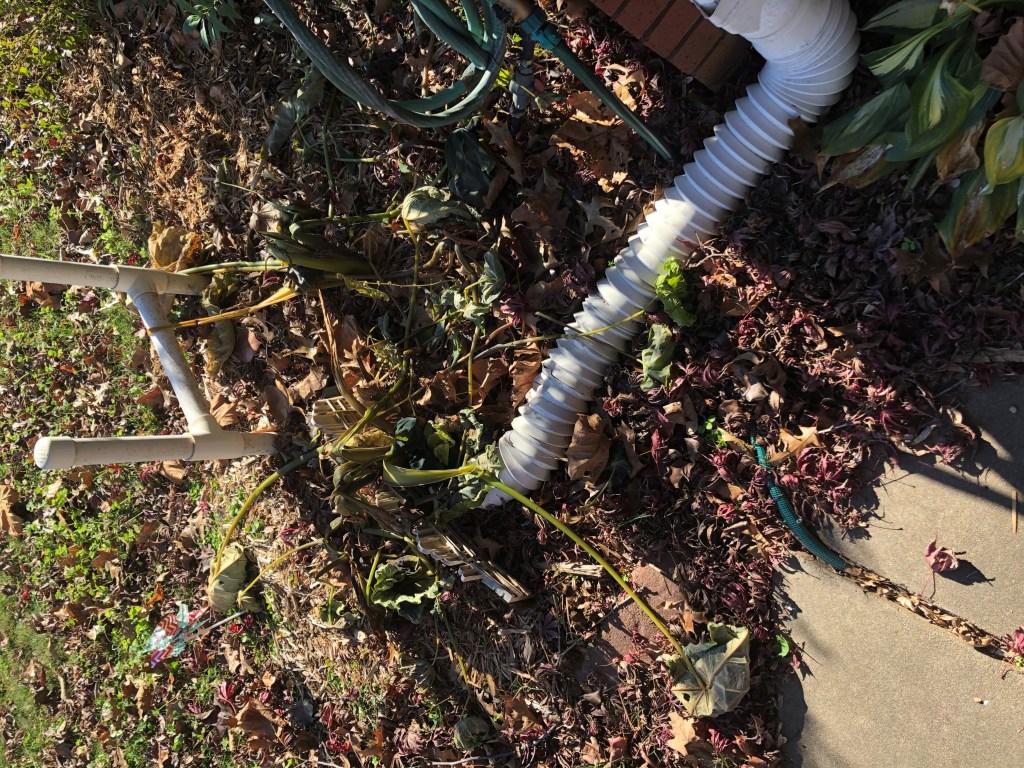
When Melissa checked on the plants the morning after the hard freeze, they were doing fine.  None of the succulents had suffered frost burn and they all looked healthy.  The gauge confirmed the afghans had done their work.  The memory feature on the thermometer indicated the minimum reached was a toasty 29F.  The elephant ears (Colocasia) on the other side of the walk did not fare so well.  They have been continuing to flourish despite the cold, although the seed pods had never produced identifiable seed.  When I checked after the hard freeze, they had all withered and laid dead on the ground.   This is the annual cycle of garden life.

Thoughts:  There are several proven ways to learn what works and what does not when it comes to gardening.  Melissa relies on the experts to provide information from their experience to let her know what they have found.  Some of this is online and some from gardener friends she has cultivated (Ha Ha).  The other way is through trial and error.  If something you try works, you do it again.  If it does not, the plants wither and you start over with new plants.  The same can be said about the pandemic.  We can listen to the experts and do what has been shown to work in the past, or we can use trial and error and hope for the best.  Hoping for the best has not worked well so far.  People are not as interchangeable as plants.  Follow the science.  Change is coming and it starts with you.

Rare

December 1, 2020

Melissa has begun to intrigue me with her cacti and succulent propagation.  After we talked about her plans to make these little guys flourish, I went online to find out more.  As I surfed, I came across a site about the ten rarest cacti in the world.  I opened the first picture and recognized this as one of the cacti in our collection.  As I scrolled through the list, I recognized at least two others we own.   All were listed as rare or endangered.  I asked Melissa about this and she confirmed we did own at least three of the ten, and probably one or two others.  When I read the fine print on the site, they stated the varieties were “rare in the wild,” but were common and in demand among growers.

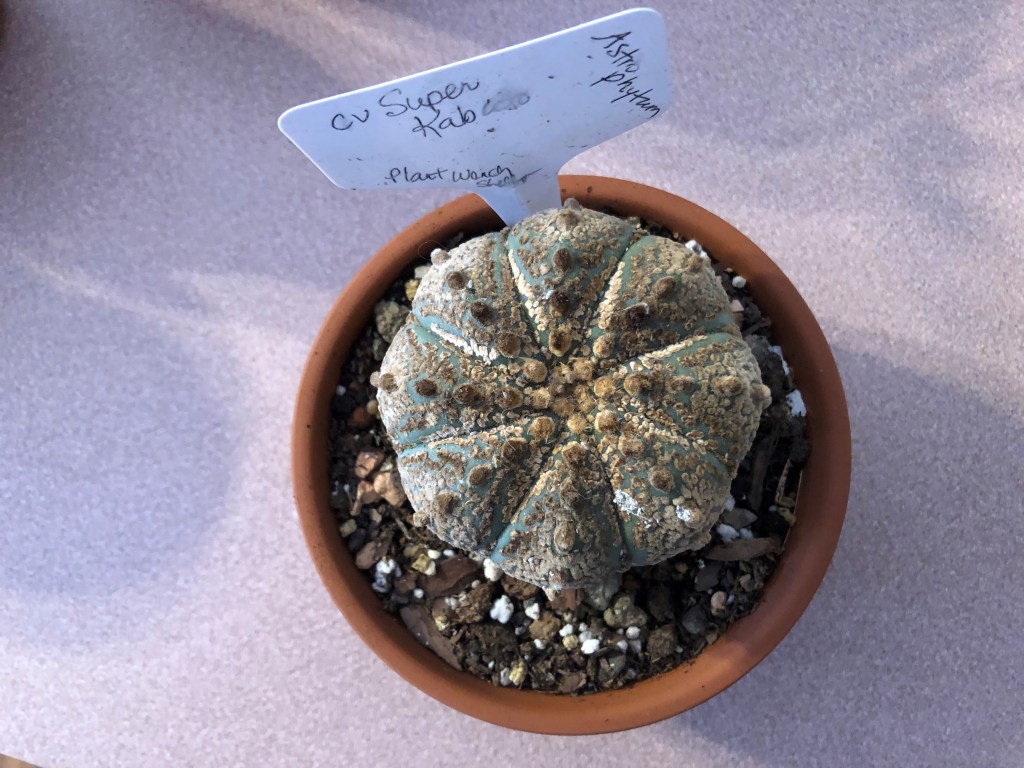
The Sand Dollar Cactus or Astrophytum asterias (also called sea urchin cactus, star cactus, or star peyote) is a rare spineless cactus that is native to parts of Texas and Mexico.  Although there are only about 2000 wild plants, it is widely cultivated by succulent and cacti enthusiasts.  The Sand Dollar Cactus has been a popular ornamental succulent since it was first collected in the mid-1800’s.  It is this popularity that makes the wild version vulnerable, and the International Union for Conservation of Nature (IUCN) Red List reports that people from around the world illegally remove the cactus from the wild and mail them home.  They stress the Sand Dollar Cactus should not be removed from the wild because it is quite easy to grow from seeds and cuttings.  Melissa told me that most of the rare and endangered species are being targeted by poachers.  She also informed me all our plants are grown and raised in reputable nurseries and are not from the wild.

When I checked poaching online, I found that cacti across the American southwest are being stolen from public lands in increasing numbers.  This ranges from the soaring saguaros (for landscaping) to tiny, rare species (indoor house plants).  The global demand is driving a booming underground market that risks destroying the sensitive species.  In 2015, US officials made a large seizure of Ariocarpus fissuratus and all 3,500 of those plants ended up at a greenhouse in Alpine, Texas, belonging to Sul Ross State University.  Authorities suspect the plants were stolen from nearby public lands. “Cactus theft is a huge issue in the Trans Pecos,” said Karen Little, Sul Ross’s greenhouse manager. “We have whole genetic lines of cacti that have been wiped out by poachers.”  Again, it is all about me.

Thoughts:  When I worked with the State of Utah, I assisted management of the resources on state and federal lands.  My federal counterparts were rangers and carried pistols.  This was a needed precaution against the armed poachers they encountered on the protected lands.  It is illegal to remove ANYTHING from state or federal lands (including cacti), and illegal on private lands without the permission of the owner.  Melissa knew several of her cacti were defined as “rare,” but she did not know how rare they really were.  Since we are expecting several nights in the low 20F, she decided to move them from the front stoop to the inside foyer to avoid freeze.  You protect what you are passionate about.  That is true for Melissa, and the Rangers.  Follow the science.  Change is coming and it starts with you.

Movies

November 30, 2020

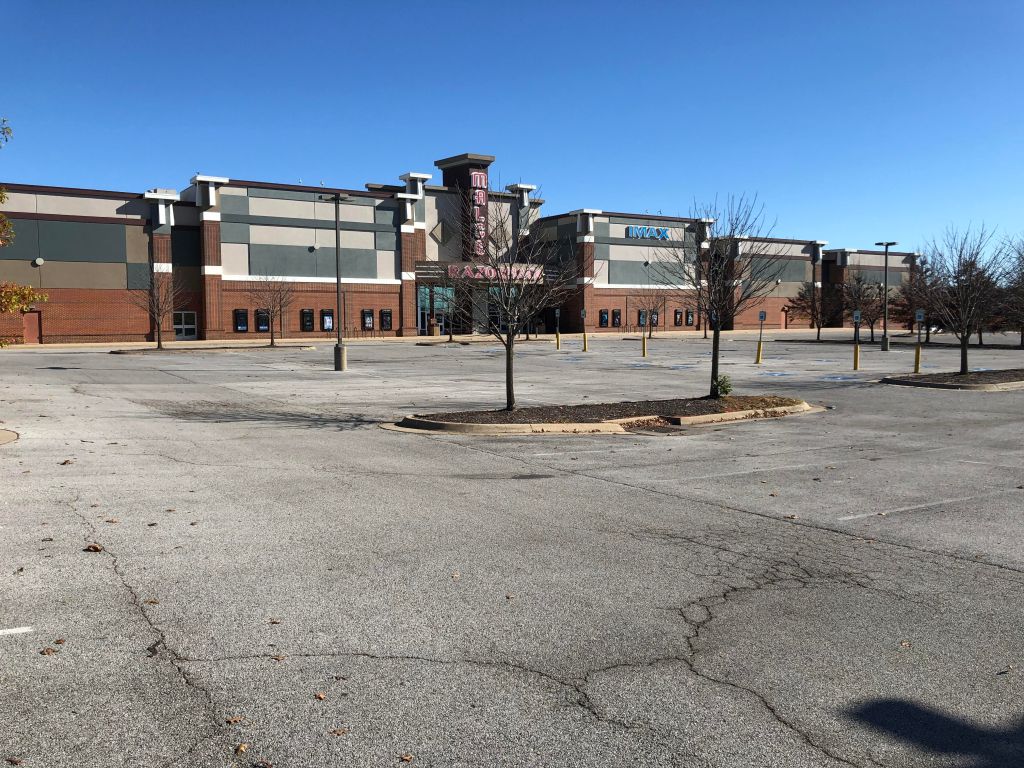
When we rescued Melissa’s succulents several weeks ago, we stopped at a local restaurant that had outside seating.  This had an order counter (with plexiglass covering) and the meal was brought to your table.  I was surprised by how many people were eating inside the restaurant, and at the number of 4-5 person groups who gathered.  We took our meal sign and went to a table on the outdoor patio and were the only ones there.  The restaurant was situated next to the local Mall and the parking lot was completely empty.  The door to the Mall entered a theater with 20 screens and an IMAX.  It was only while leaving the restaurant that I remembered this was the theater we have attended on Christmas Day.

One of the traditions Melissa and I have had since we married is to attend one of the new holiday releases in an IMAX theater.  While we attend family events around Christmas, we realized we needed to create our own traditions as well.  We have always gone to the first showing of the day, usually around noon.  These matinees were about half the price and provide a better chance of getting a good seat.  Preferably, our Christmas movie needs to be 3-D and combined with surround sound.  It creates an amazing experience.  When we first attended this theater, we were disappointed by the small size of the screen.  The theater where we used to live is billed as the largest IMAX screen in the world.   It does make a difference.

I have begun to hear of new releases over the last several weeks, but when I searched for them online, most are on one of the streaming networks and not in theaters.  While many movie theaters remain closed until further notice, and many studios have pushed back release dates on major films, there are select theaters that are open and showing movies.  These movies seem to be a mix of old classics and a few new releases.  Most of the blockbuster movies scheduled for release are being held until they can have a full release.  They are hoping for this spring.  

Thoughts:  During the early 1920’s, sociologists began cost of living surveys to create budgets for the poor.  This included all the essential needs (food, housing, utilities).  The cost of luxuries (cars, vacations, movies, amusement parks) were also recorded.  The budget surveys less than a decade later showed movies and amusement parks had become an essential need and not a luxury.  The IMAX webpage contained a link to saveyourcinema.com.  The pandemic has put both small independent screens and nationwide movie theaters at risk of closure.  As the link explains, “our local theaters employ over 150,000 people and have formed a cornerstone of the American experience.”  Once again, we are redefining what it means to be essential.  Follow the Science.  Change is coming and it starts with you.

Sponge

November 28, 2020

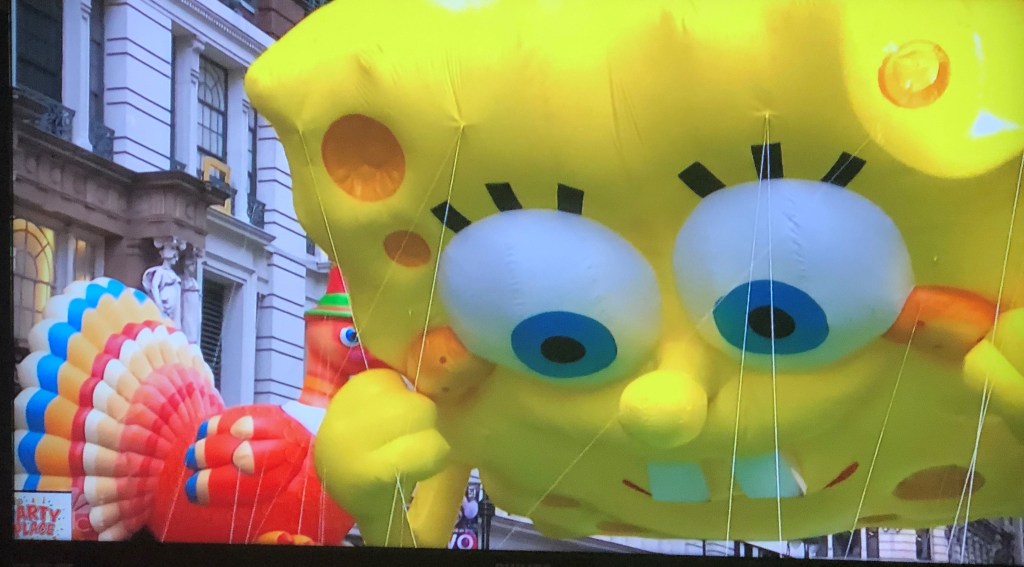
While I made good on my promise not to watch the Macy’s Thanksgiving Day Parade on Thursday, Melissa did watch.  The three-hour parade is held in Manhattan, ending outside Macy’s Herald Square, and takes place from 9:00 a.m. to 12:00 p.m. Eastern Standard Time on Thanksgiving Day.  It has been nationally televised on NBC since 1953.  This year the parade only focused on the last section of the annual march.  While it did not feature the marching bands of the past, there were some floats and of course the balloons.  The finale was also intact, as Santa arrived in front of Macy’s famed flagship store on 34th Street to kick off the holiday season.

While I did not watch, Melissa called me in to see the giant SpongeBob balloon.  I have been a fan of the Sponge since it first aired on Nickelodeon in 1999, even watching the two SpongeBob movies released so far (a third is scheduled for American release in 2021).  I even started saving SpongeBob collectables and now have around 50 different items.  It is interesting that I did not buy most of my collection but instead they were given to me.  When my adult friends learned of my collection, they began to buy small SpongeBob items to give to me.  I think they must like the Sponge as well, but do not want to admit it.    

During the early 2000’s I went to a local Arts in the Park in my city.  The featured guest was SpongeBob SquarePants.  There was a long line to be able to have your picture taken with the Sponge.  I got in line and patiently waited my turn.  Just as I got to the front, the character’s front man declared a break and asked us to come back later.  I did not want to lose my spot in line, so I waited the twenty minutes until he returned.  When he opened again, I stepped forward and he asked where my child was.  I told him I wanted a picture of me and Sponge.  He just shook his head and took the picture.  Five minutes later I had another treasure.

Thoughts:  Some would call my affection for SpongeBob SquarePants a guilty pleasure, but I would disagree.  A guilty pleasure is an activity or piece of media that someone enjoys but would be embarrassed by if other people found out about it.  These might be books, movies, TV shows, foods, or most anything ese.  Generally, the guilty pleasure is something that might be viewed as shameful by some people, like trashy novels or overdone romantic comedies.  I am not embarrassed by my passion for the Sponge, nor do I feel guilty.  Too often we allow others to dictate what we do or how we should feel, and we hide our true thoughts.  You are only embarrassed if you allow another to embarrass you.  When you wear your feelings proudly, you may be surprised how many others feel the same.  Do the work.  Change is coming and it starts with you.