Casserole

September 8, 2020

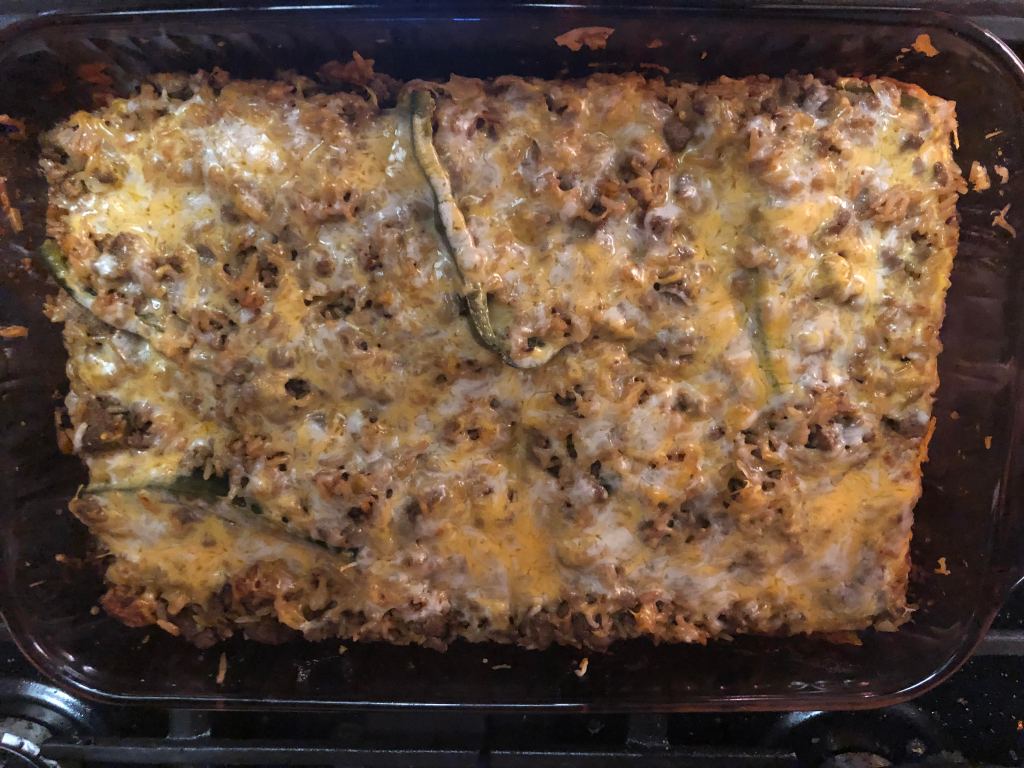
I made my “famous” stuffed poblano pepper casserole last night for dinner.  It came out just as good this time as it did the first time, albeit slightly different.  I have made stuffed green peppers many times and stuffed poblano peppers on occasion.  These are both made using different stuffing.  The green peppers use a mixture of hamburger and rice that is topped with small amounts of tomato sauce and cheese.  The poblano peppers are stuffed with cheese (preferably feta).  Both are then baked.  I have learned lately it is better to blanch the peppers for five minutes prior to baking to ensure they cook well.  I guess cookbooks are good for some things.

I learned our gardener friend was using the last of her home grown poblano peppers this weekend.  Melissa told me she was making a poblano cream sauce to pour over baked salmon.   This sounded great.  I need to spruce up the dish when I make salmon.  Melissa is not much of a fish eater except for fried catfish (she is southern after all).  I have been weaning her over by putting creative sauces on top of the fish to give it an alternative taste.  So far, she has always eaten my sauces and said they were good.  I am sure she would like the poblano cream sauce.  I bet I could find it in a cookbook, or I could just wing it.

I came up with the poblano casserole because I did not have the right ingredients for making stuffed peppers.  I have substituted an Italian cheese mix (store bought) before, but the taste and texture were not what I was hoping to find.  By making this as a casserole I had no preconceived ideas about what it was supposed to taste like.  I sliced the six peppers in half vertically, blanched them, and then layered them in the bottom of the pan.  This time I poured leftover enchilada sauce over the peppers and sprinkled shredded mozzarella cheese over them.  Next came a mixture of a pound of turkey sausage, a small onion, and two packets of 90 second Spanish rice.  This was topped with shredded fiesta style cheese, covered, and baked for thirty minutes at 400 degrees.  It tastes great.

THOUGHTS:  I tried to give enough direction to let you make this dish yourself.  It is simple and I would suggest you even try variations if you do not have the suggested ingredients.  That is what I have done the two times I made the dish.  I do have a disclaimer.  Although the poblano peppers are not spicy hot, I have found the oil on the skin to put out enough heat to leave my hands burning after preparing the dish (and do not rub your eyes!).  I find much of life is like my baking.  Rarely do I find I have the right ingredients.  That means I need to either go get what is needed or improvise.  There are advantages to either approach, but the important thing is to begin.  We need to begin the work of anti-racism or it will not be done, and this is a job for everyone, and not just a few.  Do the work.  Change is coming and it starts with you.
Packaging

September 7, 2020

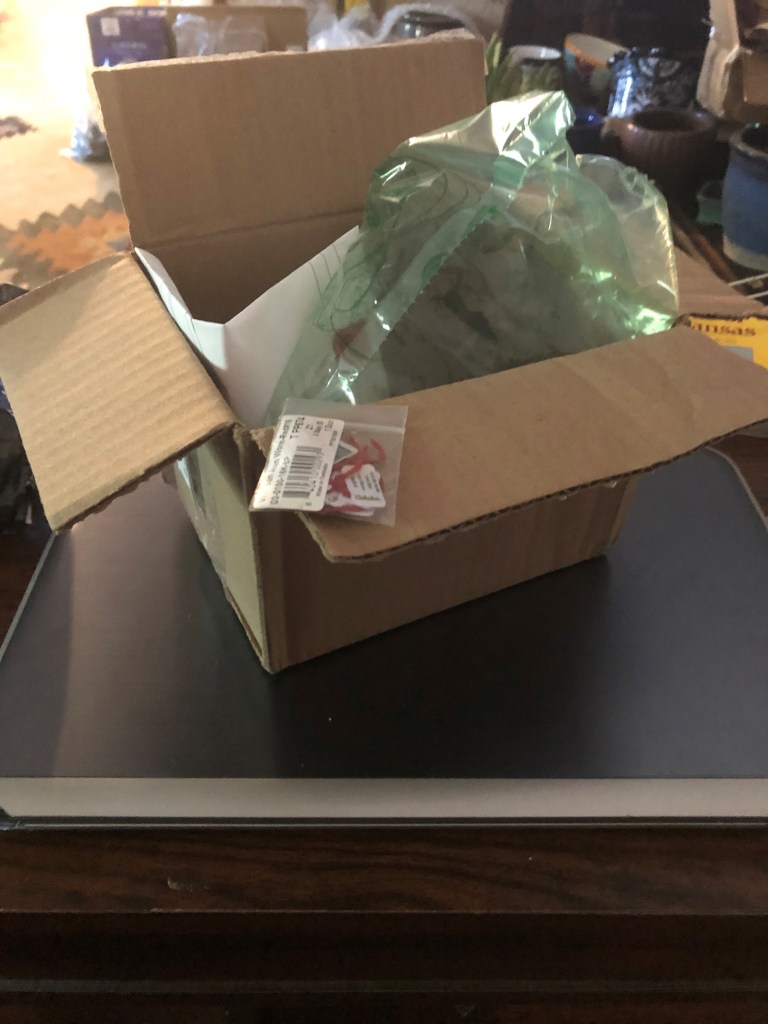
When I received my shipment of San Juan Worms, I was amazed by the packaging the order came in.  Admittedly, I did order a dozen of these flies but let me be honest, they were all on a #16 hook.  That means the whole lot slipped into a plastic baggie that was 1 1/2” by 2 ½”, and about a ¼” deep.  Even with in this small bag, over half was filled with air.  What surprised me was the box the worms shipped in.  This was a standard small shipping box that measured 8” by 6” x 6”.  The inside was packed with wadded paper and an air-filled plastic bag.  I guess this was necessary to keep the flies from bouncing around.  I doubted they would have broken.

Earlier this year the American Sustainable Business Council put out a post decrying the excessive use of packaging in America. While America has around 5% of the world’s population, we generate 40% of its packaging waste, and much of this is plastic.  In 2018 the European Union banned many single-use plastics, something the U.S has resisted. The exponential growth of online product sales has accelerated the production of direct-ship-to-user packaging waste. Incineration is a toxic solution, landfills are limited, and foreign countries are reluctant to accept our waste.  Recycling is not an option for all materials and is not widely used when it is an option.  That is for plastic and does not address the wasted cardboard surrounding my order.

I know there are some shipped products that need to be protected.  Melissa’s succulents come wrapped in gauze or paper towels and are placed in Styrofoam peanuts or other cushioning material to protect the delicate plants from the rough treatment they receive in transport.  I do not know how many of her boxes clearly marked “fragile” have arrived partially crushed.  Luckily, the interior packaging has saved the plants from destruction.  Most shipments do not need this special care.  It seems merchandisers are relying on one size fits all packaging to cut costs and to speed delivery.  My flies could have been mailed in a small envelope, with room to spare. 

THOUGHTS:  We are living in a time when our resources are being stretched to the limit.  The cardboard represents millions of trees cut down.  The single use plastics go into landfills and oceans and last for thousands of years.  When they begin to breakdown, they become even more toxic as micro-plastics chocking out animal life.  How we use packaging materials needs to be a conscious choice.  We cannot waste precious resources for a quick dollar or to shave seconds off delivery times.  Not being “business as usual” could be positive.  However, we need to rethink and retrain our old response.  This is true for packaging, but also for our treatment of others.  We need to do the work.  Change is coming and it starts with you.
Anomalies

September 5, 2020

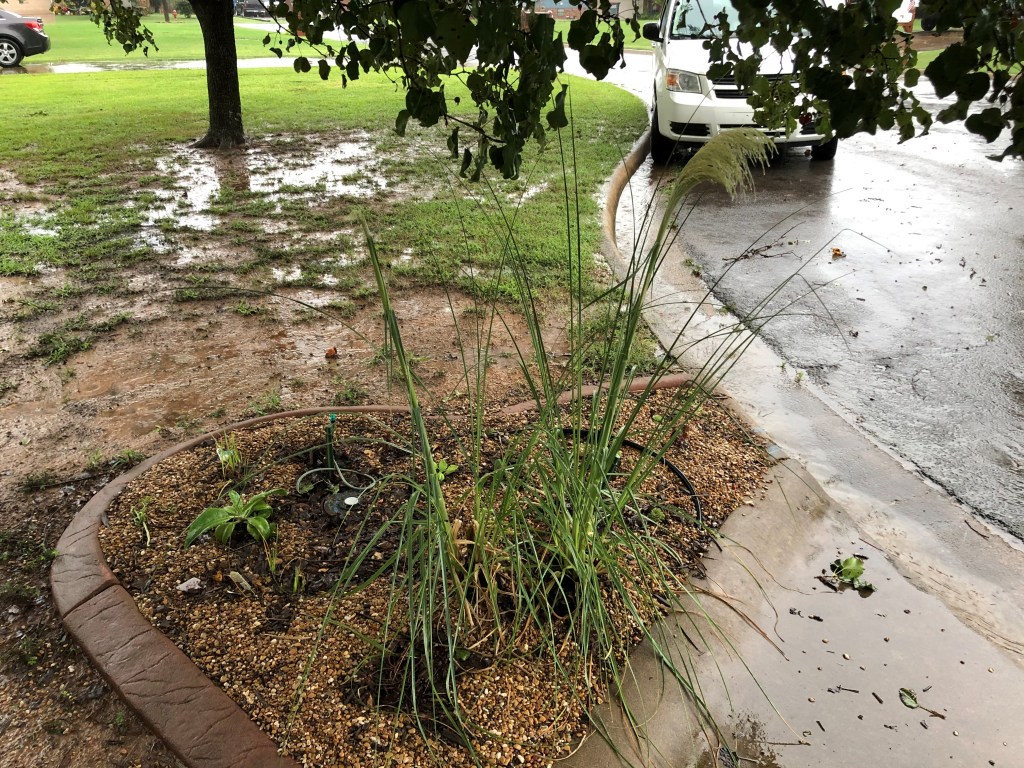
Melissa has had Pampas Grass (Cortaderia selloana), planted in one of her driveway planters for several decades.  Although she moved to Kansas with me for an eight-year stretch, she cannot ever remember it blooming.  The plant bloomed this week and I wondered why it was blooming now when it never had before.  When I checked online, I read that Pampas Grass is native to southern South America, including the Pampas region from which it is named.  While it is used as on ornamental plant in America, it has been banned in Hawaii and New Zealand because of its ability to outgrow and displace native plants. The site mentioned the plant prefers full sun, which probably explains why it does not bloom very often.  We have it planted under a shade tree.

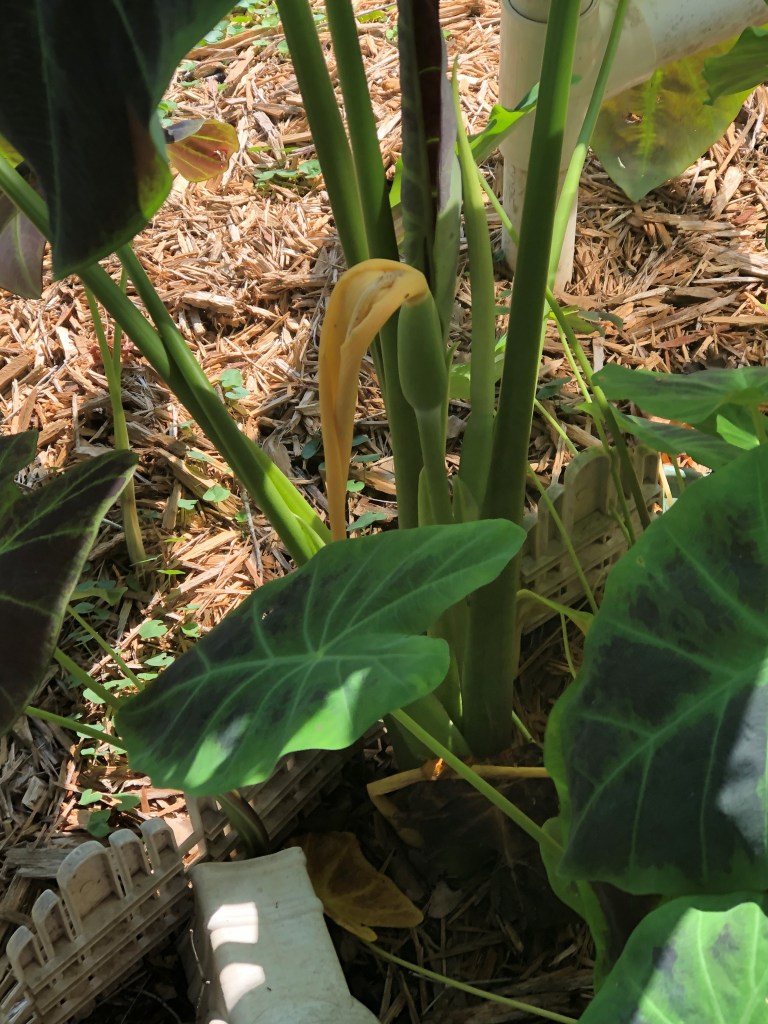
Along with the Pampas Grass we got another surprise from our Elephant Ears (Colocasia formosana). These are planted in the full sun along the front of the house and have probably been there as long as the Pampas.  They provide a tropical effect in their setting and are mixed in the bed with several Naked Ladies.  These plants have large foliage, which is reminiscent of elephant ears (hence the name). When I looked today there were several blooms sprouting among the leaves.  Again, in the decades these have been in the bed they had never bloomed.  Here was another anomaly

I texted a picture to Melissa and asked if she knew this plant bloomed.  Neither she nor her gardener friend had ever seen a bloom, but there it was.  I went online and found that while they can bloom, this is not common in climate Zone 7 in which we live.  The site said about the bloom, “The inflorescences are the typical aroid type with a white to yellow or light green spathe surrounding the spadix (What?).  They can be large, fragrant, and attractive.”  While these are usually hidden underneath the foliage, our flowers are visible.  The fruits produced are globular green or yellow berries that contain several seeds.  I hope we will get these as well.

THOUGHTS:  The Pampas Grass is an anomaly because it has not bloomed.  It is known to be prolific, but Melissa has struggled to keep it alive.  Two small plants we established last year did not make it through the winter.  The Elephant Ears are an anomaly because they have produced a rare bloom.   The Ears themselves have always grown well, and after dying back in the hot summer and cooler winter, always return.  I do not know if you can rack these two anomalies up to climate change or not, but the odd weather patterns we are experiencing this year have made a difference on our yard.  I used to pay no attention to these patterns, but now I do.  Perhaps we should pay attention to the other shifting patterns that have coalesced this summer.  We cannot allow the realizations gained to be written off as anomalies.  We need to do the work.  Change is coming and it starts with you.
Squirrel

September 4, 2020

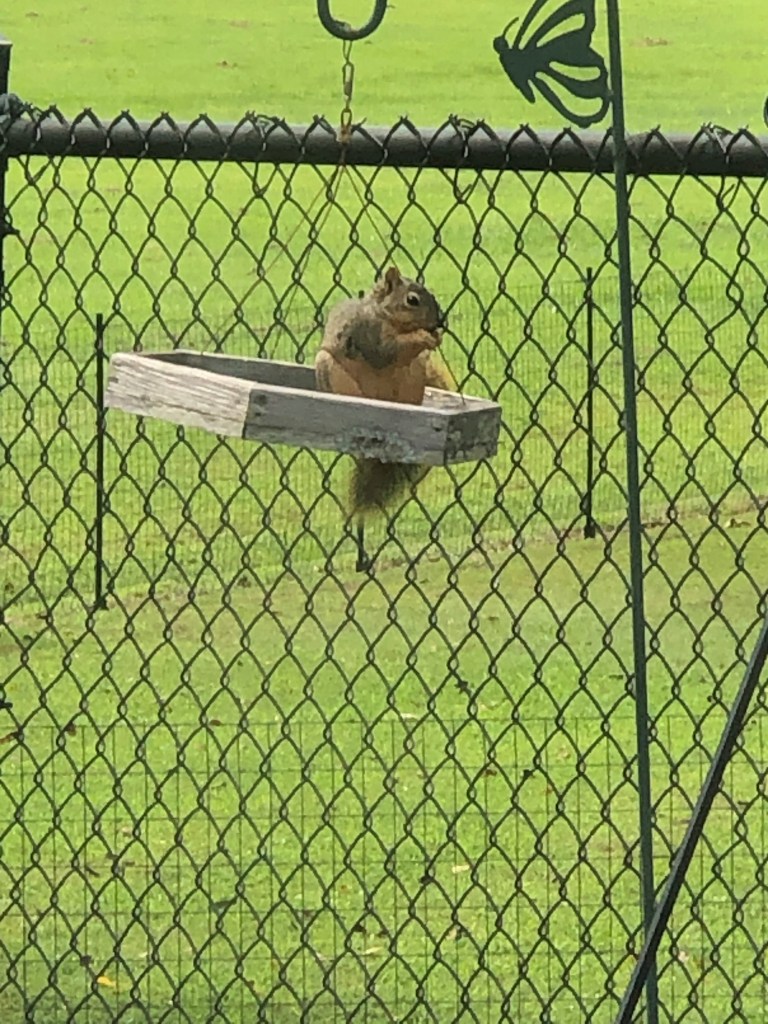
I watched as our local squirrel climbed the fence and sat above the bird feeder.  He has been raiding my feeders all summer.  I have given up trying to keep him out and have instead become resigned to letting him have his due.  The problem he faced today was of his own making.  I had converted an aluminum pie pan into a feeder by attaching wires from an old hanging flower basket.  It stood just off the fence and the squirrel had taken to jumping into the plate.  Half of the time when he did this it would rip the plate away from the wires and the whole thing would come down.  This was fine with the squirrel, as the nuts and seed reserved for the Cardinals fell to the ground and he could eat at his leisure.

Last week, one of our windstorms blew the feeder away.  This had happened before, but I always found it lying on the deck.  This time it was nowhere to be seen.  Not only was the pan gone, the wires were as well.  I looked on our porch where we keep extra parts and there were no more suitable wires.  Rather than leaving the space empty, I moved the Finch feeder to where the nuts had been.  The squirrel was perched on the fence chattering and his tail was whipping back and forth.  He was mad!  Even though his constant attack on the plate weakened it and led to its disappearance, he obviously believed it was his right to be fed.  Now his food was gone.

I did not feel too sorry for the squirrel.  He has been raiding my bird feeders all summer, often taking more than the birds themselves.  I also knew there was another feeder.  I have seen him sitting in this feeder munching away, even when my flimsy feeder was present.  Although I did not feel sorry for the squirrel, I did know that every time he raided the bird feeders there was no more food for the birds.  I believe I have finally found a way to thwart his raids.  I went to the store and bought a squirrel feeder and a special “squirrel mix” of corn and seeds.  These are larger pieces and I hope he will love them.  When I got up this morning there were three birds fighting over the feeder with the squirrel mix.  Turnabout is fair play.

THOUGHTS:  If I could anthropomorphize my squirrel, I would say he did not understand why I did not like him.  He was acting no different than the birds.  Both were just trying to get along in my yard and to understand the odd-looking animal that patrolled it.  The only real difference between their foraging habits was they looked different.  I finally realized I was the one who needed to change.  This same idea seems to guide our nation.  Genetically there is less than 1% difference in all human DNA.  Sometimes we look different, act different, and sound different, but we are all just trying to get along in this big yard we call America.  Change is coming and it starts with you.
School

September 3, 2020

I was privileged to be part of a conversation discussing (I was smart enough to listen, and not talk) the effect (and affect) of returning to school.  This came from people located across the country and in rural, town, and city locations.  As most school districts and college/universities are open for fall terms, the ongoing conversation on “what to do” has shifted from administrative offices to homes and hallways.  The questions seem to center around how to provide the essential services (food, safe housing, human interaction) offered by these institutions while maintaining some form of separation to curtail the rising spread of the virus.  This is a conversation that has not been addressed on the national level.

As Higher Education opens it has come with the normal parties and thoughts of invulnerability that were displayed over Spring Break and Memorial Day.  Most schools have been conscientious to restrict on campus activities and enforce masks and distancing.  This has resulted in students taking their events to off campus private venues.  The result has been a rush of new outbreaks that has gone beyond our original cases and daily numbers.  It has also resulted in student suspensions, school closures, and shifts to online classes.

Public Education is struggling without clear oversight or direction, and every district across the country has a different solution to the problem.  Keeping kids in as small of groups as possible is the goal, so if one gets sick the whole school does not tumble.   Some districts have chosen to put children in learning pods, monitored by daycare workers and an online teacher presence.  Some are being taught entirely from home, and usually after an outbreak.  Others are split between in person days and days at home, with students alternating days and a thorough cleaning in between.  For many parents it comes down to what can I afford?  Can I be home with my children?  Can I not work?  Grandparents have traditionally helped resolve this issue, but that is not safe now.  Instead we all try to muddle through.

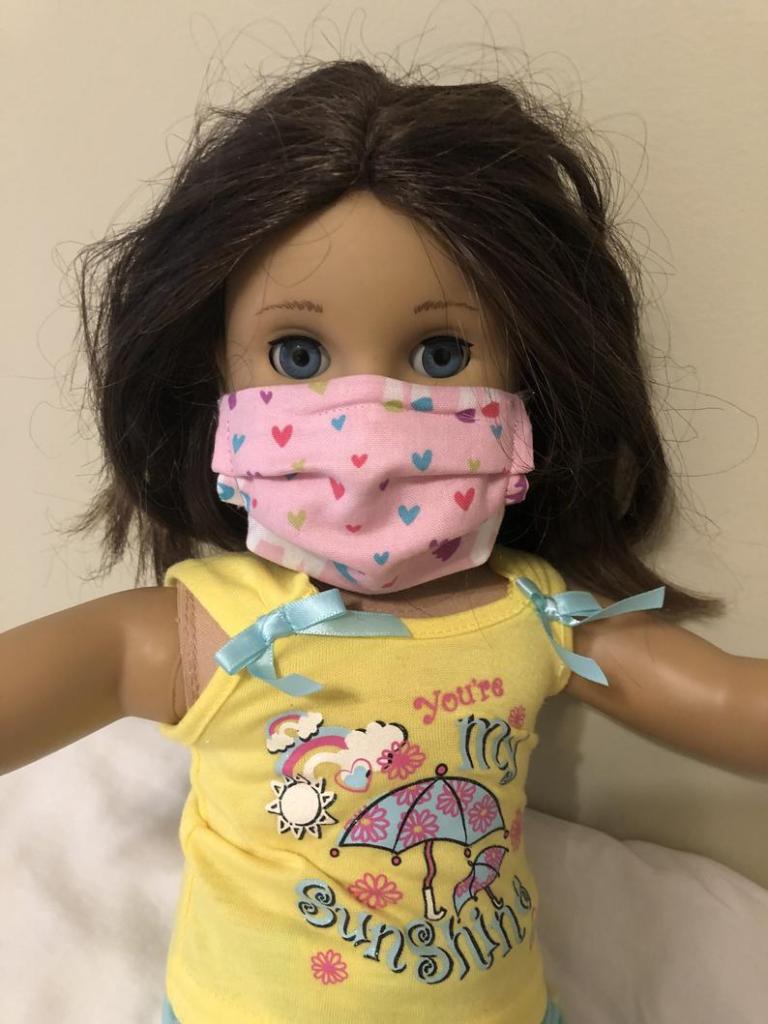
THOUGHTS:  This indecision has not only caused problems for working parents, but also for the children.  One parent told of his seven-year-old who fell to the floor crying when told her school was not going to open.  She had been looking forward to going back since May.  There was another side spoken by a grandmother.  “This generation will have skills previous ones did not have.  At two (my granddaughter) knows to wear a mask and why.  What has she learned?  To respect others and that her actions affect others.  In this (my) corner of the world that has high value.”  I hope it has value in yours as well.  Follow the science.  Change is coming and it starts with you.
Fame

Change

September 2, 2020

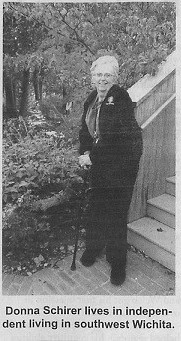
I have heard that if we live long enough, we all get our 15 minutes of fame.  That is apparently true as my 91-year-old mom made the paper last week.  Mom’s article was professionally written and fairly accurate.  It tells of her self-quarantine since last March.  When asked how she was coping during the pandemic she responded, “You meet every day head on and you do what you can.”  Mom mentioned she kept busy with a weekly family zoom call and listening to three different church service broadcasts on Sunday’s, including one from her son in Arkansas (my moment in print!).

Several years ago, Melissa and I were visiting in Arkansas over the Christmas break.  We were trying to get a light display set up at the camp I was director of and had gone into town to examine the different displays in a local park.  This was a walk-through experience that included a small mini train that transported visitors around and through the one square block of light displays.  This was a chilly New Year’s Day and we were the only ones in the park.  A photographer approach and asked if he could take our picture.  He was from the local paper that has a daily feature of people “out and about” and said he had been to three locations and we were the first people he had found.  We were in the next morning’s edition.

Mom and dad had always been active and traveled extensively around the world since his retirement.  I recall mom saying when he died 10 years ago that she would never be able to travel again.  That was before the trips to China and South Africa, not to mention the annual trips to Maine for my sister and the various side trips to family and friends across the country.  Now the only buildings she has entered other than her own are medical buildings for doctor’s appointments.  Just as with many of us, the pandemic has forced mom to change.

THOUGHTS:  Mom’s article ended saying how she hoped for the time when she could resume life as she knew it.  There is no way of knowing when that might happen, but as she said, “You have got to be positive.”  Life as we knew it will probably never return.  That does not mean we will not come through the pandemic.  It just means we will come out of this forever changed.  The same could be said for 9/11 and other transitions that we have faced in the past.  Change does not have to mean bad; it just means different.  It is how we react to change that makes our experience good or bad.   We need to look for the positive.  Change is coming and it starts with you.
Busted

Busted

September 1, 2020

The rains let up over the weekend, so I decided it was time to go fishing.  I have mentioned the new sow bugs had arrived and I was eager to get one into the water.  When I arrived at the lake, I saw the vegetation had grown up around the shore.  While there were holes in the water cover, there was no way to drag a wooly and a dropper through the thick growth.  I have both a mouse and a frog fly that I have used on occasion and I thought one of these might be perfect.  I went back to the truck to tie on my fly.

We are planning our first trip since the pandemic arrived in February for later this month.  We have secured an Airbnb and booked a morning with a local guide on the Little Red River.  This is one of the premier Brown Trout streams in the nation, including the world record (40# 4 oz).  I took an afternoon last week to get all my fishing tackle arranged.  This included re-matching reels with poles and oiling and putting new line on one of the reels that had become difficult to cast.  I do this periodically but was surprised to find how many flies and hooks had been purchased that were stored in odd places.  They are now arranged by type so I can grab what I need and not worry about hauling the excess.  My mouse was in another bag.

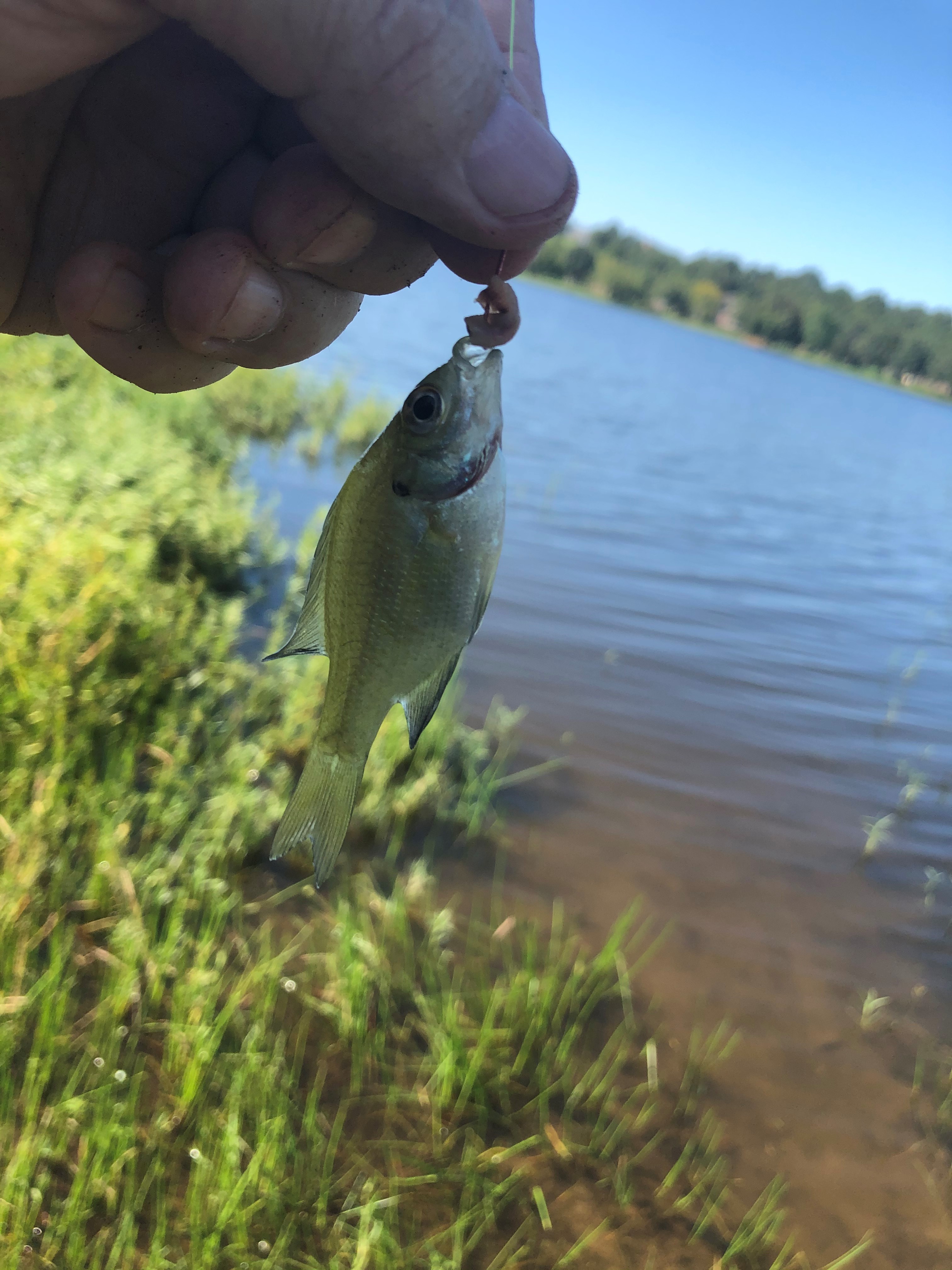
I tied on a popper and fished for thirty minutes without a bite (and losing my popper).  I moved to a spot where there was a break in the cover and threw out my cat pole and put a worm on my newly strung bobber line.  I was pleased to see how well the reel now worked.  I caught a small bluegill and tossed it back in.  I quickly caught another and decided to bait it up on my Carolina rig.  I was going to get a bass one way or another.  As I tossed this line out a truck pulled up beside me.  It was the Game and Fish officer.  When I gave him my license, he told me he had never seen a license like this but did not think it was for fishing.  He called my name into the dispatcher and they told him what it was.  I had purchased an annual 65+ license, and not the lifetime permit.   As he returned the license, he suggested I could save money if I got the lifetime license instead. Btw: this is a different fish.

THOUGHTS:  I was concerned when I was told my license was not valid.  I had delayed fishing on two different occasions when I had gone to a lake and realized my license was expired.  I purchased my new license online and carried it with me.  Great, I thought.  After all that I am going to get a citation.  I try to be overly conscientious when it comes to obeying the law.  I wear my seat belt, only drive four miles over the speed limit (on cruise control), do not use my cell phone (unless hands free), and I do not fish without a license.  I do this so I do not get in trouble, but also because I realize doing so is for the good of other people, even if not for me.  It is the same reason I wear a mask.  Change is coming and it starts with you.
Cause

Cause

August 31, 2020

I have mentioned that I am participating in a four-part webinar on “Dismantling Racism,” with Warren Chalklen, Ph.D.  This last Friday the topic was on combating institutional and structural racism.  Institutional racism is “the discriminatory treatment, policies, or practices within organizations and institutions.”  An example might be unequal pay women or BIPOC than for white males preforming the same job.  Structural racism takes the next step, as “a system of public policy, institutional practices and other norms to perpetuate racial group inequality.”  This takes the single institutions practice and makes it the norm for the entire culture and all institutions.

One of the points discussed was called Root Cause Analysis.  This is an approach to “identify the underlying causes of an incident so that the most effective solutions can be identified and implemented.”  The process asks and then answers why the event occurred, and then asks why the cause (answer) occurred.  By walking this out to the seventh level we begin to understand the underlying cause (systemic racism) of what can produce an obvious easy answer or the perplexing misunderstanding for why it happened.

A jarring example for me was to take the issue of providing food and housing help to the poor.  This is something many of us do routinely, either personally or through trusted institutions.  Root Cause Analysis takes this the next step.  The question is not whether to provide food or housing for the poor, it is instead to ask why are they poor in the first place?   From there we can ask how we can bring about the necessary steps to accomplish change.  This lets us address the outcome (economic inequality) rather than just providing food.

THOUGHTS:  I had a mentor in East Oakland who told a story of providing food for a poor family.  The wife had come to his office and asked for help to get food on the table for her four kids.  He gladly took her to the grocery and helped her carry the two sacks into the kitchen.  The husband stood there glaring angrily at him for his assistance.  What he realized was he was superseding the husbands perceived role as provider.  While he continued to provide help with food to others, he also changed his approach to include assistance with jobs, loans, cars, and banking.  He showed me a response to the Root Cause.  Change is coming and it starts with you.

Response

Response

August 29, 2020

I am not sure what response I should have to our two National Conventions.  What I saw was more One-up-Man-ship and praise for “my side” than platform.  I have always felt sorry for whatever party is forced to go first, Democrat or Republican (the incumbent has the final say).  The RNC chose to not provide a platform this year, stating on Sunday they were going to wait until 2024 to let people know where they stood.  Instead they abdicated to “whatever Trump wants to do” for a party platform.  If I heard correctly, that was to make the same promises that were propagated in 2016.

I am sorry if you are offended, but I was disturbed by the appropriation of the White House as a backdrop for political rhetoric.  The First Lady took over her revamped rose garden on Wednesday and the President took over the South Lawn on Thursday.  This was the first time the White House has been used by an incumbent for a campaign rally in the 228-year existence of the White House.  Some would say this was because of the stay at home order of the CDC due to the corona virus.  I would agree if any of the 1500 people gathered would have distanced or worn masks.  Instead, this appears to be another super-spreader event like Tulsa.

The DNC ended with a firework display, and that was then dwarfed by the RNC display on Thursday.  Everything seems to be bigger and better, which happens when you do the same thing.  I was discouraged when the DNC sent a theme of “the country will be destroyed if the Republicans win.”  The RNC response was to make the same claim about the Democrats.  Considering both responses, we appear to be on the verge of a lose-lose situation.

THOUGHTS:  I read an NPR article that said, “Both Democrats and Republicans are saying this is a battle for the soul of the nation. And they are both right. It just depends on what you want that soul to look like.”  We have had contentious elections in the past and there has always been a peaceful transition of power.  Regardless of who wins, we need to respond by doing the work to bring reconciliation to a frustrated and torn land.  If we instead choose to widen our division, we will create what both conventions predicted, a lose-lose situation.  Change is coming and it starts with you.

Missed

Missed

August 28, 2020

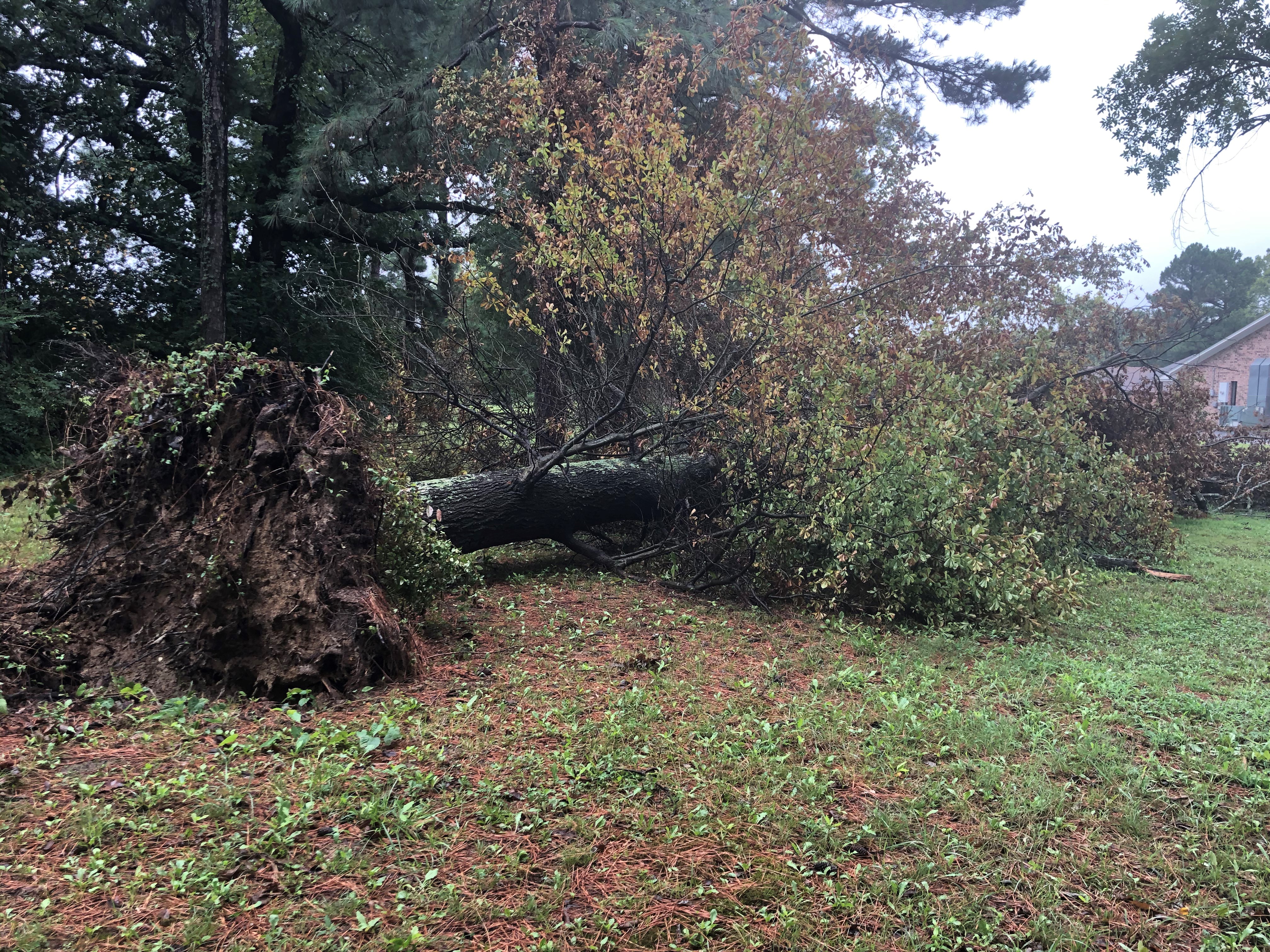
My doorbell rang as I sat working in my office.  I was a little surprised as we have had few visitors during the outbreak.  I am waiting on a FedEx shipment of San Juan Worms for a fishing trip we have scheduled in September and I thought that might be what it was.  Instead, it was the caretaker for the church that adjoins our back lot.  He mentioned the tree that had fallen on our property and wondered if I would be willing for a friend of his to cut it up for firewood.  I did not know what he was talking about and followed him outside.  Sure enough, the large oak tree that stood behind our shop had been torn up by its roots and now lay along the tree line between our properties.  There was a large root ball still attached to the tree.

The recent heavy rains had saturated the ground and the strong winds combined to bring the tree down.  It was too strong to break, so it was literally torn up by its roots.  As the caretaker and I stood around the tree talking he mentioned how many trees had been lost since they built the church in 1990 (Melissa built her house in 1995).  Apparently, the tree line had once been a small forest dividing our properties.  When I asked Melissa about this, both she and my niece told me about the ice storm that devastated the trees in 2006.  The ice accumulated to nearly three inches think, and the branches started coming down.  Many of the trees also fell from the weight, making a resounding crash in the night.  The oak had survived that catastrophe.

The tree was big enough it could have been used for lumber.  When the shop was in operation it had the saws and planers necessary to transform this tree into several hundred board feet of prime oak.  Sadly, without asking us if we wanted it, Melissa’s dad had given all the equipment away soon after we moved back.  As I looked at the size of the tree, I realized how lucky we were.   Had the tree fallen toward the shop rather than away from it, it would have crushed the building and everything we now have stored in it.  Thankfully, it missed.

THOUGHTS:  As I thought about our tree it struck me how what it had faced was like what we are now facing.  The tree had been strong enough to survive the ice storm that had claimed many of its companions.  It had continued to grow and become stronger.  However, with the combination of rain and wind it was brought down.  I have often heard the adage, “To bend but not break.”  Our tree refused to bend, and so it instead broke.  Its strength was its downfall (literally).  Some are telling us America is too strong to be brought down by the economic devastation wrought by covid-19 and systemic racism.  I hope we do not miss this opportunity to start bending.  Follow the science.  Change is coming and it starts with you.