
Mud Tracks

November 06, 2024

We have received heavy rain over the last two days, and I tried to keep the kids out of the side yard. I monitor them when I do let them out to make sure they are not mischievous (Loki is a digger and Zena is a roller) and end up covered in mud. Today the rain stopped, and I decided to brave our walk site at the lake. A portion of the walk is on a paved parking lot, but the majority covers packed dirt tracks that lead out to the end of two spits. We were the only ones there when we arrived to begin our walk. We walked to the end of the first spit and while it was wet, we were able to pick our way through the puddles without getting our paws muddy. As we were coming off the spit two 4-wheel drive pickups pulled out onto the other spit and began to cut mud tracks through the vegetation. As we walked around the paved lot on the trail the trucks moved to the area we had just left. This had a wider area that had been torn up by previous off-road activity. It did not take long for one of the trucks to get stuck axel deep in the mud. This was obviously why they had come in the first place. After extricating the truck, they drove to the boat ramp and took selfies of the mud covered truck to share with their friends. Teenagers in pickups are not the only ones that leave mud tracks.

When I looked online, I found one of the more famous mud tracks is located at Racetrack Playa in Death Valley. Racetrack playa is approximately 3 miles (4.8 km) long and 1.2 miles (1.9 km) wide and is located at a height of 3708 feet in a north-south valley east of the Panamint Range within Death Valley National Park. The playa receives only 3 inches of annual precipitation and is bounded on all sides by north-south ranges rising 1500 to 2000 feet (457 to 610 m). The surface of the playa is mainly dried clay and provides a hard, smooth, and level pavement. The sailing stones, also called sliding or walking rocks, move and inscribe long tracks along a smooth valley floor without animal intervention. The movement of the rocks occurs when large, thin sheets of ice floating on a brief winter pond break up in the sun. Rocks weighing up to 705.5 pounds (320 kg) travel across the playa and leave mud tracks. Stones with rough bottoms leave straight striated tracks, while those with smooth bottoms tend to wander. The mud trails differ in both direction and length. Rocks that start next to each other may travel parallel for a time and then one abruptly changes direction to the left, right, or even back to the direction from which it came. This phenomenon has been documented since 1948 and is not unique to Racetrack Playa. Tracks in the mud have been observed around the world.

Traditionally, these rocks were considered to be pushed by wind over a wet and slippery playa surface but observations from 2014 called this assumption into question and several aspects of the mud tracks remain a mystery. A thorough system was put up to investigate the rock movement that included a weather station near the playa, time-lapse cameras centered on the southeast corner, and 15 GPS-equipped boulders on the surface. The researchers went to the location for maintenance and data retrieval 5-8 times per year and from November to March of each year the time-lapse camera recorded hourly conditions. Interwoof GPS loggers were also installed in limestone blocks northeast of natural stones and captured GPS and temperature data every 60 minutes. The GPS trackers began recording constantly at one-second intervals after being triggered. The shape of the shallow lake named Ontario Lacus on Saturn’s moon Titan has been compared to that of Racetrack Playa.

THOUGHTS: Despite the signs and barriers forbidding driving on the surface and making mud tracks posted along parts of the playa, park rangers still find new tire tracks on it every couple of years. The walking rocks will not slide if the surface is defaced. Destruction of such natural wonders takes decades to repair. Act for all. Change is coming and it starts with you.
House Finch

November 05, 2024

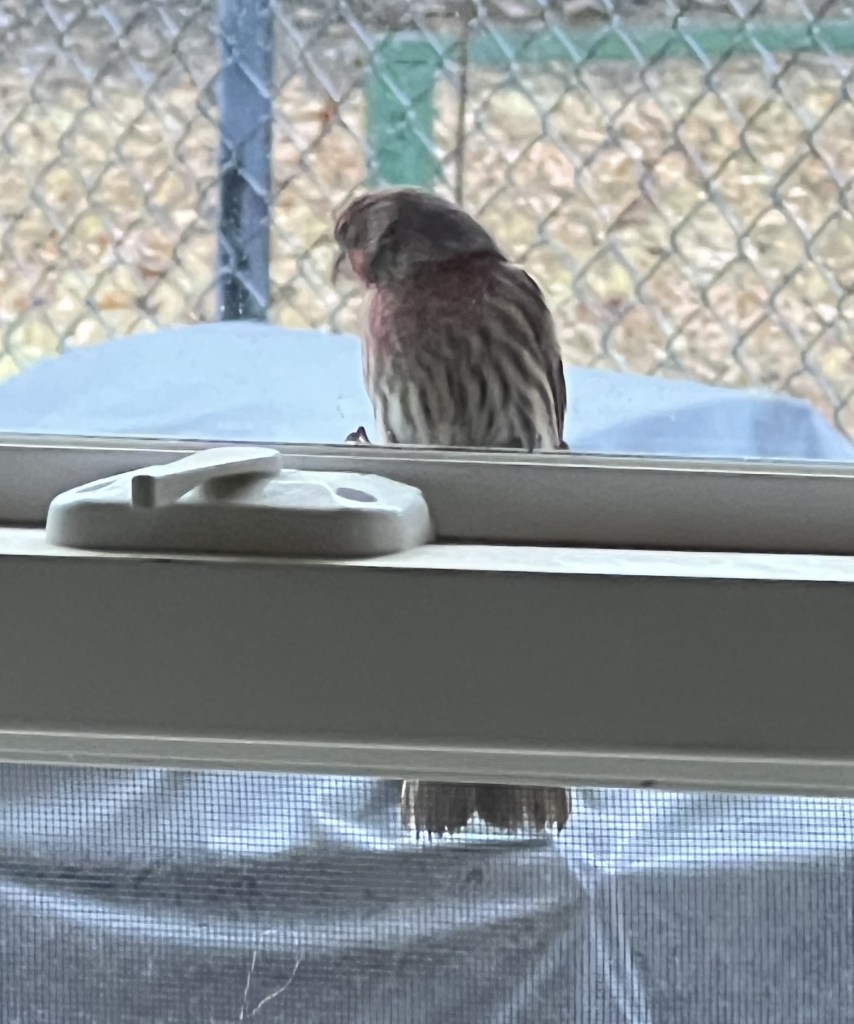
Melissa received a window box bird feeder as a gift from our son and family earlier this year. The feeder has suction cups on the back that allow it to attach directly to the glass. I placed the feeder in the bay window in the breakfast nook that serves as her home office so she can enjoy the bird activity while working. I fill the two sections of the feeder with different seeds to make it more attractive to the small birds willing to approach the window. One side has always had black sunflower seed (Helianthus annuus). I have varied the seed on the other side, but it currently has cracked safflower seed (Carthamus tinctorius). This feeder has become a preference for the eastern bluebirds (Sialia sialis), the sparrows (Genus, Zonotrichia), and purple finches (Haemorhous purpureus) that frequent our back yard. On Sunday I noticed what seemed to be a new species at the feeder. This was similar to the finches I have been watching but somehow seemed different. When I checked my bird ID this turned out to be a house finch.

When I looked online, I found the house finch (Haemorhous mexicanus) is a North American bird in the finch family. The species is native to Mexico and southwestern US but has been introduced to the eastern part of North America and Hawaii and is now found year-round throughout the US and most of Mexico. The house finch is a moderate-sized bird at 5 to 6 inches (12.5 to 15 cm) long, with a wingspan of 8 to 10 inches (20 to 25 cm). Body mass can vary from 9⁄16 to 15⁄16 ounces (16 to 27 g) with an average weight of 3⁄4 ounces (21 g). Adults have a long, square-tipped brown tail and are a brown or dull-brown color across the back with some shading into deep gray on the wing feathers. Breast and belly feathers may be streaked, and the flanks usually are. Most adult males have reddish heads, necks, and shoulders, and the color can extend to the belly and down the back as well. Male coloration varies in intensity with the seasons as it is derived from a diet of berries and fruits. Adult females have brown upperparts and streaked underparts. There are around 40 million house finches across North America, making it the second-most populous finch behind the American goldfinch.

The house finch and purple finch are closely related species and can be hard to identify. The main difference between the two species is the amount of red on the bird and the pattern on the face. They have similar body shapes, but the bill of the purple finch is a bit bigger, more conical, and deeper, while that of the House Finch has a more rounded shape. Both species get along with other small birds except during breeding season when they become protective of their territory. The other big difference comes with habitat. The house finch prefers a wide range of arid, open, and semi-open habitats, and will live in oak-juniper woodlands, open coniferous forests, and shrubby, and desert habitats from sea level to more than 11,000 feet, the house finch avoids dense forest of the purple finch. A small flock of house finch in Long Island, NY, escaped captivity in 1939 and has become the common bird of the eastern US and southern Canada. Their population has grown and expanded to millions of birds that thrive in urban and suburban places, preferring parks and urban settings with conifers and ornamental trees. Their songs are similar, but the purple finch sings a more melodious and “warbling” song, while the house finch incorporates chattering and trilled sounds.

THOUGHTS: Another similarity between the house finch and purple finch is they are both attracted to bird feeders. This explains why I have seen both species (and probably not realized it until now) in our backyard. Neither species is rare, but the house seems more urban and the purple more forest. Nature tells us that when the same species spend enough time separated and/or refusing to interact they grow apart and eventually become distinct. While humans have not yet reached that point as a species, it is a good lesson to be learned. Act for all. Change is coming and it starts with you.

Flat Stanley

October 31, 2024

Last week we received a text from my son saying we would receive a package from our grandson.  His second grade teacher in Washington state started a project for the students to connect with their relatives living in different parts of the country.  The idea was to get responses over the next month and a half by sending a journal to track the progress of his avatar, a two dimensional representation of himself.  When the package arrived, I took pictures of the avatar participating in activities around our house.  He joined the fall pumpkin display, hung out with the succulents on the porch, and spent time in the garden among the tomatoes.  I e-mailed these back to his teacher to share and sent a letter to describe the fun he was having in Arkansas.  As requested, I sent the package along to my sister in Maine for her to do the same.  The project was based on the children’s book character, Flat Stanley.         

When I looked online, I found Flat Stanley is an American children’s book series written by author Jeff Brown.  The idea began as a bedtime story for Brown’s sons, which Brown turned into the first Flat Stanley book published in 1964 featuring illustrations by Tomi Ungerer.  Brown did not continue the series until two decades later, when he published five more books: Stanley and the Magic Lamp, Stanley in Space, Stanley’s Christmas Adventure, Invisible Stanley, and Stanley, Flat Again!  By 2003, the Flat Stanley series had sold almost one million copies in the US and had been translated into French, German, Spanish, Italian, Japanese, and Hebrew.  Brown died in December 2003, but other children’s book authors have continued the series under a new name, Flat Stanley’s Worldwide Adventures.  The Flat Stanley Project began in 1995 under the direction of Dale Hubert, a third grade teacher in London, Ontario, Canada.  The project is meant to facilitate letter-writing between schoolchildren as they document Flat Stanley accompanying them around the world.  The goal of the project is to increase reading and writing skills, as well as teaching children about people and cultures from different places.  In 2008, more than 6,000 classes from 47 countries took part in the Flat Stanley Project.

My grandson’s teacher gave the Flat Stanley project a different twist.  Rather than having Stanley travel around the states, it was a (flat) picture of himself who was to participate in the adventures.  The students begin by reading the book to become familiar with Flat Stanley’s story.  Stanley is flat because a bulletin board had fallen on him, but he was able to overcome this drawback to excel and travel.  The journal will document the places and activities along the avatars’ journeys.  Each student’s journal is to be mailed back to the school with entries from family and friends.  Postcards or letters returned to the class during the project help track the various places their avatars travel.  The project is similar to the traveling gnome prank, except that the Flat Stanley Project has a focus on childhood literacy.  While the project is focused on writing letters, my grandson’s teacher also suggested using email (as well) to assist with quicker travel time.  I wrote in the journal, sent three pictures via email, and wrote a “flat” letter to the class about the wonders of Arkansas. 

THOUGHTS: When I asked my sister if she would participate, she mentioned she had met the Flat Stanley author.  She was with her daughter and entered a café in Maine that had cutouts of Stanley on the tables.  They had read the book, recognized the character, and exclaimed, “Flat Stanley!”  A man behind them answered “Yes?” and identified himself as the author.  Education can be innovative and fun when teachers take time to present learning as more than “just the 3 R’s”.  More critical is for the parents and larger family to participate.  It is one thing to force a child to do math at the kitchen table, it is quite another way to sit with them as they read or do their math tables.  It may not always take a village, but village support certainly helps.  Act for all.  Change is coming and it starts with you.
Beetle

October 30, 2024

Hidden in the back of the front section in yesterday’s newspaper was a USA Today article about Hawaii’s attempts to stop an invasive insect.  According to the Hawaii Invasive Species Council, the invader “jeopardizes the economy, the entire ecosystem, agriculture and food security.”  This species feeds by biting and boring into emerging palm fronds, creating holes in the top of the tree.  While they prefer to feed on coconut, royal, date, and fan palms, they will also feed on hala, taro, banana, pineapple, and sugarcane if the palm trees are unavailable.  The insects are nocturnal and can fly up to two miles if they are looking for food.  The insect attacks a palm at the base of the fronds (leaves) where they are attached to the trunk, bore through the base of the fronds into the center of the crown (the palm heart), and feed on the undeveloped white fronds.  Attacks cause a reduction in leaf area on the damaged fronds and results in a reduction in the number of nuts produced.  Newly planted palms can have their growth point destroyed resulting in the palms death and even mature palms may die after extremely heavy attacks by the coconut rhinoceros beetle.

When I looked online, I found the coconut rhinoceros beetle (Oryctes rhinoceros), also known as Asiatic rhinoceros beetle, is a large species of beetle belonging to the subfamily Dynastinae.  This dynastid beetle has a length of 1.4 to 2 inches (3.5 to 5 cm) and is a dark brown to black color.  The head has a horn which is more prominently developed in males and in larger specimens. The first segment of the thorax (pronotum) has a large central depression with two humps at the hind margin and the tibia of the foreleg has three large teeth.  Male beetles can be reliably distinguished from females as the tip of the abdomen is rounded, shiny, and hairless.  In females the tip is more pointed and densely covered with hair.  The larvae are C-shaped white grubs typical of other scarab beetles.  The beetle breeds in decaying palm trunks or other organic matter (sawdust or compost heaps).  The native distribution of this beetle covers most parts of tropical Asia, but human activity accidentally introduced the beetle to a large number of tropical islands throughout the Pacific.   The beetle has most recently invaded Guam, Hawaii, the Solomon Islands, and Vanuatu.

A virus disease of coconut rhinoceros beetle (Oryctes rhinoceros nudivirus) has turned out to be the most effective natural control agent.  This virus was discovered by Alois Huger in Malaysia in 1963 and was later found to occur naturally in other countries within the native range of the beetle.  The introduced beetle populations in the Pacific and in the Maldives were found to be virus-free.  The virus was introduced into the virus-free populations and caused a significant decline in the beetle population.  The virus mainly effects the adult population and spreads easily, reducing their life span and the fertility of females.  During replanting of palms more breeding sites become available and transmission of the virus is often interrupted, and outbreaks still occur.  There is also evidence of resistance to the virus in some coconut rhinoceros beetle populations.  A fungus (Metarhizium majus) is also effective in controlling the beetles in breeding sites, but it does not spread well by itself.  The fungus does have the advantage that it survives for some time outside its host (as conidia).

THOUGHTS: Use of a virus to control the coconut rhinoceros beetle population is common, and natural biological controls include predators, parasitoids, pathogens, and competitors.  Biological control can have side-effects on biodiversity through attacks on non-target species by any of these mechanisms, especially when a new species is introduced without an understanding of the possible consequences.  Viruses being transmitted to other species (and humans) may cause greater harm than the original problem.  Alexander Pope’s proverbial phrase in 1711 was, “To err is human”.  Even without forgiveness, this is more than an adage.  Act for all.  Change is coming and it starts with you.
Mini Split

October 29, 2024

I have been hinting around about getting a new HVAC system for our porch in my blog for the last week.  The idea began when Melissa and I took a Maine vacation at my sister’s house in July.  They had installed a compact system in their house and had plans for the shop and the “barn” (more like guest dining hall with a two bedroom apartment upstairs).  When I was director of a conference center in Kansas, we used heat pumps for the 30 hotel rooms and found them very efficient.  These were self-contained window units.  We also had a window mounted heat pump in our shop (it was “taken”) that had worked well, and I plan to put another in “sometime”.  My sister had instead put in an outdoor compressor with a wall mounted blower unit.  The glass we installed on the porch works during the winter keeping temps above 32F (0C), but as it continues to drop it dropped to around 25F (-4C).  Many of Melissa’s succulents were not happy.  We decided it was time to get a mini split.

When I looked online, I found Mini split systems are compact heating and cooling systems with indoor and outdoor components that can be installed in the wall to control the temperature of an individual room.  They are often referred to as ductless mini splits since they do not require ductwork to disperse air throughout a home.  A mini split consists of an outdoor compressor unit and one (or more) indoor unit (air handlers) that delivers the air.  The mini split transfers heat between the indoor and outdoor units through refrigerant lines (via heat pump) to either extract or release heat and allows both heating and cooling capabilities in one system.  Ductless mini split systems are increasingly popular due to their efficiency and versatility.  Not only do they eliminate ductwork, but they also provide more efficient heating and cooling by targeting rooms where heating and cooling is needed.  A targeted system provides significant energy savings and lower utility bills verses a conventional central HVAC system.  Benefits of mini split systems are flexible placement, easy and affordable installation, energy-efficiency, and compact design.  This seemed like the way to go on our porch.

On Friday the electrician arrived and installed the connection box from our electrical panel to the outside of the house.  The HVAC person came by at the same time to get final measurements and drill holes from the garage to the porch in preparation for the mini split arrival on Monday.  We arranged to take the kids to the kennel for foot grooming rather than cooping them up franticly in the back bedroom.  The installation went smoothly, and the system was in place by 1 pm.  I picked up the kids and took them for a walk at the lake (always a treat).  When we got home, they ran outside to survey the unit placed on the ground next to the A/C.  After a good amount of sniffing and inspection, they were happy with this new feature in their yard.  When the temps drop below freezing (32F/0C) this winter the succulents will be happy as well.

THOUGHTS: Another outcome of installing the mini split was finding local HVAC and electrical techs.  We even got the two ceiling fans installed that have been sitting on our floor since January.  Both were surprised to learn we were not looking to cool the porch, but to heat it during the coldest parts of winter.  The porch windows are open most of the year to provide circulation.  The new fan and mini split make Melissa happy.  Happy succulents, happy dogs, happy wife, all makes a happy life!  Ok, it takes a little more than that, but comfortable surroundings are a good start.  A recent Pew Research Center survey found 69% of Americans were “very concerned” about the cost of housing, up from 61% in April 2023.  “Affordable” is defined as 30% of household income and 31.3% of US households were cost burdened in 2023, including 27.1% of households with a mortgage and 49.7% of households that rent.  Affordable, comfortable housing should be a right, not a luxury.  Act for all.  Change is coming and it starts with you.
Roasted

October 28, 2024

I have continued to be amazed how productive our Kentucky pole beans (Phaseolus vulgaris, var.) have been this year.  They got a late start as the second sister and tarried through most of the summer, but the cooler temps have brought them on.  I gave my niece a bag of prepared beans on Thursday and picked another 3 cups of prepared beans on Sunday.  While I decided to flash freeze most of the quart bags of green beans for later use, I like the ability to go directly from garden to table.  We had decided to put a mini-split HVAC unit on the porch to protect the succulents this year and while moving the racks on Saturday to allow the technician access I noticed several of the Butternut squash (Cucurbita moschata) I had stored on the racks on the porch had started to rot on the stem ends (obviously too warm).  I ended up throwing two away but the other two were still good.  It seemed this might be a good time to make some roasted vegetables.

When I looked online, I found there are many benefits to making roasted vegetables.  This is not only a fairly hands-off method to prepare them, but you do not even need a recipe, just some good cooking oil and some salt.  Roasting adds a savory depth of flavor only achieved once the amino acids and reducing sugars creates melanoidins (Maillard reaction), the compounds that give browned food its distinctive flavor.  The bit of caramelization and crispy edges also add a textural delight.  Boiled vegetables tend to be mushy somewhat bland, while roasted ones are slightly charred and sweet.  Even salad greens like romaine can be roasted and transformed into more complex and intensely flavored versions of their fresh selves.  The easiest way to roast vegetables is to cut them into similar sized pieces (for uniform cooking), toss them in enough oil to completely coat them.  Lay them out on a baking sheet and sprinkle them with salt and pepper and cook them on the middle shelf in your oven at 400F to 450F (204C to 232C), until they are fork tender and have crisped up at the edges.  The timing varies depending on the hardiness of the vegetables and can range from 10 to 20 minutes for soft yellow squash to up to 60 minutes for carrots and winter squash.  The real length of time varies on how small you dice them.

I diced the squash into 1 inch (2.5 cm) pieces, cut up the last of my Yukon Gold potatoes (Solanum tuberosum, var.), peeled the smallest of my carrots (Daucus carota), and added a medium onion (Allium cepa) to round out the roasted vegetables.  We purchased several seasoning packets from a spice store in Wichita and I added a packet of Tuscan seasoning to three tablespoons of oil to coat the vegetables.  An online recipe suggested it only took 10 to 20 minutes to roast the mixture, but I was skeptical (see above).  I put them in for 15 minutes at 425F (218C) and then checked.  They were not done.  I raised the temperature to 450F (232C) and put them back for another 15 minutes.  They were perfect.  Prior to making the roasted vegetables I made a pot of green beans.  This was another simple recipe, with the beans mixed with two russet potatoes (store-bought and diced), another medium onion, crumbled bacon, and a Southwest seasoning mix.  Melissa made a small corn bread to accent the roasted vegetables.  The whole meal turned out delicious, and most of it was grown by me.

THOUGHTS: The roasted vegetables and pot of green beans were simple to make, but what made the meal truly satisfying was knowing it came (mostly) from my garden.  It was nice to have some wins out of the time and expense put into raising the crops.  Since I waffled on planting a fall crop, this is the time to start thinking about what will go into my garden next year.  Like most of life, this is a process.  Life seems to have times of frustration and times of satisfaction.  The key is to focus on the latter and let the former slide away.  Act for all.  Change is coming and it starts with you.

Long-term

October 23, 2024

I have mentioned how most of my vegetables have matured and stopped producing.  The exceptions are the pole beans (Phaseolus vulgaris) representing the last of my three sisters’ harvest.  They started late but now still provide several cups of beans every few days.  The raised beds are empty except for the 5 rattlesnake watermelons (Citrullus lanatus) struggling to mature, the 2 late starting green bell peppers (Capsicum annuum), and the 2 red okra (Abelmoschus esculentus) that produce beyond their limit.  There are also 8 cabbages that are finally picking up as the temperatures cool.  I really did not expect much from my tomatoes as the heat kept them from much production during the summer (I did get 3 jars of pasta sauce).  The friend I swap gardening stories with said she tore her tomatoes and peppers out several months ago to avoid having to water them.  We are having temperature shifts as the nights get into the 40’s (4.5+C) and the days get to the high 80’s (27+C), causing a resurgence of my San Marzano and plum tomatoes, making me wonder what to expect in long-term production.

When I looked online, I found that depending on their maturation date, “indeterminate” tomato (Lycopersicon lycopersicum) cultivars are the best long-term producers and will yield tomatoes for two to three months.  “Determinate” tomatoes, including dwarf and bush cultivars, typically only yield tomatoes for around two weeks after they blossom.  Tomatoes are grown as perennials in tropical climates and as annuals in USDA plant hardiness zones 2 through 10.  Traditional and heirloom indeterminate tomato cultivars continue to grow taller throughout the growing season and will reach heights of 5 to 8 feet (1.5 to 2.5 m) and typically require support with a wire tomato cage or stakes.  They grow flowers and yield tomatoes from shoots or “suckers” that grow on the sides of their main stem from the time they mature and flower until the first autumn frost.  The best long-term producing cultivars are those that mature early and grow in an area with a long growing season.

Most cultivated tomatoes in my area (zone 7) are planted soon after the last spring frost (c. April 15) and the fruit is expected sometime between 57 to 100 days after the seedling is planted.  If you plant an indeterminate tomato cultivar, you are encouraged to prune the vines regularly to maintain a long harvest of large, quality tomatoes.  I have done this in the past, but I have only done this sporadically this year.  The University of Arizona horticulturalists recommend pruning all but three or four of the shoots that grow in a tangle inside the cage and allow the foliage to protect the fruit from the sun.  If you don’t prune the suckers, these stems consume a lot of a plant’s energy and may result in smaller yields and fewer tomatoes (like I saw).  I did use 4 foot (1.2 m) cages but as the season went on the plants far exceeded that height.  I found out the San Marzano I planted for pasta sauce are a larger variety of plum tomatoes (I planted both) and are some of the better plants in long-term production.

THOUGHTS: As the temperatures dropped, I quit the daily watering I maintained throughout the summer and removed the dying vegetable plants one by one as they ceased production.  A month ago, I was tempted to tear out all of my tomatoes as they had essentially stopped producing fruit but kept them to see what the long-term might bring.  Now they are again producing blossoms and fruit.  I had little to lose when I took a long-term approach in my vegetable garden.  If the plants failed to produce, I would not have been out much in terms of time and water.  Since they did produce, I will reap the benefit of fresh tomatoes into the fall.  Corporations seem less willing to take a long-term approach toward products or employees.  If the product does not make a quick profit, it is dropped.  If the employee does not prove productive, they are let go.  While moving from one product to the next might make economic sense, employees should not be used as expendable.  Act for all.  Change is coming and it starts with you.

Tiger Moth

October 22, 2024

Our enclosed porch serves as a greenhouse for both Melissa’s succulents and a rack during late winter for my vegetable seedlings.  The area is also used to store Melissa’s supplies and the seeds I use to feed the birds.  When I started feeding birds several years ago, I set the bags on the floor.  This worked for several months, but as the weather got colder the rodents that thrived in the tall grass of the lot behind our house were more intent on seeking food and shelter.  While I never saw a house mouse (Mus musculus) or brown rat (Rattus norvegicus), I did have several instances of “something” chewing through the seed bags and spilling the contents onto the floor.  I now have a large 20 gallon (76 l) tub for the larger bags and 3 smaller 5 gallon (15 l) buckets to hold the daily dispersal.  The containers are large enough to contain the seed and have a lid which keeps out the (hopefully) mice.  While cleaning behind the “supplies” behind the feed buckets I found more evidence of mice, but again no actual critters.  What I did find beneath several of the buckets was a brightly colored moth.  When I checked my phone identification it said this was a harnessed tiger moth.

When I looked online, I found the harnessed tiger moth (Apantesis phalerata) is a species of moth within the Erebidae family, first described by Thaddeus William Harris in 1841.  The harnessed tiger moth’s subfamily (Arctiinae) has about 11,000 species of tiger moths divided globally across three tribes.  The harnessed tiger moth is indigenous to North America, with a geographical distribution from Ontario, Quebec, and Maine in the north, to the west in South Dakota, and stretching south to Florida and Texas.  The adult moth has a wingspan ranging from 1.2 to 1.7 inches (30 to 42 mm), and their distinctive black and orange wing patterns earned them the name “tiger” moth.  The tiger moth has a grooved exoskeletal structure (tymbals) on the posterior three segments of the thorax (metathorax) which they use to produce high frequency cicada (superfamily, Cicadoidea) like clicks.  The clicks are a defensive mechanism against predation and for communication during mating.  The lifespan of a harnessed tiger moth ranges from 5 to 10 days after mating.  The moth’s activity period varies regionally, being active from April to September in the southern parts of its range, and from May to August in the northern areas.  My tiger moth was active (at least alive) in mid-October. 

The harnessed tiger moth uses its vibrant colors to serve as a visual deterrent, signaling to potential predators that they are distasteful.  Despite their warning colors, harnessed tiger moths are preyed upon by bats, which rely on echolocation (not sight) to hunt.  This tiger moth is not poisonous, but adults do secrete a liquid to ward off predators that can cause allergic reactions in humans.  The furry body of the caterpillar can also cause rashes and irritation if touched with bare hands.  There are many spiritual meanings attached to the various species of tiger moth and different types of tiger moths hold different gravity in various cultures worldwide.  White-colored tiger moths are seen as a sign of peace and innocence as white is often considered the color of peace. 

THOUGHTS: Two common spiritual meanings are attached to all tiger moth species around their attraction to light.  Some believe spotting a tiger moth is an indication that the person must leave the dark and start embracing the light in their soul.  For other cultures this is a warning that means not to be easily lured by charming deals or things and think rationally before making decisions.  Human decisions are fraught with a similar dichotomy of good and bad.  Roman Emperor Marcus Aurelius, in his Meditations said, “You have power over your mind – not outside events.”  Nietzsche takes the same perspective, affirming the agency of the individual goes beyond good and evil and declares what is “good” and “bad” by what is serving and hindering their own goals.  There are not absolutes, only your reaction to events.  Act for all.  Change is coming and it starts with you.
Amulet

October 15, 2024

I finally got around to going through the items placed in “my bag” when we were clearing out mom’s belongings last year.   These were the items that had “made the cut” when my sister helped her downsize from her two bedroom condo to the one bedroom apartment.  We did not have a lot of time to be out of the apartment, so things were not always carefully distributed.  One particular small basket contained a number of photos of me when I was a child along with something I had no idea what was.  It was an elongated cylinder about 5 inches (12.5 cm) long with three beaded chains hanging beneath it that each held several small charms.  While I did not know what it was, it had obviously held some significance to mom.  Rather than boxing it up for my son to deal with as part of my estate, I decided to post a picture on our sib feed (messenger) and see if anyone knew what it was.  My sister immediately responded this was an amulet to bring good luck to the household given to my parents by the Turkish foreign exchange student they had sponsored.

When I looked online, I found an amulet, also known as a good luck charm, is believed to confer protection upon its possessor.  The word “amulet” comes from the Latin word “amuletum”, or an object that protects a person from trouble.  While I could not find my amulet, I did find several traditional charms popular in Turkish households, including an eye bead or naẓar (Arabic, meaning ‘sight’ or ‘attention’), an eye-shaped amulet believed to protect against the evil eye.  A typical nazar is made of handmade glass featuring concentric circles or teardrop shapes in dark blue, white, light blue and black, occasionally with a yellow/gold edge.  The bead is a mixture of molten glass, iron, copper, water, and salt, all ingredients thought to shield people from evil.  According to Turkish belief, the blue acts as a shield against evil and absorbs negativity.  Blue eyed humans are relatively rare in the Middle East and the Mediterranean, so the ancients believed people with light eyes (particularly blue) could curse someone with just one look.  The Assyrians had turquoise and blue-eye amulets used during the 2nd millennium BCE.

Two years ago (almost to the day) we were in Breisach, Germany, and the Black Forrest.  I had commented at the time on how this forest (and its tales and superstitions) was popularized by the fairy tales of the brothers Grimm.  The quaint towns and villages we passed seemed to be untouched by time, with their cobblestoned streets and traditional half-timbered houses.  As we wound through the countryside, our guide explained how every farmstead carved out among the vales had its own tiny chapel, how crucifix shrines dotted the countryside, and that charms were placed above many doorsills as deterrents for the witches said to proliferate the area.  Winter isolation gave time for stories and the dark foreboding forest gave rise to the imagination.  A trusted amulet or charm was needed by people and houses alike.

THOUGHTS:  An amulet is said to derive its properties and powers from magic, whereas a religious amulet is believed to have no power of their own without faith in Jesus and being blessed by a clergyman.  Amulets are sometimes confused with pendants, or small aesthetic objects that hang from necklaces.  Any pendant may be an amulet, with the difference being that it is believed to protect its holder from danger.  The fear of the unknown is instinctual for humans as we do not possess the fangs of a lion or the claws of a bear.  Feeling safe, we can overcome more powerful things than ourselves.  A modern human amulet is often money or a weapon, but the best protection is still found within the herd.  Act for all.  Change is coming and it starts with you.

Aurora

October 11, 2024

Both the national and local news were abuzz yesterday with predictions of the amazing light displays that were going to appear in the northern sky last night.  This dazzling display of color was the result of a powerful solar storm that slammed into Earth.  This celestial phenomenon is more often a tourist attraction for people traveling to Alaska, Iceland, and regions within the Arctic Circle, but last night’s storm triggered lights in the night sky much further south.  This is the second time a severe solar storm hit the Earth this year, with the first being in May.  My sister lives in Maine and she started the buzz for our family, posting photos on our family feed of the crimson display seen from her back yard.  It was also suggested by the National Oceanic and Atmospheric Administration that the lights were going to be visible as far south as Alabama and northern California.  Reports came in from as far south as Texas and Arizona, while the southern lights were seen in parts of Australia.  As we watched the 10 pm news, there were postings of the aurora from areas of northwest Arkansas.

When I looked online, I found an aurora, commonly known as the northern lights (aurora borealis) or southern lights (aurora australis), is a natural light display in Earth’s sky that is predominantly seen in high-latitude regions around the Arctic and Antarctic.  Auroras display dynamic patterns of brilliant lights that appear as curtains, rays, spirals, or dynamic flickers covering the entire sky.  An aurora is the result of disturbances in the Earth’s magnetosphere caused by the solar wind.  Major disturbances result from enhancements in the speed of the solar wind from coronal holes and from coronal mass ejections that alter the trajectories of charged particles in the magnetospheric plasma.  The particles, mainly electrons and protons, then precipitate into the Earth’s upper atmosphere (thermosphere or exosphere) and the ionization and excitation of atmospheric components emit light of varying colors and complexity.  The form of the aurora is dependent on the amount of acceleration the solar winds impart to the precipitating particles.  Most of the planets in Sol’s Solar System, some moons, brown dwarfs, and even comets can display an aurora.

Melissa and I had taken the bait in May and gone outside to look for the aurora on our back deck.  The TV news had been posting photos taken throughout our state and we wondered if we could see anything.  Our deck is mostly surrounded by trees, but there is a patch of northern sky that is visible.  At the time we had not seen anything.  This time Melissa’s friends began sending photos and we were again lured into the dark.  Melissa used her flashlight rather than the porch lights to keep the area as dark as possible.  When situated she turned off the flashlight and we scanned the horizon.  Nothing.  The night was pitch black with only the faint lights of the city to the north visible.  Then I remembered the lights could often be seen through filters such as a phone camera.  Again, I scanned and horizon.  Nothing.  However, as I looked higher in the sky, I began to see the pink glow above the blue caused by the lights of the city to the north.  We saw the aurora. 

THOUGHTS: Witnessing the aurora goes along with the total Eclipse of the sun as memorable celestial events for Melissa and me during 2024.  The contrast between the blackness seen by the naked eye and the colors seen by the camera were amazing.  While ancients watched the skies and considered such events as omens or predictors of the future, but this aurora would have gone unseen in the past.  The problem with celestial predictions, is they portend “something”, more so than “a thing”.  History predicts the coming elections in the US will bring some sort of change.  While that may be an easy prediction for modern pollsters, the last two elections have proven the “what” is far less known.  Change happens, but humans can play an active role in what that change is going to be.  Work for positive change.  Act for all.  Change is coming and it starts with you.