Holiday Travel

November 23, 2025

Melissa and I decided to go two days early for our trip up the Danube River and set our flights to arrive on Sunday prior to embarking Tuesday afternoon.  Our 11:30 am flight meant we began our trip taking the kids for boarding on Friday evening.  Loki has recently become frantic with visits to the Vet and again became frantic as we dropped him off at the kennel.  I watched as he got past the first door and by the second he was straining to get inside.  That made me feel better about leaving the kids for an extended visit.  Saturday began with a 1-1/2-hour drive to our connecting airport, a two hour wait for the plane to depart (customs was a breeze), and another 1-1/2 hours to arrive in O’Hare.  Since we had a 4-hour layover, we proceeded to the airlines lounge.  This was a first for us and I was pleased with the comfort, food, and drink offered for free (for members).  We sat as a steady stream of people came in and out, while another steady stream was turned away without the proper credentials.  We had planned on early travel as flights in the US have been disrupted by the government shutdown, but our greater concern was the potential crush of holiday travel. 

When I went online, I found US airlines are predicting another record Thanksgiving holiday travel season.  Airlines for America, a lobbying group representing the largest US carriers, predicted Thursday that airlines will carry more than 31 million people between Friday, November 21, and Monday, December 1.  The busiest days are expected to be the Sunday after Thanksgiving (30th), with about 3.4 million people flying, and the Monday after Thanksgiving (31st), with around 3.1 million passengers.  The airlines have expressed relief after the longest-ever government shutdown ended November 12th.  Shortages of air traffic controllers delayed and canceled flights, disrupting travel plans for some 6 million people.  The industry is pushing lawmakers to pass legislation to ensure that air traffic controllers are paid in the event of another shutdown.  The latest bill only funds the government through January, so industry members are hoping to avoid a repeat of the closure just before winter break and spring break seasons begin.

We arrived at our hotel in Budapest after 20 hours of holiday travel.  This included two drives (car 1-1/2 hours and taxi-1 hour), two layovers (6 hours), two short hops (O’Hare – 1-1/2 hours and Budapest – 1 hour), and an overseas flight to Munich (9 hours).  We were tired but thankful the trip had been relatively easy.  We had purchased economy plus (for legroom) on the overseas flight.  I got up several times to go to the restroom (actually to stretch my legs) but it was still uncomfortable.  We were both exhausted when we reached the hotel and after check-in decided to eat in the hotel bar.  We ordered a cheese and meat plate along with a variety of humus dips.  I was so tired during the meal I almost fell asleep.  By the time we went to our room it was 5:00 pm local time, but we decided it was late enough to go to bed. 

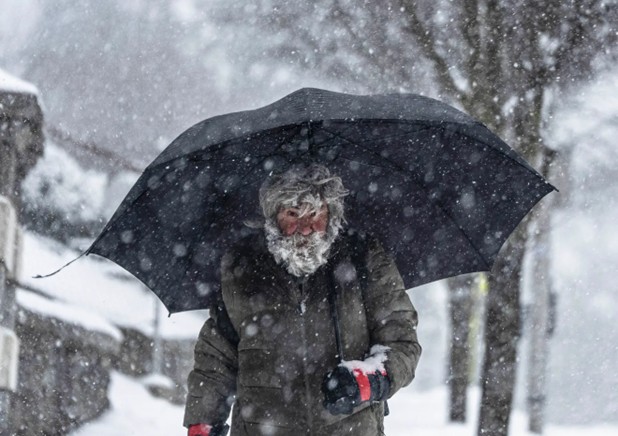
THOUGHTS: You have got to love holiday travel.  I went right to sleep but woke with horrific cramps in my left calf.  Apparently, I had not moved enough on the flight.  I looked at my watch, and it said 8:20.   Even though the blackout curtains were pulled it seemed like there should be morning light coming through from outside.  That was when Melissa told me I had only been asleep for an hour.  Since I was wide awake, I wondered how I was ever going to get through the night.  Then I realized in my new time zone it was still early.  I putzed around for a couple of hours and then went back to bed.  Even as I bemoaned the difficulty faced arriving at my trip destination, I realized how easy it was compared to earlier travelers.  It took four to six months to cover the 2,170-mile (3,490 km) to traverse the Oregon trail by wagon and 20,000 to 30,000 people died (1 in 10).  I guess cramps are not all that bad.  Act for all.  Change is coming and it starts with you.
Seed Bank

November 21, 2025

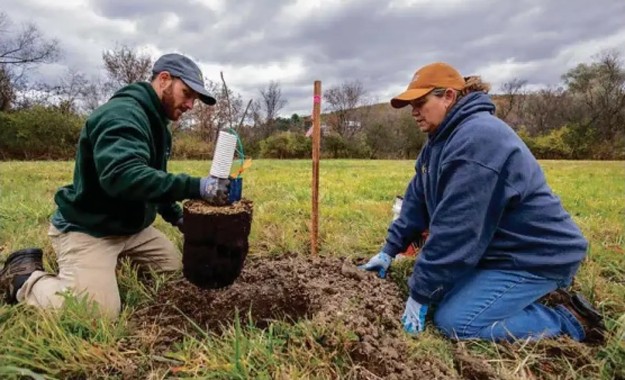
Today’s NYT The Morning scroll included a link to photos and an article from Times photographer Ruth Fremson about an island used to gather seeds to replace parts of the deforested Amazon forest.  The Brazilian government built a hydroelectric dam fifty years ago and flooded 100s of 1,000s of acres of rainforest along the Tocantins River and transforming a mountainous peak into an island.  That island now supplies seeds to replenish deforested areas and preserve native species throughout the Amazon.  Workers arrive by boat and scale towering trees to reach the fruit that contains the seeds which are then donated to schools, government agencies, and farmers.  The owner of the dam, AXIA Energia, said it compensated the 32,000 people displaced by the project and uses the seed bank to replenish areas throughout the Amazon.  Workers gathered almost nine million seeds last year and are on pace to far exceed that amount this year.  Their seed bank stores about 30 million seeds in one of three chambers (cold, humid, and dry).

When I went online, I found the worlds’ largest seed bank is the Svalbard Global Seed Vault, a secure backup facility for the world’s crop diversity on the Norwegian island of Spitsbergen in the remote Arctic Svalbard archipelago.  The vault provides long-term storage for duplicates of seeds from around the world, conserved in gene banks.  This provides security of the world’s food supply against the loss of seeds in gene banks due to mismanagement, accident, equipment failures, funding cuts, war, sabotage, disease, and natural disasters.  The vault is managed under terms spelled out in a tripartite agreement among the Norwegian government, the Crop Trust, and the Nordic Genetic Resource Center (NordGen).  The Norwegian government entirely funded the Seed Vault’s KR$45 million (US$8.8 million in 2008) construction cost.  Norway and the Crop Trust pay for operational costs and storing seeds in the vault is free to depositors.  As of June 2025, the seed bank conserves 1,355,591 accessions, representing more than 13,000 years of agricultural history.

Another Amazon Basin living seed bank is located at Camino Verde in the richly biodiverse region of Madre de Dios in Peru.  This resource grows over 400 species of native trees and plants, and some with often incredible properties little-known to science.  Camino Verde sits alongside the Tambopata River, whose basin is one of the richest ecological areas on the planet.  It is home to native (endemic) species of birds, reptiles, and mammals, along with at least 1,255 plant species.  However, the unique biodiversity of this region has been disappearing over the past decades.  In 2020, Peru recorded its highest levels of deforestation in history, with a total of 502,296 acres (203,272 ha) of Amazonian forest lost due largely to logging and mining.  Since 2001, almost 741,3161 acres (3 million ha) have been deforested.  Similar deforestation is taking place across the tropics both legally and illegally.

THOUGHTS: I do not have a seed bank, but Melissa did buy me several 100 packets of seed two Christmases ago.  I used several varieties that first year and then replanted some of the leftover seeds again this year.  Most seed packets state the year of intended use and many also list minimum germination standards and usual seed life.  Seeds that have been stored in a cool, dry place are generally viable for at least a year past the season for which they were packaged and may be good for up to five years.  I realize I do not have the perfect conditions required for a seed bank, but I was surprised by how many of the seeds were not viable.  My “survival seed packets” are still sealed in airtight packaging intended to keep them viable for longer periods.  The oldest viable seed ever planted and successfully grown is a 32,000-year-old narrow-leafed campion (Silene stenophylla) found in the Siberian permafrost. Preserving seeds for the next year is another step toward being sustainable.  Act for all.  Change is coming and it starts with you.
Lady Beetle

November 20, 2025

Last week Melissa and I were in a wooded area along the Arkansas River when we were inundated by flying insects.  Many species overwinter as adults sheltering in culverts, under bridges, or cavities in trees.  In the spring they will wake up and get along with starting the next generation.  Other than the short cold snap last week, we have been having nice weather this fall so these fliers may not have even begun the process.  Hibernating adults are also known to come out on unseasonably warm days.  The temperature was uncommonly warm (high 70’sF/25+C) so it would not have surprised me to find some insects buzzing around, these were literally everywhere.  I do not believe I have ever seen so many Asian lady beetle in one place.

When I went online, I found a lady beetle or ladybird (Harmonia axyridis) is a species commonly known as the harlequin, Asian, or multicolored Asian lady beetle.  This is one of the most variable lady beetle species in the world with a wide range of color forms.  The species is native to eastern Asia and has been artificially introduced to North America and Europe to control aphids (family Aphididae) and scale insects (Superfamily, Coccoidea).  It is now common and spreading in those regions and has also been established in Africa and across South America.  Individuals are beetles in shape and structure, being domed and having a “smooth” transition between their wing coverings (elytra), thorax (pronotum), and head.  It ranges from 0.22 to 0.34 inches (5.5 to 8.5 mm) in size.  The common color form is orange or red with 0 to 22 black spots of variable size.  The bright color makes the species conspicuous in North America and may be known locally as the Halloween beetle as they often invade homes during October to overwinter.

The Asian lady beetle is considered one of the world’s most invasive insects, due in part to their tendency to overwinter indoors.  They have an unpleasant odor and stain left by their bodily fluids when frightened or crushed, along with a tendency to bite humans.  In Europe they are increasing to the detriment of indigenous species as its voracious appetite enables it to outcompete (and consume) other ladybugs.  The Asian is highly resistant to diseases and carries a microsporidian parasite (it is immune) that can kill other lady beetle species.  Native ladybug species often experience dramatic declines from the invaders.  They were declared the fastest-invading species in the UK in 2015, spreading throughout the country after the first confirmed sighting in 2004.  The Asian lady beetle has been reported to be a minor agricultural pest that has been inadvertently harvested with crops in Iowa, Ohio, New York State, and Ontario.  This causes a detectable and distinctly unpleasant taste known as “lady beetle taint”.  The contamination of grapes by the beetle has also been found to alter the taste of wine.

THOUGHTS: Various methods of control have been tried where the Asian lady beetle has been introduced, causing a threat to native species, biodiversity, and to the grape industry.  These include insecticides, trapping, removal of beetles, and mechanically preventing entry to buildings.  The best methods for dealing with the Asian lady beetle in private homes involve sealing openings they enter and sweeping or vacuuming if they are inside.  Placing a nylon stocking inside the vacuum cleaner’s hose and securing it with a rubber band keeps the beetles from collecting (and being crushed) inside the machine.  Despite the dozens of beetles that landed on Melissa and me we were not bitten.  I have been bitten before and it was a sharp (but not lasting) pain.  Once again importing a species to get rid of another caused more problems than it solved.  Act for all.  Change is coming and it starts with you.
Citrus

November 19, 2025

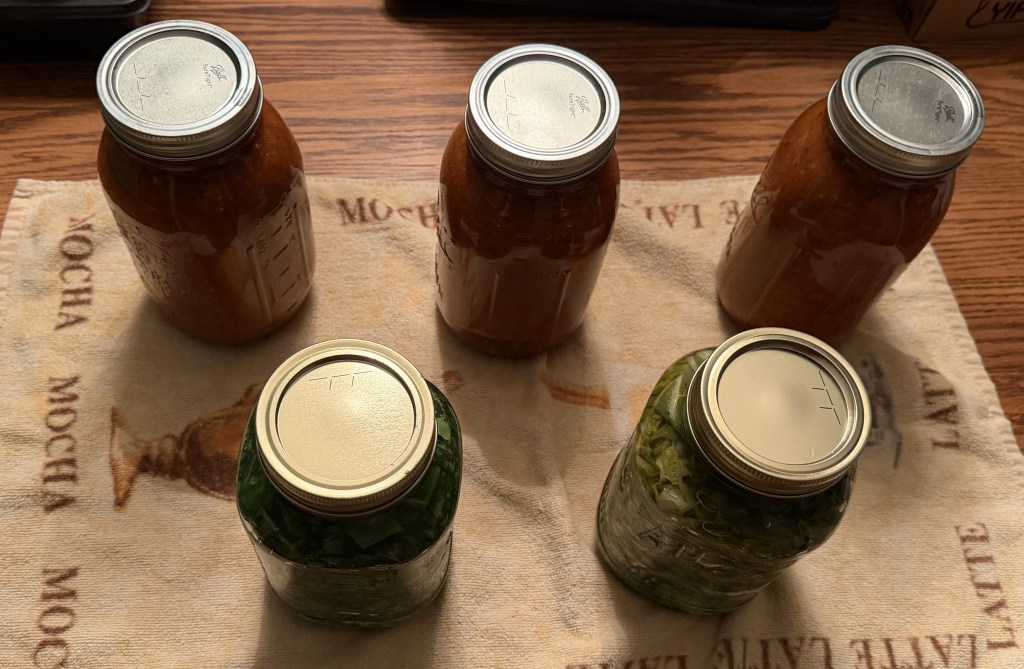
I have been winterizing my garden for the last several weeks.  That means taking down the trellises for storage and removing what is left of the plants.  I mentioned how I tore out the tomato (Solanum lycopersicum) vines in mid-October, resulting in 14 jars of salsa verde.   I did keep three vines on the off chance the fruit would ripen but gave up on them last week.  While I did have several fruits that had begun to ripen, most were solid green.  I was surprised as several more of the green tomatoes have ripened on the counter.  I harvested one head lettuce (Lactuca sativa) that grew, and we ate it as a salad last night.  The one spinach (Spinacia oleracea) that grew will become a wilted spinach salad for tonight along with fried green tomatoes.  I blanched the ripe/partially ripe tomatoes and froze them to make pasta sauce later.  I still have six cabbage (Brassica oleracea) I am holding out for sauerkraut.  They have yet to form a head so they will probably not make it before the frost.  Only about a third of the second crop peas (Pisum sativum) grew and are now producing pods.  We will finish them this week.  This year I am also trying another tact to preserve my citrus trees.

When I went online, I found Citrus is a genus of flowering trees and shrubs in the family Rutaceae that produce fruits.  Citrus is native to South Asia, East Asia, Southeast Asia, Melanesia, and Australia where indigenous people have used and domesticated various species since ancient times.  Citrus cultivation first spread into Micronesia and Polynesia through the Austronesian expansion (3000 to 1500 BCE), later spread to the Middle East and the Mediterranean (1200 BCE) via the incense trade route, and then from Europe to the Americas.  Citrus fruits are renowned for their fragrant aromas and complex flavor and are among the most popular fruits in cultivation.  The plants tend to hybridize between species making their taxonomy complicated.  The numerous varieties cover a wide range of appearance and fruit flavors.  Many important citrus crops have been developed through extensive hybridization, including oranges (Citrus macroptera), lemons (Citrus limon), grapefruits (Citrus paradisi), and limes (Citrus aurantiifolia) which all have many cultivars.

Two years ago, I purchased two citrus trees (limon and lime) hoping to grow my own fruit.  These were 4 feet (1.3 m) tall, and the seller suggested I might even get a few fruits that first year.  While the lime never fruited, the limon did have one fruit that I used for zest.  I had placed them in pots seated on rolling carriers to move them inside as I did not think they would survive the winter.  It proved impractical to move them indoors, so I bought protective covers to keep out the frost.  Citrus trees are evergreen and keep their foliage year-round, but stress from sudden temperature drops, low light (especially indoors), or lack of humidity can cause them to shed leaves.  When I removed the covers in late winter the leaves and most of the branches were dead.  I thought they had completely died, but they both began to sprout new stems by the spring.  This year I am putting them in the garage to protect them from the bitter cold.  Now to get them some light (grow lamps?).

THOUGHTS: It made more sense why my citrus trees died when I found out they were evergreen.  While some leaves may fall, they still need sunlight, water, and moderate temperatures.  Covering them deprived them of sunlight and never watering them dried them out.  Melissa told me when we return from our trip, she will make room on the sunporch so they can winter with the succulents.  I am hopeful they will continue to thrive under these conditions.  Much like my citrus trees, humans also need the right conditions to survive.  That includes adequate food, safe water, and protection from the elements (clothing and shelter).  A study focusing on low- and middle-income countries suggests 4.4 billion people lack safe drinking water and the WHO found 1 in 4 lack safe access to water.  We need to find another tact.  Act for all.  Change is coming and it starts with you.

Volatile

November 17, 2025

It seems hard to believe that last week I was protecting the pipes in our RV from a hard freeze.  The temps dropped to 28F (-2C) on consecutive nights.  While it did warm up to the mid 40’sF (7C) on both afternoons it was still a cause for concern.  I did not winterize the water lines and tanks since we are still hoping to take a trip around Christmas.  Our mechanic told us the lines in our Sunseeker are contained inside the compartment and there are water heaters to keep the tanks warm.  I turned on the water heater, set the tanks to Arctic mode, and turned the inside furnace to 60F (15.5C), its lowest setting.  After a brief spell, the temperatures warmed again.  Two days later it climbed back to 80F (26.6C) and our unit had survived its first test.  The temps have stayed in the 70’s+F (21+C) this week, although they will dip just as we leave for another extended trip at the end of the week.  While the wildflowers in the front bed did not survive the chill, the clematis (Clematis var. “The President”) on the back fence decided to burst into bloom.  Is it just me or does the weather seem more volatile?

When I went online, I found the weather is becoming more volatile.  This includes rapid temperature swings and increases in atmospheric instability due to a warmer, moister atmosphere.  According to climate scientists and studies global warming is a primary driver, making the atmosphere more unstable and extreme events more common.  Studies show the frequency and intensity of extreme weather are increasing, and this trend is expected to continue.  An increase in low-level moisture content and warmer air temperatures have significantly increased atmospheric instability over the past 40 years.  This makes the weather volatile with more frequent and intense “climate whiplash” or rapid temperature changes, which give little time for adaptation.  This volatility contributes to a rise in extreme events such as record-breaking heatwaves, more intense rainfall, and more powerful storms.  The world’s oceans are at the highest temperatures recorded in the last 1,000 to 2,000 years, which can fuel more extreme weather.  A study in Nature noted rapid intensification rates in the Atlantic have resulted in an increase for hurricanes since 1971.

While most changes to address the volatile nature of the weather require systemic shifts, there are some things individuals can do to prepare.  Pay attention to local weather forecasts and heed warnings for extreme events like flash floods.  Encourage your community to plan for volatility by designing resilient infrastructure will be better equipped to handle extreme events.  Understand your local flood risk and take steps to prepare, as weather patterns are changing.  Lori Peek, director of the Natural Hazards Center at the University of Colorado, said, “Infrastructure is aging in our country and is more vulnerable given the fact that there are just simply . . . more people living in harm’s way.”  This is true for the wildfires of California, the floods of the Midwest, and the hurricanes of the east coast.  None are going to go away on their own.

THOUGHTS: The US is responding to this volatile weather with mass layoffs and cuts to the agencies that study climate and help warn and deal with disasters.  Workers at the Federal Emergency Management Agency, the National Weather Service, and research labs at the National Oceanic Atmospheric Administration and the US Geological Survey are also leaving and taking their expertise with them.  It could take years to make up for this brain drain.  The country needs to plan for worst case scenarios and build infrastructure to lessen the effect.  The dinosaurs did not know the comet was going to strike.  We know but need to act.  Act for all.  Change is coming and it starts with you.
TV

November 13, 2025

The 2021 C class RV we purchased this summer had a TV mounted inside, but it was an older model.  This was a special 40-inch (101.6 cm) RV TV built to withstand the vibrations and temperature changes of being on the road and had a 12V power option that was connected directly to the house batteries for use when not plugged into shore power.  We were told a regular TV might not handle the constant shaking or the temperature and humidity fluctuations.  Melissa did quite a bit of searching online and in the RV Facebook group she frequents and determined a regular smart HDTV would be adequate for our use.  She also checked the dimensions of the cab and found the space would easily accommodate up to a 55-inch (139.7 cm) TV.  We have purchased several TVs over the last several years, including two 70-inch (177.8 cm) screens at the conference center where I was director.  Each time we found the best (or comparable) deals were from the big box store.  Last week I decided it was time to bite the bullet and purchase a new TV.  When I walked into the store, I was confronted with a display featuring a 100-inch (254 cm) screen TV.

When I went online, I found a 100″ TV should be placed in a room with a viewing distance of roughly 8 to 11 feet (2.5 to 3.4 meters) away from the viewers.  The center of the screen should be at eye level when seated, or around 42 inches (105.7 cm) from the floor, and positioned so viewers are facing it directly with minimal glare from windows or lights.  For a more cinematic experience, use the Society of Motion Picture and Television Engineers (SMPTE) or THX (Thanks) recommended 30-to-40-degree field of view, which means sitting closer or about 9.7 to 11.18 feet (2.9 to 3.4 m) away.  Arrange your furniture so that viewers are directly in front of the TV, within a 30-degree angle of the screen and use curtains or blinds to block direct sunlight and position the TV to avoid reflections from lamps or other light sources.  Finally, ensure there is enough space for people to walk around comfortably and to avoid blocking the screen.

It was clear our RV did not have the space to hold the 100-inch screen, let alone the distance away to provide a clear picture.  The 50-inch TV we wanted suggests a range of 4.2 to 6.3 feet (1.3 to 1.9 m) which is perfect for seating in the camper dining area.  The previous owners had removed the bench and table seating and replaced it with fabric covered chairs and ottomans.  We replaced these with a faux leather reclining loveseat that was more comfortable and provided more room for the kids on the floor.  The box store had a variety of other TV sizes, so I walked back to the row of 50-inch TVs. There were three different brands and several levels of picture quality.  After a text discussion with Melissa (she had done the research) I settled on a 50-inch 4K QLED Smart TV that is streaming and Bluetooth ready.  We have determined a way to run a power strip to the TV which will run off the generator if we are off grid (boondocking).  Now all I have to do is install the TV.

THOUGHTS: The THX designation on a smart TV refers to sound quality rather than picture and is an acronym for “Tomlinson Holman’s eXperiment”, a company founded by Tomlinson Holman and George Lucas.  The name is also a nod to the 1971 George Lucus film, THX 1138.  “Thx” is also a common abbreviation for “thanks”, used as a casual way to express gratitude in texting and online communication.  Other common texting abbreviations include LOL (laughing out loud), BRB (be right back), IDK (I don’t know), IMO (in my opinion), FYI (for your information), OMG (oh my God), ASAP (as soon as possible), BTW (by the way), TBH (to be honest), and LMK (let me know).  An acronym is a word formed from the first letters of other words that can be pronounced as a single word.  If you are familiar with the media or field, they make sense.  Language can be a way to both communicate and exclude others.  Act for all.  Change is coming and it starts with you.
Squash

November 12, 2025

Following a second night of hard freeze (28F/-2C or lower for several hours) temps are forecast to be in the 60’sF (15.5+C) and 70’sF (21+C) for the next week or two.  I had removed the sheets covering the last vegetables during the day between the freezes but permanently removed them yesterday as the daytime temps will remain well above freezing until we leave for a trip later in November.  By that time any 2nd crop vegetables that are going to produce fruit will have done so.   I already have a few peas (Pisum sativum), and the cabbage (Brassica oleracea) is beginning to curl into heads.  My garden activity got me motivated to make something with the butternut squash (Cucurbita moschata) I harvested several weeks ago.  The two ways I prefer to eat squash are roasted or in a cream soup.  I had a variety of vegetables in the refrigerator to go along with the squash, so I decided to make both.  

When I went online, I found squash, or Cucurbita (Latin ‘gourd’) is a genus of herbaceous fruits in the gourd family, Cucurbitaceae (also known as cucurbits or cucurbi), native to the Mesoamerica and the Andes.  The five edible species are variously known as squash, pumpkin, or gourd, depending on species, variety, and local jargon.  Other kinds of gourd, called bottle-gourds, are native to Africa and belong to the genus Lagenaria.  These are in the same family and subfamily as Cucurbita but in a different tribe.  The young fruits of bottle gourds are eaten like those of the Cucurbita species while the dried gourds are used as kitchen utensils.  There is debate about the taxonomy of the genus and the number of accepted species varies from 13 to 30.  The five domesticated species are Cucurbita argyrosperma, C. ficifolia, C. maxima, C. moschata, and C. pepo, all of which are called winter squash because the full-grown fruits can be stored for months.  Most squash species are herbaceous vines that grow several meters in length and have tendrils.  The yellow or orange flowers are either female (fruit) or male (pollen).  While botanical fruits, squash are cooked and eaten as vegetables.

I make my squash soup differently than most recipes (surprising, right?).  They suggest roasting squash and onion (Allium cepa) and adding it to a base of chicken broth and cream.  Nutmeg (Myristica fragrans) and sage (Salvia officinalis) then give the soup a sweeter taste.  I begin with roasting but add other vegetables and forego the spices.  Yesterday I roasted a sheet of baby carrots (Daucus carota), green bell peppers (Capsicum annuum), cauliflower (Brassica oleracea), potatoes (Solanum tuberosum), and red onions at 425F (218C) for 20 minutes to let them caramelize.  Next, I placed four small squashes, cut in half and seeded, on a sheet with salt, pepper (Piper nigrum), and olive (Olea europaea) oil.  I added a half cup of water (steam) and roasted them for 45 minutes.  During the last 20 minutes I added the same vegetables (minus the potatoes) to another sheet to roast.  I added the vegetables to the cream and broth base and used a hand mixer to puree the vegetables.  Melissa likes chunkier soup, so I did not make smooth puree.  I tasted the soup, and it seemed bland.  Melissa suggested more salt (tried to be low sodium) and black pepper (Piper nigrum) along with red pepper (Capsicum annuum) flakes.  That made it.

THOUGHTS: Melissa and I enjoyed the squash soup yesterday.  I kept some of the extra in a bowl for later this week and the rest went into a freezer bag, along with the two freezer bags of first batch roasted vegetables.  These went into the freezer for later meals.  Canning and freezing have become my go-to for excess produce and even leftovers.  While I enjoy the dishes I make, they are often too much for the two of us.  I also share as much as I am able with neighbors or the local food bank (produce).  Residential and community gardens can make a difference for those who face food insecurity.  Act for all.  Change is coming and it starts with you.
Iguana

November 11, 2025

Credit…Daniel Mulcahy

The Morning Read of the NY Times feed included an article on a possible reprieve for a previously invasive reptile species.  Biologists say DNA evidence proves the lizard landed on Clarion Island nearly half a million years ago, long before any humans might have transported them from the mainland.  Researchers reported the discovery last month in the journal Ecology and Evolution, and the finding means that the animals should be able to continue living on Clarion Island, a remote, mostly uninhabited Mexican archipelago in the Pacific Ocean.  There are around 100 iguanas there, and scientists and locals alike assumed that they had been introduced by humans in the late 20th century because they had gone unmentioned in prior accounts of the island’s fauna.  “It was all speculative that they were introduced — no one ever tested it,” said Daniel Mulcahy, an evolutionary biologist at the Museum of Natural History in Berlin who is an author of the new study.  The government was planning to exterminate the invaders to protect island’s delicate ecosystem.  Mulcahy and his colleagues compared mitochondrial DNA, passed down maternally, from the Clarion iguanas and the mainland spiny-tailed iguanas and found a 1.5 % difference in their DNA.  That meant these spiny-tailed iguana are genetically distinct and could not be recent invaders.

When I went online, I found the spiny-tailed iguana (Ctenosaura pectinata) is a species of is a species of iguanid lizard found in eastern Mexico and extreme western Guatemala.  This iguana has distinctive keeled scales on its long tail, to which its common name refers.  It is one of the larger members of the genus Ctenosaura, capable of growing to 4.3 feet (1.3 m) in total length (including tail), with females being slightly smaller than males at 3.3 feet (1.0 m).  It usually has a brown or grey-brown colored back (dorsally), with a yellowish underbelly (ventral surface).  It has a crest of long spines which extend down the center of its back.  Mating generally occurs in spring with the male showing dominance and interest by head bobbing before chasing the female until he can catch her and subdue her.  Within eight to ten weeks, the female will dig a nest and lay clutches of up to 24 eggs which hatch in 90 days with the babies digging their way out of the sand.  Hatchlings are often bright green with no body pattern and juveniles are typically green with brown markings, although all-brown hatchlings have been recorded.

Some wonder how a 4-foot (1.2 m) black-and-yellow lizard went unnoticed on Clarion Island for decades.  Clarion’s landscape has changed dramatically in recent years. The island was covered in prickly pear cactus (genus, Opuntiathat) that made exploration difficult, but was consumed by sheep (Ovis aries) and pigs (Sus domesticus) introduced by thew Mexican Navy in the 1970’s.  Those animals are gone and a shrubland community (chaparral) remains.  The iguanas are wary of humans and hide when approached.  The destruction by sheep and pigs underscores the damage invasive animals can cause.  Island ecosystems are particularly vulnerable.  Rayna Bell, an evolutionary biologist at the California Academy of Sciences said, “This type of work is fundamental to conserving some of the world’s most unique and imperiled diversity.”  Mulcahy’s colleagues are working to spread the news to government officials in Mexico to stop the eradication program.

THOUGHTS: The spiny-tail iguana is a traditional food in Mexico, listed as “Least Concern” by the IUCN Redlist, but the species is listed on the Mexican Red List as threatened and it is illegal to hunt them.  Their presence on Clarion suggests a 700-mile trip on a floating mat of vegetation.  It would be the second-longest known iguana aquatic journey, topped by another species of iguanas traveling 5,000 miles from North America to Fiji.  Humans thought the 1947 Kon-Tiki expedition was amazing.  We are always outdone by nature.  Act for all.  Change is coming and it starts with you.

Screwworm

November 10, 2025

The Sunday before Halloween, the Homes section of my local newspaper ran a Reutters article detailing a new sterile fly plant added in Mexico.  In Metapa, Mexico, engineers, veterinarians, and entomologists are racing to repurpose a plant that will play a pivotal role in trying to eradicate the flesh-eating fly threatening the country’s cattle industry and raising tensions with the US.  The facility used to help control Mediterranean fruit flies, but workers are dismantling old infrastructure and rebuilding specialized laboratories designed to mimic the conditions of an animal wound.  The plant aims to be ready by July 2026 and would double the number of sterile flies Mexico can release into the wild.  The US has kept its border mostly closed to Mexican cattle imports since May 2025 and has invested US$21 million towards the US$51 million facility in Chiapas state in an effort to keep the screwworm fly out of America.

When I went online, I found the New World screwworm fly (Cochliomyia hominivorax), or simply screwworm, is a species of parasitic blowfly which is present in the New-World tropics.  The screwworm larvae (maggots) eat the living tissue of warm-blooded animals.  Of the four species of Cochliomyia, only the species hominivorax is parasitic, but a single parasitic species of Old-World screwworm fly is placed in a different genus (Chrysomya bezziana).  The maggots of many fly species eat dead flesh and may occasionally infest an old and putrid wound.  Infestation of a live vertebrate animal by the screwworm maggot (myiasis) is unusual because they attack healthy tissue, increasing the chances of infection, which then attracts more flies.  Screwworm females lay 250 to 500 eggs in the exposed flesh which hatch and burrow into the surrounding tissue as they feed.  If the wound is disturbed during this time, the larvae burrow or “screw” deeper into the flesh, giving the larva its common name.  The maggots can cause severe tissue damage or even death to the host.  About three to seven days after hatching, the larvae fall to the ground to pupate, reaching the adult stage about seven days later.  The female will mate four to five days after hatching and can lay up to 3,000 eggs and fly up to 120 miles (200 km) during her life.  Males mate up to ten times, but females mate only once and retain the male’s sperm for life, leading to the sterile eradication technique.

The screwworm was the first species to be tested with the sterile insect technique and resulted in control and systematic eradication of the species from the US, Central America, and parts of the Caribbean beginning in the 1950’s.  The US and Mexico bred and released more than 94 billion sterile flies from 1962 to 1975.  By the early 2000’s, it was considered eradicated from North America, but was detected in Mexico in 2024 and 2025, prompting renewed efforts to prevent its re-emergence.  The fly is still widespread in tropical and subtropical parts of the Caribbean and South America and animals imported from these areas must be inspected or treated to prevent the pest’s reintroduction.  Eradication efforts continued and in 1998 the first sterile flies were released in Panama with the goal of creating a barrier zone at the Darién Gap against a screwworm invasion.  This is achieved through weekly sterile screwworm releases of up to 50 million insects bred in factories and sterilized by ionizing radiation.  The bred insects must not suffer any impairment to compete with wild, fertile insects.  In September 2025, a case of New World screwworm was found in Sabinas Hidalgo, Mexico, less than 70 miles (110 km) from the US-Mexico border.

THOUGHTS: When sterile screwworm males’ mate with wild females no offspring are produced, and the population collapses over time.  Coordinator Jose Luis Quintero said, “The screwworm was eradicated once before in Mexico — it took 19 years.  We hope to do it in far less time.”  Let’s hope that is the case.  Act for all.  Change is coming and it starts with you.

Freeze

November 08, 2025

The front page of yesterday’s local newspaper ran a USA Today article telling gardeners how to prepare for the impending cold snap.  The first frost in Arkansas’ River Valley usually takes place around November 5.  Scot Covert, chief meteorologist at KFSM-TV, said we will be a little late this year, “we’re looking at Monday the 10th.”  Even before temperatures dip to 32 F (0C), frost can form in low lying areas like gardens (raised beds?) as plants cool faster than the surrounding air.  Randy Forst, extension educator with the University of Arkansas Division of Agriculture, said, “All indoor tropical plants and house plants should be moved into an area that does not go below 35 degrees.”   If you do not take this precaution, it is likely they will freeze.

When I went online, I found that a freeze will damage vegetables by causing ice crystals to form and expand inside the plant which ruptures the cell walls.  A freeze can cause visible damage like wilting, blackening, or water-soaked areas in the leaves.  While most vegetables are negatively affected by freezing (while in the ground), root vegetables and cabbages (brassicas) can become sweeter after a light frost as the cold converts their starches to sugars.  After they thaw, freeze-damaged vegetables are often softer and mushier than their fresh counterparts.  A hard freeze (28F/-2C for several hours) can kill plants outright.  That is particularly true for warm season crops like tomatoes (Solanum lycopersicum) and peppers (Capsicum annuum).  Freezing halts the growth of microorganisms but does not stop all enzymatic activity, which can lead to a loss of quality over time.  That is one reason to blanche your fresh vegetables before placing them in the freezer.

Forst went on the say cool-season vegetables that can tolerate a freeze should be covered to prevent leaf-tip burn.  A bigger concern during this time of year is drought.  Arkansas does not tend to get the moisture needed to keep outdoor plants hydrated.  You need to water outside plants if it does not rain at least once a week.  Outdoor perennials can also use extra care.  Once a frost happens you should clip back the dead foliage and then cover the crown with a biodegradable mulch.  Annuals that bloom during the cool season should continue to receive a water-soluble fertilizer once a month.  Four types of action should be taken to aid your garden and outdoor plants.   Once the temps fall below 40F (4.4C) houseplants should be moved inside.  On clear, calm nights vegetables should be covered if the temps will get into the mid-30’sF (1.6C), then be sure to uncover them when temps rise back into the 40’s+F (4.4+C).  Outdoor plants should be watered weekly if there is low rainfall.  Finally, mulch any perennials after the frost kills the top growth.  These actions will aid your plants’ regrowth the following spring.  I had better cover my plants tomorrow.

THOUGHTS: My vegetables are not the only thing I need to protect against a freeze.  We purchased a used C class RV and it is now approaching our first winter.  Everything I have read extolls the virtue of winterizing the unit if you are going to store it during the cold months.  Part of the process involves draining and pouring food grade antifreeze into the lines and tanks.  Once I do this, I cannot use the RV until I again drain and flush the lines.  While I should just bite the bullet and shut the unit down, I have wavered to the point where it is almost too late.  Our repair person told me the lines are enclosed within the vehicle so I should be fine turning on the water tank heaters and the furnace set low to keep everything warm.  The freeze is set to only last two nights and then it will warm up to the 70’sF again.  I hope I do not regret this decision.  We often delay action until it is too late.  We must address our environmental and communal issues/disagreements now rather than later.  Act for all.  Change is coming and it starts with you.