Leak

July 17, 2024

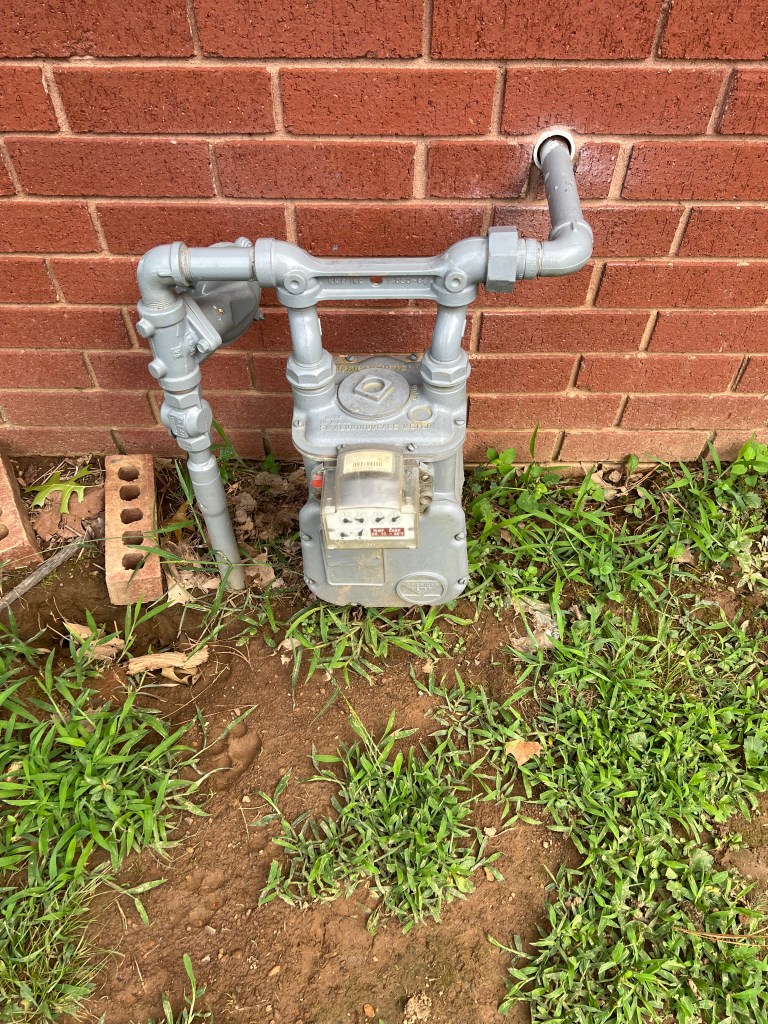
I had taken the kids to the park for a walk and when I got home, I was met by an obvious odor.  I had smelled the odor before when I accidentally left the burner on our gas stove partially on.  I had also noticed the smell when I was working in my office earlier in the day and the air conditioner kicked on.  I had gone to the garage and checked the furnace and water heater closet but had not smelled anything out of the ordinary, so I did not worry.  On my return from the park the smell seemed to be stronger.  I rechecked the stove to make sure the burners were off and asked Melissa about the smell.  She mentioned how she had had a headache all day and wondered if that was not the problem.  She had worked for the local gas distribution company and suggested I should call them and see what we ought to do.  I was sure we must have a gas leak.   

When I looked online, I found methanethiol (also known as methyl mercaptan) is an organosulfur compound with the chemical formula CH3SH that many gas companies add to natural gases and propane to help homeowners detect a dangerous leak.  The safety data sheet (SDS) is a document that lists information relating to occupational safety and health for the use of various substances and products in commercial settings.  The SDS lists methanethiol as a colorless, flammable gas with an extremely strong and repulsive smell (similar to rotten eggs).  At very high concentrations it is highly toxic and affects the central nervous system.  Its strong odor serves as a warning when the gas is in dangerous concentrations.  An odor threshold of 1 ppb has been reported, but the OSHA Ceiling Limit in the US is listed as 10 ppm.  This gas is a natural substance found in the blood, brain, and feces of animals (including humans), in plant tissues, and occurs naturally in foods like some nuts and cheese.  It is one of the chemical compounds responsible for bad breath and the smell of flatus.  

There are more than 77 million natural gas customers (residential, commercial, and industrial) in the US according to the American Gas Association, accounting for 32.2% of all energy consumption in 2021 (the latest year with full data).  The majority of times gas is used without incident but when a gas leak occurs it can be hazardous.  When I called the gas company, they told us to avoid open flames or vapes, open our windows, and immediately get out of the house and wait for the technician to arrive.  They assured me he was already in our neighborhood, and it would not take long for him to be here.  We opened the house and then corralled the kids and went outside to wait on the back patio.  It took less than 10 minutes for the technician to arrive.  He told me they had opened a new storage well at 10 am that morning and the smell and complaints had been coming ever since.  He Immediately registered the presence of gas on his meter when he entered the house.  He then checked our furnace and water heater compartment, along with the gas stove, and said there was not a leak.  He recommended we continue to keep the windows open to allow the smell to dissipate and call if we still had concerns.  I was glad today’s temperature had dropped back to 90F (32C).

THOUGHTS:  During the 1990’s I was trained as a 2nd responder emergency person while I lived in California’s Bay Area.  Part of our training concerned checking for a gas leak after a catastrophic event like an earthquake.  Due to the danger posed by natural gas, only trained professionals should attempt to diagnose the location or correct a leak.  Our job was to make sure the gas was turned off in buildings that had been impacted by the event.  We were told that several years ago the 2nd responder groups in the LA area (California) had responded following an earthquake.  They had dutifully gone out and turned off the gas lines for 1000’s of homes in the affected area, whether there was a leak or not.  It took the gas company weeks to get their customers back online.  At times a little knowledge can be worse than no at all knowledge.  Act for all.  Change is coming and it starts with you.

False Mermaid

July 16, 2024

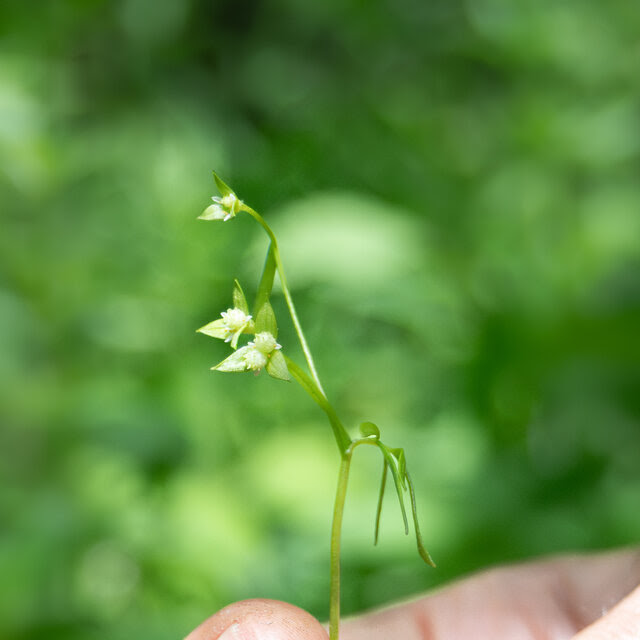
Last month my NY Times online feed reported on the discovery of a species of plant thought to have been extinct in Vermont since 1916.  Vermont state botanist Grace Glynn has been searching for the species for years but the spring-blooming herb with dainty flowers has always eluded her.  That changed on May 7th when Glynn was surveying turtle habitat and was sent a picture.  When she opened the photo. she saw the elusive flower in the corner of the frame.  Glynn then visited the site where the photo was taken in the state’s rural Addison County and found hundreds of false mermaid-weed sprigs on both public and private land.  Vermont Department of Fish and Wildlife (VDFW) called the discovery “BOTANICAL BREAKING NEWS,” in a Facebook post announcing the find.  The Department said it was not surprising that the flower had gone undetected for over a century as each individual plant is “absolutely tiny” with flowers that are “as small as the head of a pin”.  Even when trained experts are searching for the plant can be easily overlooked.

When I looked online, I found false mermaid (Floerkea proserpinacoides) is a monotypic genus of plants in the meadowfoam family containing a single species.  Other common names are false mermaid-weed and floerkea.  This tiny wildflower is native to many parts of North America, where it is found in moist areas, such as shady forests.  It is a fleshy, annual herb which grows short stems which may lie flat on the ground, tangle into a clump, or grow somewhat erect.  The foliage is hairless and shiny.  The leaves are divided into many oval-shaped, pointed leaflets up to 0.79 inches (2 cm) long.  The flower is a cup of pointed green sepals containing three tiny white spoon-shaped petals and a bunch of stamens with yellow anthers.  Growing in the center of the flower are the two to three fruits, which are bumpy, spherical nutlets.  False mermaid only emerges for a short time from late April to early June and is referred to by botanists as an “ephemeral” plant.

Botanists suspect false mermaid-weed populations have suffered because of extreme flooding, invasive species, and human development.  This rediscovery is “a sign that good stewardship by landowners and conservation organizations really can make a difference,” according to the VDFW.  The last botanist to document false mermaid-weed in Vermont was a woman named Nellie Flynn, who collected 22,700 plants from around the world during her lifetime.  Glenn found herself reflecting on the past.  “Nellie Flynn was probably the last person to ever touch this species in Vermont back in 1916.  And I always think about how there are just these threads through history that kind of tie you to other botanists, and it just adds depth and richness, I think, to an already rich story.”  The plant’s state rank in Vermont has now been updated from possibly extinct and missing to “very rare and critically imperiled”.  Glynn plans to send some of the plant’s seeds to a seed bank in Massachusetts that preserves native New England species.  The work of Vermont botanists is far from finished as they still have another 600 or so rare and uncommon native plants to search for (and conserve) throughout the state.

THOUGHTS:  The 2024 discovery of false mermaid-weed is not the first time an unusual plant has been found in Vermont.  In May 2022, a citizen scientist discovered nine specimens of a federally threatened orchid, known as the small whorled pogonia (Isotria medeoloides), in Chittenden County. This was the first time anyone had seen the plant since 1902.  Life has a remarkable ability to survive amid the worst of human conditions.  How much more could survive if we would take concerted steps to preserve it.  Act for all.  Change is coming and it starts with you.
Starfish

July 14, 2024

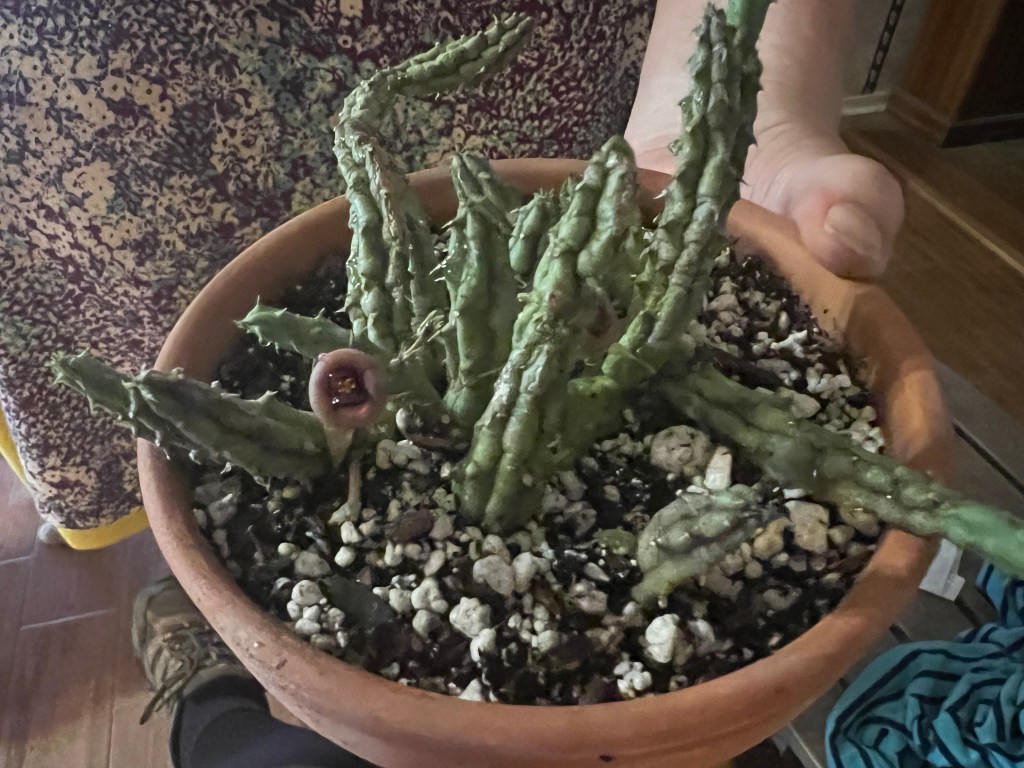
I was working in my office yesterday when Melissa brought in one of her succulents.  This was from a stem cutting she had obtained from a grower friend in California two years ago.  She had replanted and cared for it, moving it from the house to the porch to shield it from the extremes of Arkansas’ heat and cold.  Melissa was excited because it had a star-shaped bloom on one of the new stems that had grown from the original cutting.  She mentioned it usually takes two to three years for flowers to form on cuttings from the original.  The friend’s plant had grown to a large amorphous mass.  The succulent is easy to grow but is not common in the US as it is native to Africa.  The common name for this succulent is the African starfish flower.

When I looked online, I found the African starfish flower (Piaranthus decipiens), also known as carrion flowers locally, is a succulent native to Namibia, Botswana, and South Africa.  The plant gets its common name from the flower that grows in the appearance of a marine starfish (class, Asteroidea).  The plant grows in sandy and rocky soil, and usually under small bushes around the northern and eastern edges of the driest parts of the Kalahari Desert.  The starfish has horizontal (decumbent) stems with tubercles mainly joined into four angles along the stems and forms diffuse mats that may reach a diameter of 3.3 feet (1 m).  The stems are dull green to grey and are often mottled with purple.  They have a distinctly narrow base and grow up to 6 inches (15 cm) long and 0.8 inches (2 cm) thick.  Each tubercle is initially tipped with a small, narrowly deltoid (triangular) leaf rudiment that dries out and persists for a while as a whitish husk.  Flowers are produced in small numbers towards the tips of the younger stems and open simultaneously or with long intervals in late summer or fall.  They are up to 1.2 inches (3 cm) in diameter, usually brown becoming paler in the tube and with low rounded nipple-like structure (papillae), each with a small bristle.  The scientific name for the starfish flower was formerly Huerniopsis decipiens after the genus (Huerniopsis) was created with this flower as the single species by N. E. Brown in 1878.  Another species was later transferred to Huerniopsis in 1937, and both were distinguished by their absence of an outer corona on the flowers.  Both species were revised in 1994 as part of the genus Piaranthus.

More interesting than the scientific back and forth naming of the starfish flower is the origin of the locally (southern Africa) common name of carrion flower.  The flowers emit a very sweetish-nauseous odor that locals describe as having the smell of rotting meat.  The corona-lobes secrete a sweet fluid copiously upon their backs and sides.  The cultivators of the flower found this smell is strongest during the evening, and by the next morning it had almost disappeared, leading to the assumption the plant is fertilized by a late evening flying insect in the wild.  The flowers may open at the same time or with long intervals in late Summer or Autumn.  The starfish on our porch found the right conditions in the heat of mid-summer, but that might resemble the cool of the Kalahari.   

THOUGHTS:  The starfish flower lives on the edge of one of the driest deserts in the world.  The harsh desert environment has resulted in adaptation by the plants that thrive there.  Plants use a lot of energy and reserves producing flowers for pollination and in a desert environment where water is scarce.  Pollinating insects (bees, ants, moths) are in short supply, so plants produce colorful flowers to attract the scarce pollinators.  The starfish flower blooms and then quickly dies to reserve energy.  The carrion smell entices flies not normally associated with pollination.  Everything in nature is designed to propagate the species and not the individual.  While that is also the design for humans, it is sometimes ignored.  Act for all.  Change is coming and it starts with you.
Leaning

July 11, 2024

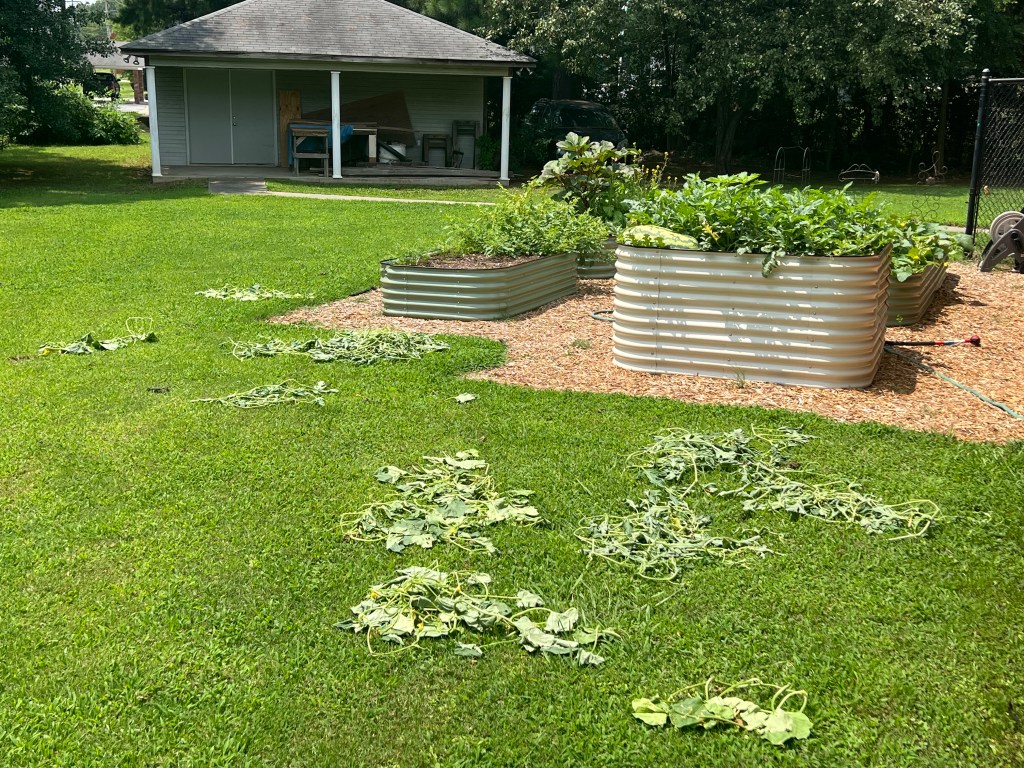
I was heartsick when I came out to water my three sisters beds yesterday.  I have mentioned how few of the corn seeds I initially planted had sprouted (@40%).  I replanted additional seed and allowed it to (mostly) resprout before moving on to planting the pole beans (Phaseolus vulgaris) as the second sister, and then a week later adding the winter squash (Cucurbita moschata) to provide ground cover as the third sister.  These combination beds had been progressing nicely, even surviving the excessive heat in my absence.  The corn was producing ears, the beans were climbing, and the squash was spilling out across the four beds.  That came crashing to a halt when I came out to find most of the corn stalks lying on the ground.  My first thought was it was the work of my arch enemy, the nine-banded armadillo (Dasypus novemcinctus) that had helped itself to the melons I had tried to grow in the same bed for the last two years.  I have fenced the beds this year (for Loki) and I could not find any sign of invasion other than the downed corn stalks.  That left the other conclusion that the corn had suffered from lodging.

When I looked online, I found leaning (or lodging) of the corn plant occurs when the plant essentially bends or ‘lays down’ without the stalk breaking.  Although this symptom looks devastating, it often causes only minimal damage.  The majority of plants will re-orient themselves upright, and if this recovery occurs prior to corn pollination, little impact on pollination success will be observed.  Corn plants have been shown to upright themselves fairly quickly (in 3 to 4 days) after an initial wind event when they are in the rapid growth phase. However, if a plant cannot reorient itself properly, some leaves can become shaded and a reduction in photosynthesis can occur.  If the damage occurs near the beginning of pollination, the leaves of any neighboring, lodged plants may shade some of the exposed silks and cause poor pollination.  “Root lodging” can occur with strong winds and high soil moisture levels that results in corn roots being pulled out of the soil.  Root-lodged corn plants that are still in the vegetative phase of growth and within the process of stalk elongation can recover by bending or “goose-necking” to become upright again. However, the later in the vegetative growth period lodging occurs, the less flexibility the stalks have to reorient themselves properly, and the greater chance that pollination and yield will be impacted.

I had never heard of lodging, even though I have seen it in some of the corn fields in Kansas after a high wind event.  Not knowing it “might” spring back up on its own, I tried to right the stalks and prop dirt around them for added support.  When I came back out to water this morning, several of the stalks were down again and others were again leaning.  This time I placed rebar stakes next to the plants and tied them off with plant tape.  I hope that between their natural urge to right themselves and the assistance provided by the stakes they will continue to grow and produce.  They all have ears, although none are near to being ripe.  We will see.

THOUGHTS:  As I thought about the leaning event, I am glad this did not happen while the neighbor girls were watering.  I am sure they would have thought it was because of something they had (or had not) done.  Since I did not know of the syndrome, I probably would have thought to blame them as well.  We appear to be living in a time of chaos and when destructive events happen the urge is there to “blame someone”.  There is no one to blame for my leaning corn.  It is a normal part of nature and the shifting climate.  While blaming may make us feel better, it does not resolve the problem.  And it can have negative impacts on our feelings and treatment of “the other”.  Act for all.  Change is coming and it starts with you.
Turquoise

July 10, 2024

Mom had given most of her possessions away to family when she downsized prior to moving into assisted care.  She also took care to give a special necklace from her collection to each of the great grandkids who visited in hospice care, along with the story of its acquisition.  That still left dozens of pairs of earrings, necklaces, and bracelets representing “special times” in her life.  None of us knew what to do with the remaining collection, but since Melissa was also a jewelry collector, she was given the remainder to sort through and distribute “as you will”.  When our family got together in Maine these last weeks it brought up questions about mom’s jewelry and wondering if select pieces were still available as they held a memory or attachment.  When we got home, Melissa and I perused the collection to see if we could find the cherished items.  My sister had asked about a pendant and earrings mom had purchased while on vacation in the American southwest.  The stones were from a mineral called white buffalo turquoise.

When I looked online, I found white buffalo turquoise (howlite), is a calcium borosilicate hydroxide (Ca2B5SiO9(OH)5) mineral found in water-soluble sedimentary mineral deposits (evaporite).  Howlite was first discovered near Windsor, Nova Scotia, in 1868 by the Canadian mineralogist Henry How who had been alerted to the unknown mineral by miners in a gypsum quarry.  How called the mineral silico-boro-calcite, but it was quickly renamed howlite by the American geologist James Dwight Dana.  The rare howlite crystals are small (1/3rd inch or1cm in maximum size), and are only found in a few places in the world.  The most common form is irregular nodules resembling cauliflower.  The nodules are white with fine grey or black veins in an erratic web-like pattern.  Howlite is commonly used to make decorative objects such as small carvings or jewelry components, and because of its porous nature is often dyed to imitate other minerals, especially turquoise.  In its natural state, howlite is sold under the trade names of “white turquoise” or “white buffalo turquoise” and is used to produce jewelry similar to the blue to green turquoise (CuAl6(PO4)4(OH)8·4H2O) associated with the jewelry of the American southwest.   

Varieties of the unrelated gemstone turquoise which are white instead of the typical blue or green color have been mined in the US states of Arizona and Nevada and are marketed as “white buffalo turquoise”.  The blue turquoise is found in only a few places on earth, and the world’s largest turquoise-producing region is the southwest United States.  Turquoise is prized for its attractive color, often an intense medium or greenish blue, and its ancient heritage.  While turquoise is used in a number of styles, it is closely associated with southwest and Native American jewelry.  Some turquoise contains a matrix of dark brown markings, providing a contrast to the gemstone’s bright blue.  Most of the white varieties of turquoise are chalk-like with a Mohs hardness of 1 and are not as hard or durable as howlite and require stabilization in order to be used in jewelry.  This has resulted in white buffalo turquoise (howlite) being more popular in jewelry than the artificially stabilized white turquoise.

THOUGHTS:  Native Americans in the Southwest used turquoise for personal adornment reflecting the cultural diversity and history of its makers.  Native American tribes and artisans continue to develop distinct aesthetics rooted in their personal artistic visions and cultural traditions of their tribes.  Adornment became an important element of Indigenous communication and conveyed many levels of information.  Later, jewelry was used as a signal for resistance to assimilation.  Today, it remains a statement of tribal and individual identity.  Indigenous peoples around the world create jewelry to stay connected with their past.  Act for all.  Change is coming and it starts with you.
Mess O’ Greens

July 09, 2024

When we got back from our Maine vacation, I was anxious to see how my vegetables had faired.  I was surprised to find only a few tomatoes ripe on the vine but figured my watering crew had helped themselves to the ripe fruit (I was right).  The cantaloupe I was waiting on to ripen was missing for the same reason, but four green ones had replaced it, so it was just a matter of time.  The beets (Beta vulgaris) had continued to mature, and the rutabaga (Brassica napus) was ready to harvest.  I thinned the larger beets and then went ahead and harvested the rutabagas.  I love pickled beets and enjoy the radish like taste of rutabaga in salads and on their own.  I chopped the tops off and trimmed and washed the root tubers.  Rather than throwing away the tops of the beets and rutabagas (as I had done many times) I saved them.  That left me with a large “mess o’ greens” for a Southern style meal.

When I looked online, I found a mess o’ greens are a time-honored tradition in southern kitchens.  Greens have held an important place on the southern table for well over a century and there is no other vegetable that is quite so unique to the region.  Greens can refer to any sort of cabbage in which the green leaves do not form a compact head.  They are most often made from kale, collards, turnip, spinach, mustard greens (all varieties of Brassica oleracea), and even my beets.  Collard greens are vegetables that are members of the cabbage family but are a close relative to kale.  Although collard greens are available year-round, they are at their best from January through April.  In the Southern states, a large quantity of greens to serve a family is commonly referred to as a “mess o’ greens.”  The exact quantity that constitutes a “mess” varies with the size of the family.  A traditional Southern meal may include pan-fried chicken, field peas (such as black-eyed peas; Vigna unguiculata), greens (such as collard greens, mustard greens, turnip greens, or poke sallet), mashed potatoes, cornbread or corn pone, sweet tea, and dessert, typically pie (sweet potato, chess, shoofly, pecan, or peach), or cobbler (peach, blackberry, or sometimes apple in Appalachia). 

Having not grown up in the South, I had never eaten anywhere near to a mess o’ greens in my life.  The closest I had ever come was when my mom (occasionally) served canned spinach (sorry popeye, not to my liking).  I decided to turn to the southern chef I had married to find out what I had been missing.  The meal we ate was meatless (as is common) with the exception to the bacon fat and bits used to sauté the greens.  Melissa made cornbread baked in an iron skillet and then served with honey.  Next came the buttery mashed potatoes served without gravy (a rarity for me).  The final treat was the mess o’ greens.  I learned that the stems were cut from the leaves, chopped, and sautéed with garlic and onion.  This mixture was later added to the leafy greens and sautéed together.  While this was not the “meat and potatoes” I had grown up with in the Midwest, it was good.

THOUGHTS:  Many of the recipes I found for a mess o’ greens suggested using several varieties of greens to create a nuisance of flavors.  I was also able to use the sauteed stems as a pasta topping and plan to use the remaining greens in lieu of spinach in a breakfast casserole.  One result of my attempt to create subsistence gardening is I am eating more vegetables (and in a wider variety of ways) than before.  That is probably a good thing.  Learning to cook with the vegetables I grow is interesting and satisfying.  It also gives me suggestions on what to grow (and how much) next year.  This is another way to decrease my carbon footprint.  Act for all.  Change is coming and it starts with you.
Angel

July 03, 2024

One of the places I visit when in Maine is the Wildlife Park located just outside of Gray.  The park is home to over 30 species of Maine wildlife that cannot be returned to their natural habitats.  Some of the animals were injured or orphaned, while others are human dependent after being raised (often illegally) in captivity.  The Maine Department of Inland Fisheries and Wildlife game wardens and biologists team up to bring the animals to the park where they can safely receive the specialized care they need.  My sister packed lunch and then loaded the two granddaughters (grandnieces) and I into the car for the short ride to the park.  School is out and the day camps are in full swing, so we shared the space with three large groups of campers in addition to the family groups that frequent the park.  I immediately noticed signs advising me not to feed the wildlife.  They are on a specially controlled diet and feeding could adversely affect them.  While such signs are often posted at zoos and wildlife areas, I notice another sign asking visitors to stay away from the geese.  Most of the Canada geese (Branta canadensis) in the park are afflicted by a condition called angel wing and are ornery.

When I looked online, I found angel wing, also known as airplane wing or drooping wing, is a syndrome that affects aquatic birds of the family Anatidae (geese and ducks).  The syndrome causes the last joint of the wing to twist so the feathers point out laterally instead of lying against the body.  The syndrome is acquired in young birds and develops in males more than females.  Angle wing is the result of a high-calorie diet, especially one high in proteins and/or low in vitamin D, vitamin E, and manganese, causing one or both wrist joints (carpus) to be delayed in development relative to the rest of the wing.  It is not known why but if only one wing is affected it is usually the left one.  The afflicted wrist is twisted outwards and unable to provide lift (flight).  Symptoms include stripped flight feathers (remiges) in the wrist area, or remiges protruding at odd angles.  In extreme cases the stripped feathers resemble blue straws protruding from the wings.  Angel wing is incurable in adult birds and usually leads to an early death (predators) as the birds are effectively flightless.  Young birds may recover by wrapping the wing and binding it against the bird’s flank, along with feeding the bird a nutritionally balanced diet to reverse the damage.

While the angel wing geese are more visible around the park, the main attraction is the moose (Alces alces) housed in a large and forested enclosure.  Maine’s moose population is second only to Alaska, and many Maine visitors dream of spotting a moose exploring the state (as do I).  Seeing a moose in the wild requires both patience and “being in the right place at the right time”.  Moose can be seen if you spend hours around swampy bogs or cruise remote logging roads at dusk if you are lucky.  The surefire way is to stop at the Wildlife Park.  Even here the moose was hard to detect, sitting still next to a its protective shelter at the back of the enclosure.  Many of the animals that find their way to the Wildlife Park are eventually released to their natural habitats. “We only keep those that have some sort of condition that keeps them from being viable in the wild,” Maine Wildlife Park Superintendent Curt Johnson explained.  Animals that cannot be rehabilitated educate visitors about Maine’s diverse native mammals, birds, and fishes.

THOUGHTS:  Although many associate Maine with lobster (and lobster rolls!), the Official State Animal of Maine is the moose.  Since 1992, the Maine Wildlife Park has received no state tax dollars and relies on admission fees, donations, and creative revenue sources.  Maine has 35 state parks, public reserved lands, and state historic sites.  Tourism accounts for nearly US$6.5 billion dollars in Maine and is one of the state’s largest industries, supporting more 17% of the state’s jobs (116,000).  I am not the only one wanting to see a moose.  Act for all.  Change is coming and it starts with you.
Oyster

July 01, 2024

One of the fun things about vacationing in the summer is the food and drink festivals that happen somewhere every weekend.  When we arrived, we saw signs advertising an event in Freeport, Maine.  While Freeport is only 17 miles (27 km) from my sister’s house, that meant 40 minutes in Maine driving time.  There is no “straight shot” and the twisting roads average around 40 mph (64 kph) driving speed.  I wanted to go to Freeport anyway as this is the headquarters and outlet store of L.L. Bean.  L.L. Bean is a retail company founded in 1912 by Leon Leonwood Bean specializing in clothing and outdoor recreation equipment.  On Saturday we borrowed the car and took off on the way to the festival (including a short patch of dirt road).  We arrived around noon on the first day of the festival to find it in full swing.  Parking was hard to find, but it was hardly more than usual as the Bean outlet is surrounded by other outlets and specialty shops located in the three-square block area of town.  After finding a place to park, we made our way to the Maine Oyster festival.

When I looked online, I found the Maine Oyster Festival is celebrating its third year in Freeport.  Organizers of the event say Maine is now home to more than 150 oyster farms and dozens of these sea farms joined mobile shuckers to serve oysters harvested from up and down Maine’s coastline.  The festival is not only a celebration of the oysters, it also celebrates the people who farm them.  Adam Augulewicz, of the Spinnaker Shellfish Company said, “We love trying to get people into the industry.  It’s a good industry to be in.  It’s fun, it’s pretty laid back, we’re all just looking to make a good product for our customers.”  The L.L. Bean hosted event included live music, oyster farm tours, an oyster of the year ceremony, a professional shucking contest, and opportunities for tasting raw, broiled, and fried oysters.  Although it seemed lightly attended, “a good time was had by all.”

Oyster harvesting represents the highest-volume production of shellfish in the country, with 42 million pounds (19,050,879.5 kg) of oysters harvested in 2019 alone, according to the Fisheries of the US report.  While an oyster lover might have the palate to detect the differences between East Coast and West Coast oysters, the nuances of the varieties run deep.  In addition to the range of oysters around the country, each oyster-producing region offers different growing conditions that can impact the size, shape, texture, and flavor of the oysters.  The environmental factors that affect the oyster crop are like the terroir (French term) used to describe the environmental factors on the wine crop.  For oysters this is termed “merroir,” as it refers to the marine and not terrestrial environment.  Exploring and comparing the flavors across multiple regions is part of oyster tasting.  While the Oyster Festival featured Maine oysters, the nuances between areas were still evident.  The Freeport Oyster Festival started as the Maine clams and the Massachusetts oysters are both moving north due to warming sea water.  Prediction says the clam harvest will end up moving to Nova Scotia, Canada.

THOUGHTS:  Melissa and I arrived two hours after the start of the first day of the Oyster Festival.  We immediately bought our tasting tickets and tried out one vendor.  We toured the booths (oyster related products and art) and sat sipping a drink before deciding to taste again.  I stood in line (30 minutes) to get a noodle stir fry while Melissa went for raw oysters.  Three of the vendors were already out of oysters and she gave up.  We thought this odd as the festival still had 5 hours before it closed that night.  We stood in a fourth line and were finally able to cash in all our oyster tickets.  The second batch did not seem as good as the first, but that may have been in part because of the sour taste already in our mouths.  Many sea and land plants and animals are being forced to migrate to new locations to find environments suitable to survival.  Merely being in “the water” does not mean they are safe.  Act for all.  Change is coming and it starts with you.
Browntail

June 29, 2024

When Melissa and I arrived in Maine we were immediately warned not to touch any furry brown caterpillars we see crawling in the brush.  While the larvae do not bite or sting, their presence can trigger a range of discomforting reactions due to the hairs (setae) they possess.  These tiny hairs contain toxins that can evoke pain, itching, and discomfort.  We were warned it is essential to quickly recognize the symptoms from such encounters, ranging from redness and swelling to itching and burning sensations.  While the reaction generally dissipates within a few hours or several days, the severity of the response varies from person to person.  My great-nieces showed us the rash left by the caterpillars and nearly everyone in the families had stories to tell of chance encounters.  It seemed even the dropping of the adult moth can cause skin irritation and bumps, commonly known as white bumps.  These brown hairy caterpillars are the larval stage of the browntail moth.

When I looked online, I found the browntail moth (Euproctis chrysorrhoea) is a moth of the family Erebidae native to Europe, neighboring countries in Asia, and the north coast of Africa.  The moth’s life cycle is atypical, as it spends approximately nine months (August to April) as larvae (caterpillar), leaving about one month each for pupae, imagos, and eggs.  The larvae are covered in hairs and two red spots on the back (toward tail) distinguish the browntail from similar hairy moth larvae.  The adults have white wings and a hairy white body with a tuft of brown hair at the tip of the abdomen.  Females lay one egg cluster on the underside of a leaf of a host plant with around 200 eggs.  The species feeds on many different species of trees (polyphagous) including pear, apple, maple, and oak.  Larval feeding causes reduction in growth and occasional mortality for the host plant.  The species was accidentally introduced into Somerville, Massachusetts from Europe in 1897, and by 1913 had spread to all the New England states and northward into New Brunswick and Nova Scotia in Canada.  Populations have since slowly decreased due to natural controls until the 1960’s, when the browntail moth was limited to Cape Cod and a few islands off the Maine coast in Casco Bay, but populations are again building in Maine and are found in patches along the coast and up to 60 miles inland from the western Maine border to the New Brunswick border. 

One theory for the browntail moth decline appears to come from a parasite fly (Compsilura concinnata) introduced to combat spongy moths (Lymantria dispar), or Gypsy moths, in 1906.  The introduction of this fly has created other invasive problems.  The fly can alter its life cycle based on the host it inhabits allowing it to act as a parasite on more than 150 species of moth and butterfly (Lepidoptera) in North America.  While it attacks the spongy moths (and perhaps the browntail), it also acts as a parasite on beneficial native species.  Keith Hopper at the Delaware Department of Agriculture’s Beneficial Insect Introduction Research Unit emphasizes you would need to perform many kinds of tests before concluding what controls an insect population.  Hopper was adamant concerning the release of concinnata, saying no one today would introduce a parasite, “With a host range of nearly 200 species!  That wouldn’t even make the list of possibilities.”

THOUGHTS:  the use of biological control (biocontrol) against the browntail moth is one of many attempts to reduce pest populations using natural enemies such as parasitoids, predators, pathogens, antagonists, or competitors to suppress pest populations.  While this is often preferable to the use of chemicals, it can result in the introduction of another invasive species that has other negative effects.  This was particularly true early in the biocontrol process.  Introducing foreign species into a new ecosystem often has unforeseen results.  Act for all.  Change is coming and it starts with you.

Lighthouses

June 28, 2024

Yesterday we decided to tour some of the lighthouses located around Portland harbor.  We started off with Two Lights (1828), a double tower lighthouse located on Cape Elizabeth.  Next it was off to Spring Point Ledge Lighthouse (1897), the only caisson-style light station in the United States that visitors can walk to.  Then it was off to the Portland Breakwater Light (also called Bug Light) first built here in 1855 as a wooden structure.  The breakwater was extended, and a new lighthouse was constructed at the end of it in 1875 made of curved cast-iron plates whose seams are disguised by six decorative Corinthian columns.  Portland Head Light is a historic lighthouse south of Portland on a head of land at the entrance of the primary shipping channel into Portland Harbor.  Construction of Head Light began in 1787 at the direction of George Washington and was completed on January 10, 1791.  The final lighthouse was the Rams Island Light located just offshore of Ram Island marking the eastern entrance to Boothbay Harbor.  The lighthouse was built in 1883 and automated in 1965.

When I looked online, I found a list of lighthouses in the state of Maine as identified by the United States Coast Guard.  There are fifty-seven active lights in the state, two of which are maintained as private aids, nine are standing but inactive, three have been destroyed, and one has been replaced by a skeleton tower.  Two of the stations were originally twin towers.  In both cases both towers survive but only one of each pair is active.  The Portland Head Light is the oldest light in the state and was the first US lighthouse completed after American independence.  The second Whitlocks Mill Light is the last lighthouse in the state and was first lit in 1910.  Whitlocks Mill is also the most northerly light in the state as well as on the US Atlantic Coast.  The West Quoddy Head Light sits on the easternmost point of the continental US.  The Boon Island Light tallest tower is 137 ft (42 m), although the Seguin Light is the highest in the state at 180 ft (55 m).

Lighthouse preservation in Maine has been facilitated by the Maine Lighthouse Program (MLP).  The MPL came about in the aftermath of the Rockland-based Island Institute’s (1986) successful but protracted negotiations to acquire the keeper’s house of the Heron Neck Light Station.  A program for facilitating transfers was proposed by Peter Ralston of the institute, and legislation was introduced by George J. Mitchell.  A later bill introduced by Olympia Snowe in 1995 met with greater success and was signed into law late in 1996 as part of the coast guard authorization act.  Under the program, thirty-six light stations were offered to qualified preservation and historical groups and local governments.  Applications for transfer were reviewed by a board set up at the state level, headed by Richard I. Rybacki, a retired USCG rear admiral.  Four lights were to be transferred to the US Fish and Wildlife and twenty-eight other lights were transferred in the summer of 1998.  Prior to this program, some lights in the state had already been sold to individuals following deactivation in the 1930’s.  The most notable of these is the Tenants Harbor Light, bought by Andrew Wyeth in 1978.

THOUGHTS:  The modern era of lighthouses began at the turn of the 18th century, as lighthouse construction boomed along with increasing levels of transatlantic commerce.  The advances in structural engineering and lighting equipment allowed for the creation of more powerful lighthouses, including ones exposed to the sea.  The function of lighthouses shifted toward the provision of a visible warning against shipping hazards, such as rocks or reefs.  There is a reason for all the lighthouses in and around Portland, Maine.  The Port of Portland is the 2nd largest tonnage seaport in New England as well as one of the largest oil ports on the East Coast.  The port also docked 100 cruise ships in 2019 making it Maine’s second-largest cruise ship port behind Bar Harbor.  That is a lot of traffic guided by the many lighthouses.  Act for all.  Change is coming and it starts with you.