Social

June 27, 2024

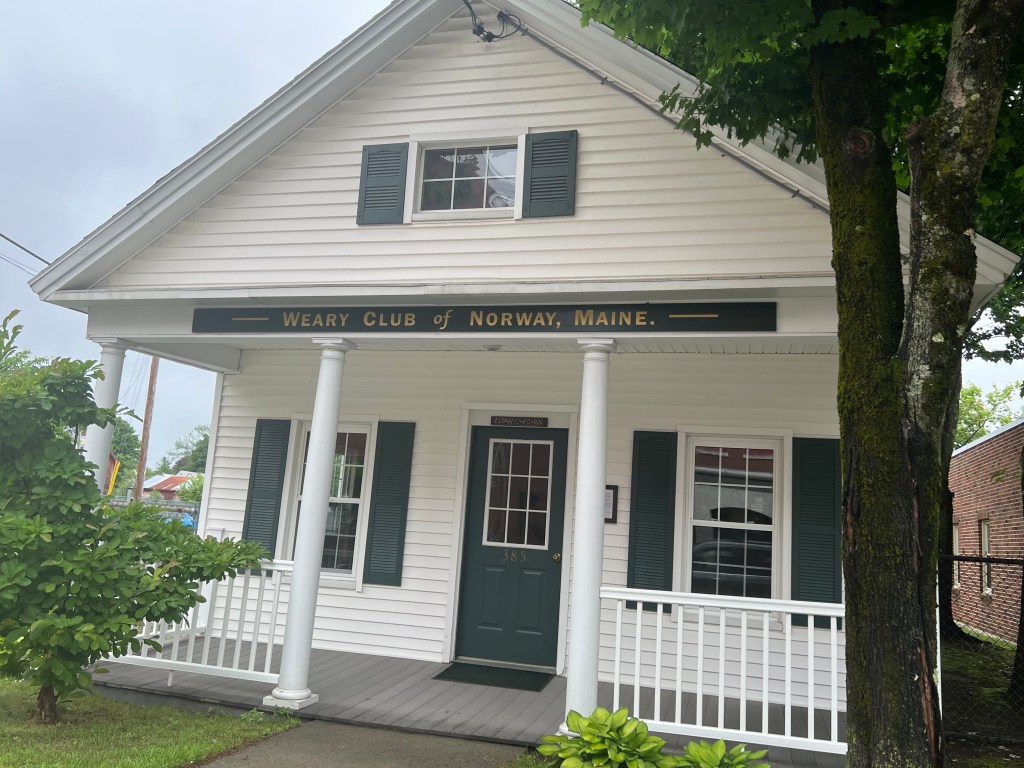
During our Sunday tour we came across another New England staple still operating today.  The Weary Club was founded in the Norway community in 1923 by Advertiser Democrat (newspaper) owner and publisher Fred Sanborn.  Sanborn rented a vacant store on Main Street where a group of like-minded friends and businessmen could meet and share pastimes, such as playing cribbage, smoking, chewing tobacco, and conversation.  By 1926 the group had christened itself the Weary Club, built a clubhouse, established a board of officers and directors, and established a set of by-laws.  Gambling and drinking were not allowed, but local gossip was permitted.  No more than 200 members were allowed, and applicants might have to wait for a member to die before they were approved to join.  A lifetime membership cost US$25 (currently US$50) and was granted to those who could whittle a “shaving light enough to float.”  The requirement was later dropped as whittling became passe.  Ben Tucker, longtime member and historian said, “The main function of our club now is that one Saturday morning a month from 8 to 9:30 we share coffee and doughnuts”, along with conversation.  The Weary Club is a continuing example of the early era social clubs established for sharing political wisdom and Yankee philosophy.

When I looked online, I found a social club is an organized group of individuals (or the place they meet) who come together to engage in shared interests, activities, or causes. The clubs serve various purposes, including fostering social interactions, providing recreational opportunities, and supporting community initiatives.  The primary objectives of social clubs are to create a sense of belonging, and members benefit from a structured environment where they can pursue their interests, develop new skills, and contribute to their communities.  The origins of social clubs can be traced back to ancient civilizations where people gathered in informal groups to discuss politics, philosophy, and social issues.  In medieval Europe, guilds and fraternities formed among tradespeople and artisans to provide mutual support and camaraderie.  Social clubs became more formalized during the 18th and 19th centuries, particularly in Europe and North America.  Gentlemen’s clubs, literary societies, and scientific associations offered intellectual and social engagement for their members.  The Industrial Revolution and urbanization spurred the growth of social clubs as people sought community and connection in rapidly growing cities.  Today’s social clubs include a variety of interests and activities and often incorporate technology and virtual events to connect members.

Researching community interaction in a Utah smelter town I realized the early 20th century saloons and the town’s church both served as social clubs.  The saloon was a place to relax after work with a drink and a meal.  The saloon would cash the checks from the local smelters and hold accounts like a bank.  The workers only had access to their beds for 8 hours a day (yes, three shifts for the same bed) and the saloon was a place to socialize until your bed was available.  The church (Ward House) served a similar purpose (without alcohol) as a community gathering spot.  The farmers would gather on Sunday for day long services and events, while individual groups of men or men would come to socialize during the week.  The church provided financial support for the poor and destitute who were part of the social group. 

THOUGHTS:  I always wanted to write a paper on this obvious comparison (unless you were in one of the two social groups) to present to my own social group of historians.  I wondered if it would have been accepted by either of the two factions (or my own).  Most social clubs think of themselves as serving the “unique desires of their members”.  Social interaction is a need we all have but cannot allow it to separate the “us” and “them”.  Act for all.  Change is coming and it starts with you.
Hamlin

June 25, 2024

Sunday was a rainy afternoon in Maine and my sister decided to take us on a tour.  We climbed into the car and drove along the winding roads through lush trees and Cape Cod style cottages.  I grew up in the homesteader state of Kansas where everything is both (relatively) flat and the roads are laid out in grids that divide the 180-acre homesteads available for anyone willing to brave the Great American Desert.  That means I am used to seeing where I am going, and the miles are marked by (some sort of) road every mile telling my mind how far I have driven and how far I have yet to go.  Another Maine feature is passing through towns named for the countries or cities the initial populous had immigrated from.  We broke into a settled area and drove up the hill toward the Paris Hill Historic District, an area that encompasses the historic 19th century village of Paris Hill in Paris, Maine.  On the bluff with views of the White Mountains to the west sat the Hannibal Hamlin house.

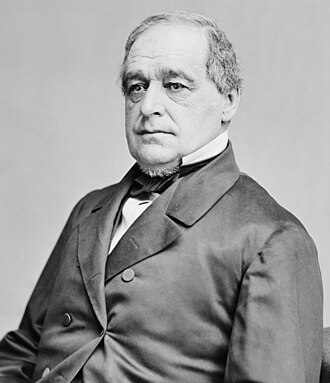
When I looked online, I found Hannibal Hamlin (August 27, 1809 – July 4, 1891) was an American attorney and politician who served as the 15th Vice President of the US from 1861 to 1865.  He was the first Republican Vice President during President Abraham Lincoln’s first term.  Hamlin began his political career as a Democrat in Maine’s House of Representatives and was later elected twice to the US House of Representatives, and then to the US Senate.  Hamlin had strong abolitionist views and left the Democratic Party for the newly formed Republican Party in 1856.  Hamlin was selected as Lincoln’s running mate in the 1860 general election to balance the ticket, as Hamlin was from New England while Lincoln was from the Northwest.  Although not a close friend, Hamlin supported Lincoln’s key projects like the Emancipation Proclamation.  After leaving the Vice Presidency, Hamlin was elected to two more terms in the US Senate, and finally served as US Minister to Spain before retiring in 1882.  On July 4, 1891, Hamlin collapsed while playing cards at the Tarratine Club he had founded in Bangor, Maine, and died a few hours later at the age of 81.  Hamlin was the third US Vice President to die on Independence Day.

Hamlin was replaced as vice-presidential nominee in the 1864 presidential election.  The Republicans and War Democrats joined to form the National Union Party in June 1864 and while Lincoln was renominated, War Democrat Andrew Johnson of Tennessee was named to replace Hamlin.  Lincoln was seeking to broaden his base of support and was looking ahead to Southern Reconstruction.  Johnson had proven himself an adept military governor in the Union occupied state of Tennessee.  Hamlin was an ally of the Northern “Radical Republicans” (who impeached Johnson).  Lincoln and Johnson were elected in November 1864 and Hamlin’s term expired on March 4, 1865.  Hamlin swore Johnson in as Vice President, who was drunk and proceeded to give an incoherent acceptance speech.  Hamlin narrowly missed becoming the 16th president, as Lincoln was shot on April 14, 1865, five days after the Union victory at the Battle of Appomattox Courthouse.  Hamlin’s vice presidency ushered in a half-century of sustained national influence for the Maine Republican Party in national politics that is unmatched by any subsequent Maine political delegations.

THOUGHTS:  The Hamlin estate and Paris Hill Historic District reminded me of the eight years I worked for the Division of State History documenting historic buildings and sites for the National Register of Historic Places.  While this seems a lifetime ago, I still like seeing architectural styles and researching history.   America is a young (European) nation with sites dating back to the 1600’s, but they pale compared to the ancient structures of Europe and Asia.  History gives a new perspective on one’s place in the greater world.  Much can be learned from the past, and from the descendants that still thrive amid that history.  Act for all.  Change is coming and it starts with you.
Johnson’s

June 24, 2024

The first thing we did upon arrival in Maine was to go to one of the many Portland eateries for seafood.  My brother-in-law ordered clams but Melissa and I both opted for the lobster roll that we had been waiting for.  Even at “market price”, the delicacy was well worth it.  We spent the rest of the day in conversation and that evening were served my brother-in-law’s special hot dogs.  These dogs featured Nathan’s hot dogs and a bun split down the middle rather than on the side.  The buns were grilled on the flat sides to give them a toasted quality.  The secret to these dogs was the number of possible condiments that could be added to make each dog unique.  There were five different styles of mustards, two types of relish, chopped onions, and pickles.  When I put my dog together the piece de resistance was brought out, celery salt.  While I was reluctant to salt my dog, I was told you could tell how good the dogs were going to be depending on whether the vendor had celery salt as a possible garnish.  I salted my dog (it was good) and completed my Howard Johnson’s style dog.

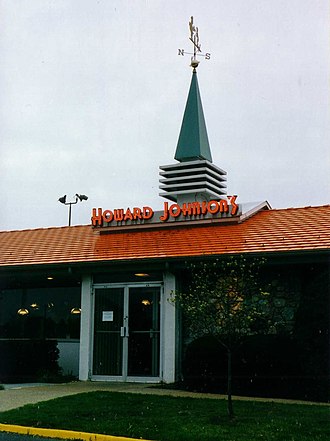
When I looked online, I found Howard Johnson by Wyndham, or Howard Johnson International, Inc. legally, is an American hotel brand that began as a restaurant chain.  The chain began as a restaurant founded by Howard Deering Johnson in 1925.  With the rise of the Interstate System in the US during the 1950’s, the company expanded operations by opening hotels known as Howard Johnson’s Motor Lodges which were often located next to the restaurants.  During the 1960’s and 1970’s, Johnson’s was the largest restaurant chain in the US with more than 1,000 company-owned or franchised locations.  Howard Johnson’s restaurants were franchised separately from the hotel brand beginning in 1986 and in the years that followed dwindled in number until eventually disappearing altogether.  The last restaurant, in Lake George, New York, closed in 2022.  The Howard Johnson’s line branded supermarket frozen foods (including ice cream) are also no longer manufactured.

Johnson began his business venture as a small pharmacy in Wollaston, a neighborhood in Quincy, Massachusetts.  He soon discovered the recently installed soda fountain had become the busiest part of his drugstore.  That led Johnson to devise a new ice cream recipe.  Some say the recipe was based on his mother’s homemade ice creams and desserts, while others say that it came from a local German immigrant.  The secret for the new recipe was the flavor added by the increased butterfat.  Johnson eventually created 28 flavors of ice cream, saying “I thought I had every flavor in the world.  That ’28’ (flavors of ice cream) became my trademark.”  Throughout the late 1920’s, Johnson opened concession stands on the beachfront property along the coast of Massachusetts selling soft drinks, hot dogs, and ice cream.  The success of the stands allowed him to convinced local bankers to lend him funds to operate a family-style restaurant and by the end of the decade the first Howard Johnson’s restaurant opened in Quincy.  It featured fried clams, baked beans, chicken pot pies, frankfurters, ice cream, and soft drinks.  The clams were another of Johnson’s innovations (along with the dogs and ice cream).  While many restaurants served fried whole-body clams, Howard Johnson’s sold just the clam feet as “strips”, which took off and are now popular throughout seafood restaurants.    

THOUGHTS:  I recall the long trips my family took as a boy as my father attended the annual conventions of our denomination in big cities alternating across the country.  These included 500-mile (805 km) days mostly along the new interstate system.  While we never stayed in a Howard Johnson’s hotel or ate in one of the restaurants, the image of their gleaming orange metal roofs stands out in my mind.  The baloney sandwiches we ate could not have compared to the condiment laden hotdogs served under those magical roofs.  One day, and already lobster roll and Howard Johnson’s dogs.  I can only dream of what is next.  Act for all.  Change is coming and it starts with you.

Longest

June 21, 2024

Melissa and I planned a trip to Maine to escape the summer heat in Arkansas that quickly became more involved than it has been in the past.  We drop the kids at a kennel and although it has several times for drop offs, they are only 1-1/2 hour periods.  That means we work our departure schedule around the kids drop off schedule.  Melissa has been fussing over the succulents for the last two weeks making sure the active plants are watered and the dormant plants groomed during their summer sleep.  The Real problem is my garden.  We have been away for a couple of days during my summer gardens, but this garden is more extensive, and the vegetables in the raised beds are less forgiving of neglect.  When I realized we were gone at the beginning of the summer heat (and possible harvest) I contacted the neighbor girl to water in the mornings.  Just when all seemed well, we got a text from my sister saying the heat index in Maine was 103F (39.4C).  So much for cool.  Melissa responded was it was lucky this happened on the longest day of the year since the 1700’s.

When I looked online, I found the 2024 summer solstice (June 20) is the earliest in 228 years, making this the longest day and the solstice is set to get progressively earlier for the next 72 years.  Today’s solstice is the earliest since 1796 because of the variation caused by the Gregorian calendar.  The calendar divides one year into 365 equal days, but the Earth’s actual orbit around the sun takes 365 days, 5 hours, 48 minutes and 45 seconds.  This difference is accounted for by adding a leap year every four years to round the calendar up one day.  This creates its own problem as four times 5 hours, 48 minutes and 45 seconds is 23 hours and 15 minutes, or 45 minutes short of a full day.  To account for this drift, the calendar is “reset” by skipping a leap day every four centuries.  The next reset is due in 2100 but until then during leap years (like 2024) the solstice will occur 18 hours earlier than the previous year and 45 minutes earlier than the previous leap year.  Every successive leap year from now until the end of the millennium the solstice will be the earliest since 1796 by 45 minutes.

Other phenomena correspond with today as the longest solstice since 1796.  The summer’s first full moon (Strawberry Moon) in 2024 is set for moon rise the day after solstice (June 21).  Since 2024’s June full moon happens near the solstice (sun’s highest point) the moon is at the very lowest point.  The moon being so low makes it appear bigger (Moon Illusion).  The solstice itself happens because of the Earth’s tilt along its axis.  The origins of tilt can be traced back more than 4 billion years to the Earth’s formation when our planet suffered an estimated 10 gigantic collisions with other planets.  The last collision was with a Mars-size planet (Theia) that hit with such force that it transformed Earth’s surface into molten rock and ejected rocks and dust into space, which later coalesced to become our moon.  The impact also created the Earth’s 23.5 degrees of axial tilt with respect to the sun.  As the Earth orbits our star (Sol), one hemisphere leans away from the sun and the other towards it.  It is this tilt that gave rise to the seasons that spurred more complex ecosystems to evolve.

THOUGHTS:  Today is the longest day due to human manipulation of the Calendar.  The earth has suffered and overcome a number of catastrophic collisions like Theia and the asteroid that caused the Chicxulub crater near the Yucatan Peninsula in Mexico.  The earth was able to overcome these events and evolve.  Theia gave us the moon and seasons and the asteroid brought about the rise of mammals.  While both may have been positive for human evolution, they also destroyed/changed “life as we know it”.  Unlike the dinosaurs, humans may be able to survive the next catastrophe but “life as we know it” will no longer exist.  Our planet should be treated as a gift to be cared for, not exploited.  Otherwise, we may be the cause of the next end of “life as we know it”.  Act for all.  Change is coming and it starts with you.
Barking

June 20, 2024

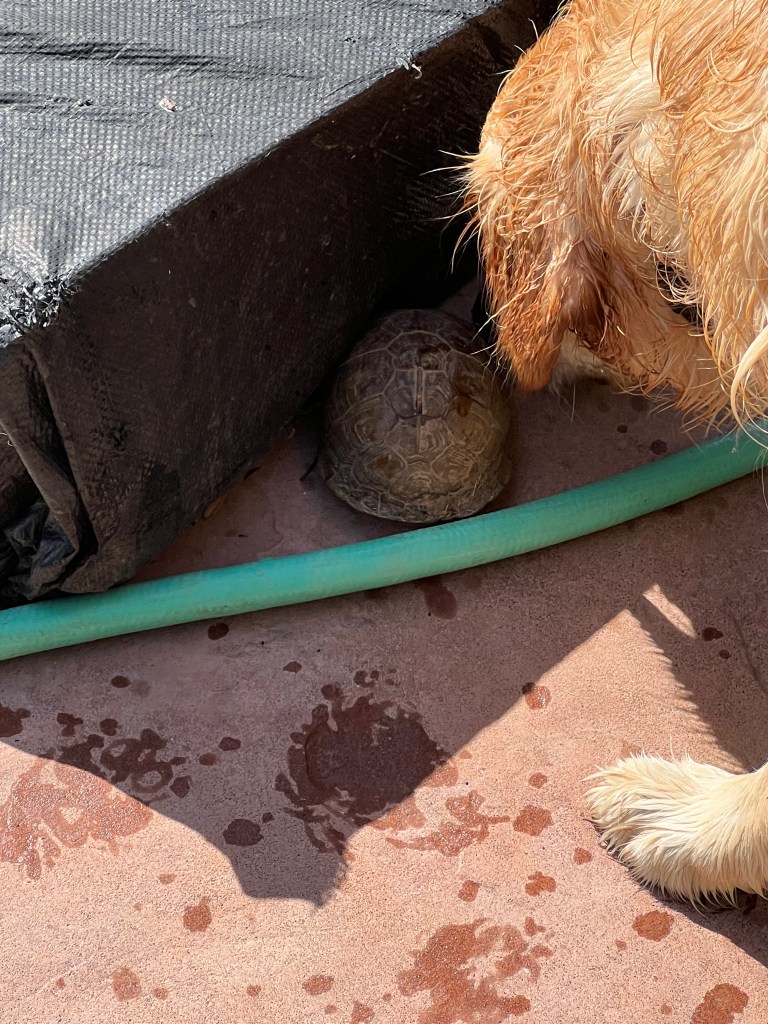
Zena is a bit of a scaredy baby when she comes across new items in what she defines as her space.  I put her outside last year and she went into a fit of continuous barking.  I looked out the window and did not see anything unusual, but the barking continued.  I finally went out to see what had gotten her into such a tizzy.  I had placed a 40 pound (18 kg) bag of compost up against the fence.  Zena knew it was not there the last time she had gone out and believed it should not be there now.  She continued barking until I went with her and let her sniff the strange object.  On the other hand, Loki is very adventurous and loves to check out any unknown critters that ramble into our yard.  Several weeks ago, I had come across a three-toed box turtle (Terrapene triunguis) crawling along the ditch next to the neighbor’s fence.  The turtle sent both Zena and Loki into a barking frenzy, but for different reasons.  Zena was barking to let the intruder know it was not welcome, while Loki was barking because he wanted to investigate this new presence in his territory.

When I looked online, I found according to Dr. Stanley Coren’s, “How to Speak Dog: Mastering the Art of Dog-Human Communication,” there is far more complexity to a barking dog than you may realize.  Barks are not a one-size-fits-all vocalization.  The sounds made in different situations not only sound different but likely have different meanings.  While dogs may bark when they are excited and trying to get your attention, they also bark when frightened, lonely, surprised, irritated, and other reasons.  A dog can vary the pitch of their barking, the number of barks in a row, and the space between barks to change the bark’s meaning.  The lower the barking pitch the more serious the dog.  During playtime a dog will tend to have a higher-pitched bark than one designed to warn off intruders or discipline a rude companion.  A lonely dog makes higher-pitched barks to request attention, and sometimes this can rise to a plaintive yelp.  The more barks in a row, the more aroused the dog is.  A single bark may sound when a dog is surprised or annoyed, but a long string of barks indicates the dog is more worked up.  The space between barks is also telling, and the quicker the succession of barks, the more aggressive the dog is feeling.

When I first let the kids outside, they are always on high alert.  If the birds (or squirrels) are in the feeders, they will run to the fence.  Their next move is to the back of the fenced yard to see if the German Shepherd next door is in the yard.  Zena will then take a prance around the fenced yard to see if anything is unusual.  Loki is less predictable, but often comes back to the patio area to see if anything new catches his eye.  Yesterday I let the kids out and they took their normal stroll, but this time there was a new player on the patio deck.  The turtle that had caused a commotion last week had crawled onto the deck and hidden up against one of the concrete blocks used to hold down the pool cover.  Zena pranced right past the hidden turtle, but Loki stopped to sniff and check it out.  The turtle immediately tightly closed its shell.  Interestingly neither began barking at this new intrusion.  I picked the turtle up and put it outside the fence to keep it safe from any unwanted nips.

THOUGHTS:  Research has found that humans are good at classifying barking dogs, even if they do not own one.  Prerecorded dog barks were played to human listeners who were asked to categorize the barks given a list of possible situations.  They also rated the emotion the barking dog was feeling.  The results showed people can match the bark to the situation with a far higher accuracy than chance and can identify the dog’s emotion using the pitch of the bark and the pause between barks.  While humans may be good at identifying barking, we appear less so paying attention to the words of other humans.  Perhaps barking dogs are identified as a threat.  Perhaps we just choose not to listen to others who hold different views than we do.  Act for all.  Change is coming and it starts with you.

Greens

June 19, 2024

You may recall when I built my hügelkultur beds I promised some of my “first fruits” for the use of our friends trailer to haul the compost and soil.  Even though technically the real first fruits were the radishes, they did not seem like an appropriate gesture.   I now have red beets that are ready to harvest, and they sounded more appropriate.  Melissa mentioned our friends’ garden was not planted until several weeks after mine and their tomatoes (Solanum lycopersicum) have yet to start producing.  I threw in some ripe San Marzano and smaller Grape tomatoes (both plum varieties) and added four large green bell peppers and two small yellow banana peppers (varieties of Capsicum annuum).  I plucked the beets and brought them inside to wash and remove the stems and bottom roots from the bulbus tuber I have always eaten.  As I was about to cut off the stems for disposal in my composter, I remembered we are in the South.  When I asked Melissa if people ate beet tops, she assured me they did.  I left the beet greens intact to let our friend decide what she wanted to do.

When I looked online, I found beetroot is the taproot portion of a beet plant (Beta vulgaris) known in North America as beets, while the vegetable is referred to as beetroot in British English.  Beets can be roasted or boiled, canned (whole or cut up), and are often pickled, spiced, or served in a sweet-and-sour sauce.  The domestication of beetroot can be traced to the emergence of a variant of the order of nucleotides on a DNA molecule (an allele) which enables biennial harvesting of leaves and taproot.  Beets were domesticated in the ancient Middle East, mostly for their greens, and were grown by the Egyptians, Greeks, and Romans.  By the Roman era they were also thought to have been cultivated for their roots.  From the Middle Ages, beetroot was used to treat various illnesses, especially those relating to digestion and the blood.  It is one of several cultivated varieties of Beta vulgaris grown for their edible taproots and leaves (called beet greens).

Kemp Minifie is a top-level food editor, writer, and recipe developer for premier national food and travel magazines who spent 32 years writing about food for Gourmet magazine.  Minifie posted an article in 2019 about how the stems of beets are far more delicious than those of kale and collards.  Beet greens are also some of the most nutrient-rich greens, containing more antioxidants and other phytonutrients than the bulbous roots themselves.  The problem comes in trying to find them in order to cook a batch of greens.  Beet greens are now standard fare at (most) farmers’ markets, and beets are increasingly available with their greens in (some) supermarkets.  Minifie recalled her “shock and disdain” when she found her local grocery chopping the bushy greens from bunches of beets and, “no joke, stuffing them in the trash!”  Supermarkets are not alone in tossing the greens.  Farmers often lop off the tops at the customers’ request.  The hacked-off greens leave people wondering if you can even eat beet greens.

THOUGHTS:  Michael Twitty is a food historian who cooks the meals slaves would have eaten at places like Monticello, Thomas Jefferson’s grand estate in Charlottesville, Virginia.  Root vegetables like turnips (Brassica rapa) and beets were often fed to livestock, while their leaves (greens) became a quintessentially Southern dish.  Our local market carries turnip (Brassica rapa) greens, but not the roots.  I have yet to find beet tops anywhere other than my garden.  My Central Plains upbringing taught me to eat the roots of both and throw away the tops.  I may have to cook up a “mess of greens” and find out what (or if) I have been missing.  Cultural preferences dictate what is good and proper to eat, and how to eat it.  I am even growing okra (Abelmoschus esculentus) for Melissa.  We will see if I dare go that far.  Act for all.  Change is coming and it starts with you.
Wetlands

June 17, 2024

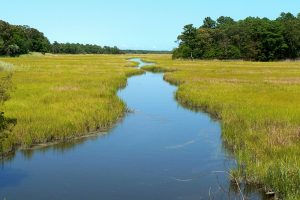
Inside the back section of my local newspaper, I found a USA Today article on a new bill intended to protect the wetlands of Delaware.  Delaware is the only Mid-Atlantic state that does not have state protection for its wetlands and relies solely on the federal “Waters of the United States” protected under the Clean Water Act.  Last year’s Supreme Court decision (Sackett v. EPA) limited the definition of what constituted these US waters, leaving millions of acres of wetlands unprotected from dredging, development, or other harmful activities.  Wetlands make up over 25% of the state’s total area and an estimated 75,000 acres (30,351 ha) of non-tidal wetlands are no longer protected under federal jurisdiction.  Senate Bill 290 amends the portion of the code relating to wetlands and broadens the procedures to include protection of both tidal and non-tidal wetlands.

When I looked online, I found wetlands are a distinct ecosystem that is flooded or saturated by water, either permanently, for years or decades, or seasonally for shorter periods.  Wetlands can be tidal (inundated by tides) or non-tidal and the water held can be freshwater, brackish, saline, or alkaline.  Flooding results in the occurrence of oxygen-poor (anoxic) processes, especially in the soil.  All true wetlands have three characteristics: typical wetland plants, wetland soils, and evidence that water is or can be at or near the surface.  Wetlands are different from other landforms or bodies of water as their aquatic plants have adapted to oxygen-poor waterlogged soils.  Wetlands are considered among the most biologically diverse of all ecosystems and provide habitat for a wide range of plant and animal species.  There are four main kinds of wetlands.  A marsh is a wetland that is dominated by herbaceous (no woody stem) plants rather than by woody (hard stem) plants.  A swamp is a forested wetland that is a transition zone where both land and water play a role in creating the environment.  A bog is a wetland that accumulates peat as a deposit of dead plant materials (typically sphagnum moss).  A fen is a type of peat-accumulating wetland fed by mineral-rich ground or surface water.  Some experts also recognize wet meadows and aquatic ecosystems as additional types of wetlands.

Despite nearly half of Delaware’s original wetlands having been lost over the last two centuries, wetlands still make up nearly 25% of land in Delaware, and 75% of these wetlands are non-tidal.  The vast majority of the wetlands are privately owned, with only 20% owned by the state or federal governments.  Delaware’s Department of Natural Resources and Environmental Control (DNREC) assesses these lands regularly, but only non-tidal wetlands of 400 acres (162 ha) or more are regulated by the state.  Rep. Debra Heffernan, chair of the House Health & Human Development Committee and sponsor of SB290, said “As our communities continue to deal with increased flooding, drainage issues and habitat loss, protecting our remaining wetlands, one of our state’s most valuable ecosystems and assets, is more important now than ever.”  This bill will require a permit issued by the DNREC prior to activities that might impact these ecosystems. 

THOUGHTS:  The proximity of wetlands to lakes and rivers puts them at risk for development and human settlement.  Wetlands are often converted to dry land by constructing dykes and drains and used for agricultural purposes.  Once settlements are constructed and protected by dykes and levees, they are more at risk for land subsidence and increased flooding.  The flooding and subsidence of the Mississippi River Delta around New Orleans, Louisiana is a well-known example.  Wetlands offer safety for plants and animals (including humans) and need to be protected, not drained and leveled.  Act for all.  Change is coming and it starts with you.

Hot Dog

June 13, 2024

I am not sure whether it was a slow news day but one of the lead stories on my local news was the “controversy” surrounding the banning of Joey Chestnut from Nathan’s 4th of July Hot Dog Eating Contest by Major League Eating (MLE).  On Tuesday, June 11, it was announced that Chestnut was not allowed to compete because of a deal he has with Nathan’s competitor, Impossible Foods, which recently released a plant-based hot dog.  MLE released a statement saying, “For nearly two decades we have worked under the same basic hot dog exclusivity provisions.  However, it seems that Joey and his managers have prioritized a new partnership with a different brand over our long-time relationship.”  Chestnut responded to the statement claiming the rules were changed this year.  “To set the record straight, I do not have a contract with MLE or Nathan’s and they are looking to change the rules from past years as it relates to other partners I can work with.”  Chestnut has won Nathan’s hot dog eating competition 16 times.

When I looked online, I found Nathan’s Famous International Hot Dog Eating Contest is an annual hot dog competitive eating competition held on July 4 at Nathan’s Famous’ original restaurant in Coney Island, New York City, since 1972.  During the 1990’s and 2000’s the event was dominated by Japanese contestants and gained public attention since the mid-2000’s with the stardom of Takeru “The Tsunami” Kobayashi and Joey Chestnut.  Chestnut is the defending men’s champion who ate 62 hot dogs in the 2023 contest.  Miki Sudo is the defending women’s champion who ate 39.5 hot dogs in 2023.  MLE has sanctioned the event since 1997, and today, only entrants under contract with MLE can compete.  The field of about 20 contestants are selected by invitation or from qualifying events.  The event draws spectators and worldwide press coverage, with an estimated 50,000 on site in 2007.  ESPN has enjoyed solid ratings from its broadcast of the Hot Dog Eating Contest and on July 1, 2014, announced it extended its agreement with MLE to broadcast the contest through 2024.

Another twist was an offer by Paige Spiranac to fill Joey Chestnut’s shoes.  Spiranac is described as golf’s top social media influencer and as of October 2023 has 3.9 million Instagram followers, 359,000 YouTube subscribers, and a subscription-based website (OnlyPaige) which features golf instructional videos, livestreams, and vlogs.  Spiranac has also been cyberbullied for “sexualizing women’s golf” after appearing in the Sports Illustrated Swimsuit Issue and for her provocative outfits.  The LPGA introduced a stricter dress code in July 2017 to restrict plunging necklines, leggings, and short skirts.  After Chestnut was barred from Nathan’s contest, Spiranac volunteered for the event saying, “I’m available to fill in for him.  My record is 6.5 hotdogs in 10 minutes.”  Spiranac shared a video saying, “I found the video proof.  And I lied, it was only 6 hot dogs and not 6.5.”  Many viewers commented on Spiranac’s unorthodox way of eating hot dogs while others thought her enthusiasm for the contest could provide a new dynamic to the annual competition.  It is not about winning, but providing a good show even if you lose.

THOUGHTS:  While the history of advertising can be traced back to ancient civilizations, modern advertising began with the advent of newspapers and magazines in the 1840’s, and ads on social media are the latest permeation.  Social media influencers build a reputation for their knowledge and expertise on a specific topic and their posts generate large followings of people who pay attention to their views.  Brands love social media influencers because they can create trends and encourage their followers to buy products they promote.  While the medium has changed, selling from a “trusted source” is the same, only now it reaches millions of customers in milliseconds.  The Romans coined the phrase “Caveat Emptor” (buyer beware).  Act for all.  Change is coming and it starts with you.
Fruit Flies

June 11, 2024

At the beginning of June, I mentioned how we were being inundated by house flies (Musca domestica) and fruit flies (Drosophila melanogaster).  Melissa mentioned how her work mates and friends have also been complaining about the same infestation.  I have been trying different approaches to get rid of the flies and have been relatively successful with the house flies (keep the door shut).  I cannot say the same about fruit flies.  We have cleaned the counters and flushed the sink drains.  I keep the kitchen composter closed and regularly run the processed remains outside to my inground composting bin.  I have tried glue strips and apple cider vinegar traps.  These have worked but do not seem to be keeping up with the growing number of fruit flies that are making my kitchen sink and counters home.  This morning, I reached my limit when Melissa called me into the kitchen to find around 30 fruit flies covering our sink.  I swatted them with a towel, went to my office to research the best ways to get rid of the fruit flies, and then took off for the market to buy a more effective ways of getting rid of the pests.  

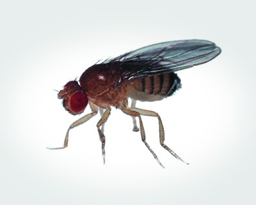
When I looked online, I found the common fruit fly (Drosophila melanogaster) is among the common types of flies in Arkansas and the US, but they are also found around the world.  These flies are about 0.12 inches (3 mm) in body length with the females are generally larger in size compared to males and have a more rounded abdomen.  Both have brick-red eyes and a yellow-brown body.  The fruit fly has a lifecycle of 10 to 14 days.  They are commonly found near decaying fruits and vegetables where they feed on the yeast and bacteria that thrive in those environments.  Fruit fly eggs are only visible under a microscope, measuring 0.04 inches (1/2 mm) in length.  The eggs are oblong (like a piece of rice) and pale yellow in color.  The female can lay up to 500 eggs at a time, primarily in the fermenting or decaying, sweet, organic material found in the fruits and vegetables that attract the adults.  The fruit fly is usually attracted to moisture and light.

Many of the remedies I found online to combat my fruit flies involve using the fly’s attraction of moisture and light.  Several of these involved a combination of ultraviolet blue light and sticky traps.  The theory is the light will attract the flies who then settle on the scented sticky trap and are unable to get off.  I also renewed my effort of placing a cider trap to provide the liquid they find appealing.  Jody Green, a contributor to the journals of the Entomological Society of America, specializes in urban and industrial entomology or “the bugs that people love to hate the most.”  Green said, “They don’t just magically appear like most people think they do, but you can find them inside when you have fermenting foods.”  If you want to get rid of fruit flies, all you need to do is remove the rotten fruits or any rotten organic matter from your home.  Cleaning habits are an important step in getting rid of fruit flies.  My cleaning habits will never receive the Good Housekeeping seal of approval.

THOUGHTS:  I discovered while researching how to get rid of fruit flies that I was making my apple cider trap wrong.  I poured the cider into a trap and watched as dozens of fruit flies swarm the trap in the morning, but there were only a few dead ones inside the trap.  Then I read you need to add a few drops of dish soap in the vinegar to break up the surface tension of the liquid and allow the flies to sink rather than float on top.  So much for the person who refuses to take STEM classes in school because they “will never be useful in real life”.  I am banking on biology and surface dynamics to resolve the problem with my fruit flies.  Act for all.  Change is coming and it starts with you.
Bridge Housing

June 07, 2024

The back page of the front section of my local newspaper ran a USA Today article on a new US$40 million housing campus that just opened in Detroit, Michigan.  The complex broke ground in 2022 and officially opened on Monday, but the planning for the center has taken place over the last nine years.  Rev. Tim McCabe, president and CEO of the Pope Francis Center (PFC) toured 27 other shelters from around the US to gain insights and ideas for the facility.  The site includes a specialty “hot room” for disinfecting blankets and clothing upon arrival or heat lamps that warm a covered patio designed for people seeking shelter from the cold but who are just not ready to come inside.  McCabe said, “We’re going to change the conversation around what it means to be homeless . . . and we do that with radical compassion and love.”  In Detroit, this radical compassion is on display at the Bridge Housing Campus.

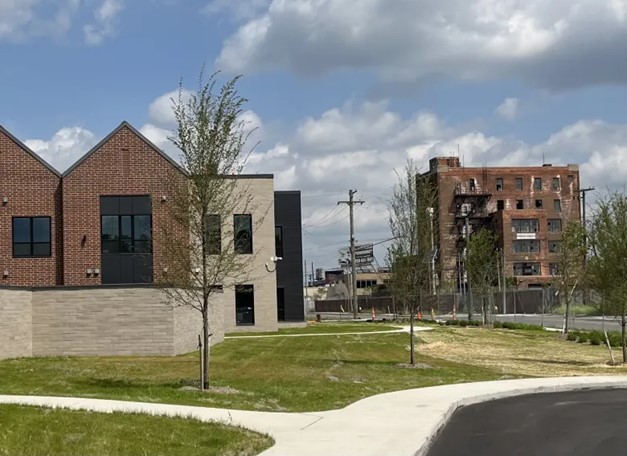
When I looked online, I found PFC’s Bridge Housing Campus is a 60,000 foot2 (5574 m2) campus that sits on 5.3 acres (2.1 ha) of once vacant land.  Residents are greeted by a building with gable roofs and contrasting exterior bricks to convey a sense of residence.  Each of the 40 residents (men for now) will be assigned a separate studio apartment connected by wide inside hallways painted in calming neutral blue and green colors so nobody feels closed in.  The 336 feet2 (31.2 m2) units feature a bathroom and living area, bed, television, kitchenette, and bright windows.  Three of the units are designated as anti-ligature rooms (cannot be used by someone to harm self by bind or tie) equipped with fixtures to keep residents safe such as sinks with no knobs.  Bridge Housing not only provides residents with a place to live for 90-120 days but services to promote their independence and well-being such as a medical and dental clinic along with a team of social workers, addiction specialists, and psychiatrists.  Other amenities are an 8-bed respite center for those discharged from the hospital but needing time to recover, a full kitchen for meals and culinary training, classrooms to provide for job preparation and financial literacy, a library, computer lab, art room, meditation space, barber shop, and a gymnasium for fitness or social activities.  The PFC’s regular services at the nonprofit’s downtown location will continue once the campus opens.  The downtown day center provides two meals, laundry and shower facilities, medical and dental clinics, and legal clinics to help people to find housing. 

A major difference of the Bridge Housing Campus than other facilities designed to address chronic homelessness is a partnership with the surrounding community.  McCabe said the campus will not only benefit its residing guests but their neighbors who consented to have the project built.  The neighborhood will also have full free access to the campus’ health clinic, classrooms, cafeteria, and gymnasium.  “I can’t wait for the kids in the neighborhood to see this and to come and throw a basketball around,” McCabe said, “The community needs to see these people, not as scary”.  The interaction between residents and the community will help tear down the stereotypes that add to the trauma already experienced by the homeless and allow the community to see them as people.

THOUGHTS:  The potential success of Bridge Housing comes from the willingness of the community to act as a partner in the project.  We have had several attempts to build housing communities (tiny houses and community center) on vacant land in the city near us that have been shot down by residents near (not in) the areas suggested.  They decried the bad element that would be brought to live in these communities even more than any potential loss of property values.  Both reflect the stereotype Bridge Housing was able to overcome through cooperation.  People in crisis need a hand up, not a push down.  Act for all.  Change is coming and it starts with you.