Helmet

January 14, 2024

Last night the Chiefs and Dolphins squared off in a Wildcard playoff game that ranked as the fourth coldest NFL game on record.  Arrowhead Stadium has a seating capacity of 76,416, making it the 25th-largest stadium in the United States and the fourth-largest NFL stadium.  It was reported the sellout crowd braved the weather as an estimated 76,000 showed up to brave the -24F (-31C) windchill temperature.  Tailgaters arrived outside the stadium with heaters and hot drinks trying to stay warm.  They brought multiple layers of clothing, heated gloves and socks, thermal underwear, and long johns.  The game cameras again and again focused on Chief’s head coach Andy Reid’s frozen mustache.  According to one fan, “You’ve got to enjoy it while you have it.  This is the golden era.  I’m not going to miss it because it’s a little cold.”  The sub-zero game in Kansas City was everything that fans expected from the fourth-coldest game in NFL history, but Patrick Mahomes’ broken helmet was not expected.

When I looked online, I found the coldest game in NFL history was the 1967 NFL Championship between the Dallas Cowboys and the Green Bay Packers.  The gametime temperatures for “The Ice Bowl” was -13F (-25C).  The game was attended by 50,861 people, selling out Lambeau Field.  While Green Bay won the game 21-17, both teams finished with less than 200 total yards (Green Bay–195 yards; Dallas–192 yards).  The wind chill was even colder at -48F (-44.5C).  A layer of condensation had formed between the tarp and the field and once the tarp was removed the field froze.  Green Bay has been home to several of the coldest games in NFL history.  According to Stathead, the average temperature for playoff games at Lambeau Field is 21.8F (5.7C), and the warmest playoff hosted at Lambeau was 35F (1.7C) when the Packers hosted the Los Angeles Rams on January 16, 2021.  It is one of only two playoff games played at the stadium where temperatures were above freezing.  Four of the games played there have either been in the single digits or in the negatives.  Despite the cold, last night was the first time a helmet broke.

The broken helmet occurred when Mahomes took a helmet-to-helmet hit from Miami’s DeShon Elliot in the third quarter.  While Mahomes shrugged off the hit, his helmet was not so lucky.  The plastic headgear cracked, and a large piece was broken off.  The image of Mahomes’ helmet cracking captured the attention of NFL fans, and the replays showed the three inch (7.5 cm) long piece of plastic flying through the air after the hit.  Mahomes played several downs before the referee stopped the action and allowed Mahomes to switch out his helmet.  The drive ended with a field goal.  Maholmes worked on the new helmet while Miami had the ball, trying to stuff the old padding into the new one (it did not work) and trying to change out the face mask.  Despite the irritation, Mahomes led the Chiefs to their second touchdown of the night on the next drive.  The Chiefs won the game 26-7.

THOUGHTS:  Melissa’s question was after hearing about the cold was, “Why are they playing?”  Buffalo did postpone their game, but because of snow and not from the cold.  Mahomes’ broken helmet worked out and he was not injured.  The companies that manufacture the helmets are required to put them through safety tests to be approved for use in the NFL, but it is unclear whether testing is done under the extreme temperatures that Kansas City experienced.  Pro Football Talk said both the NFL and the NFL Players Association should insist on testing helmets in subzero temperatures and if there is a temperature where it is too cold for helmets to perform reliably, it should be too cold to play.  Short of a lightning strike, little gets in the way of football.  Act for all.  Change is coming and it starts with you.

Improvement

January 12, 2024

Last fall we decided it was time to take on construction projects on our house and two immediately came to mind.  We have struggled with keeping the succulents alive and happy over the last three winters (the cacti seem fine with most anything).  The 10 mil plastic we placed over the porch screens kept out the bitter cold, but it filtered the sunlight and was difficult to allow air flow on nice winter days.  Last October we decided to bite the bullet and install a window system in the sunroom.  The other project was for our dogs.  We have felt bad about the kids being confined in the fenced area of our pool/patio and decided it was time to extend the fence around a larger portion of our yard.  We were taken back by the cost and delayed the project, but again bit the bullet in December.  This will also help keep Loki out of the new raised garden beds Melissa surprised me with for Christmas.  Both the fence and windows were installed this week.  This will make it easier for the succulents, the dogs, the vegetables, and Melissa and me.  This was a true home improvement.

When I looked online, I found the concept of home improvement or remodeling is the process of renovating or making additions to your home.  Home improvement can consist of projects that upgrade an existing home interior (kitchen, bath, electrical, and plumbing), exterior (masonry, concrete, siding, roofing, or windows), or other improvements to the property (lawn, garden, and fence work).  Home improvement projects can be carried out for a variety of reasons but are often completed for repair, energy savings, or to enlarge or improve the living space.  Home improvement often refers to building projects that alter the structure of an existing home, but can include lawns, gardens, and outdoor structures like gazebos, garages, and sheds.  Home or residential renovation is an almost US$300 billion industry in the US and a $48 billion industry in Canada.  The average cost per project in the US is US$3,000 and $11,000 to $15,000 in Canada.  This is a booming business.

During the pandemic home improvement was (reportedly) delayed by “supply chain issues”.  Melissa and I were wary about delays in our windows because winter was rapidly approaching.  We were assured in October the new system would arrive “within four weeks”, so I delayed installing the plastic and ordered the windows.  The system did not arrive until the 18th of December and then installation was delayed by the holidays and weather.  Ten weeks later we have the porch installed.  It looks nice and while it has gotten well below freezing for the high, the unheated porch has stayed above 55F (12.7C).  The succulents will be happy to get out of the house.  Our fence was instead delayed by code regulations.  We intended to fence the side yard and shed to the south but were told a drainage easement (effective November 2023) prevented construction.  We switched gears, had the plans redrawn and re-estimated, and had the fence installed on the north.  The kids enjoyed running in the new play area last night and have already “christened” the space.  This is something else I will need to keep tabs on.

THOUGHTS:  Professional home improvement goes back to the beginning of recorded civilization.  Sergius Orata is said to have invented the hypocaust in the 1st century BCE according to Vitruvius in his famous book De architectura.  The hypocaust is an underfloor heating system used throughout the Roman Empire in villas of the wealthy.  Orata became wealthy buying villas at a low price, adding spas and his hypocaust, and reselling them at higher prices.  On average, home improvement projects provide a 70% return on investment (ROI).  Home improvement with the best ROI are projects that add functional space and square footage.  Our porch (with HVAC) provides another room and an additional 200 square feet (18.5 m2).  This should please future buyers (and us now).  Act for all.  Change is coming and it starts with you.

Springtails

January 11, 2024

Hidden deep down in my browser I came across a story about a class of tiny creatures that survived the transition that occurred at the end of the Ordovician period around 450 million years ago.  The hot and humid environment that had allowed life to flourish changed as the land masses began to freeze and a vast ice cap expanded across the surface.  Over a brief span the Earth saw its second-worst mass extinction event as half of all known species perished.  However, the springtails survived.  Over 9,000 species of springtails have been identified, and their habitats range from the soils of backyards to the foliage of dense forests.  The class gets their name from a forked tail (furcula) located on the fourth abdominal segment and folded beneath the body.  When released, the tail snaps against the substrate in as little as 18 milliseconds and allows them to jump (spring) up to 4 inches (10 cm) high when threatened, allowing for rapid evasion and travel. 

When I looked online, I found Springtails (Collembola) form the largest of the three lineages of modern hexapods no longer considered insects (the other two are the Protura and Diplura).  The three orders are sometimes grouped together in class Entognatha as all have internal mouthparts, but they are no more closely related to each other than they are to their previous class Insecta, which have external mouthparts.  The word Collembola is from the ancient Greek kólla (glue) and émbolos (peg).  Springtails are normally less than 0.24 inches (6 mm) long, have six or fewer abdominal segments, and possess a tubular appendage (collophore) with reversible, sticky vesicles, projecting ventrally from the first abdominal segment.  The appendage is the reason for the common name and was previously thought to stick to surfaces to stabilize the creature.  Current scientific consensus is that this structure plays a role in water intake and excretion (osmoregulation).  Springtails are omnivorous (eat animal and vegetable mater), free-living organisms that prefer moist conditions. 

Springtails have another impressive adaptation.  Researchers from Aarhus University and Queen’s University in Canada suggests that the springtails may have been the first animal to ever produce antifreeze proteins.  Prior to this discovery, the scientific consensus was that animals did not develop this ability until much later.  “We knew that antifreeze proteins had developed independently of each other several times during evolutionary history.  Fish have them.  Insects have them.  Some spiders have them.  But until we saw these results, we didn’t know that they’d developed so early in the animal world,” says Martin Holmstrup of the Department of Ecoscience at Aarhus University.  The gene mutation leading to antifreeze protein genesis for the springtails occurred during the Ordovician period.  Another survival adaptation is that springtails protect their cells from freezing by drying out completely, much like a freeze-dried raisin, and their metabolism drops to near-undetectable levels.  In spring they absorb water and swell back to normal size, good as new.

THOUGHTS:  The springtails were not the only species to emerge during this period, which spanned from 485 to 443 million years ago.  The Ordovician experienced an explosion in marine life as trilobites, brachiopods, graptolites, and nautiloids dominated the oceans.  This period also gave rise to the first fish and corals begin constructing the first reef systems that laid the foundation for today’s marine ecosystem.  The world’s continents also transformed during the Ordovician and by the end of the period evidence of life on land began to emerge with non-vascular plants (bryophytes) taking root on shore.  The antifreeze proteins of springtails continue to be researched and reaches beyond our understanding of evolutionary survival.  The food industry (particularly the frozen sector) has taken a keen interest.  Humans still have much to learn from the myriad of tiny creatures that thrive around us.  Act for all.  Change is coming and it starts with you.

Naloxone

January 10, 2024

We were driving through Oklahoma last week on the way to Wichita and stopped at one of the many rest areas along the interstate highway.  This was the kind that has a fast food restaurant on one side, a convenience market on the other, and shared restrooms in the middle.  I decided to stretch my legs and went inside to browse the snacks and odd state themed collectables these stops are known for.  The typical travel brochures were prominently placed just outside the restroom entrances, and next to them was a brightly colored vending machine.  At first, I could not figure out what was dispensed in the rows of boxes on display, but it was clear the product was the same for each box.  When I took a closer look I read, “Naloxone and Fentanyl test strips” and in larger letters, “SAVE LIVES”.   

When I looked online, I found the Centers for Disease Control and Prevention (CDC) estimated that more than 107,000 Americans died of drug overdoses in 2021, or a 15% increase from the previous record set in 2020.  This amounts to roughly one overdose death every 5 minutes.  In Oklahoma, the CDC’s estimates show the state saw an even greater rise in overdose deaths, or a 22% increase compared to the previous year.  The provisional count for overdose deaths in Oklahoma for the year ending December 2021 is predicted to be 923, compared with 755 the previous year.  Unintentional fentanyl overdose deaths in Oklahoma have also skyrocketed and reached almost 700 from April 2022 to April 2023.  The life-saving naloxone nasal spray is available over the counter at local pharmacies, but a package of two doses can cost almost US$45 causing many to wonder if the product can make it into the hands of those who need it.  As fentanyl overdose deaths rise, Oklahoma began a campaign to get free Narcan (naloxone) to anyone who needs it.  “Mothers and fathers are losing their children.  Children are losing their brothers and sisters,” said Dr. George Monks, former President of the Oklahoma State Medical Association. “So, we’ve got to get control of this situation.”

Six months after placing Naloxone vending machines across Oklahoma the state has dispensed more than 26,000 doses (13,000 boxes) and boosted awareness of fentanyl overdose.  Naloxone is an anti-overdose medication also known by the brand name Narcan.  Heath Hayes, communications chief for the Oklahoma Department of Mental Health and Substance Abuse Services (ODMHSAS), said only half of the state’s available vending machines have been placed so far.  Motorists will have access to free naloxone and fentanyl test strips at vending machines at seven of Oklahoma’s busiest turnpike travel centers under a partnership between the ODMHSAS and the Oklahoma Turnpike Authority OTA).  In addition to offering the machines at public locations on turnpikes, OTA also added Narcan and fentanyl test strips to the first aid kit of more than 350 agency maintenance and construction vehicles due to the potential for workers to possibly be exposed to these substances when working crash sites.  The department will place 40 vending machines in zip code locations where overdose prevalence in Oklahoma is high.  This the largest scale overdose initiative in the US. 

THOUGHTS:  Overdoses can be accidental or intentional.  An accidental overdose is the result of mistiming doses of medication, overconsumption of medication without knowing the danger, or using multiple substances at once.  Intentional overdoses are attempts at ending one’s life through the overuse of a substance.  More than four times as many people died from drug overdose in the US than from homicide, and 72% of those deaths are related to fentanyl and the majority of those are unintentional.  ODMHSAS has provided 213,528 Fentanyl test kits and 427,056 Naloxone doses to Oklahomans since 2021 in addition to the 13,067 boxes and 7,025 test strips in the vending machines.  During fiscal year 2022 Oklahoma’s overdose prevention funding was US$2,481,405.  This is a societal problem, not a legislative one.  Act for all.  Change is coming and it starts with you.

Dairy

January 09, 2024

The front page of Sunday’s local newspaper ran a follow-up USA Today article about a disaster that happened on April 10, 2023.  The fire took place at the South Fork Dairy Farm about 10 miles south of Dimmitt, Texas.  The dairy was started by Eltje Frans Brand who immigrated from Netherlands in 1984.  He started a small dairy of 40 cows that grew to several dairies with over 1000 cows each.  Brand purchased the land for the Castro dairy in 2019 with a total of 640 acres (258 ha).  South Fork Dairy started with 8,000 cows in 2020 and then added 9,500 more the following year, bringing the total to 17,500 mostly Holstein and Jersey cows.  The fire killed all the approximately 17,500 cows at the dairy and injured one person.  The fire was ruled to have started in a vacuum truck used to suck up the manure and water waste in the cattle barn.  This was one of the deadliest fires involving animals, and the deadliest fire involving cattle in at least a decade.  The fire wiped out 3% of all dairy cattle in the state of Texas.

When I looked online, I found the South Fork Dairy Farm is a dairy production facility located in Castro County, Texas.  According to the 2021 Texas Annual Dairy Review, the county houses 30,000 cattle and is the second largest dairy-producer in the US, with more than 147,000,000 pounds (67,000,000 kg) of dairy produced in February 2023.  The South Fork facility was an area of more than 2,100,000 square feet (200,000 m2).  The Texas Commission on Environmental Quality (TCEQ) in 2019 had authorized the South Fork Dairy Farm to double the amount of cattle present at their facility (from 11,500 to 23,000), and to allow the dairy to increase manure production by 50%.  South Fork Dairy was investing in the latest technology and was operating at a scale that dwarfed the area’s other large dairies.  The dairy was in the process of building a biogas digester to process the cow manure currently being stored in outdoor lagoons.

The biogas digester proposed for the South Fork Dairy is touted as a win for the environment.  The methane gases produced by the waste lagoons are captured and converted into a renewable source of energy for truck engines and power plants.  The EPA listed 343 digestors across the US as of January 2023, another 86 in construction, and 290 are located on dairy farms.  The digesters cost from US$20 million to US$70 million to build and incentivize large farms to increase their herd size to sell the waste byproduct.  While a dairy will not get rich off the digestor projects, it provides a stable income stream to offset the volatile milk prices.  Oil and gas energy giants are pouring billions of dollars into these new plants in return for a percentage of the profits.  Shortly after the fire, TCEQ granted South Fork approval to install the digester.  Another state agency allowed the dairy to expand the herd to 32,000 cows, making it one of the largest dairies in Texas.  Hopefully, there will not be another fire.

THOUGHTS:  I visited a friend in high school whose dad operated a 100 cow dairy in Wisconsin.  The cows spent most of the winter inside the barn due to the extreme cold.  I had worked on a smaller dairy with a parlor (four cows milked at a time) and was interested to see the difference milking in a barn.  The barn had a trough with a conveyor system that moved the solid and liquid waste outside to a holding bin which was later spread across the field that grew feed for the cows.  My job was to stand outside and make sure the conveyor was working correctly.  I still remember the horrific stench as the waste slopped into the bin.  I cannot image how much waste (and the smell) goes into the lagoons.  The digestor uses a sustainable source (cows) to produce energy and cuts down on the smell.  This is a win for the environment and people living on surrounding farms.  Act for all.  Change is coming and it starts with you.

Perspective

January 08, 2024

My family gathered at the home of my brother this weekend to celebrate one of the life changes (birth, marriage, death) that bring families together.  After a meal of homemade pizza (my brother’s specialty) we retired to the living room to watch the end of Saturday night’s NFL game.  As the conversation came up the volume on the TV came down.  Our talk began casually enough (life and what was going on with family) and then moved to memories of growing up.  The way my family participates in these conversations is by sharing personal stories of the past.  For me, this tradition began as I sat around the table at my grandparents’ house and listened to my aunts and uncles tell their stories of growing up.  After my grandparents, the venue often shifted to my parent’s house as my sibs would sit and tell stories.  Both parents are now gone, but we continue the tradition at some point when we all come together at other locations.  What I like about these conversations is the back and forth as each remembers the story in different ways.  This will result in additions and different understandings (but never corrections) to the stories that have been told for decades.  As we talked, I realized the additions often came from the perspective held by each participant in the same event.

When I looked online, I found the Britannica Dictionary definition of perspective has four parts.  If we start at the last (least to most common understanding), the fourth definition of perspective refers to its understanding in the world of art as “a way of showing depth or distance in a painting or drawing by making the objects that are far away smaller and making the objects that are closer to the viewer larger”.  The third was similar, with perspective as, “the angle or direction that a person uses to look at an object”.  Second was understanding how perspective is, “a condition in which a person knows which things are important and does not worry or think about unimportant things”.  The first definition is how most English language users understand the word.  Perspective is “a way of thinking about and understanding something” and can refer to “a particular issue or life in general”.   The example Britanica used to illustrate this definition was, “The story is told from the perspective of a teenage boy in the 1940s.”  While all four definitions provided nuanced understandings of the word, understanding perspective as a “way of thinking” is what resonates with me.

The different perspective my family brought to our stories comes from our memory, or the brain’s ability to acquire, store, and recover information from various experiences.  These memories change over time as the information may not be stored properly, or we may forget the details.  What we remember is generally associated with the happy times in our life rather than negative experiences.  Those who suffer from anxiety or post-traumatic stress disorder find it difficult to overcome bad memories no matter how hard they try.  Researchers believe the key to knowing how we remember starts with pinpointing what we remember and why.  Understanding our memories and why we recall some events over others can help us better understand ourselves and the world.  The positive events and how they are stored as memories are directly tied to our perspective.

THOUGHTS:  It is interesting to listen to a story about yourself told by another and hear how different their perspective is on what occurred.  I have also listened to old stories and noticed they change over time.  These changes may be from loss of memory, or from an unconscious (conscious?) desire to tell a better story.  I rarely make corrections and the new perspective may become how the event is remembered by others.  Commentators now “fact check” after a political speech to determine the accuracy of any statements.  Many statements often contain a basis in fact but are out of context.  An unknown author said, “Statistics can be made to prove anything – even the truth.”  The “truth” depends on your perspective.  Act for all.  Change is coming and it starts with you.

Kimberlite

January 06, 2024

Trending news on Microsoft Bing this week reported how diamonds fall from the sky during volcanic eruptions.  These “fountains of diamonds” could be sent shooting up to the surface of the Earth as part of a major geological event.  The breakup of supercontinents brings the diamonds up from deep in the earth’s core according to research by Thomas Gernon, professor of Earth and climate science at the University of Southampton, UK.  The pulling apart of the tectonic plates leads to rock from the upper mantle and lower crust to mix and flow against each other, causing instability and leading to eruptions.  The plate activity also leads to rock, water, and carbon dioxide combining with minerals (diamonds) which all mix together to create explosive rushes towards the Earth’s surface.  Gernon hopes the work could help in the search for unexplored diamond deposits.  These fountains of diamonds can erupt from the Earth’s center in explosive eruptions called kimberlites.

When I looked online, I found kimberlite is an igneous rock and a rare variant of peridotite that is commonly known to be the main host matrix for diamonds.  The rock is named after the town of Kimberley, South Africa.  The discovery of an 83.5 carat (16.70 g) diamond called the Star of South Africa in 1869 spawned a diamond rush and the digging of the open pit mine called the Big Hole.  Kimberlite occurs in the Earth’s crust in vertical structures known as kimberlite pipes, in igneous dikes, and as horizontal sills.  Kimberlite pipes are the most important source of mined diamonds today.  The consensus about kimberlites is they are formed deep within the mantle at depths between 93 to 280 miles (150 to 450 km), potentially from anomalously enriched exotic mantle compositions.  They erupt rapidly and violently and are often accompanied with considerable carbon dioxide and other volatile components.  It is this depth of melting and generation that makes kimberlites prone to hosting diamond crystals.

Despite their relative rarity, kimberlites have attracted attention because they serve as a carrier of diamonds and garnet peridotite mantle rock fragments (country rock) that become enveloped in a larger rock during the latter’s development and solidification (xenoliths) to the Earth’s surface.  Diamonds form at around 93 miles (150 kilometers) down in the Earth’s crust and are brought up to the surface very quickly in these eruptions.  Kimberlite eruptions can travel up to 82.6 miles (133 km) per hour and create enormous explosions on the surface, according to research published in Nature.  Gernon and his team looked at these kimberlites and their research found that eruptions regularly take place around 22 million to 30 million years after the plates begin to pull apart.  One of the cases pointed to in their research came around 25 million years after the supercontinent Gondwana began breaking up in what is now Africa and South America.  According to Gernon, “The diamonds have been sat at the base of the continents for hundreds of millions or even billions of years.  There must be some stimulus that just drives them suddenly because these eruptions . . . are powerful”.

THOUGHTS:  Gernon likened the kimberlite eruptions to shaking up a soda bottle.  For some kids (not me, of course) it was a funny joke to shake up a bottle of soda and leave it for an unsuspecting person.  Carbonated drinks are made by forcing carbon gas (CO2) into a beverage under pressure.  Opening the bottle results in fizzing as the pressure that has kept the carbon dissolved is released.  The pressure found deep beneath the earth results in the formation of diamonds and the kimberlite eruptions.  I would rather find diamonds than be sprayed by soda.  Act for all.  Change is coming and it starts with you.
Centepede

January 05, 2024

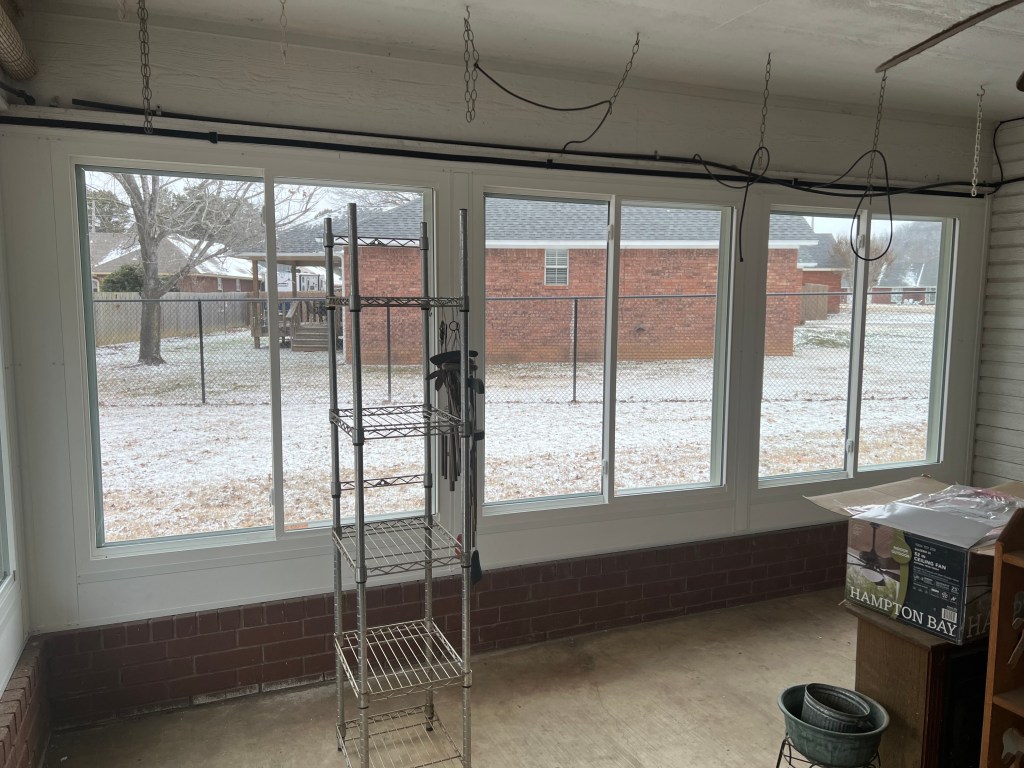
Melissa and I have been talking about installing a chain link fence along our back property line to provide more room for the dogs to play.  Melissa prefers a chain link fence over cedar slats as they are open and allow her to watch traffic around the neighborhood while she works.  We hired a contractor, and they came out this week to start the project.  The first step was to trim the brush back from along the back fence.  As the brush was being cleared, I noticed a broken bird bath that had been disposed of in the tree line.  While the pedestal was clearly broken, I thought I might be able to salvage the basin.  When I tried to move the basin, I was surprised at how heavy it was.  Using all my effort I was able to dislodge the basin from the soil and lift it to its side.  As I lifted the basin, a reddish-orange centipede scattered across the exposed ground to escape exposure to the sun.

When I went online, I found a centipede is an order of predatory arthropods belonging to the class Chilopoda.  The name comes from the Neo-Latin “centi” (hundred), and Latin “pes or pedis” (foot).  They are from the subphylum Myriapoda, an arthropod group which includes millipedes and other multi-legged animals.  Centipedes are elongated segmented (metameric) creatures with one pair of legs per body segment.  All centipedes are venomous and can inflict painful stings, injecting their venom through pincer-like appendages known as forcipules (toxicognaths), which are modified legs rather than fangs.  No centipede has exactly 100 pairs of legs.  Instead, the pairs range from 15 to 191 pairs, and there is always an odd number (mine had 17 pairs).  Centipedes are generalist carnivores and hunt any prey that can be overpowered and eaten.  They have a wide geographical range and can be found in terrestrial habitats from tropical rainforests to deserts.  Whatever habitat, they require a microhabitat that is moist as they lack the waxy cuticle of other insects and arachnids and will rapidly lose water.  Centipedes avoid direct sunlight by staying under cover or by being active at night.

The first year we moved back to Arkansas I decided to trim several of the tree branches that were scraping the car as I pulled into our drive.  After pruning the small limbs, I asked Melissa what I should do with them, and she told me they had always put these trimmings in the tree row along the back fence line.  I continued this practice for the next three years as the trimmings piled up.  Last year my neighbor cut down several wind damaged trees and severely pruned back three others.  I noticed he cut the limbs into 4-foot (1.2 m) lengths and then piled them up along the curb, but out of the gutter.  When I asked him about this, he informed me the city trash picked the limbs up on the first Monday of the month.  Melissa, her dad, and now I had been needlessly hauling the debris to the back of the yard.  I am now hauling my limb trimmings and yards debris out to the curb, and the contractor removed what had accumulated over the last 25 years.  We had created the perfect hideout for a centipede.

THOUGHTS:   I found out while I was writing my blog that Melissa had known about the city trash pickup all along.  Even knowing, she was trying to create a compost pile.  Limbs, leaves, old bulbs, and grass clippings had all been dumped in the tree line.  Had I known this, I would have been using the tree lines in a different manner.  There was never enough debris (or purposeful care) to create any compost, but there was enough to create a moist hideout for the centipede.  By avoiding sunlight and injecting their victims through their fang like legs, centipedes remind me of the tales of Dracula.  Our care for the earth cannot be haphazard.  A centipede may be able to survive on a decimated earth, humans not so much.  Act for all.  Change is coming and it starts with you.
Praetorius

January 04, 2024

Just after Christmas my local newspaper carried a USA Today article on the arrival of the first humans in North America.  Archaeologists have traditionally argued that people walked through an ice-free corridor that briefly opened between ice sheets an estimated 13,000 years ago (BP).  Human arrival was a hotly debated topic when I studied archeology at the University of Utah 40 years ago, but a growing number of archeological and genetic finds suggests people made their way onto the continent much earlier.  These early Americans likely traveled along the Pacific coastline from Beringia, the land bridge between Asia and North America that emerged during the last glacial maximum when ice sheets bound up large amounts of water causing sea levels to fall.  Research presented by Summer Praetorius at the American Geophysical Union Annual Meeting (AGU23) in San Franciso on December 15th said paleoclimate reconstructions of the Pacific Northwest hint that sea ice may have been one way for people to move south. 

The idea that early Americans may have traveled along the Pacific Coast is not new.  People were likely south of the massive ice sheets that covered much of the continent by at least 16,000 years ago, and then there are the human footprints in New Mexico dated to around 23,000 BP.  Since the ice-free corridor would not be open for another thousands of years for these arrivals, scientists proposed people may have moved along a “kelp highway”.  This theory holds early Americans slowly traveled down into North America in boats while following the bountiful goods found in coastal waters. This theory is supported by archeological evidence of coastal settlements in western Canada dating from as early as 14,000 BP.  However, in 2020 researchers noted that freshwater from melting glaciers may have created a strong current that would have made it difficult for people to travel along the coast.  Praetorius and her colleagues looked at tiny, fossilized plankton in ocean sediment from the coast to determine ocean conditions.  The abundance and chemistry of these organisms help reconstruct ocean temperatures, salinity, and sea ice cover. 

Praetorious and her team also used climate models and found that ocean currents were more than twice the strength they are today during the height of the last glacial maximum (20,000 BP) due to glacial winds and lower sea levels.  Paddling a boat against these currents would have been very difficult.  The records also showed that much of the area was home to winter sea ice until around 15,000 BP.  As a cold-adapted people, “rather than having to paddle against this horrible glacial current, maybe they were using the sea ice as a platform”.  The climate data suggests conditions along the coastal route may have been conducive to migration between 24,500 BP to 22,000 BP and 16,400 BP to 14,800 BP, possibly aided by the winter sea ice.  Most of the archeological sites associated with this migration are underwater, but the theory provides a new framework for understanding how humans may have arrived in North America.  This theory is not exclusive to other means of human migration.  Praetorious said, “We will always be surprised by ancient human ingenuity.”

THOUGHTS:  The surprise in ancient human ingenuity by Praetorious can only be matched by that of humans in general.  Humans as a collective consider, invent, and test innovative ideas to solve challenges and answer questions.  It is how we both create and transform society.  Human ingenuity also considers the consequences of our collective actions and how our decisions today will impact future generations.  This worked to get around/through the glacial ice.  This could also work to get around/through the issues of climate change.  Act for all.  Change is coming and it starts with you.

Winter Moth

January 03, 2024

Yesterday’s local newspaper carried a USA Today article on how the state of Rhode Island is dealing with unwanted visitors.  An invasive moth from Europe is causing widespread damage to hardwood trees and blueberry (section Cyanococcus within the genus Vaccinium) crops.  According to Alana Russell with the Department of Environments Management (DEM), infestations in Rhode Island were knocked down in coastal communities by introduction of a parasitic fly (Cyzenis albicans) that feeds solely on the moths and is not seen as a threat to other insects or vegetation.  Between 2011 and 2017 scientists from the University of Rhode Island and the DEM released 2000 flies into eight Rhode Island communities.  Testing for the presence of the winter moth is done by placing traps in trees with the pheromone of the female moth in order to attract and trap the males.

When I looked online, I found the winter moth (Operophtera brumata) is a moth of the family Geometridae.  The moth is an abundant species in Europe and the Near East and is a famous study organism for evaluating insect population dynamics.  It is one of the few lepidopterans (moths and butterflies) of temperate regions in which adults are active in late autumn and early winter.  The adults use internally generated heat (endothermy) for movement in cold temperatures.  The forewing color of the winged males varies from greyish yellow to beige-brown or a slightly reddish-tint.  The patterns are often band-shaped dark brownish, with a yellowish fringe.  The hindwings are pale grey or yellow grey.  The antennae are short and finely hairy.  The female winter moth has greatly reduced wings and are flightless.  Body length for adults of both sexes is around 0.4 inches (1 cm).  The larvae are 0.1 inches (2.5 mm) in length after hatching and grow to 0.75 inches (19 mm) over a six-week period.  After the first frost in late fall the females emerge from their pupae and move up the trees where they emit pheromones in the evening to attract males.  After fertilization, they move higher to lay an average of 100 eggs each.  The larger the female moth is the more eggs laid.  In North America, the winter moth can be confused with a related native species, the Bruce spanworm (Operophtera bruceata), and the two species have hybridized.

The winter moth is native to Northern and Central Europe and genetic populations in Europe are a result of recolonization following the last glacial period (12,000 BP).  The winter moth is considered an invasive species in North America with the first confirmed infestations in Nova Scotia, Canada, in the 1930’s.  It was later accidentally introduced to Oregon (1950’s) and Vancouver Island, British Columbia around 1970.  Defoliation by the moth was first noted in the US in eastern seaboard states in the late 1990’s.  The moth is now well established in Massachusetts, Rhode Island, Maine, and New Hampshire.  Expansion inland and north in New England appears to be curtailed by cold winter temperatures and the species is found along the coast but not far inland.  Milder winters from global climate change may be allowing local expansion of the moth’s territory.  A study conducted in Massachusetts documented that winter moth defoliation reduced the annual trunk diameter growth rate of oak trees by an average of 47% while not significantly impacting growth rates of the less defoliated maple trees.  Efforts at biological control are underway.

THOUGHTS:  The winter moth is believed to have arrived in North America from Europe along with infected nursery stock.  An article published in Molecular Ecology in 2021 suggested there were four successive invasions that account for the spread along the northern Atlantic and Pacific coasts of the continent.  That would imply negligence in shipping procedures throughout the 20th century.  What is the adage, “fool me once . . .”  Act for all.  Change is coming and it starts with you.