
Scarce

March 25, 2022

It took a long time after we lost Bella to work through our stages of grief.  I always liked dogs but enjoyed playing with other’s puppies more than the responsibility of raising one myself.  Melissa always had dogs and cats in the house growing up, and usually in multiples.  She has been testing the water for the last year wondering when we (I) might be ready for a puppy.  Melissa has combed the rescue sites and pound notices looking for the “right” dog.  Dogs have been scarce during the pandemic as everyone seemed to be wanting a companion to replace their office mates.  Several weeks ago, she found what she thought might be the dog for us.  We plan to pick up the 8-week-old puppy this evening.

When I went online, I found that animal welfare advocates are warning scarce adoptable pets in some US states corresponds with a break in the supply chain, and that other shelters continue to face floods of stray animals.  While northern states have seen a surge in pet adoptions that have cleared some shelters, southern states face the same annual influx of new animals.  Matthew Bershadker, CEO of the American Society for the Prevention of Cruelty to Animals (ASPCA) told NPR that on average about 45,000 southern animals are transported north each year to states with emptier shelters.  The northern carpetbaggers after the Civil War have been switched to the southern flea-baggers of the pandemic.

The pandemic has led to varying domestic travel restrictions and hindered the transportation networks to move animals to more scarce population shelters.  There has been a decline in donations to shelters as millions of Americans file for unemployment and emptied shelters do not have the resources to obtain more animals.  Jean Shafiroff, an ambassador for the American Humane Society, said she’s happy some shelters have been cleared but she is concerned that once social distancing guidelines are scaled back some will decide to return their pets.  She also worries reports of scarce shelter animals could deter people from adopting animals.  “To say that there is a shortage of adoptable dogs and cats when between one and two million are euthanized every year makes no sense,” Shafiroff said. “A lot of dogs have been adopted now but not that many.  It does not appear that we’ll ever have a shortage.”  Like other supply chain issues, it is just a matter of getting adoptable pets to available owners.

THOUGHTS:  While many consider monetary donations to a local pet rescue shelter, there are other ways to help.  Donating your time is one of the most impactful, as many shelters need help cleaning, caring for the animals, and keeping the facility in good condition.  If you have a talent or hobby like photography or videography you may help by highlighting one of the available pets.  Gently used items from previous pets can be donated to provide extra supplies.  General cleaning supplies are always in need (especially newspapers!).  Always check with your local shelter for their donation needs and how you can best use your time and talents.  Follow the science.  Do the work.  Change is coming and it starts with you.

Anomie

March 24, 2022

When I pulled up my NY Times feed yesterday it reported the rising number of mass shootings in the US.  Crime experts define a mass shooting as an event where four or more people are shot.  Last weekend, there were at least nine mass shootings across the US, including one in my home state at a car show.  Ironically, the annual car show is held against gun violence.  The burst of weekend crime violence continues a trend that began in the outset of the pandemic and shows no sign of easing.  Reporter David Leonhardt wrote there is no good answer for the crime wave, and it appears to be a distinctly American response to the pandemic.  Historians point out crime waves often occur when people feel frustrated with society, the government, and their fellow citizens.  This frustration can feed a breakdown in societal norms and a rise in what sociologist Émile Durkheim (1893) called “anomie.”

When I went online, I found Anomie is a social condition defined by a breakdown of moral values, standards, or guidance for individuals to follow.  Anomie was thought to evolve from a conflict of belief systems and causes a breakdown of social bonds between an individual and the community.  Personal alienation can progress into an inability to integrate with normal situations of the social world, like finding a job or a successful relationship.  Durkheim used anomie to refer to the effects of industrialization in Europe.  The contemporary understanding of anomie accepts greater flexibility in the “norm”, and some have used the idea of normlessness to reflect a situation like the idea of anarchy.  However, for Durkheim and later theorists’ anomie is a reaction against the social controls of society, while anarchy is a state of disorder due to absence or rejection of authority or other controlling systems.

In the 1950’s Robert Merton extended the theory of anomie to the US and argued anomie is not simply about unregulated goals, but a broken relationship between cultural goals and legitimate means of accessing them.  Merton argued everyone in the US is socialized to believe that their possibilities, regardless of their circumstances, are limitless and that they should desire success on a large scale.  However, society restricts or eliminates access to approved ways of acquiring these symbols of success for a considerable part of the population.  Those in lower economic classes may share the goal of success but are limited by lack of education and job opportunities. The mismatch between goals and opportunity creates anomie and can result in increased crime.

THOUGHTS:  According to Gallup, nearly 80 percent of Americans are dissatisfied with the country’s direction and feel frustrated with the government, the economy, and fellow citizens.  Many consider people with opposing political ideas are so wrong they do not deserve to express their views.  Polls show an alarming degree of skepticism about democracy and an openness to political violence.  Along with alienation, a wide range of behavior has deteriorated.  Alcohol abuse and drug overdoses have increased, blood pressure is up, measures of mental health are down, and vehicle crashes have surged.  The anomie created by the shift to industrialization has been replaced by the anomie brought on by globalization.  This turmoil will continue to rise until society (and individuals) decide to make opportunity available for all.  Do the work.  Change is coming and it starts with you.

Eagle

March 23, 2022

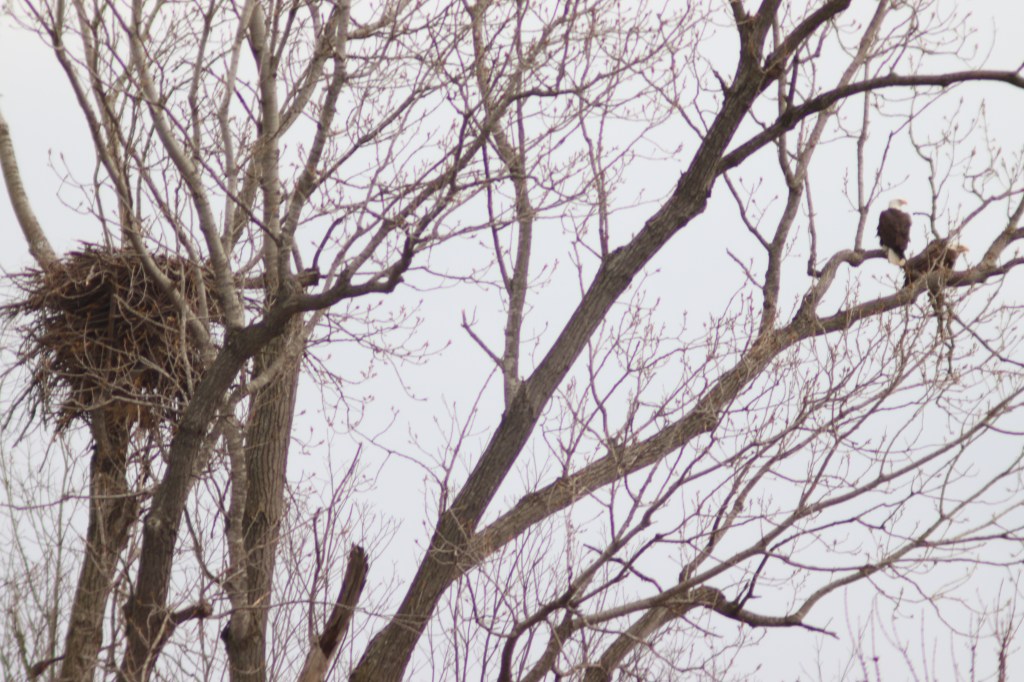
Melissa has a friend who has been texting her about the crappie run along the Arkansas River bottoms.  She sent me the link and suggested I see if this was an accessible location for us to fish.  Many areas along the river have steep banks and others are overgrown with trees which make it difficult for fly fishing.  The location was an hour and a half away, but I decided to check it out.  I followed the directions along a levee road and ultimately to a small boat launch.  This area did not seem accessible for bank fishing.  As I prepared to leave a bald eagle flew across the river.  I waited and moments later it flew back with a fish grasped in its talons.  The eagle circled and then flew to its nest (aerie) located in a tree just 100 yards from me.

When I looked online, I found it takes the bald eagle (Haliaeetus leucocephalus) four feather shedding’s (molt) and almost five years to obtain their white head.  Both the male and female eagle have their distinctive white heads when they reach maturity at five years and will start breeding.  A bald eagle spends most of its juvenile years covered in dark feathers, anywhere between brown and black.  With each yearly molt the eaglet comes closer to its definitive color, but its plumage goes through four different stages during these molts.  The head stays mostly brown before maturity, while the rest of the feathers go from dark to light and back to brown again.  The eagle mates for life and the pair will often return year after year to the same nest.  While nesting, the pair continuously adds to the structure.  After many seasons the nest can assume gargantuan proportions and stands as a symbol of their fidelity.

As I watched the nest, I noticed the eagle sharing the fish with another bird.  I thought it might be a chick, but the bird was too large, and it was too early in the season for eaglets.  It did not look like the second bird had the characteristic white head and I thought it must have been a younger eagle coming into maturity.  While eagle courtship rituals are spectacular displays of aerial acrobatics, it is nest building that cements the bond between male and female.  The male stays with the female to help incubate the eggs and feed the offspring.  According to Wayne Mones, “monogamy is advantageous only when nesting and parenting responsibilities demand an extraordinary investment of energy by both parents.  When the two flew over to a nearby branch I saw they both had white heads.  They were a mated pair reclaiming their nest for the spring.

THOUGHTS:  Contrary to popular legend, there is no evidence that Benjamin Franklin publicly supported the wild turkey (Meleagris gallopavo) rather than the bald eagle as a symbol of the US.  However, in a letter written to his daughter in 1784 he stated his personal distaste for eagle behavior.  “For my own part.  I wish the bald eagle had not been chosen the representative of our country.  He is a bird of bad moral character.”  Franklin believed our founders focused on perception when choosing the national bird.  Human prejudice also relies on perception rather than actions.  Looking the “right” way does not imply good character.  Character is determined by how we treat each other.  Do the work.  Change is coming and it starts with you.

Hotter

March 21, 2022

The Nation & World section in yesterday’s newspaper blared the headline, “Antarctica, Artic 70 and 50 degrees above normal”.  The AP reporter went on to say what made this unique was that both the earth’s poles were hotter at the same time.  Weather stations in Antarctica shattered records Friday as the region neared autumn.  The two-mile high (3,234 meters) Concordia station was at 10F (-12.2C), which is 70 degrees warmer than average.  The even higher Vostok station was barely above 0F (-17.7C), beating its record high by 27F degrees (15 degrees Celsius).  Officials at the National Snow and Ice Data Center in Boulder, Colorado, were surprised as they had been monitoring the Arctic where temperatures were 50F (30C) warmer than average and areas near the North Pole were nearing or at the melting point.  These high temperatures occurred as the northern hemisphere entered spring and the southern hemisphere entered autumn.

When I looked online, I found the Earth’s tilted axis causes seasons.  During the year different parts of the Earth receive the Sun’s most direct rays.  When the North Pole tilts toward the Sun, it is summer in the Northern Hemisphere, and when the South Pole tilts toward the Sun, it is winter in the Northern Hemisphere.  There is a common (incorrect) belief that the Earth is closer to the Sun in the summer (hotter) and is farther from the Sun (cooler) in the winter.  The Earth’s orbit is lop-sided and during part of the year the Earth is closer to the Sun than other times.  In the North, we have winter when Earth is closest to the Sun and summer when it is farthest away.  This change in the Earth’s distance through the year does not have a perceptible influence our weather.  The seasons are the result of the tilt of the axis, rather than distance to the sun.  The Earth has seasons because the axis does not stand up straight.

When I read newspaper reports I try and find corroborating reports from other online sources.  When I typed in my request, I found a (nearly) identical story by the same author dated today titled, “Hot poles: Antarctica, Artic 40 and 30 degrees above normal”.  What I realized was the Sunday article was written for the Associated Press (AP) and was directed toward a US audience.  Today’ report was picked up by Connected TV (CTV) which is internet based for a global audience.  Both articles were saying the poles were getting hotter but hidden within the articles were correlations of Fahrenheit to Celsius.  The Antarctic is 70F above normal, or 40C, while the Arctic is 50F above normal, or 30C.  Either way it is not good, but the difference may affect the perceived urgency of the problem.  

THOUGHTS:  How we collect, and report information can dramatically change interpretation by the public.  Melissa and I watch local broadcast news during the evening (6 and 10 pm) and alternate between two stations.  Both reports each station are essentially the same during their early and late broadcast, but one seems to focus on Northwest Arkansas and the other on Fort Smith.  We alternate to get a broader perspective.  This difference is marked between the 24-Hour news stations and seem based on political ideology.  When we exclude any viewpoints other than our own, we can miss the urgency of the problem.  This only makes the dialogue hotter.  Do the work.  Change is coming and it starts with you.

Brackets

March 19, 2022

I am playing the NCAA Men’s Tournament Challenge again this year.  Last year I filled out one bracket and then completed the bracket I found in my local paper.  This year I got excited and filled out five brackets online, as well as my hard copy.  The site allows each person to complete 25 brackets.  I stopped at five because I could no longer keep track of what I had predicted.  As the first round ended on Friday it did not seem to matter as I had losses in all six of my brackets.  I was comforted by the fact that in 10 of the 32 games the lower seed defeated the higher seeded team.  While many of these games were not considered upsets, there were two games where the 12 seed knocked off the 5 seed (common) and one where the 2 seed lost to a 15 (rare).  When I checked the stats, out of 17.3 million brackets, they all had at least one wrong prediction.

When I looked online, I found there have been 52 upsets by 12-seeds since the NCAA expanded the tournament brackets in 1985.  Going into 2022, the lower seed was 51-93 (35.42%).  That percentage went up again this year, as two of the four 12 seeds won round one games.  The average margin of victory in 2 verses 15 matchups since expansion has been just over 17 points per game, and that includes the eight times a 15 seed has beaten a 2 seed.  The games are not typically competitive, but the lower seed comes in knowing they have nothing to lose and everything to gain.  It happened again this weekend, as Saint Peter’s defeated a 2 seed Kentucky team many had picked to win it all.  There is always hope.

The only 1 seed to lose to a 16 happened in 2018, when the University of Maryland, Baltimore County (UMBC) Retrievers defeated the Virginia Cavaliers and became an overnight sensation.  By the end of this weekend there will be 16 teams left in the brackets.  Of these 16, I potentially have 15 teams that could move on, and all my selections for the elite eight are playing well.  Even as I write, another 1 seed fell to an 8.  As always, it will be a long three weeks.  Maybe I should just go fishing.

THOUGHTS:  I enjoy picking tournament brackets even though I am not very good at it.  The other side of the tournament is the billions of dollars expected to be wagered by Americans.  The American Gaming Association estimates 45 million people could combine to wager $3.1 billion on the NCAA tournament through bracket pools and wagers with sportsbooks and friends.  The $3.1 billion is approximately three times more than was estimated bet on the 2022 Super Bowl.  I would bet most of these people were not very good at it either.  While a 1 can defeat a 16, the house will always win.  Do the work.  Change is coming and it starts with you.
Driverless

March 18, 2022

One of the articles on the inside of my newspaper this morning addressed the use of driverless vehicles.  Americans have been told for years that autonomous technology was improving and driverless vehicles were just around the corner.  Now the first fully automated vehicles are set to roll out by the end of the year.  These are not improvements to the current crop of driverless cars or even full sanction of the semi-trailer trucks that drive across the southwest.  The driverless age is coming to the farm.  This fall the John Deere factory in Waterloo, Iowa, is rolling out green 14-ton tractors that can plow day or night with no one sitting in the cab, or even watching.  The age of driverless farming is here.

When I looked online, I found the Society for Automotive Engineers (SAE) defines six levels of driving automation.  In Level 0, the automated system issues warnings and may momentarily intervene but has no sustained vehicle control.  Level 1 is “hands on”, where the driver and the automated system share control of the vehicle (cruise control or automatic emergency braking).  Level 2 is “hands off”, where the automated system takes full control of the vehicle, but the driver monitors and is prepared to intervene immediately.  Level 3 is “eyes off”, where the driver can safely turn their attention away from driving but must still be prepared to intervene when required.  Level 4 is “mind off”, where no driver attention is required for safety, but self-driving is only supported in limited areas (geofenced) or special circumstances.  Level 5 is “steering wheel optional”, where no human intervention is required at all.

It is no surprise driverless tractors are beating cars.  One problem faced by autonomous systems is humans doing foolish things in their path.  There are fewer obstacles (and humans) in a field to avoid.  If something unexpected present itself, the system is designed to stop until it is cleared.  Given that less than 2% of Americans work on farms and rural populations have dwindled for decades, the autonomous tractors are expected to help with chronic labor shortages.  The shift to more sophisticated tractors is part of a movement that emphasizes planting, fertilizing, and harvesting during narrow time windows when conditions are perfect.  A driverless tractor can work around the clock and complete the task before bad weather.  That could be worth thousands or tens of thousands of dollars every year.  CNH Industrial is developing driverless capabilities for its Case and New Holland tractors, and other companies are exploring smaller autonomous machines to handle other farm work.  Jobs are not lost if no one will do the work.

THOUGHTS:  There are 80 companies researching driverless capabilities on 1400 vehicles.  While fully autonomous vehicles are not available in the US, some cars already operate with minimal human assistance and others are expected to run without human drivers in the future.  Automobile accidents (with human drivers) are the leading cause of death among healthy people in the US.  Statistics show 40,000 people are killed in vehicle accidents every year and nearly 2.5 million are seriously hurt or permanently disabled.  Even with driverless vehicles there will be accidents resulting from human error.  In our litigious culture, who do you sue when a driverless car is in an accident?  Do the work.  Follow the science.  Change is coming and it starts with you.

Patrick

March 17, 2022

I woke early this morning with the “ding” of my phone letting me know I had received a text message.  I paid no attention and tried to go back to sleep, but five minutes later received the follow-up “ding” letting me know I had ignored the first one.  This was the start of a lively back and forth conversation (and dings) between my sibs concerning the celebration of St. Patrick’s Day.  Today’s chat was a continuation of last night when my brother-in-law (part Irish) sent a reminder that we needed to celebrate Patrick.  I would like to blame him for my early rise, but apparently Melissa had finally gotten around to looking at the feed and started this morning’s conservation.  Since I was constantly being dinged anyway, I decided to get up. 

When I looked online, I found Patrick was a 5th-century Romano-British Christian missionary and Bishop in Ireland.  Patrick died before the formal canonization of saints began in the 12th century.  He instead became a saint by popular acclaim, probably with the approval of a bishop.  Much of what is known about Patrick comes from the Declaration, which he allegedly wrote.  It is believed he was born in Roman Britain in the fourth century, into a wealthy Romano-British family.  His father was a deacon, and his grandfather was a priest in the Christian church.  He was kidnapped at the age of 16 by Irish raiders and taken as a slave to Gaelic Ireland.  Patrick spent six years working as a shepherd, and it was during this time he found God.  God told Patrick to flee to the coast where a ship was waiting to take him home.  Patrick became a priest after making his way home.  Patrick returned to Ireland to convert the Irish to Christianity, and spent his remaining years evangelizing in the northern half of Ireland.

Saint Patrick’s Day is held on March 17th, the traditional date Patrick died (c. 385 – c. 461), to honor Ireland’s patron saint.  The day was made an official Christian feast in the early 17th century and is observed by many liturgical Christian denominations.  The day commemorates Patrick and the arrival of Christianity in Ireland, as well as celebrating Irish heritage and culture.  Celebrations involve parades, festivals, social gatherings with traditional Irish or Scottish music, dancing, and storytelling (called céilís), and the wearing of green attire or shamrocks.  Christians attend church services, and as a feast day the Lenten restrictions on eating and drinking alcohol were lifted for the day, encouraging, and propagating the day’s tradition of alcohol consumption.

THOUGHTS:  Patrick’s efforts toward conversion turned into an allegory in which he drove “snakes” out of Ireland, even though snakes were not known to inhabit Ireland.  Patrick became a saint as the “people’s choice” rather than canonization.  Over the following centuries, legends grew up around Patrick and he became Ireland’s foremost saint.  The hold of Patrick and his celebration still seems to exist today.  What other day would tempt you to pinch your mother and drink green beer?  Do the work.  Follow the science.  Change is coming and it starts with you.
Ides

March 16, 2022

While yesterday was the Ides of March, I did not want to write about it on the actual day.  Some might think I was waiting to see what happened before I put pen to paper.  Afterall, you never really know, right?  Your best friend might decide to stab you in the back (literally).  Obviously, that did not happen, or I would not still be blogging today.  I have always been intrigued by what “ides” meant.  I have heard that anything I really care about, I would research to find out what it meant.  While I am not sure “ides” meets those criteria, I decided to look it up anyway.

When I looked online, I found the definition of ides refers to the 15th day of March, May, July, or October or the 13th day of any other eight months in the ancient Roman calendar.  This can also broadly refer to this day and the seven days preceding it.  The Romans did not number each day of a month from the first to the last day.  Instead, they counted back from three fixed points of the month: the Nones (the 5th or 7th, nine days inclusive before the Ides), the Ides (the 13th for most months, but the 15th in March, May, July, and October), and the Kalends (1st of the following month).  Originally the Ides were supposed to be determined by the full moon, reflecting the lunar origin of the Roman calendar.  In the earliest calendar, the Ides of March would have been the first full moon of the new year.  Now I know.

Today, the Ides of March is best known as the date on which Julius Caesar was assassinated in 44 BCE.  Caesar was at a meeting of the Senate when as many as 60 conspirators stabbed him to death, including Brutus and Cassius.  According to Plutarch (Roman historian), a seer had warned Caesar that harm would come to him on the Ides of March.  On his way to the Theatre of Pompey where he would be assassinated, Caesar passed the seer and laughed, “Well, the Ides of March are come”, implying that the prophecy had not been fulfilled, to which the seer replied “Aye, they are come, but they are not gone.”  This meeting is famously dramatized in William Shakespeare’s play Julius Caesar, when Caesar is warned by the soothsayer to “beware the Ides of March.” 

THOUGHTS:  Caesar’s death triggered the civil war that resulted in the rise to sole power of his adopted heir Octavian (later called Augustus).  On the fourth anniversary of Caesar’s death in 40 BCE Octavian executed 300 senators who fought against him to avenge Caesar’s death.  Perhaps there is more to beware in the ides than we might think.  Unlike Caesar and Octavian, we need to pay more attention to what is to come than what has gone before.  We have no ability to change what has happened.  However, our attitude and response directly impact what is to occur.  We cannot forget history, but we can use history to make better choices in the future.  Do the work.  Follow the science.  Change is coming and it starts with you.
Fox

March 15, 2022

I received a text from Melissa today that while she was working in her kitchen office about a red fox that had run across the back of our property.  The two dogs who Eddie was in conversation with over the last weeks have also made a habit of running to the back of their yard and barking at nothing.  The division between our yard and the church property behind us has a thick (10 feet/3 meter) line of trees that separates us.  While it has always seemed the dogs were barking aimlessly, I wonder if instead they had seen (sensed?) the fox and that was what had set them off.  While the fox was beautiful to see, it quickly passed through the yard, across the open field, and was gone in a matter of seconds.

When I looked online, I found the red fox (Vulpes vulpes) is the largest of the true foxes and one of the most widely distributed members of the order Carnivora.  The fox is found across the Northern Hemisphere including most of North America, Europe, and Asia, plus parts of North Africa.  Apart from its large size, the red fox is distinguished from other fox species by its ability to adapt quickly to new environments.  Despite its name, the species often produces individuals with a variety of other colorings.  Forty-five subspecies are currently recognized, which are divided into the large northern foxes and the small southern grey desert foxes of Asia and North Africa.  Red foxes are usually together in pairs or small groups consisting of families.  The young of the mated pair remain with their parents to assist in caring for new kits.  The fox primarily feeds on small rodents, though it may target rabbits, squirrels, game birds, reptiles, invertebrates, and young ungulates (hoofed mammals).  The fox is vulnerable from larger predators, including wolves, coyotes, eagles, and large cat species.

This fox species has a long history of association with humans, having been extensively hunted as a pest and furbearer for centuries, as well as being represented in folklore and mythology. Because of its widespread distribution and large population, the red fox is one of the most important furbearing animals harvested for the fur trade.  Since it is too small to pose a threat to humans, it has benefited from the presence of human habitation.  The fox has successfully occupied many suburban and urban areas.  Domestication of the red fox is also underway in Russia and has resulted in the domesticated red fox.  While the fox seen by Melissa was not domesticated, it had been urbanized.

THOUGHTS:  The range of the red fox has continued to increase alongside human expansion.  The foxes were established in Australia through successive introductions in 1830’s and 1840’s by British settlers who wanted to foster the traditional English fox hunt.  The species is an apex predator on the mainland but is less common in areas where the dingo is prevalent.  Still, the red fox has been implicated in the extinction or decline of several native Australian species.  The spread of red foxes across the southern part of the continent coincides with the spread of rabbits (another invasive) in Australia and corresponds with declines in the distribution of several medium-sized ground-dwelling mammals.  The red fox is included on the list of the “world’s 100 worst invasive species”.  Hardly a desirable list to be noted on.  Once more, one person’s sport is another’s bane.  Follow the science.  Change is coming and it starts with you.
Tulip

March 14, 2022

On our way home Sunday, we dropped by our friend’s house to pick up supplies for the display Melissa is planning for the local Farmer’s Market in May.  They had made a run to Florida and as always hit the flea markets and garage sales along the way.  This provides the items for her resale business, and she had picked up a variety of interesting pot for Melissa’s succulents.  We took this opportunity to say hello to Eddie.  Eddie had been ecstatic when they picked him up two days ago and was now again ecstatic to see us.  You have got to love puppies.  As we drove out of their subdivision, we noticed a tulip tree in full bloom on one of the street corners.  It was too early for the tree to bloom, but this year’s temperature fluctuations make the plants crazy.

When I looked online, I found the tulip tree (Liriodendron tulipifera), also called the tulip poplar, yellow poplar, or canoe wood, is one of the largest native trees in North America.  Liriodendron is a genus of two species of large deciduous trees in the magnolia family (Magnoliaceae).  The tree is widely known by the common name for the large flowers superficially resembling tulips.  The botanical name originates from Greek, as Liriodendron means “lily tree”, and tulipifera means “bringing forth tulips”.  There are two extant species, the Liriodendron tulipifera is native to eastern North America, and the Liriodendron chinense is native to China and Vietnam.  Both species can grow to great size.  The North American species reaches a mature height of 70-90 feet (21-27 meters) and a width of 35-50 feet (10-15 meters).  In the small valleys of Appalachia (cove forests) the tree is known to reach the height of 191.8 feet (58.49 meters).

The tulip tree produces goblet-shaped, orange-yellow-green flowers in late spring after the leaves have already emerged.  The cone-like seed clusters sit upright on the branches.  The tree provides many forms of food for animals.  In fall and winter, young trees are browsed by white-tailed deer and rabbits.  The spring flowers provide nectar for ruby-throated hummingbirds.  Tulip tree seeds mature in summer and persist into winter, providing food for both birds (finches, cardinals, and quail) and mammals (mice, squirrels, and rabbits).  The golden-yellow fall color of makes it an excellent choice for large landscapes.  This tulip fit well on the corner lot of the subdivision.

THOUGHTS:  The tulip trees of North America are commonly used horticulturally.  The tulip was favored by loggers for railroad ties and fence posts and are now used for furniture.  George Washington planted tulip trees at Mount Vernon which are now 140 feet tall.  Canoe wood refers to the tree’s use in construction of dugout canoes by eastern Native Americans, and Daniel Boone used the wood of this tree for his 60′ canoe.  While the tulip tree is sought after for its tall, straight trunks, the tree has grown in popularity as an ornamental landscape feature.  Its size requires a large lot, but when allowed to mature it creates an impressive display throughout the year.  When we nurture and allow our youth room to mature, they also have the potential to be impressive.  Nurture seems to be a greater force in shaping a child than nature.  The potential is there for them all.  Do the work.  Change is coming and it starts with you.