Smallmouth

June 30, 2025

My MSN browser scroll included an article on the attempts to eradicate an invasive fish from a midsized lake in the Adirondacks.  While the fish are native to North America, they were introduced widely across the Adirondacks in the 1900’s, where they took over many lakes.  Their arrival led to declines of native fish species and stunting of growth rates in prized brook and lake trout, which compete for the same prey.  A study published in the journal Proceedings of the National Academy of Sciences revealed that in response to the annual removal of a quarter of the invasive fish from the lake, the numbers of fish 5 inches (12.7 cm) and under have increased while fish larger than 12 inches (30.5 cm) were mostly eliminated.  The findings have important implications for fish management.  It highlights the importance of preventing non-native species invasions before they happen and illustrates how efforts to suppress a species may backfire, leading to the opposite effect.  The smallmouth bass rapidly evolved to grow faster and invest more in early reproduction, leading to an even larger population of smaller fish.

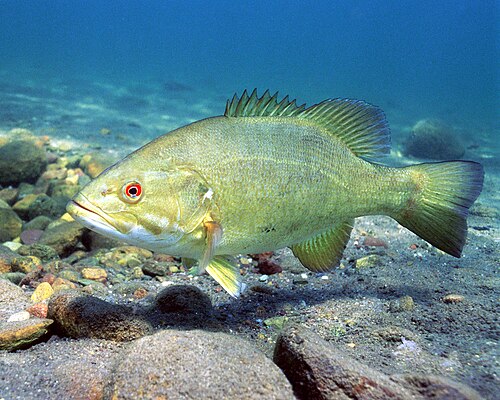
When I went online, I found the smallmouth bass (Micropterus dolomieu), also known as brown bass, bronze bass, and bareback bass, is a freshwater fish in the sunfish family (Centrarchidae).  It is the type species of its genus Micropterus (black basses) and is a popular game fish throughout the temperate zones of North America.  Males are generally smaller than females. The males tend to range around two pounds, while females can range from three to six pounds.  The maximum recorded size is approximately 27 inches (69 cm) and 12 pounds (5.4 kg).  The color of the smallmouth ranges from golden olive to dark brown dorsally which fades to a yellowish white ventrally with dark brown vertical bars or blotches along the body and dark brown horizontal bars on the head.  The combination of muscular fusiform body shape and camouflage like coloring make these fish highly effective ambush predators.  The color varies greatly depending on age, habitat, water quality, diet, and the spawning cycle.  The fish has spread through stocking, along with illegal introductions, to many cool-water tributaries and lakes in Canada and especially the US.  

Peter McIntyre, professor in the departments of Natural Resources and Ecology and Evolutionary Biology and among the senior authors, said, “Twenty-five years ago, Cornell’s Adirondack Fishery Research Program set out to test whether we could functionally eradicate smallmouth bass from a lake.  It took us 25 years to prove why the answer is no: the fish evolved to outmaneuver us.”  Efforts began in 2000 to suppress bass in Little Moose Lake in the Adirondacks by using a generator to electrify the water to temporarily stun fish (electrofishing).  Scientists then scooped them up, released the native species back into the lake, and removed all captured bass.  The removal of 1000’s of fish worked for several years, then the smallmouth began to make a comeback, especially the smaller fish.  Genetic analysis revealed that selection pressures from removing fish resulted in dramatic genetic changes between 2000 and 2019 in the genomic regions associated with increased growth and early maturation.  

THOUGHTS: The introduction of smallmouth bass to the mountain lakes presented a new apex predator.  The brook (Salvelinus fontinalis) and lake (Salvelinus namaycush) trout are threatened by warming surface waters and depleted oxygen levels in cooler deeper water during the summer, and then competition with the smallmouth.  The genetic evolution resulted in a lose-lose for anglers.  The trout are disappearing, and the smallmouth are too small to keep.  Ecosystems are delicate balance and human intervention is rarely positive.  Act for all.  Change is coming and it starts with you.
Leafcutter

June 29, 2025

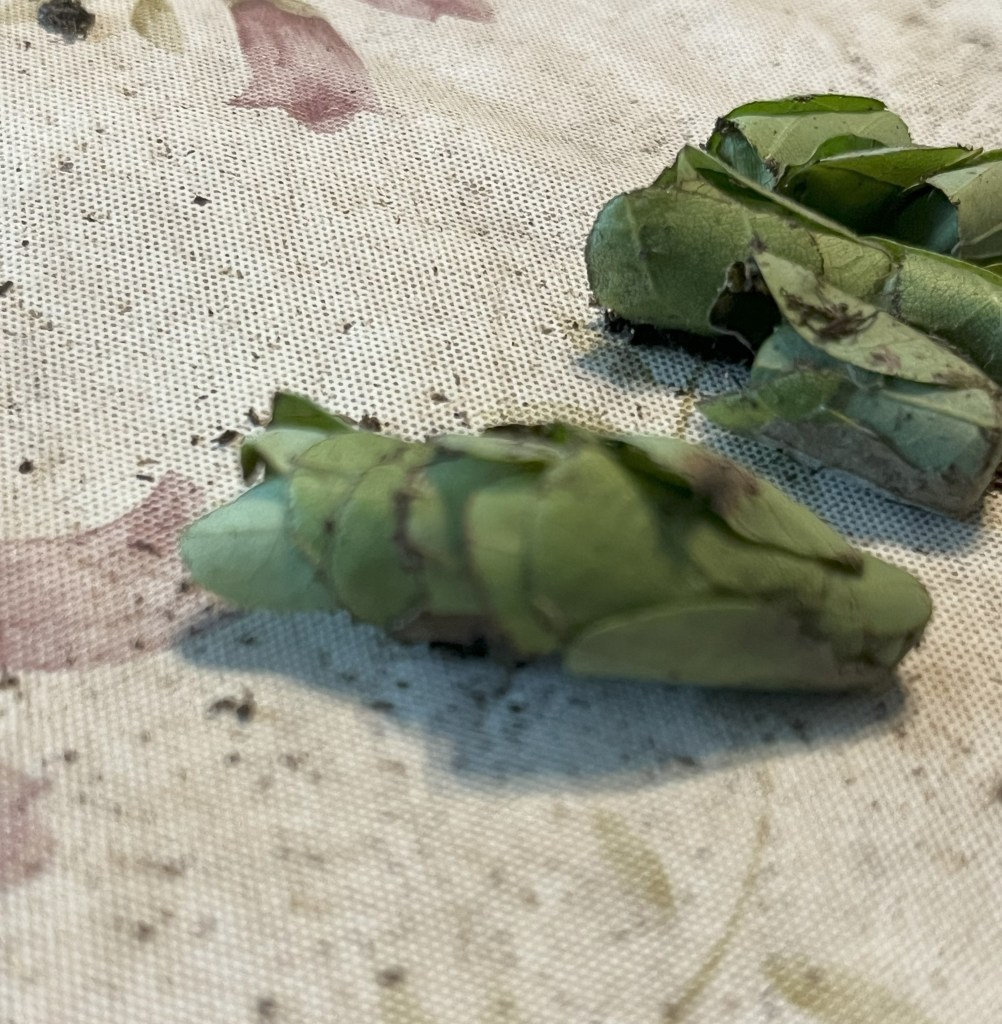
Melissa went shopping with me yesterday to get out of the house.  I needed to get some roasted peanut chips for the birds and Melissa wanted to look at the succulents.  She was surprised by the large number of inexpensive arraignments, and by their state of disrepair.  They were all soaked in water (causes root rot) and the leaves were starting to fall off.  Melissa bought a large arraignment to divide into separate plants and try and save them.  As we were checking out, I mentioned to the attendant that the plants were getting too much water.  She agreed and said she had also bought several to save them from dying.  When we got home Melissa began dividing the arraignment and repotting them into a cactus medium.  The plants were in potting soil (retains water) rather than cactus medium and the bright containers were made of plastic (retains heat).  Each of the plants were root-bound from their previous pots and the soil had not been broken up.  As Melissa dug through the potting soil she came across what looked like a leaf tube buried deep in the soil.  When she googled the odd structure, she found it was the egg nest of a leafcutter.

When I went online, I found leafcutter bees (Megachilidae), are part of a widespread (cosmopolitan) family of mostly solitary bees.  Characteristic traits of this family are the restriction of their pollen-carrying structure (scopa) to the ventral surface of the abdomen, rather than on the hind legs as in other bee families, and their typically elongated flap-like structure immediately in front of the mouth (labrum).  The scientific name Megachilidae refers to the genus Megachile, translating roughly as large lipped (Ancient Greek mégas – “big” and kheîlos – “lip”).  Their “large lips” and strong jaws are well-suited for collection of building materials for the nest.  These bees get their names from the materials they use to build their nest cells.  Leafcutter bees use leaves while mason bees use soil.  A few species collect plant or animal hairs and fibers (carder bees) while others use plant resins in nest construction (resin bees).  All species feed on nectar and pollen, but a few are kleptoparasites, which feed on the pollen collected by other megachilid bees.  The parasitic species do not possess scopae.  North America has an estimated 630 different megachilid species.  Most are native but a few are introduced, accidentally and intentionally.  Globally the number of species identified exceeds 4,000 and represents 15% to 20% of named species of bees.

The Nonparasitic Megachilidae divide their nests into cells with each cell receiving a supply of food and an egg.  The larva hatches from the egg and consumes the food supply.  After molting a few times, it spins a cocoon and pupates, then emerges from the nest as an adult.  Males die shortly after mating, but females survive for another few weeks, during which they build new nests.  Nest cavities are often linear, like the one found by Melissa, but not always.  Above ground megachilid bees are more commonly cultivated than ground nesting bees.  They accept nesting materials made from hollow stems, tubes, and blocks with preformed holes (“nest blocks”), and several megachilids have become important species for agricultural or horticultural pollination.  In North America these cultivated bees include the introduced alfalfa leafcutter bees (Megachile rotundata), used extensively in alfalfa pollination, and the orchard mason bee or blue orchard bee (Osmia lignaria), used in orchard pollination.  Other species are also in commercial use in North America, Europe and Asia.

THOUGHTS: Arkansas is home to at least 40 species of bees and the genus Megachile, has an estimated 15 to 20 species, including many leafcutter species.  Finding the nest tube of a leafcutter bee shows how easy it is to transport a species to another area.  While the leafcutter is beneficial, not all invaders are.  People criticize states like California which have tight controls on agricultural products.  Perhaps we should all be vigilant.  Act for all.  Change is coming and it starts with you.
Cucumber

June 27, 2025

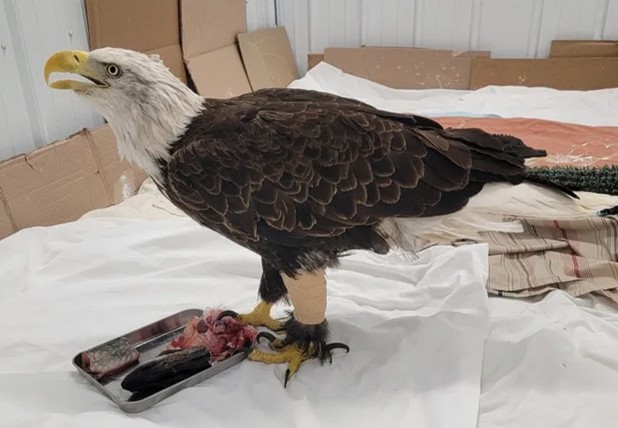
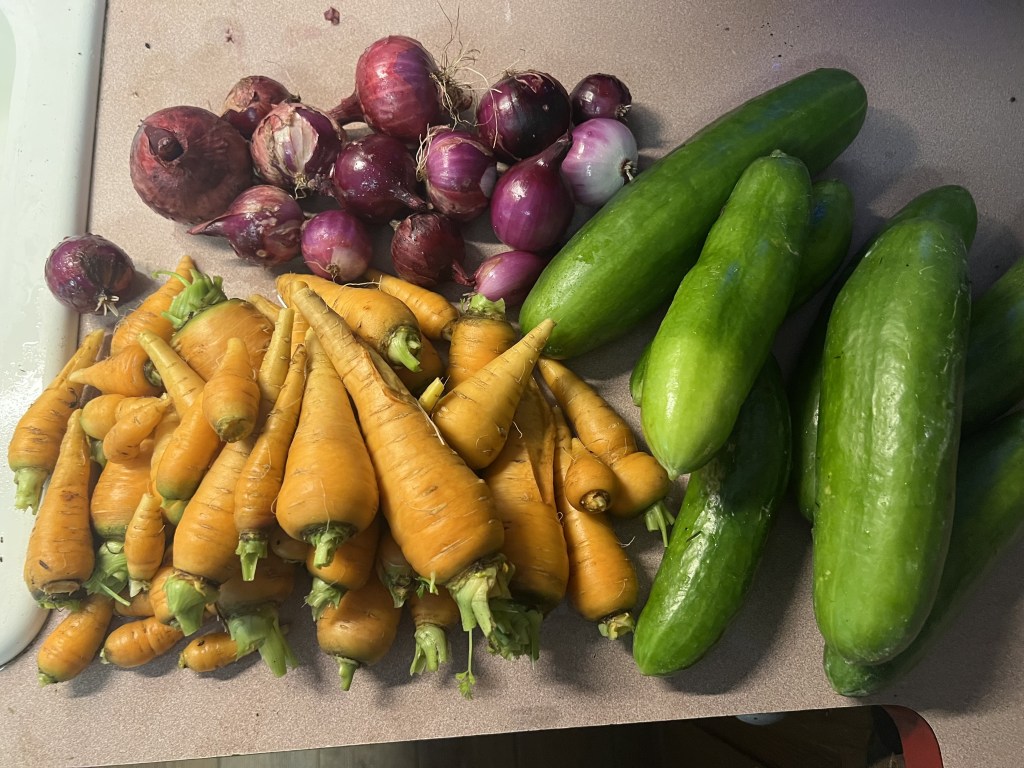
Earlier this month I commented on the pickling I was doing.  That post mentioned the sliced cucumbers I use in a variety of salads.  This year I decided to grow “pickling” cucumbers.  I enjoy dill pickles, so I ended up canning 11 jars of dill pickle spears and three jars of dill pickle slices.  The slices are the result of having to cut more off the ends of the spears to get them into the pint jars I used for canning.  The cucumbers have excellent taste, and I am looking forward to trying my first jar of dill pickles.  While some vegetables produce a single crop at around the same time, cucumbers do not.  I waited for the cucumber to grow and discovered when a pickling cucumber gets large (over about 8 in/20 cm) the seed becomes a prominent feature of the eating experience.  I now harvest daily to ensure the fruits do not grow too large.   I bring in a bag of cucumber every morning. 

When I went online, I found cucumber (Cucumis sativus) is a widely cultivated creeping vine plant in the family Cucurbitaceae that bears cylindrical to spherical fruits elongated with tapered ends.  The fruit may grow as large as 24 inches (62 cm) long and 4 inches (10 cm) in diameter.  Cucumber is considered an annual plant whose fruits consist of 95% water.  There are three main types of cucumber (slicing, pickling, and seedless) within which several cultivars have been created.  The cucumber originates in Asia, extending from India, Nepal, Bangladesh, China (Yunnan, Guizhou, Guangxi), and Northern Thailand.  The plants are now grown on most continents and many different types of cucumber are grown commercially and traded on the global market.  In botanical terms, the cucumber is classified as a type of botanical berry (pepo) with a hard outer rind and no internal divisions.  Much like tomatoes (Solanum lycopersicum) and squashes (genus Cucurbita), cucumber is often perceived, prepared, and eaten as a vegetable. 

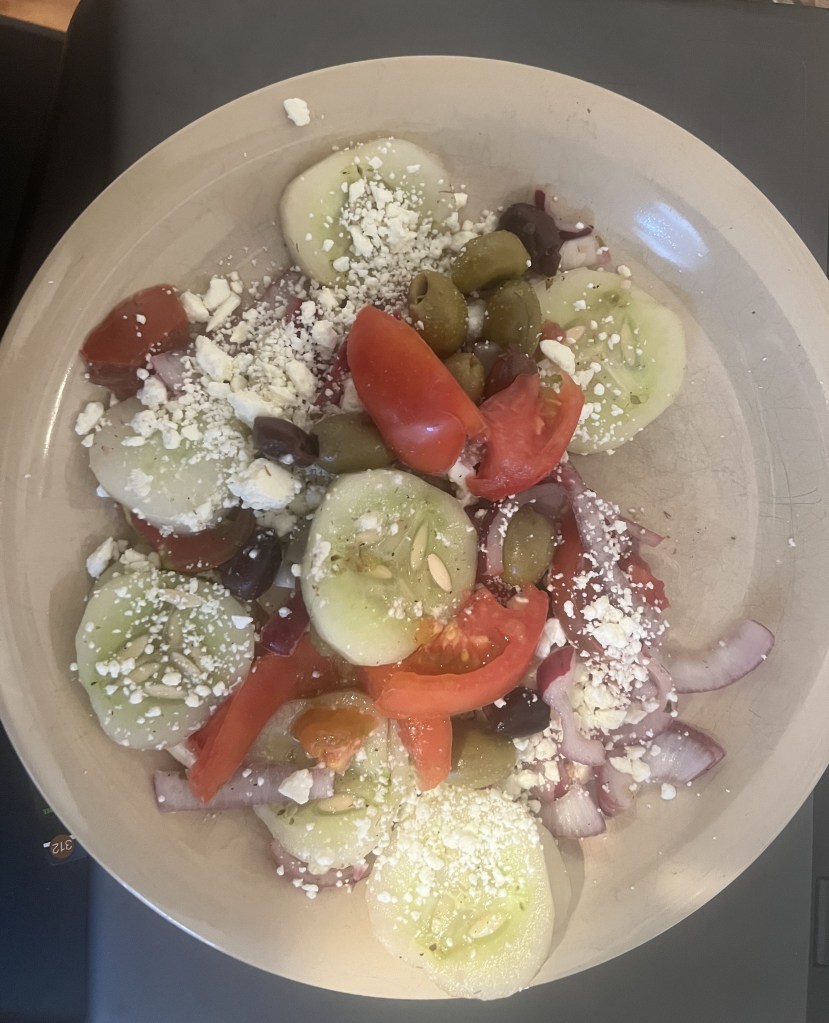
After pickling my two batches of cucumber I decided that was enough.  Even there I gave a jar away to our gardening friend and to my sister-in-law.  They have also been the recipients of cucumber and squash bags, as has my next-door neighbor.  Melissa wants to use some of the fruit to make a sweet refrigerator pickle.  I took 20 pounds (9 kg) of cucumber and 10 pounds (4.5 kg) of squash to the local food bank (and will no doubt take more).  Still, the cucumber keeps coming which has gotten me to be more innovative with the cucumber.  Last night I made a cucumber salad which we enjoyed along with fresh corn (local farmer) and squash I roasted on the grill.  Melissa commented the salad did not look much different than the Greek salad we were served when we were there earlier this year.  I took some of the salad, added tomato, feta cheese, and Kalamata olives and turned it into a passable version of a Greek salad.  Since the larger cucumber gets seedy, I am going to remove the seeds and use the larger fruit to make one of our favorites, Tzatziki Sauce (it goes on everything!).  I am looking forward to a long and fruitful summer.

THOUGHTS: Harvesting and eating fresh vegetables, like cucumber and tomato, is one of the reasons we grow our garden.  I also like to share the harvest with others who do not have access or the ability to grow their own vegetables.  Picking fresh vegetables off the vine or out of the soil to make dinner is its own reward.  The produce is crisper, and you know exactly what went into the soil without the expensive “organic” label.  Growing your own vegetables can be inexpensive, but if you want to grow a larger crop it does take up an investment (annually).  Harvesting, processing, canning, and freezing the produce is another step toward reducing our carbon footprint.  Act for all.  Change is coming and it starts with you.
Cactus Barrel

June 24, 2025

Earlier this week Melissa called me into the kitchen to take care of a “problem” she had found while working on her succulents.  Our pool/pond on the back patio has been teeming with grey tree frogs (Dryophytes versicolor) caught in the height of mating season.  This has resulted in successive scores of tadpoles that grow up to be adults.  I often see one of the small frogs hopping across the straw mulch that covers the potato plants as I am watering.  The frogs also like to hide behind the cushions on the Adirondack chairs on the patio.   It appeared one of the larger adult frogs was not content hiding on the patio or in the American elm (Ulmus americana) trees that line the back property line and had decided to take up residence in the “jungle” of succulents Melissa was working with on the kitchen table.  Melissa does not like hoppy things and called on me to remove it.  I thought it was interesting and snapped a photo before grabbing the frog and releasing it over our back fence (away from the kids).  It was not until I later looked at the photo that I realized the frog had been hiding next to a cactus barrel that appeared to have a bloom on its top.

When I went online, I found Cactus Barrel Milkweed (Larryleachia cactiformis), is a small perennial stem succulent with a globular body displaying a pattern of repeated shapes or polygons (tessellate) with either five pointed (pentangular), flat, or depressed projections (tubercles) on the surface.  The species can vary greatly, particularly in the color of flowers, which open in the summer.  The cactus barrel is native to South Africa and Namibia and grows at an altitude of a half to one mile (800 to 1600 m) above sea level.  It is found amongst a belt of natural shrubland (Fynbos) and desert (Succulent Karoo) vegetation on the quartz hills of the Kamiesberge mountain range.  The species is highly succulent (juicy) and adapted to the very harsh and bright habitats of the desert.  The plant is an excellent example of convergent evolution and is easily mistaken for a cactus.  It is widespread and the Red List of Threatened Species from the International Union for Conservation of Nature says it is common and not threatened.

One of my apps first misidentified my photo of the cactus barrel as a candelabra cactus (Euphorbia lactea).  This made sense as when I looked at the photo there appeared to be a yellow flame coming out of the top of the succulent.  When I mentioned this to Melissa, she pointed out the yellow bloom was on a low-lying elephant’s foot (Dioscorea elephantipes) succulent behind the cactus barrel.  Melissa had placed four different types of elephant’s foot in the bowl, and said the only way to tell the difference (even for most botanists) was by the color and shape of the bloom.  My flaming candelabra was an optical illusion formed by the angle from which I took the photo.  I obviously have a long way to go when it comes to succulent identification.

THOUGHTS: The cactus barrel milkweed succulent is like other members of the Apocynaceae genus in its difficulty for cultivation.  Propagation is a problem as the plant does not offset or seed readily and grows difficultly and slowly from seedling.  Melissa has had this small specimen for two years and it has yet to flower (despite my declaration).  Humans can also find it hard to propagate (spread) and are easy to be misidentified.  When we say other newcomers “all look alike” we lump individuals into categories that may not define their true nature.  We need to wait and take time to see what flowers (fruits) they produce to understand and accept them.  Act for all.  Change is coming and it starts with you.
Pestalotiopsis

June 20

In the middle of the back section of my local newspaper was a Reuters article on the discovery of a fungi that can break down the plastic found in landfills.  The discovery has launched a startup in Austin, Texas, which will sell disposable diapers paired with the fungi intended to break down the plastic.   Tero Isokauppila co-founded Hiro Technologies which now sells online “diaper bundles”.  Three sealed jars at the company’s lab show the stages of decomposition of the treated diaper overtime.  By 9 months the product appears as black soil.  The diapers the fungus attacks contribute significantly to landfill waste.  The Environmental Protection Agency says an estimated 4 million tons (907,000 metric tonnes) of diapers were disposed of in the US in 2018 with no significant recycling or composting.  It takes 100’s of years for the diapers to break down naturally.  Each of the Myco-Digestible Diapers comes with a packet of Pestalotiopsis microspore fungi which is added to the dirty diaper before it is thrown into the trash.

When I went online, I found Pestalotiopsis microspora is a species that lives within a plant for at least part of its life cycle without causing apparent disease (endophytic).  The fungus can break down and digest polyurethane (plastics).  Pestalotiopsis was originally described from Buenos Aires, Argentina in 1880 in the fallen foliage of common ivy (Hedera helix) by mycologist Carlo Luigi Spegazzini, who named it.  Pestalotiopsis also causes leaf spot in Hypericum ‘Hidcote’ (Hypericum patulum) shrubs in Japan.  The species polyurethane degradation activity was only discovered in the 2010’s in two distinct strains isolated from plant stems in the Yasuni National Forest within the Ecuadorian Amazon rainforest.  This was a discovery by a group of student researchers led by molecular biochemistry professor Scott Strobel as part of Yale’s annual Rainforest Expedition and Laboratory.  It is the first fungus species found to be able to subsist on polyurethane in low oxygen (anaerobic) conditions making the fungus a potential candidate for bioremediation projects involving large quantities of plastic.

The Pestalotiopsis fungi evolved to break down the lignin compound found in trees.  Isokauppila said the carbon backbone of the compound is very similar to the backbone of plastics.  Lignin is a class of complex organic polymers that form key structural materials in the support tissues of most plants.  Lignin is particularly important in the formation of cell walls, especially in wood and bark, because it lends rigidity and does not rot easily.  Most fungal lignin degradation involves secreted peroxidases.  Fungal laccases are also secreted, which aid degradation of phenolic lignin-derived compounds.  An important aspect of fungal lignin degradation is the activity of accessory enzymes to produce the hydrogen peroxide (H2O2) required for the function of lignin peroxidase.  More research is required to see how Pestalotiopsis will decompose in real world conditions.  That data should enable the company to make a “consumer-facing claim” by next year.  Hiro Technologies plans to experiment with the plastic eating fungi on adult diapers, feminine care products, and other items.

THOUGHTS: When my son was born the reaction of Pestalotiopsis on plastics was unknown.  I decided to avoid the waste of disposables by using cloth diapers.  While his mom agreed, it was my job to take care of the mess and cleaning required by the diaper pail.   There has been a resurgence of interest in cloth diapers recently among environmentally and financially conscious new parents.  While disposable diapers remain popular, a growing number of families are choosing to use cloth diapers.  This shift is driven by environmental concerns, cost savings, and improved cloth diaper designs.  The cost of the fungi diaper packs is not cheap (neither are the disposables), but it could make a significant difference environmentally.  Act for all.  Change is coming and it starts with you.

Pickling

June 18

I got excited last year when my cucumbers started coming up.  We like to make cucumbers (Cucumis sativus) as an appetizer.  I peel and slice the cucumbers and arraign them on a plate.  Then I drizzle olive oil over them and sprinkle them with either Italian seasoning or a spice mixture called Slap Your Mama.  I also like eating cucumbers on my salad.  We often make a side salad for whatever happens to be the entrée.  This is what I call a “full-blown salad” of lettuce (Lactuca sativa), carrots (Daucus carota), and bell pepper (Capsicum annuum).  Melissa will add tomatoes (Solanum lycopersicum) to hers as well.  My “easy salad” is just romaine lettuce with slicked cucumber.  When the cucumbers began producing, I bought canning jars, vinegar, pickling salt, and a bag of dill pickle seasoning so I would be ready.  Then I checked to see how to begin pickling my cucumbers.  I found I had grown slicing cucumbers, not the pickling variety.

When I went online, I found pickling is a way to preserving or extending the shelf life of food by either anaerobic fermentation in brine or immersion in vinegar.  The procedure typically affects the food’s texture and flavor.  The resulting foods are called pickles.  If the food is named, the name is prefaced with the word “pickled”.  Foods that are pickled include vegetables, fruits, mushrooms, meats, fish, dairy, and eggs.  Pickling solutions are typically highly acidic, with a pH of 4.6 or lower, and high in salt, preventing enzymes from working and micro-organisms from multiplying.  Pickling can preserve perishable foods for months or even years.  Antimicrobial herbs and spices, such as mustard seed, garlic, cinnamon, or cloves are often added.  If the food contains sufficient moisture, a pickling brine may be produced by simply adding salt.  Sauerkraut and kimchi are produced by salting the vegetables to draw out excess water.  Natural fermentation at room temperature, by lactic acid bacteria, produces the required acidity.  Other pickles are made by placing vegetables in vinegar.  Unlike the canning process, pickling does not require that the food be completely sterile. The acidity or salinity of the solution, the temperature of fermentation, and the exclusion of oxygen determine which microorganisms dominate, and determine the flavor of the pickled product.

This year I grew pickling cucumbers.  As usual I did not know how many cucumbers a single plant would produce.  I bought a small six pack of plants and looked forward to completing the job I tried to do last year.  Neither did I know when I should pick my pickling cucumbers.  I knew for slicing cucumbers they were often 8 to 10 inches (20 to 25 cm) long.  If I picked them too soon, they would not be ripe, but if I waited too long, they could be tough.  I ended up picking fruits that were getting too large as well as what I thought were the ripe ones.  When I prepared them for pickling, I realized the “right size” was determined by what would fit in the pint jars I was using.  I cut the ends off the cucumbers.  The blossom end has enzymes that soften the pickles, and I do not like it when the stems are left on my pickles.  I was making spears, but since some were too long to fit in the jar I also ended up with pickle slices.  I found that 6 cumber plants produce way more fruit than I wanted to can.  I ended up pickling 8 jars today and will have more by the time I am ready to pickle my beets.  Now I just need to figure out what to do with all my pickling.

THOUGHTS: It is often claimed that pickling cucumbers was developed for workers building the Great Wall of China, although another hypothesis is that they were first made as early as 2030 BC in the Tigris Valley of Mesopotamia.  Ancient sources documented awareness around the nutritional benefits of pickling and the perceived beauty benefits of pickles.  Cleopatra credited pickles with contributing to her health and legendary beauty.  Perhaps it is a good thing to have 15 jars of pickles.  The best part is sharing produce with others.  Act for all.  Change is coming and it starts with you.
Hammerhead

June 17

Inside the back section of my local newspaper was an article on an invasive species that has been reported in Texas.  The worms have been reported throughout Texas for decades but several weeks of excessive rainfall have literally flushed the creatures into the open.  Usually, during the day the worms can be found under leaves, rocks, or logs.  The rain has brought them out to driveways, patios, and sidewalks.  Ashley Morgan-Olvera, director of the Texas Invasive Species Institute, said while the worms are not a direct threat to humans or household pets, they do have a lasting effect on the ecosystem as they prey on the earthworms that are responsible for distributing oxygen, draining water, and creating space for plant roots.  This genus is collectively known as hammerhead worms.

When I went online, I found hammerhead worms (Bipalium) are a genus of large predatory land flatworms (planarians), also known as broadhead planarians.  The name Bipalium comes from Latin bi- (two) and pala (shovel or spade), because species in this genus resemble a pickaxe.  Hammerhead worms are unique in that they possess a highly ciliated (hair-like) region on the ventral epidermis (a creeping sole) that helps them to creep over the substrate.  The worm is typically light honey colored with a darker collar and one to five strips on its body.  The worm can grow up to 15 inches (38 cm) in length.  Bipalium species are predatory and some species prey on earthworms while others also feed on mollusks.  These flatworms can track their prey.  To feed on their prey, the hammerhead often turns the pharynges out of their mouths (evert), which are located on the midventral portion of their bodies and secrete enzymes that begin the digestion of the prey.  The liquefied tissues are sucked into the branching gut of the flatworms by ciliary action.  Hammerhead worms are native to Asia, but several species are invasive to the US, Canada, and Europe.

The hammerhead does not bite but they do secrete a poisonous chemical for protection from predators which can cause skin irritation.  If a cat or dog eats a hammerhead it will likely get nauseated and throw it up, but there is no long-term threat.  Morgan-Olvera said if you see a hammerhead do not try to kill it or cut it up.  The worm can reproduce asexually and if you cut it up and leave it in the yard a new head could form within about ten days.  To dispose of the worm, place the whole worm in a resealable bag with salt or vinegar and put it in the trash.  The worms can also be sprayed with a combination of citrus oil (orange essence) and vinegar.  You should always wear gloves when handling the worms to avoid irritation and wash your hands thoroughly with soap and water followed by hand sanitizer.  The Texas Invasive Species Institute is asking if you spot a hammerhead that you contact your local extension agent to let them know

THOUGHTS: Four invasive species of hammerhead worms have been found in the US which are thought to have come via infected plants and soil.  The worms are veracious predators and have been identified as a nuisance in the earthworm raising beds of the southern US.  In 2019, the worms were found as far north as Montreal, Canada.  The worms have few natural enemies due to their toxic surface secretions and control is difficult.  However, because of their cannibalistic tendencies they may be their own worst enemy.  While humans are rarely cannibalistic, we are also considered our own worst enemy.  Rather than following an innate need to survive, the danger comes from a conscious choice to harm each other.  The choice can also provide compassion and aid.  Act for all.  Change is coming and it starts with you.
Long-beaked

June 14

Charles Hamilton Smith circa 1837.

Biologists have confirmed the existence of a 200-million-year-old species of egg-laying mammal thought to be extinct.  Footage was captured in 2023 by Oxford University during an expedition to the Cyclops Mountains in Indonesia.  Researchers said the species had not been recorded in the region for more than 60 years (a dead specimen), but evidence of the animal’s existence was found in recent decades.  In 2007, researchers found “nose pokes” in the Cyclops, or the trace signs made when they forage underground for invertebrates.  Indigenous groups also reported sightings of the species in the past two decades.  In 2017 and 2018, researchers combined participatory mapping with indigenous and other knowledge to assess the probability the animals still existed.  Camera traps deployed in the Cyclops in 2022 and 2023 garnered 110 photos from 26 individual events.  In a paper published in the journal NPJ Biodiversity in May 2025, by combining modern technology with indigenous knowledge researchers confirmed the long-beaked echidna had been found,

When I went online, I found the Attenborough’s long-beaked echidna (Zaglossus attenboroughi), also known locally as Payangko, is one of three species from the genus Zaglossus that inhabits the island of New Guinea.  The species lives in the Cyclops Mountains near the cities of Sentani and Jayapura in the Indonesian province of Papua in Western New Guinea.  It is named in honor of naturalist Sir David Attenborough.  The long-beaked is the smallest member of the genus Zaglossus, being closer in size to the short-beaked echidna (Tachyglossus aculeatus).  The weight of the type specimen when it was alive was estimated to be 4.4 to 6.6 pounds (2 to 3 kg).  The male is larger than the female and is further differentiated by the spurs on its hind legs.  The species has five claws on each foot like the eastern long-beaked echidna, and has short, very fine and dense fur.  The diet of the long-beaked echidna consists primarily of earthworms, in contrast to the termites and ants preferred by the short-beaked echidna.  The long-beaked is listed as critically endangered by the IUCN, and there had been no confirmed sightings between its collection in 1961 and November 2023, when the first video footage of a living individual was recorded. 

The long-beaked echidna is not a social animal and only comes together once a year, in July, to mate.  The female then lays the eggs after about eight days, with the offspring staying in their mother’s pouch for around eight weeks.  The long-beaked is nocturnal and rolls up into a spiky ball like a hedgehog (family Erinaceidae) when it feels threatened.  According to the research paper, these are the “sole living representatives” of egg-laying (monotreme) lineage that diverged from marsupials and placental mammals (therians) more than 200 million years ago.  The long-beaked echidna also once lived in the Oenaka Range of Papua New Guinea, but the Cyclops Mountains are the only location where the long-beaked has been recorded in modern times.  The long-beaked echidna is one of just five egg-laying mammals in existence today, including the platypus and two modern echidnas.

THOUGHTS: The long beaked echidna were one of more than 2,000 “so-called lost species”, or species that have gone undocumented for sustained periods of time.  The research paper said, “Rediscoveries offer hope that others survive, especially in places where biological research has been limited.”  Only 3% of the earth’s land mass is unexplored, but over 80% of the ocean remains unexplored.  It is estimated that between 15,000 and 18,000 new species are discovered annually, in addition to lost species rediscovery.  While all types of species are discovered every year, insects are by far the most common.  There is still a lot that humans do not know about the earth and new discoveries are always possible.  Act for all.  Change is coming and it starts with you.
Pig’s Ear

June 13

As the weather has warmed Melissa has been moving her summer succulents out of the sunroom and onto the patio.  We moved the two glass-topped tables that were in our entry way onto the patio to provide the plants with more light.  Melissa also bought several Talavera Mexican Pottery wall hangers.  Talavera Pottery are works of art handcrafted using techniques that have been passed down generation to generation since the 16th century and produced in the Mexican state of Puebla, and Dolores Hidalgo.  Each piece is hand molded clay or a poured ceramic.  While there was no room for them inside, they were perfect for hanging high on the patio fence.  These became a nice arraignment next to the gate leading to the side yard.  The succulents Melissa chose to plant in these hangers were all small but ones that would send shoots for the flower clusters when they bloom.  One of these early bloomers was a pig’s ear.

When I went online, I found the pig’s ear (Cotyledon orbiculate), also known as round-leafed navel-wort, is a South African succulent belonging to the genus Cotyledon.  The common name comes from the shape of the leaves resembling a pig’s ear.  Pig’s ear is an extremely variable species but grows to around 4.3 feet (1.3 m) in height.  It has gray-green leaves up to 5.1 by 2.8 inches (13 by 7 cm) which naturally develop a white, powdery substance (farina) on their surfaces.  The farina helps reflect sunlight and conserve water.  If the leaf area is brushed against or disturbed the farina will become noticeably smudged.  The farina will not regenerate if disturbed, but this is not detrimental and rarely unsightly.  Water (dew, marine fog, mist, rain, or even garden hose) does not seem to wash the powdery farina off and it reappears as the leaves dry.  The bell-shaped flowers are usually a blood orange-red or a paler salmon-orange, but yellow varieties also exist.  Cotyledon produces tubular, upside-down bells which are small, usually less than 1.2 inches (3 cm) in length.  They hang and droop from the top of a 24-inch (60 cm) stalk.

While pig’s ear is native to South Africa, it is popular in gardens in many countries.  In the wild it grows naturally in rocky outcrops in grassy shrubland and the Karoo region.  In New Zealand, it is considered an invasive plant and is listed on the National Pest Plant Accord.  Pig’s ear has several medicinal uses.  The fleshy part of the leaf is applied to warts and corns in South Africa and heated leaves are used as poultices for boils and other inflammations.  Single leaves may be eaten to expel parasitic worms (vermifuge) and the juice has been used to treat epilepsy.  However, the leaves contain a bufanolide called cotyledon toxin, which is toxic to sheep, goats, horses, cattle, poultry, and dogs, causing a condition known as cotyledonosis.  Lucky this is high on the fence and Loki will not be able to chew on it.

THOUGHTS: In their native country of South Africa pig’s ear generally bloom in the winter.  It is interesting that in Arkansas this plant has chosen to bloom in the summer.  Since the plant was imported, perhaps it is confused and thinks it is still in the southern hemisphere.  The Talavera planter is not frost or freeze proof, so we will need to move it indoors during the winter.  Neither does the pottery like to sit in water, wet mulch, or be subjected to the extreme humidity of a growing green house.  That makes hanging on the fence the perfect location.  Imported plants (and people) are forced to adapt to their new location.  However, their preference is to stay the same.  Finding a comfort level is what creates the Barrios and ethnic neighborhoods that make up most larger cities in all countries.  Adaptation is often a long process.  Act for all.  Change is coming and it starts with you.
Inca

June 12, 2025

As I looked out my back window this afternoon, I saw a flash of copper as a bird flew from our window feeders to the pool deck.   At first, I thought it was one of the elusive mourning doves (Zenaida macroura) I see and hear frequently around our property (but not at our feeders or been able to get a picture).  The problem was that it seemed a little smaller than a mourning dove, and then there was that copper flash as the bird landed on the deck.  I enjoy watching the small passerines that flock to our feeders in the morning and evening.  I will even tolerate the common grackles (Quiscalus quiscula) that drive the other birds off and eat the entire feeder in short order.  That is as long as they do not arrive en masse.  I have watched them strip all eight feeders along the fence in less than 10 minutes.  Now I have taken to occasionally send Loki out to scare them away.  While he does not do anything except run into the yard, the grackles seem to be afraid of his size.  The bird on the deck seemed to be a species I was unfamiliar with.  I was able to get a photo of the bird before it flew off and I checked it against the google identification app.  It turns out it was a new bird, an Inca dove.

When I went online, I found the Inca dove (Columbina inca), also called the Mexican dove, is a small New World dove first described by French surgeon and naturalist René Lesson in 1847.  The Inca reaches 6.5 to 9.1 inches (16.5 to 23 cm) in length, weighs 1.1 to 2.0 ounces (30 to 58 g) and has an average wingspan of 11.2 inches (28.5 cm) and a max wingspan of 12.6 inches (32 cm).  The Inca is a slender species, with a gray-brown body covered in feathers that resemble a scaled pattern.  The tail is long and square and edged with white feathers that may flare out in flight.  The underwings are reddish (hence the copper I saw) and on takeoff produce a distinctive, quiet rattling noise.  The species ranges from Costa Rica in the south to the American Southwest in the north and is often common to abundant in suitable habitat.  This terrestrial species forms flocks in desert, scrubland, and cultivated areas and may also be found in urban settings where they feed on grass seeds and take advantage of the availability of water from agricultural and suburban irrigation.  During winter, Inca doves roost in communal huddles of 10 or more birds by making a pyramid formation that aids them retain body heat.  They often flock outside of their territories, with flocks growing up to 100 birds.  Its range has been expanding northward and southward in the past few decades. 

Despite being named after the Inca Empire, the species does not occur in any of the lands where the Inca empire existed.  When I looked at the range map for the Inca dove, I noticed it did not include Arkansas.  The closest it came was toward the top of Texas, or several 100 miles (320 km) to the south and west.  The Inca has in the past escaped or been deliberately released in the state of Florida in the US, but there is no evidence that the population is breeding.  It may only persist due to more releases or escapes.  The single bird I saw may have been blown off course by the current round of storms which have been coming up from Texas.  Or perhaps it just wanted to be a tourist in the Natural State (i.e., Arkansas).  Regardless, this qualifies as a rare bird sighting.  A rare bird sighting is observance of bird species that are uncommon in a particular region or that are considered at risk of extinction.  These sightings can include birds that are not typically found in a specific area due to changes in migration patterns, unusual weather conditions, or simply because they are very rare.

THOUGHTS: When I identified the Inca dove it became my first rare bird sighting.  I was a little skeptical being a newbie birder, but my daily rare bird notification listed another Arkansas sighting as well.  I posted the picture and have already gotten a Like.  Being an amateur and posting on a site of experts made me nervous.  Perhaps more of us should follow the advice of Eleanor Roosevelt – “Do one thing every day that scares you.” Act for all.  Change is coming and it starts with you.