Rough

July 02, 2021

When I went out to look at my feeders yesterday, I noticed one of the hanging tripods had broken and it was dangling along the fence.  I had previously written about the mystery of the suet feeder first being knocked to the ground, and then completely disappearing from the same general location.  While I had not mentioned it, the squirrel feeder had the Plexiglas barrier torn off and thrown to the ground several weeks ago.  I have never seen the perpetrator for any of these events, but as I mentioned previously, the likely suspects are one of the three squirrels that I have seen feeding in all five stations.  Now they appear to be getting rough.

Squirrels are best known as the cute little animals found in parks across America.  What you may not know is they are often intentionally placed in man-made parks.  They are generally not aggressive toward humans, but they can be rough toward each other.  That is especially true when humans decide to feed the squirrels.  When you feed wild animals such as squirrels, others that are not getting fed get jealous.  Just like gulls at the beach, when you feed one you will observe that quickly becomes countless birds also wanting their share.  The same is true of squirrels, and they will get rough with each other for food if they are hungry.  Feeding squirrels in the park also makes them become more aggressive toward humans.  That is why most parks have signs advising visitors to not feed the animals.

While I am not feeding park squirrels, I am suffering some of the same consequences.  My squirrels have become rough with the feeders and have driven off the birds to keep the food for themselves.  There are two differences between the park and my yard.  First, many people in the park feed processed human food to the squirrels.  Even the peanuts that are still in the shell are often heavily salted to conform to the human pallet.  Processed food does not have the nutrients that the squirrels need and find in their normal diet.  Second, as I mentioned when I started feeding them, they were robbing the feeders whether I fed them or not.  These are not hand fed, and they still run away when I come out of the house.  I guess I better go get some more shelled and unsalted peanuts to add to the squirrel mix.

Thoughts:  I admit I did resonate with one of the statements made by the anti-feeding site, “How many squirrels are you willing to feed?  One?  Two?  One hundred?”  Whether you deliberately feed wild squirrels in your backyard, or actively try to keep them out of your feeders, the result is the same.  They will get their cut and will be rough with each other and the other birds until they do.  Apparently, they are just as rough with the feeders if they do not provide access to the needed seed.  About 14 percent of U.S. households, or roughly 48 million people (1 in 7), go hungry at some point during the year, child rates are higher (1 in 5 in US and 1 in 4 in my community).  The major cause of food insecurity is the lack of jobs (especially with high enough wages to avoid food insecurity), lack of job skills, and single parent families.  When we see hungry animals, we place feeders in our yard to help keep them from going hungry.  When we see humans who live in the food deserts of the inner cities and rural areas of the US, should we not do the same?   Do the work.  Change is coming and it starts with you.

Turkeys

July 01, 2021

The numbers are in, and the Wild Turkey season recorded 7,014 birds checked in Arkansas this spring, including 28 hens.  Wild turkey is the second most popular game animal in Arkansas with 112,000 hunters.  Deer is by far the most popular with 308,000 participants and Ducks come in third with 87,000.  The squirrel ranks fourth with 75,000 hunters.  For turkeys, that means just over 6% of the participants come home with a bird.  The turkey hunt is intended to be a challenge, and the regulations are in place to bolster declining populations to ensure better (if any) hunts in the future.  There are some who find ways to beat the odds by not playing by the rules.  This resulted in 152 major wildlife violations during the 21-day season.  Hunting turkeys over bait accounted for 72 of those cases.

When I looked online, I found the wild turkey (Meleagris gallopavo) is an upland ground bird native to North America.  This is one of two extant species of turkeys, and the heaviest member of the order Galliformes.  It is the ancestor to the domestic turkey, and originally derived from a southern Mexican subspecies of wild turkey.  Although native to North America, the turkey probably got its name from the domesticated variety being imported to Britain from the Levant.  The British associated the wild turkey with the country Turkey and the name prevailed.  The term was transferred to the New World bird by English colonizers with knowledge of the imported birds.  Wild turkeys are omnivorous, foraging on the ground or climbing shrubs and small trees to feed.  That is what makes them easy to bait.

I came across another site offering a 5-step process for baiting wild turkeys: get the right tools (including cracked corn), scout the hunting area, set the bait, arrange the decoys, and call the turkeys.  The article claims, “I can say without any doubt that now you know everything about how to bait turkeys.”  The small print at the bottom of the page adds, “Don’t forget to check the local laws and regulations before you try to bait turkeys.”  When I checked another site on hunting turkeys it stated that baiting wild turkeys with food is banned in all states with turkey populations.  The only exception is if you have a permit to capture and relocate turkeys or for a depredation hunt.  The author described himself as having been “hunting and fishing for over 20 years now!”  I hope it has not all been illegal.

Thoughts:  While domestic turkeys are not known to fly, their wild counterparts are fast and agile fliers.  In their ideal habitat of open woodland or wooded grasslands, they may fly beneath the canopy top and find perches in the trees.  My sister tells of walking through a wooded area of Maine in the morning when suddenly a turkey dropped to the ground close by.  This was followed by another and then another, as the entire flock dropped from their evening roost to begin foraging on the forest floor.  Perhaps Herb Tarlek should have used wild rather than domestic turkeys when he dropped them from the helicopter (vis a vie, WKRP in Cincinnati).  Baiting turkeys seem to provide the same result.  As Les Nessman said, “Oh, the humanity!  Regulations are there to help us overcome circumstances, not to deprive us of rights.  Follow the science.  Change is coming and it starts with you.

Resting

June 30, 2021

When I was out at the lake last week, I noticed a group of turtles resting on a log floating in the water.  The vegetation around the lake came right down to the shore giving little area for the turtles to lay in the sun.  I also saw only one log floating in the water for the turtles to rest on.  Since turtles are cold-blooded animals, they need to regulate their body heat by the surrounding temperature.  When turtles are too cold, they will slow down.  If they are too hot, they will overheat and risk internal damage.  That means the turtles alternate between warming in the sun and cooling off in the water.  There were eight turtles resting on the log.

When I looked online, I found the Red-eared Slider (Trachemys scripta elegans) is one of 17 species of turtles which live in the ponds, lakes, and streams of Arkansas.  In the wild they can often be found resting in the sun on a log or sand bar.  Red-eared sliders are native to the southern US and northern Mexico.  It is the most popular pet turtle in the US and is popular as a pet across the world.  Since the Sliders are the most traded species of turtle, they are also the most invasive turtle in the world due to pet releases.  The slider is included on the list of the world’s 100 most invasive species published by the International Union for the Conservation of Nature.  This seems pretty busy for an animal who spends so much time resting.

Another name for a turtle resting in the sun is basking.  When turtles bask, they absorb heat from both the sun and the substrate on which they bask.  The sandy shore or the log they are resting on absorbs and gives off the sun’s heat.  For North American turtles including sliders, the optimum temperature of the basking spot is between 90F to 95F.  Exposure to UVB light enables turtles to produce vitamin D3, which is needed for the absorption and utilization of calcium.  Drying out in the sun helps the turtle deal with fungal infections and parasites as those require moisture to live, as well as drying out the algae on the turtle’s shell, which will then fall off.  Who knew resting could be so beneficial?

Thoughts:  Some US states have laws and regulations regarding possession of Red-eared Sliders because they can be an invasive species where they are not native.  It is now illegal in Florida to sell any wild-type red-eared slider, as they interbreed with the local yellow-bellied slider population (Trachemys scripta scripta).  In Australia, the turtles are considered a significant threat to native turtle species, as they mature more quickly, grow larger, produce more offspring, and are more aggressive than native species.  It seems these invaders are quite active when they are not resting.  During the height of the pandemic many decided to forgo their usual vacations.  Whether it was fear of losing a job, believing you were essential to your work, or finding nowhere to go with the country basically shut down, many workers powered through.  Setting time aside for resting is just as important as being active during working hours.  We need to learn from the Sliders.  Follow the science.  Change is coming and it starts with you.
Phlox

June 29, 2021

Once more the intermittent rains have caused another of the flowers in our front bed to flourish.  The phlox were one of the flowers planted by Melissa’s mom when her parents moved in with her twenty years ago.  I previously talked about taking the time to weed around these plants and cut back the dead stems that die over the winter.  If you do not remove them, they will persist as dead casings and detract from the overall beauty of the flowers.  Even though I have given the plants only limited attention, they have now exploded in a flurry of color over the last week.

When I looked online, I found that Phlox are one of the most diverse perennial plants in nature.  They fall into one of two groups, the creeping phlox (Phlox subulata) and the tall phlox (Phlox paniculate).  The name of the plant is derived from the Greek word “phlox” meaning “flame” and refers to the intense flower colors of the different varieties.  While both groups feature masses of small florets in a range of vibrant colors, the similarity ends there.  The creeping phlox is a semi-evergreen ground cover that bursts into bloom in the spring.  It is often seen in rock gardens or spilling over walls.  Tall phlox are conical flower spikes made up of hundreds of florets that bloom in the summertime.  I guess the intense heat conditions this year mean the flowers know it is already summer.

Tall Phlox is a native American wildflower that grows from New York to Iowa, and south to Georgia, Mississippi, and Arkansas that blooms from July to September.   The Phlox paniculate are also commonly known as garden phlox and rather than creeping along the ground, they grow upright.  Fertilized flowers typically produce one relatively large seed.  The seed is a longitudinally dehiscent capsule with three or more valves that sometimes separate explosively.  All phlox are fragrant, and the aroma is used to attract birds, bees, and butterflies to your garden.  Melissa’s mom loved hummingbirds and butterflies, and that was why the Phlox were planted.  They have done well.

Thoughts:  While melissa knew the plants in our front bed were phlox, the only examples I could find were creeping phlox.  The creepers hug along the surface and the flowers do not get more than 6-8 inches above the ground.  Our phlox were almost 3 feet high, so I knew this could not be what we had.  It took a diligent search to identify the second type, the tall phlox.  Quite often humans will “know” something even though the facts do not bear it out.  I knew the flowers were phlox even though none of the images I found were remotely similar.  What I found was it was close, but different.  In matters of importance, close enough rarely works in the long term.  We got close enough to herd immunity with the vaccine, and many decided it was no longer their responsibility to protect themselves or others.  That is why the cases are again on the rise across the US.  Follow the science.  Change is coming and it starts with you.

Vaccination

𝘑𝘶𝘯𝘦 28, 2021

Both my national and local news feeds led with the same story this morning.  The NY Times article by David Leonhardt stressed how heavily Republican areas of the US have a growing covid-19 problem.  This is a reverse of earlier this spring when the virus was not spreading any faster in areas with low vaccination rates than in those with high rates.  That seems to have convinced some that the pandemic was over.  Governments opened doors and relaxed rules.  Masks fell to the ground (literally) and social distancing was reserved for those who struggled with other immune deficiency problems.  Now it seems we have moved too quickly, especially for those who have not or refuse to get a vaccination.

My local feed opened with an article by Yacob Reyes declaring our governor is making a push to reverse the low vaccination trends.  Arkansas has one of the lowest rates of vaccination in the nation, and as I watch the nightly broadcast the rate has stayed right around 40% for the last several weeks.  Even the initial dose has stayed steady at around 10%.  Our Republican governor commented on the slowed rate saying, “People saw the cases of hospitalizations go down.  And so, the urgency of getting the vaccine slowed down.”

The Times article went on to report that the places with the lowest vaccination rates tend to be heavily Republican.  In an average US county that voted Republican, only 34% of people are fully vaccinated.  In an average country that voted Democrat, the share is 45%, and those receiving one shot is even higher.  While it is too early to know whether the trend will continue and cases will rise in communities with low vaccination rates, it does seem likely.  We have always bet on vaccination as the way the pandemic will end.  Now we cannot get people to get the shot.

𝗧𝗵𝗼𝘂𝗴𝗵𝘁𝘀:  The US is in a phase where we will make a political statement out of anything.  That seems true with masks and vaccination.  While it might be argued that wearing a mask is a way to keep others from getting the virus from you (hopefully unknowingly, but not always the case), getting the vaccination is essentially about you.  With waning numbers of vaccinations, many states have begun to offer incentives to entice people to get the shot.  My state has already spent $2 million on incentives that include scratch-off lottery tickets and $20 gift certificates good toward hunting and fishing licenses.  Some residents have been annoyed by the timing of the program, as only those who received a vaccine after May 26 qualify for the incentive.  It is not enough incentive to keep from dying.  Follow the science.  Change is coming and it starts with you.
Determined

June 26, 2021

The squirrel(s) seem to have finally decided the squirrel feeder is there for them.  Many of the birds that frequent the feeder do not like the large corn seed that is offered and spend a lot of time tossing it out onto the pool deck.  That is especially true for the Blue Jays.  I have noticed that even when they do, the doves will hop down on the pool deck and eat the larger kernels of corn that have been discarded.  As determined as the squirrels are to raid the feeders, I have never seen them eating on the ground below the feeder.  When the corn disappears, I sometimes wonder who ate the kernels.   The alternative to the doves is other critters that come in at night and eat the corn.   I am determined to not think about what those critters might be.

When I Looked online, I found that squirrels are members of the family Sciuridae, a family that includes small or medium-size rodents.  The squirrel family includes tree squirrels, ground squirrels, chipmunks, marmots (including groundhogs), flying squirrels, and prairie dogs amongst other rodents.  Squirrels are indigenous to the Americas, Eurasia, and Africa.  Someone obviously liked to watch the determined antics of the little rascals, and they were introduced by humans from England to Australia.  They are now extinct in Australia except for a group of Northern Palm Squirrels (Funambulus pennantii) living in the Sydney Zoo where they are thriving.  There are three known species of squirrel in Arkansas, the Eastern Gray Squirrel (Sciurus carolinensis), the Eastern Fox Squirrel (Sciurus niger), and the Southern Flying Squirrel (Glaucomys volans).  Mine are Fox Squirrels.

When I looked at the squirrel feeder today, I saw a squirrel was determined to get the best seed first.  It had its head stuck inside the feeder and was munching on the peanuts that tend to rise to the top of the seed.  I made some comment about the little imp and Melissa immediately corrected me, saying not to disparage “her” squirrels.  She works from home and sits next to a window that gives her full view of the feeders and loves to watch the determined rodents as they move from feeder to feeder trying to get as much seed as they can.

Thoughts:  One of the cartoons I loved to watch was Rocky and Bullwinkle.  The lead characters were Rocky the flying squirrel and Bullwinkle J. Moose.  I started watching this show when I was a child, but like so many cartoons of the 1960’s, it was also written with an adult audience in mind.  I never understood many of the jokes in the show until I rewatched them in High School.  The plot rarely varied as Boris Badenov and Natasha Fatale from Pottsylvania (between Wrestlemania and Yoursovania), are determined to keep our heroes from saving the day.  This Cold War plot was lost some of its humor with the fall of the Berlin Wall on 9 November 1989.  Over the last years it is clear there are some determined to keep the conflict alive.  As we have witnessed in America over the last year, Democracy is something which we need to be determined to keep alive.  There are always those determined to keep power for themselves.  Do the work.  Change is coming and it starts with you.
Work

June 25, 2021

With the weather patterns we have been having this year the Hosta I planted along the sidewalk leading to my house have taken off.  I had been afraid that at least one of them had died between the heat we suffered last Fall and the cold snap we had this winter.  Instead, all three plants have thrived and are the tallest and fullest of the last three years.  I mentioned how the moles got the two hostas planted beside my driveway last summer.  Then last winter got the two agaves Melissa had replaced them with.  This is causing me to reconsider what to plant in these two exposed beds.  They receive full sun throughout the day.  No matter what I decide to replant, I know it is going to take more work.

When I looked online, Hosta is a genus of plants commonly known as hostas, plantain lilies, and occasionally by the Japanese name gibōshi.   Hostas (Hosta species pluralis) are America’s most popular perennial garden plant for a simple reason.  They are one of the few plants that thrive in shade, are easy to care for, and easy to propagate.  Unlike many perennials that require laborious work to be lifted and divided every few years, hostas are content to simply grow in place without much work at all.  I have three different varieties planted in the narrow strip beside my walk, and the pink and white hosta (var. Night Before Christmas) is currently in flower.

Every time I see my Hosta it reminds me of a memory with my sister.  I had purchased my first house in Kansas, and she came out from Maine during the summer to see relatives.  She has always planted flowers around her houses, and I asked for advice on what to plant at mine.  The front of the house had a narrow bed along the porch designed for flowers.  The problem was the porch faced north and the gable associated with it blocked the sun throughout the day.  Since most flowers require at least some sun during the day, Marcia suggested I plant Hosta in the bed.  There was just enough room for four plants to space properly.  We went to work, and soon the hostas were planted in my bed.  While I delighted in the hostas during the seven years I lived in this house, the best part was the memory of sharing this work of planting them with my sister.

Thoughts:  One of the mistakes made by beginning gardeners (or neophytes like me) is to put a sun plant where it receives too much shade or a shade plant where it gets too much sun.  We read the tag for the plant’s light requirements, and then ignore the instructions and place them where we would like to see them grow.  Another problem for beginners is defining what constitutes full sun, full shade, and partial sun, or partial shade, and the amount of light will directly impact the plants success.  My work in the lawn and garden has made me realize gardening is not so much about what is produced, as the memories shared in the production.  That is true when sharing yield stories with my gardener friend or remembering times shared with my sister.  Humans have always thrived on shared stories, oral and written.  It is hard to find unity when we fail to listen and discounted another’s story.  Do the work.  Change is coming and it starts with you.
Lilies

June 24, 2021

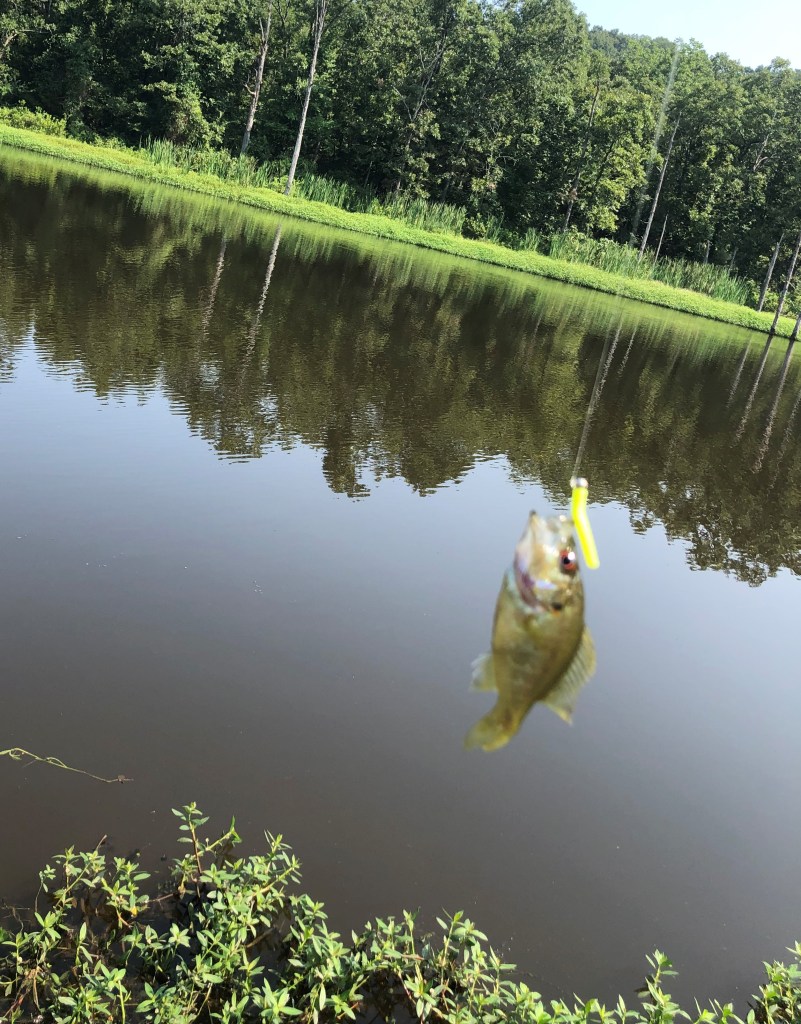
When I fished the lake last week there was a moderate patch of water lilies just off the shore.  While fishing these patches of aquatic cover can be taxing at time due to snags, I have always found them stocked with small fish.  I found this bed no different as I tossed my bobber on the outside corner of the pads.  I quickly caught fish, but not the larger fish I was looking for.  I did not pay much attention to the catch until the third or fourth fish.  That was when I noticed I was catching small crappie rather than the bluegill I had expected.  I guess the protection and food provided by the lilies was just as good for the crappie as it was for the bluegill.

When I looked online, I identified these lilies as the Yellow Water Lily (Nuphar lutea).  This is a common plant in our area that thrives in still or slow-moving water, growing in ponds, lakes, canals, and ditches.  It has large, lily-pad leaves that are up to 16 inches (40cm) across and grows in water up to 9 feet (3m) deep.  The leaves and flowers float at the surface, while the rest of the plant is submerged, growing from the mud bottom.  The Yellow water lily flowers during the summer, from June to September, and smells like the dregs of wine, giving it common names like ‘Brandy Bottle’.  Mine did not smell.

While invasive in some areas, water lilies are native and beneficial in other areas.  The lilies may become invasive if they are allowed to grow unchecked.  A single rhizome can reproduce and grow to cover an area 15 feet in diameter in as little as 15 years.  When spread to non-native habitats, water lilies can shade the water and make it too cold for native species of fish and plants.  Water lilies also compete with native plants for nutrients.  In moderate growths and native habitats, the lilies are a great benefit by providing shelter for fish and shade to keep the water cool. Water lilies provide safe spaces for frogs to perch on their leaves as they hide from underwater predators.  Lilies also produce natural oxygen that allows fish to breathe and beneficial bacteria to thrive.  Seems “everything in moderation” is the key.

Thoughts:  Another online site I found chastised anglers (like me) who shy away from fishing the interior of the lilies.  Lilies provide bluegills with all the amenities: protection, food, and oxygen.  The tangled vegetation keeps most of us along the edges, while the big fish are often deep in the greenery.  I watched a Bass fishing show awhile back that showed the same thing, as the angler tossed three feet into a weed bed to bring out the big bass feasting on bluegills.  Most tend to shy away from things they do not know.  That was true with fishing the interior of the lilies for me.  When the unknown is faced and understood, we may find it provides great benefits.  That is true for both different people and new practices.  Do the work.  Follow the science.  Change is coming and it starts with you.
Sun

June 23, 2021

The temps dropped yesterday, and the humidity came down with it as a cold front swept across the southeast.  Between health concerns and weather, I had not been able to get out to fish for the last month and it seemed like this was the perfect day.  I decided to try the stream Melissa and I had come across last month on one of our outings.  The stream was a tail stream of a reservoir about an hour from our house.  When I arrived, the sun was shining and the stream was clear, and even though the water level had dropped, there were still good holes to fish.  I rigged my line with a small (#10) black wooly (due to the sun) with a sow bug drop and added an indicator to let the line drift.  I fished three holes and quickly caught nine hybrid perch.  Then inexplicitly, the water silted from a disturbance upstream.  The bites stopped and I was forced to move on.

I fished the reservoir for another hour but found a way to stay in the shade and out of the sun.  I caught another five fish, but only later realized they were small crappie (really small!).  I decided to call it a day and headed home.   On my way home I came across a construction project that I had ignored on the trip out.  A large open field had been fenced (with barb wired on top) and rows of pipes sticking from the ground.  When I stopped at the site, the warning signs said to be aware of electric current.  The site was still under construction, and I initially thought this was a geothermal field, but the configuration seemed wrong.  I did notice the open field faced west and was in full sun. 

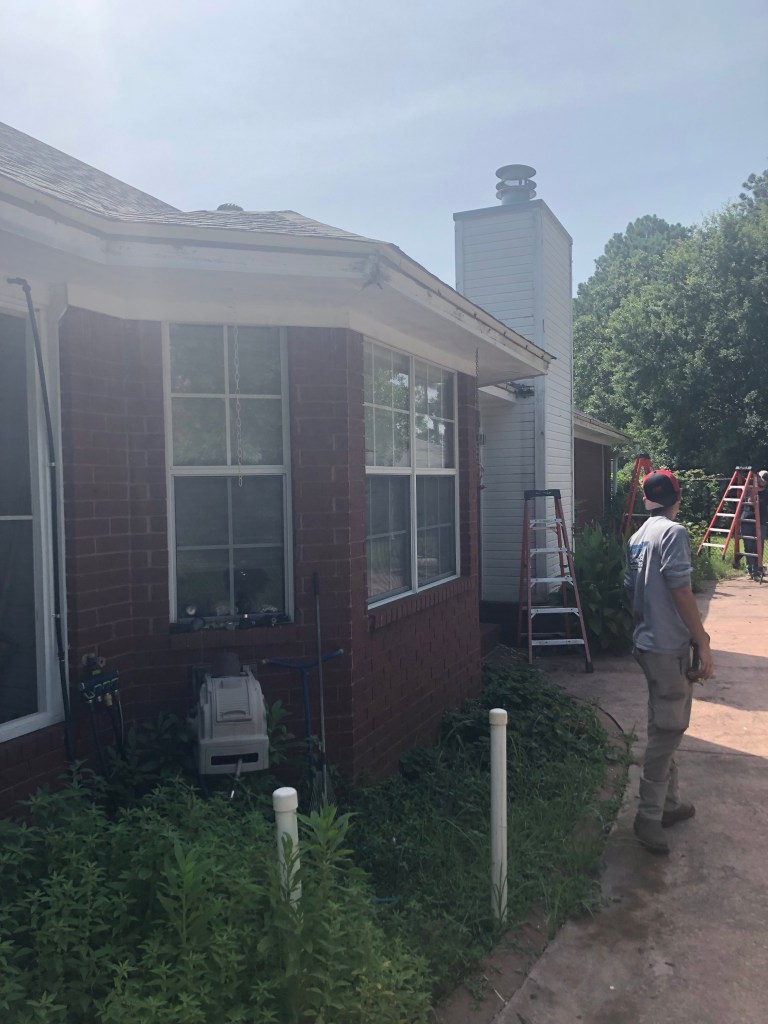
When I showed the picture to Melissa, she mentioned Arkansas had just announced availability of grants for solar farms.  A photovoltaic power station, also known as a solar farm, or solar power plant, is a large-scale photovoltaic system (PV system) designed to capture the sun to supply power into the electricity grid.  These are different than building-mounted units because they supply power at the utility level, rather than to local users.  The sun powered grid is made up of photovoltaic modules that convert the sun directly to electricity.  Most existing large-scale photovoltaic power farms are owned and operated by independent power producers, but the involvement of community and utility-owned projects is increasing.  This was the answer for the odd configuration, the solar panels had yet to be installed.

Thoughts:  To date, almost all PV systems have been supported in part by regulatory incentives such as feed-in tariffs, tax credits, or grants (as in Arkansas).  Another advantage of capturing power from the sun is the capability of multiple uses for the land to systems sit on.  While the best location for a solar park is on barren sites with no other valuable land use, in cultivated areas a significant proportion of the farm can be devoted to growing crops or other biodiversity projects.  Solar energy accounts for 1.6% of total US electricity generation and has ranked first or second in capacity added in the US since 2013.  The power of the sun is renewable, provides multiple uses for the site (including cultivation), and is becoming cost effective.  Once installed, the solar farm has no carbon footprint.  Follow the science.  Change is coming and it starts with you.
Discard

June 22, 2021

When I opened yesterday’s newspaper the front-page story was on a petition asking one of the large grocery stores to not discard unwanted plants.  Bryce Capocelli of Barling heard from a friend that plants were being dumped in Sallisaw, Oklahoma, and when he asked his local store if they did the same, he was told they did.  On May 20, Capocelli launched a petition on Change.org, asking the grocery chain to change its policy of disposing non-sellable or out-of-season plants and instead donate the plants to non-profits which can use them to feed the poor.  Capocelli’s petition states, “One tomato plant can yield up to 20 pounds of fruit per season.  Imagine how many people (the store) could stop from going hungry just by making a small change.”  Over 79,000 people have signed the petition as of June 16, with responses coming from across the US.

Every year, grocery stores discard more than 43 billion pounds of food (not including plants!).  Much of the food is technically edible, but most large grocery chains limit what food gets donated out of fear of litigation from vague laws and regulations.  Food banks or charitable organizations could evaluate the quality of the product prior to redistribution and determine whether it is edible.  In our litigious society large corporations are hesitant to donate items that could be deemed questionable.  There is some legal protection for those who donate under the Bill Emerson Good Samaritan Food Donation Act (BEGSFDA).  That act was put into law to encourage the donation of “food and grocery products to nonprofit organizations for distribution to needy individuals”.  It seems like a good idea.

Responding to a request for comment on the petition, a spokesperson highlighted the efforts of the company to meet its sustainability goals.  They are looking for ways to recycle rather than discard plant waste in select locations.  This is part of the companies zero waste strategy, which calls for diversion of approximately 80 percent of waste, including food waste, from landfills and incineration.  The goal is to create zero waste in the US operations by 2025.  Last year the company donated more than 627 million pounds of food in the US alone.  Inedible food is converted to animal feed, compost, or energy.  In 2020, more than 950 million pounds of discard went through these programs.  That leaves a lot of discard, and it does not address the petition on plant discard.

Thoughts:  The BEGSFDA is a federal mandate that requires States to adopt legislation to protect those who donate (not discard) food in good faith from civil or criminal liability should the donated food later cause harm to recipients.  On Dec. 20, 2018, the Agriculture Improvement Act of 2018 (Farm Bill) was signed into law.  The Bill directs the USDA to issue guidance to promote awareness of donations of wholesome food by qualified donors protected under the Child Nutrition Act of 1966 (GSFDA).  This guidance only applies to privately donated foods provided to The Emergency Food Assistance Program state and eligible recipient agencies.  It is daunting to even read this explanation paragraph.  Like so many good intentions, we are content to let the courts figure out what it means.  It is easier to discard what cannot be sold.  Do the work.  Change is coming and it starts with you.