Broken

March 23, 2021

The first weekend of the NCAA Men’s and first round of the Women’s Basketball Tournaments are over.  I always fill out a Men’s bracket and check the results hoping that my picks are better than my basketball knowledge.   Even though I suffered some hits in the Round of 64 I was confident my selections would come through during the Round of 32.  Now that we are down to the last 16 teams I must admit, my bracket is broken.  Even in my broken state (read not going to win any prizes for best selections), I am not yet ready to concede that it has been busted.  As it stands, I still have 9 teams in the Sweet 16, 3 teams picked for the final four, and the potential overall winner in my broken bracket.  On a better side note, the Razorbacks are moving on to the next weekend.

While I fill out a bracket every year, I have not done it online until this year.  I like to be able to write the names in the brackets and then mark them off when my predictions are wrong.  Rather then following the updated pairings that come out prior to weekend two, I also hold onto my original bracket.  What changed this year was the boy next door.  He came to our house last week offering a chance to enter a bracket in the local football team’s ESPN group.  Half of the $20 entry would be split by the top three brackets, and the remainder went to support the team.  We supported the team the four years my nephew played for them.  That meant buying pounds of sausage the first three years and T-shirts the last year.  I got a better return on the sausage than my bracket.

The Razorback men were in a 25 year Sweet 16 drought prior to Sunday.  After winning the national championship in 1994 and finishing runner-up in 1995, Arkansas snuck into the NCAA Tournament in 1996 and reached the Sweet 16.  In the 25 years since the Razorbacks have been to the tournament eight times, winning the opening game four times but always failing to advance beyond the first weekend.  During those 25 years 95 different teams reached the Sweet 16.  Some of them have been Cinderellas, while others are college basketball blue-bloods.  That is true again this year.  While the other 14 teams may not be true blue-bloods, they have been there many times before.  There are only two real Cinderellas, Oral Roberts and Layola.  Sadly, the No. 4 seeded Razorback women dropped their opening round to the 13th seeded Wright State.  This was a disappointment for the women and the first time since 2012 that a No. 4 lost to a No. 13.

Thoughts:  When I was in High School the league had banned fundraising for individual sports teams.  The thought was they were a public service, and fundraising would give certain teams an advantage over others.  Things have changed dramatically since those days.  Most of the larger schools in our state boast artificial turf, jumbotrons, and indoor practice facilities to go along with state-of-the-art weight rooms.  Donors are a large part of how these facilities are funded, but coaches try to put responsibility on the players.  I noticed there were 250 participants in our group bracket.  That comes out to $2,500.   That might cover the cost of the name changes on the back of new jerseys.  The head football coach for our local district was paid $106,000 in 2019, while the base teacher’s salary was just over $24,000.  They say you put money where your priorities are.  Perhaps our priorities are broken.  Do the work.  Change is coming and it starts with you.
Coconut

March 22, 2021

I have fond memories of the local drug store where I grew up.  I worked as a paper boy when I lived in this small Kansas town.  My two brothers and I delivered all the papers for the whole town (75?).  I believe officially the route belonged to my older brother, but he gave parts of the route he did not like to Danny and me.  The papers came from a larger town forty miles away and were delivered to the local drug store. The store was one of the classic old stores with a counter for the soda fountain and a rack of penny candy off to one side.  Although I occasionally bought some of the penny candy, I usually spent my money on baseball cards.  Still, there were times I would sit at the counter or stand and stare at the racks of candy and wonder.

When I was growing up there were not a lot of sweets in our household.  It was not that we did not have sugar, it was just the candy that is so prevalent today was not readily available.  The big treat came every year when my grandfather would bring two pockets full of ribbon candy when they visited for Christmas.  We would clamor around as he would dole the candy out to his doting grandchildren.  Instead of regular candy, my mother would make taffy.  Fudge and divinity also became a tradition for Sunday night, and mixed with popcorn, it became the staple meal.  Mom still practices the popcorn part of this habit (and fudge when she can get it) today at 92 years old.

The other thing I recall were the special cakes we had for our birthdays.  While I do not remember all the favorites, I do recall the German Chocolate (with pecans and coconut in the frosting) that was my dad’s favorite.  I also know the Angel food cake we had on Christmas Eve.  What else would you serve for Jesus’ birthday?  Mine was always Elephant Cake.  I am not sure where the recipe came from, but mom would use one cake pan for the body and cut the other pan into the head (center circle) and the outer ring into the four legs and trunk.  This was a white cake decorated with licorice for the tail, toenails, and tusks, and the white frosting was covered in coconut.  Mom continued to make elephant cake until I graduated High School.  Coconut cake is still one of the few sweets I crave.

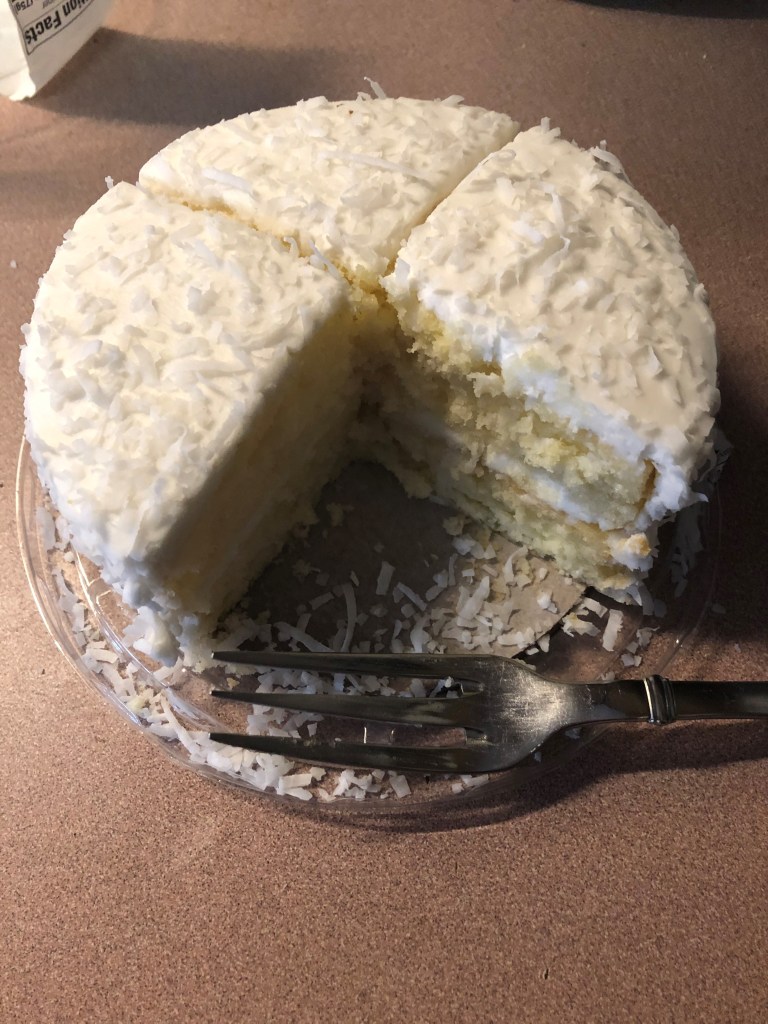
Thoughts:  In the movie “It’s a Wonderful Life”, George asks Mary if she wants coconut on her ice cream.  When she hesitates, he retorts, “Hey, brainless, don’t you know where coconut comes from?  The Fiji Islands, . . .”  How could she not like coconut and its connection to far away?  When I was at the grocery today, I came across a small coconut cake.  The Box store in town makes a great coconut cake.  It is 16” in diameter and three layers high.  There were times when I would buy one and split it with my parents.  I now live in another town and Melissa does not like coconut.  This cake was only six inches and two layers high.  I cut it into four pieces to enjoy over time.  There are times when traditions help keep us going.  That is true with mom and popcorn, and that is true for me and coconut cake.  There are other times when we rely on hope and expectation to help us through a rough patch.  That was the expectation of George. That is also our expectation of the vaccine.  While the virus will not “magically disappear,” there is hope for a return to something closer to normal.  Even with the vaccine, we still need to adhere to proper protocol.  Follow the science.  Change is coming and it starts with you.

Equality

March 20, 2021

Even though we are in the middle of Women’s history Month, EQUAL PAY DAY does not happen until April 2nd.  It is interesting to note that this recognition is not a demand for women to be paid the same wage for the same work.  Rather, April 2 is the day in the US when women try to catch up to what men typically earned the previous year.  The date varies in other countries.  Women make about 80 cents for every dollar a man makes in the US, according to Census data crunched by the American Association of University Women (AAUW).  While the wage gap is slowly closing, women, even those with university and professional degrees, face wage discrimination and other obstacles to achieving pay equity.

When I looked up the gender difference online, I found that many say the gender pay gap has been attributed to women’s own choices.  Women tend to select lower-paid, female-dominant professions, or they decide to take time off to care for children.   However, those factors do not account for the disparity says Kim Churches, AAUW’s chief executive officer.  Women are paid less than men even a year out of college.  Female business majors earned $38,000 a year after graduation, compared to $45,000 for men.  And while it is often assumed that education is the best way to close the gap, that is not a guarantee of equality based on gender.

The pay gap tends to be narrower for minimum-wage and service jobs, such as food service.   For accountants, auditors, physicians and surgeons, women experience the biggest pay gap.  The gap also varies from state to state because individual states’ economies and the laws are applied differently as states discourage and punish wage discrimination.  States whose primary industries tend to be male dominated have even wider pay gaps.  Churches says, “We also see that there is a clear distinction between states that have put equal pay legislation and other policies that are supportive of women into place and those that have not.”  It appears white males’ practice equal opportunity discrimination.

Thoughts:  Experts tell us the remedy is only partly in laws and regulations.  Federal law bans wage discrimination based on sex (as do many states).  Both the federal government and states need to go further.  One way is to ban questions about salary history so prospective employers will not base wages on previous jobs.  The Paycheck Fairness Act was presented in 2019 and approved by the House of Representatives.  The Republican controlled Senate at the time did not see the need to take the legislation up.  Laws and workplace policies need to reflect the new changing labor market, and women need to be included.  A Pew Research Center study from 2013 found that a record 40 percent of households with children under 18 had women as the primary breadwinners.  These same households comprise most children living in poverty.  Do the work.  Change is coming and it starts with you.
Crappie

March 19, 2021

I got a picture from my son Alex that showed a crappie that was believed to be a record for the state of California.  The picture showed the fish being held out in front to the angler and appeared to dwarf him with its size.  Being an angler myself, I know how the picture angle can change the appearance of a fish.  That is especially true if you hold it nearer the camera and away from your body (not that I would ever do that!).  I found the picture online and it had another picture from a different angle that better depicted its size.  While it was not the monster of the first picture, it was a huge fish.

A Black Crappie (Pomoxis nigromaculatus) is a freshwater fish found in North America and is one of two species of crappie.  It is similar to the White Crappie (Pomoxis annularis) in size, shape, and habits, except that it is darker, with a pattern of black spots.  The black crappie’s range is uncertain as it has been widely transplanted and easily adapts to many types of water.  It is assumed to have a similar range to the white crappie’s, whose native range is suspected to be in the eastern US and Canada.  As of 2005, populations existed in all 48 contiguous US states and introduced populations exist in Mexico and Panama.  The firm flesh and abundance of fish make these a staple for the weekend fish fry throughout the Midwest.

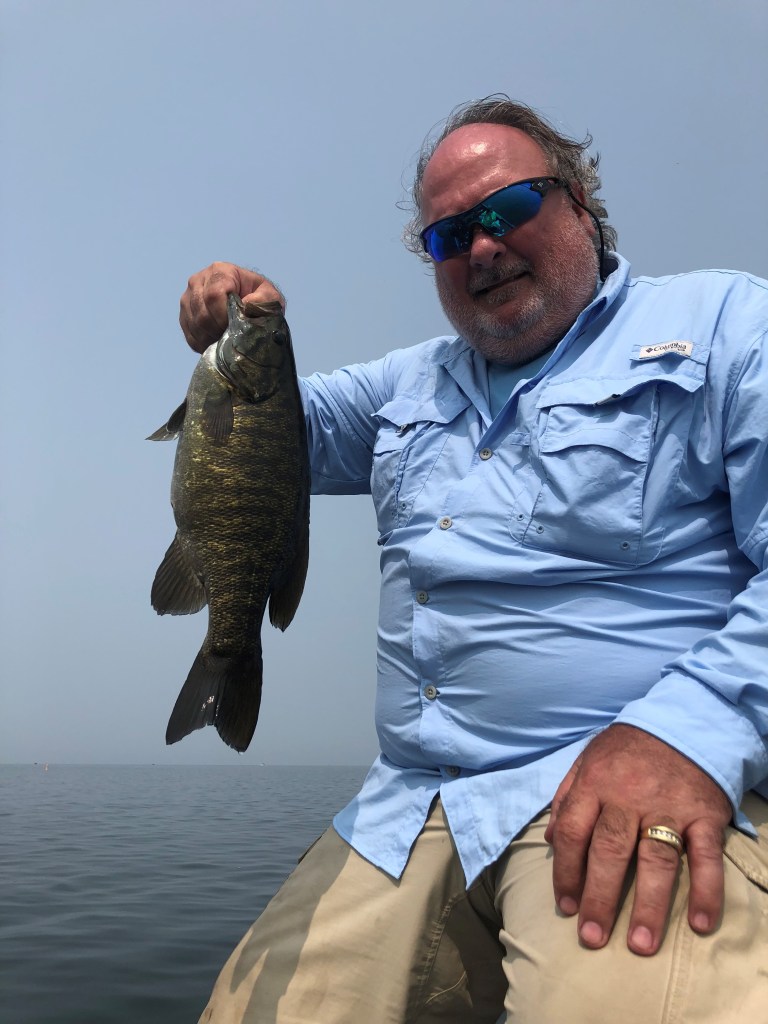
David Burruss of Clear Lake Outdoors in Lakeport, California, made the catch in mid-February.  Burruss was fishing at Clear Lake, which is known as a premier bass lake.   When Burruss located the crappie, he thought from their size they must be a school of bass on his fish finder.  He is said to have gotten the surprise of his life when he hooked one of the fish and it was instead a record-size crappie.  The crappie weighed 4.33 pounds (4 pounds, 5.3 ounces), breaking a 46-year-old California record of 4.1 pounds.  The crappie measured 17.71 inches.  The fish I caught in Minnesota pictured was the biggest crappie I ever caught.  It would be dwarfed by the California crappie.  As I said, it was a huge fish. 

Thoughts:  One of the unique things about crappie is they run in schools that remain together.  That means if you get a big fish, there are plenty of others in the same spot.  I went to High School near one of the premier crappie lakes in Kansas.  I heard stories of anglers renting U-Haul trailers to load with the schools of fish.  Those were stories of the good ol’ days, and I never encountered that kind of catch.  The problem when I fished the lake was twofold.  One was degradation of the habitat as the Lake silted in and the other was overfishing.  Both are a response to human activity.  If we do not take responsibility for our natural resources, they will not be available for the next generation.  Or even for us.  Follow the science.  Change is coming and it starts with you.
Hurry

March 18, 2021

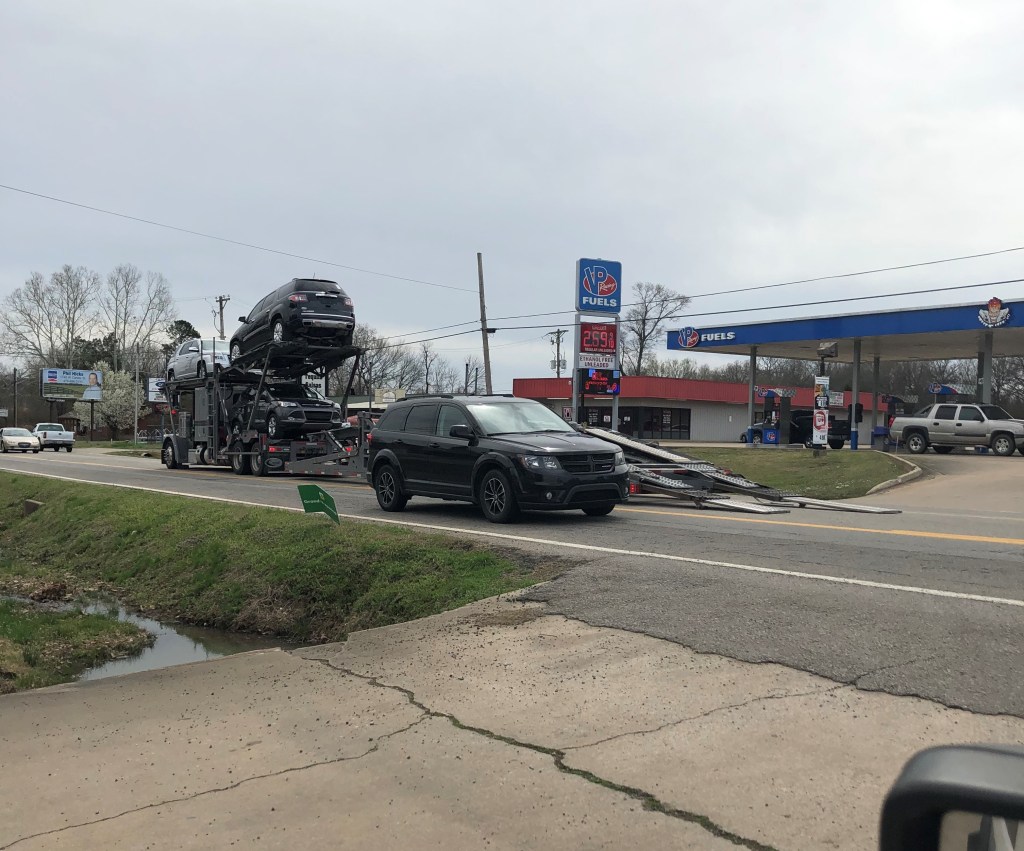
As I sat at the redesigned drive-thru window at a local restaurant I was amazed as a semi-truck carrying six different types of vehicles stopped in the middle turn lane of the busy main street in the town where I live.  The street serves as a main through fare going east for most of the small towns of central Arkansas.  I watched as the driver got out, pulled out his ramps, and then proceeded to back each vehicle off the truck.  The cars shot off (in reverse!) at about 40 miles an hour before reaching the used car lot 100 yards away.  He then ran back up the street to get the next one.  I was not sure if this was legal but assumed the reason for his hurry was because it was not.  With the new drive-thru I rapidly got my order and hurried off before I saw if he got caught.

One aspect of the pandemic has been all the construction that has happened.  There are new houses being built all over town where I live.  Whole subdivisions have hurriedly gone up overnight.  While the covid-19 pandemic plunged the US into a recession that left millions of Americans out of work and hungry, the housing market has boomed.  Between September 2019 and September 2020, homeowners accumulated a collective $1 trillion in additional home equity.  The exploding demand and historically low supply of housing has led buyers to desperately bid up the prices of available properties.  This boom has been welcome news for the 65% of households that are owner-occupied.  It is not so good for the growing number of Americans who are being shut out of the housing market.

New units are not the only construction boom that has happened.  As people began to work from home the realized they needed more space.  There is something about working at your computer while trying to make breakfast and tutor your 10-year-old that makes an extra room for an office seem attractive.  That is also true when you realize not being able to go outside for recreation means you need redesign your existing space to meet your new requirements.  In the “good ol days” we hurried to move, now we remodel.  The same hurry is evident in business real estate.  Economists project that more than 100,000 small businesses shut permanently in the first months of the pandemic.  Data suggests at least 2% of small businesses are gone, and that rises as 3% of restaurant operators have gone out of business.  Still, business construction is booming, and restaurants are remodeling to accommodate drive-thru pickup.

Thoughts:  The greatest disparity emphasized by the pandemic has been economic inequality.  This is true for corporations as well as people.  The four largest corporations in America (all global) now control 21% of the GNP.  The top 1% of earners in the US account for about 20% of the country’s total income annually.  Meanwhile, the lowest-earning quarter of Americans account for just 3.7% of annual income.  While some struggle to survive, others are in a hurry to make more.  The rich seem to be winning.  If economic insecurity is not a priority, we will all be left behind.  Do the work.  Change is coming and it starts with you.
Dentist

March 17, 2021

I finally got into the dentist today to repair a capped tooth.  I have never been good about going to doctors or dentists for no reason (read, preventative checkups).  When I was younger it was because I had no insurance, but it also came from a lack of trust in medical science.  I have always said there is a reason they call it medical “practice.”  That mellowed as I grew older.  One reason is because I now have insurance but also because I know with my age comes more potential for things to go wrong.  Age has forced me to both doctors and dentists to fix what I had neglected in my youth.  To quote Doc Holiday (a dentist) from the 1993 movie Tombstone, “my hypocrisy only goes so far.” 

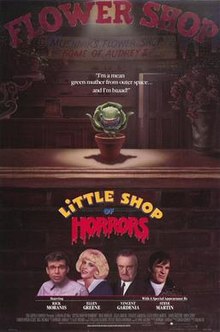
Like many medical offices, things have changed during the pandemic.  While that includes the safety protocols, it also means no longer providing nitrous oxide to help nervous patients (that would be me).  As I sat in the chair, I recalled one of my favorite scenes from the movie Little Shop of Horrors.  The online trailer said this “horror black comedy musical film” was released in 1986 and adapted the 1982 off-Broadway musical comedy of the same name.  This was in turn based on the 1960 film The Little Shop of Horrors.  The 1986 film stars Rick Moranis, Ellen Greene, Vincent Gardenia, Steve Martin, and Levi Stubbs as the voice of the carnivorous alien plant Audrey II.  The film also featured appearances by Jim Belushi, John Candy, Christopher Guest, and Bill Murray.  With so many of my favorite comedians, how could I not like it?

The film is about a geeky florist shop worker who finds out his Venus flytrap has an appetite for human blood.  One of my favorite scenes from the movie happens with a visit to the dentist.  Steve Martin was cast as Orin Scrivello, DDS, a sadistic, nitrous oxide-addicted dentist.  The patient was played by Bill Murray as Arthur Denton, a hyperactive masochist who visits Orin the dentist for “a long, slow root canal.”  The more pain Scrivello inflicted on Denton the more they both enjoyed it.  While I did not suffer the same fate, there have been times in the past when I have believed I was coming close.

Thoughts:  One thing I have been forced to realize is that when I ignore problems they rarely go way on their own.  In the past I probably would have ignored the tooth because it did not hurt.  The problem with that approach is that by the time it did hurt, the problem would have intensified.  By taking care of the problem early I avoided greater discomfort in the future.  We took my former approach when it came to addressing the pandemic.  We ignored it, said it would go away, and then denied it even existed, until the pain was too great.  Some have decided to do the same with the new vaccines now available.  If enough others get vaccinated, we will develop herd immunity and they will not have to worry.  That ignores the pain caused if you do get the virus or if you spread it to others you love.  I got the vaccine.  Follow the science.  Change is coming and it starts with you.
Warmer

March 16, 2021

Now that it has gotten warmer all the bugs and critters in my yard have come back in full array.  I always wondered what the robins and blackbirds were eating as they canvased my yard until I read about the insects that stay just under the surface to avoid freezing during the winter.  When it begins to get warm, they emerge and then rest on the grass to warm up and gain strength before taking off in flight to find a mate.  Many of them do not make it much farther than the blades of grass as the birds devour them.  Unlike the insects who hibernate as larva, mosquitoes find animal burrows or similar shelter and enter a state of torpor to survive the cold.  Now that it is warmer, they are again on the loose and I have seen several large ones on the windowpanes of my bay window in the kitchen.  Time for the birds to go to work.

Insects are not the only thing brought out by the warmer weather.  The grubs and worms that inhabit my yard have also become active.  The recent rains have forced them out of the ground for the apparent mass suicide they tend to suffer.  When I looked online for an explanation, I found an article by Teri Balser, an associate professor of soil and ecosystem ecology at UW–Madison.  The answer starts with worms breathing through their skin.  “Oxygen from air or water passes directly from their outer cuticle into their blood vessels.”  Normally, soil has a 50/50 mix of air and water in the pore space between the soil particles.  After a rain, the soil pores and the worm burrows fill with water.  Oxygen diffuses about a thousand times slower through water than through air.  The worms cannot get enough oxygen, so they come to the surface to breathe.

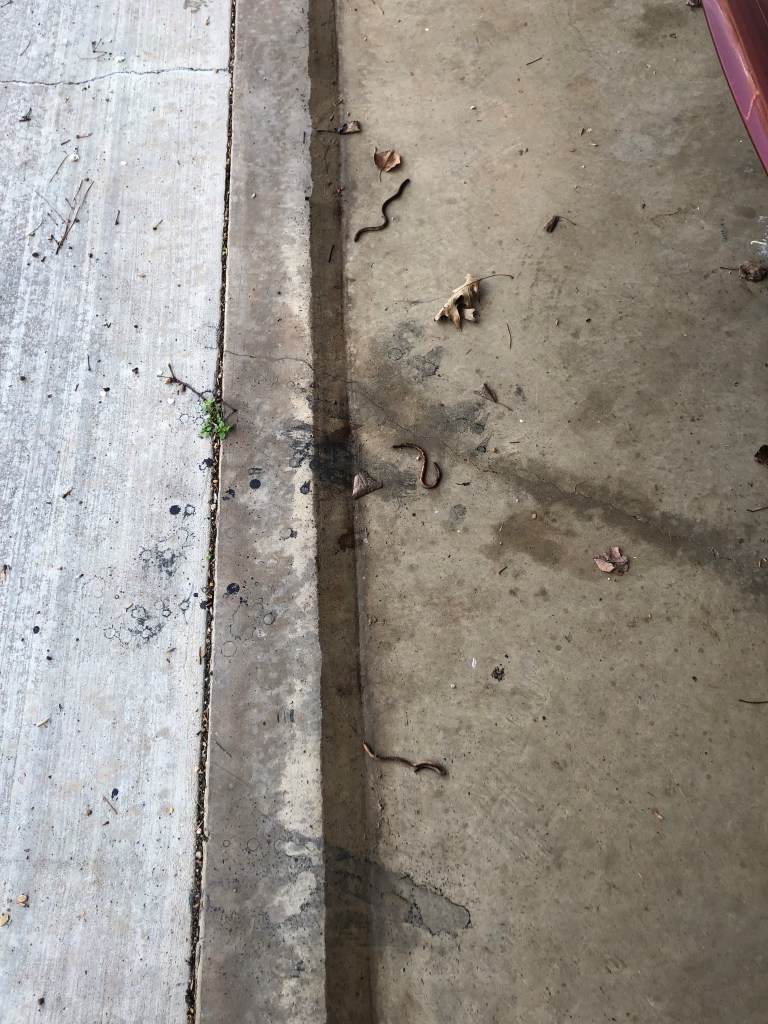
Why they get lost on the surface is less clear.  Once they get out on the surface, they seem to become confused and cannot find their burrows after they dry out.  They move around trying to find safety, but those who wander onto the concrete driveways or gutters have no way to go back into the ground.  As the sun begins warming the concrete and the water dissipates, the worms dry out and die.  The three worms I found yesterday had taken refuge under my garage door.  Two appeared to have succumbed and dried out but one was still alive and wiggling.  I threw them all back in the yard, just in case.

Thoughts:  Almost every earthworm in North America came from somewhere else.  Native earthworms north of Pennsylvania were all but all but wiped out by the glaciers of the Pleistocene ice age 10,000 years ago.  Even the southern earthworms were forced to compete with the European worms brought by European settlers as early as the 1600’s.  They crossed over in root balls or the dry ballast of ships.  As the British, French, Spanish and Dutch colonized the American continent, European worms came with them.  These species thrived in the upper soils of forests and gardens, while any native earthworms remained deeper underground.  Europe’s earthworms established an empire that outlived any built by its nations.  It is odd to think the Canadian night crawlers I use for bait are descendants of immigrants.  Ironically, so are all of us.  Do the work.  Follow the science.  Change is coming and it starts with you.
Pear

March 15, 2021

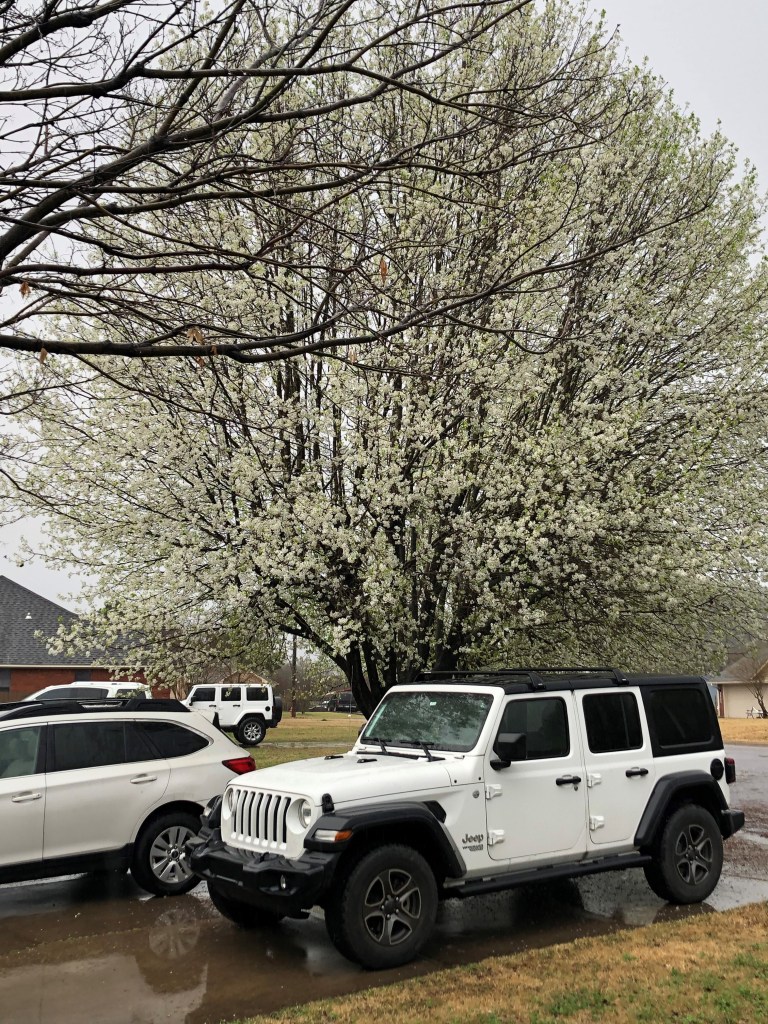
When I came back from work yesterday, I noticed the pear tree planted in our front yard had exploded into bloom.  The entire tree was covered with showy white flowers.  I had been noticing the buds on the tree for several days but did not think anything about them.  I just knew the cold caused the tree to stop shedding its remaining berries that drop on our cars.  These are sticky and clump on the bottom of your shoe to be drug into the house.  I was glad to be rid of the berries, and pleasantly surprised by the intensity of the flowers.  Even those this is my third year in the house, I did not pay much attention to the yard plants until last year.  It makes a difference when you know what you are looking for.

When I looked online, I found that the Bradford pear (Pyrus calleryana ‘Bradford’) is a spring-flowering tree that has been widely planted throughout the eastern US, especially over the last decades.  It is so popular that it can be found in nearly every city within its growing range and is the most common tree planted in South Carolina.  The Bradford grows 30 to 50 feet tall and 20 to 30 feet wide.  It has a wider, more erect, and branchier canopy than other trees of the species.  Early spring flowering may last two weeks unless caught by a late spring frost.  The species is a native of China, Taiwan, Japan, and Vietnam.  The flowers, unfortunately, have an unpleasant fragrance.  Melissa calls it our “stinky tree.”

The varieties of Pyrus calleryana are on the Invasive Plant Pest Species of South Carolina list.  Although the ‘Bradford’ pear was originally bred as sterile and thornless, they readily cross-pollinate with other cultivars of callery pears and subsequently produce viable fruit.  The ripened fruit is eaten and disseminated by birds, which results in thorny thickets of wild pear trees.  These escapees are generally unnoticed until spring when the edges of fields, abandoned lots, and forests are white with blooms.  Unlike the Bradford, most callery pears have thorns ranging from ¼-inch to over 2-inches long.  The thorns are known to cause extensive damage to equipment as land managers try to remove them from their property.  The Clemson Cooperative Extension site recommends planting native white-flowering trees rather than the invasive Bradford.

Thoughts:  As is the case with most invasive species, the Bradford pear was specifically brought to the eastern US because of its rapid growth and beautiful flowering.  The resulting cross-pollination brought unforeseen consequences and the species are now not only invasive but considered a pest.  The Asian carp presents a similar problem.  It was brought to the US because of its rapid growth and reproduction.  When flooding allowed the carp to escape their containment ponds it has gone on to dominate much of the Mississippi River system, decimating native species of fish.  We need to realize that when we transplant species from one location to another, they rarely have any of the natural checks found in their natural environments.  The same could be said for covid-19.  Follow the science.  Change is coming and it starts with you.

Optimism

March 13, 2021

I read an online news article from the New York Times by David Leonhardt that addressed how we need to face the world with the proper amount of optimism.  He pointed out the early coronavirus mistakes were mistakes of excessive optimism.  Neither the scientists nor the press grasped the depth of the threat.  The president exacerbated this mistake with a series of false statements minimizing the problem.  Now one year later and 544,000 deaths, politicians continue to show undue optimism by ending mask mandates and allowing full restaurants.

While over optimism caused errors, pessimism does the same now.  Thousands of schools remain closed even though epidemiologists say that many can safely open (with guidelines).  Irrational talk about the vaccines has created a reluctance to get them.  A widespread notion that life will not return to normal this year has caused people to give up trying to follow the science.  Leonhardt stressed that while difficult truths can be a vital public-health tool, so can optimism.  Optimism can help people get through tough times and be willing to make sacrifices, with the belief that better days are ahead.

A realistic optimism is what Biden tried to present in his first public address to the nation on Thursday night.  After a somber recitation of the cost of Covid-19, Biden offered a challenge and an optimistic result.  If we wear masks, maintain social distancing, and get vaccinated now, there is a good chance we will be able to gather in backyards for cookouts and barbeques by Independence Day.  We have faced the grim reality of the pandemic for the last year.  Biden offered a factual picture of our current state but went on to provide a source of motivation to do the right thing that was not based on fear.  It was an optimistic promise.

Thoughts:  One of the best parts about Spring Training in baseball is the optimism.  This is a time when teams get to evaluate the health of veterans, test the strength of potential rookies, and enjoy the game as a game.  Up until April 1st, even the worst team in the league is tied for first.  Now that I have received my first vaccine shot, I have new optimism.  I realize there is still the second shot and then the ten-day waiting period, but there is a renewed hope.  I also know being able to have a back-yard barbeque is not the same as jumping into a Spring Break pool with 500 of my closest friends.  My optimism still needs to face reality.  Follow the science.  Change is coming and it starts with you.
Focus

March 12, 2021

I was in that wonderful state of sleepy wakefulness this morning when an amazing idea for a Blog came to me.  I played this out as I always do in my mind before beginning to write.  I knew the point and the illustrations I was going to use to make the point.  I understood the plot twist I like to put at the end in my “thoughts” section.  I even convinced myself it was sooo good I needed to get up and write it down before it went away.  I got up and shook myself awake as usual, and then realized the whole concept had been lost by the act of getting fully awake.  I had lost my focus and the only thing I had left was the title, “Comments.”

When I mentioned this to Melissa, she suggested I needed to start keeping a pen and paper next to the bed so I could write down my ideas before they left me.  I had done this before when I wrote my thesis.  I had immersed myself in the research for two years prior to beginning to write and the basis was taken from research I was doing working with the state.  That meant total focus in the task.  When I did begin to write I was constantly waking up in the middle of the night with a new thought or a nuance that I should explore.  At first, I would go back to sleep and dream on.  I found when I woke up in the morning, I could not remember the great idea I had the previous night.  The pen and paper helped me focus. 

When I mentioned this to Melissa, she told me, “busy creative minds do not rest.”  While I am sure that is true, I have found that when we focus a large part of life on one aspect, that is what we also dream about.  A case in point is in the 1970’s when I worked as a cook in a taco shop.  We had a sale on weekends with five tacos for a dollar yes, really).  That meant families would come in and order 25 tacos, knowing it would only cost five dollars.  I worked the dinner shift and people would flood into the store.  I recall at one point during the sale I was behind on the orders by 250 tacos.  After the rush died down the workers began to talk and share taco stories.  I came to find out that amid our focus we had all been having dreams about being overrun by tacos.

Thoughts:   When I retired, I was no longer confined by the constraints of a job.  This left me with a lot of free time.  At first, I went aimlessly from task to task without any real focus.  If something needed to be done, I did it.  If I did not want to do what was needed, I ignored it knowing it would still be there tomorrow.  What I soon realized was I needed focus in my life.  That is when I began to be purposeful in my garden and fishing.  Over the last year I have also added birding (and yes, a job).  One of the hardest aspects of the pandemic for many has been removal of the focus we used to have.  For some that has been the loss of a job.  For others it has been separation from grandchildren.  There is also the task of trying to juggle work, family, finances, childcare, and tutoring, none of which has provided focus or left a lot of free time.  For many, this overload has resulted in a lack of ability to focus.  This happened before the pandemic, but then we called it a single-parent household.  Do the work.  Change is coming and it starts with you.