Open

March 11, 2021

During the first week of March, governors in Mississippi, Texas, Alabama, Arizona, West Virginia, and Connecticut announced significant loosening of statewide pandemic restrictions, including mask mandates and indoor capacity limits.  They were joined by several others in loosening statewide coronavirus restrictions in early 2021.  During 2020, other states like Georgia and Alaska chose to never implement statewide mask mandates.  Last September, Florida became one the largest states to roll back Covid-19 capacity restrictions when the governor reopened bars and restaurants to full capacity.  This is happening while the number of Covid-19 cases in the US crossed 29 million and more than 524,000 people have died across the country.  The CDC says one way to make a difference is to wear a mask.

When I substituted for several local Elementary and Jr. High Schools last year, I was constantly amazed by what students wore to school.  The lockers were shut down for safety reasons so what the students had on was what they came with.  More correctly, I was amazed by what they did not wear.  I grew up with the definition of a sweater as, “something you wore when your mother got cold.”  These students seemed to not get cold at all, having neither coats nor sweaters, and quite often wearing shorts in sub-freezing weather.  When they did bring outerwear, it was usually left on the back of a chair or crumpled in the corner when I closed the room for the day.

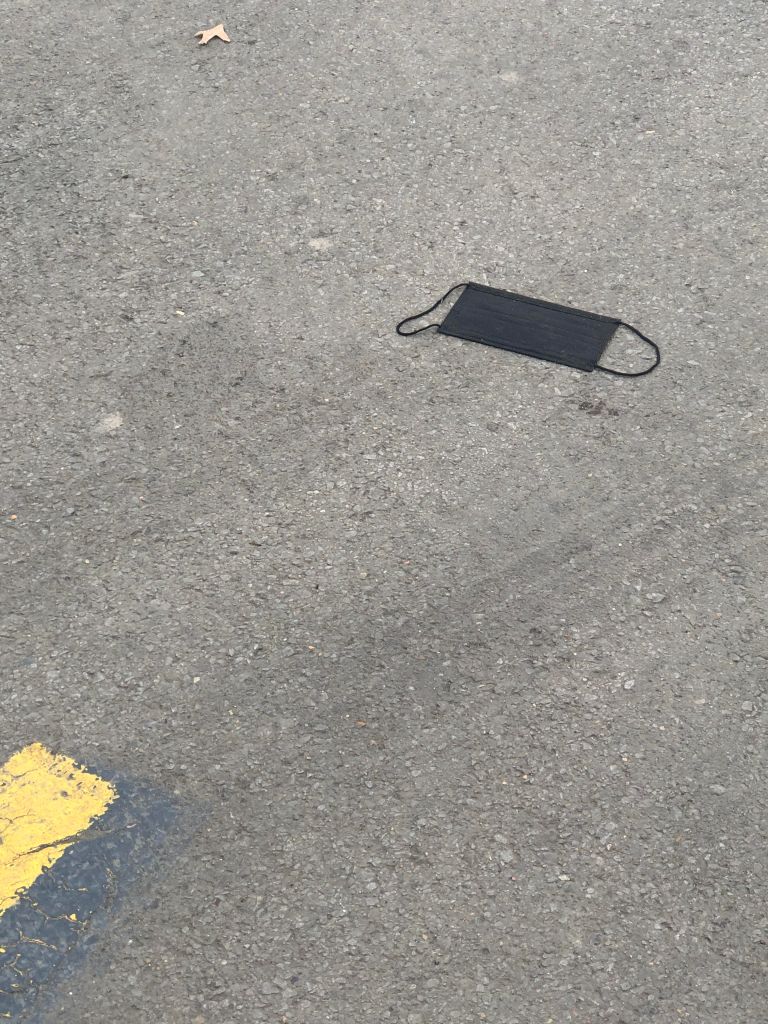
I have been amazed during the last year by how many masks I have found lying on the ground (no, I did not pick it up!).  These have been both the disposable paper masks and the reusable cloth masks.  When governors loosening the restrictions are asked about the wisdom on news reports, they have universally responded that “people know the risks and they will do the right thing.”  The reason for the mandates is because people refused to do the right thing, and Spring Break, Memorial Day, and 4th of July sent the numbers through the roof.  The only masks I have not seen on the ground are the homemade cotton masks.  Apparently, when you or a loved one takes the time to put in the love to make a mask you take better care of them.

Thoughts:  One of the things I have often heard this last year is that it is the students and not the adults who take the mask mandates seriously.  When I first heard of the school mask mandates, I had visions of masks spread out in a line from the classrooms to the bus in a modern replay of the breadcrumbs of Hansel and Gretel.  Students not only wear their masks but know how to wear them properly.   In recent weeks health officials in the US have repeatedly warned that the emergence of the new variants and loosening open restrictions will cause another spike in cases.  That means we need to be vigilant and not open until cases stabilize.  Many refuse to heed the warning.  Follow the science.  Change is coming and it starts with you.
Blooms

March 10, 2021

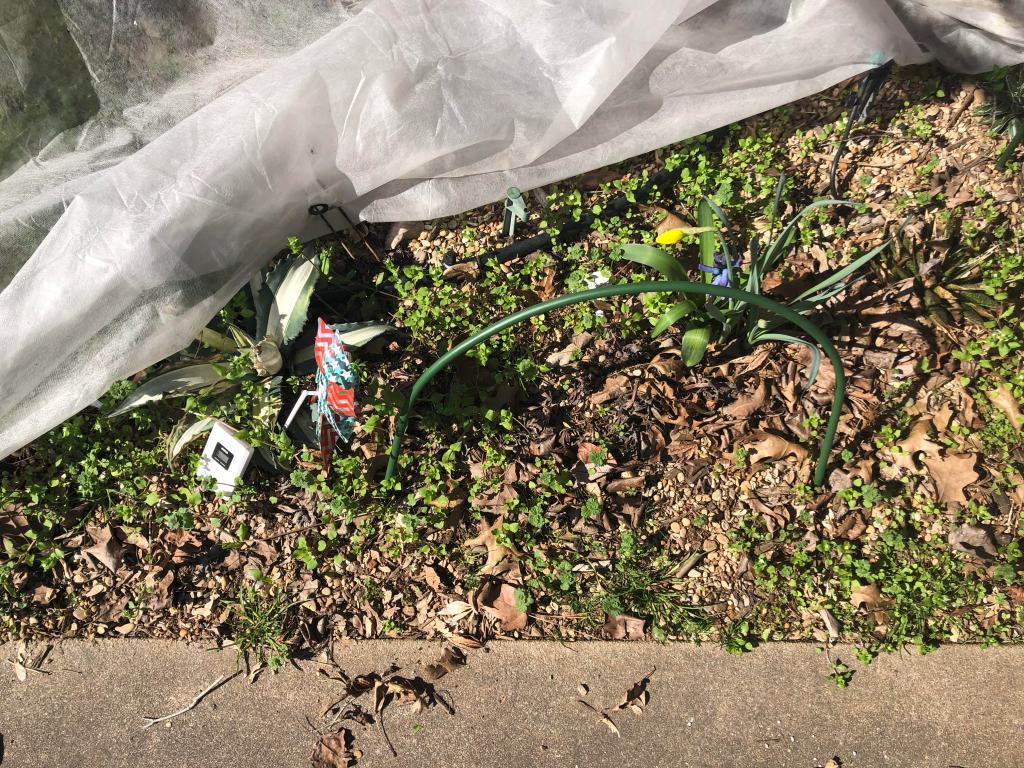
Melissa and I have been so concerned this winter with trying to keep the succulents in our outside beds alive that I ignored the other species that share the same space.  When I walked out of the house on Monday, I noticed a flash of yellow under the mesh we used to cover the succulents to keep them warm.  I was excited as I thought this was a cactus flower that had bloomed now that it is warmer.  You can imagine my surprise when I pulled back the covering and saw a single yellow Daffodil with a grape Hyacinth growing within its foliage.  I had forgotten these Spring blooms were even in the bed when we planted the succulents last fall.  Their blooms served as a reminder.

Daffodil is one of the common names for flowers of the Narcissus genus.  Other common names include narcissus and jonquil.  All Narcissus genus plants have conspicuous flowers with six petal-like tepals surmounted by a cup- or trumpet-shaped corona.  The flowers are generally white and yellow (ours are yellow) but also orange or pink in some garden varieties.  The genus is generally considered to be about ten sections with approximately 50 species.  The number of species has varied, depending on how they are classified, due to similarity between species and the continuous resulting hybridization.

When I checked online, I found that flower longevity varies by Narcissus species and conditions, ranging from 5–20 days.  After flowering leaf and root senescence sets in, and the plant appears to be ‘dormant’ till the next spring, conserving moisture.  However, the dormant period is also one of considerable activity for the bulb.  Like many bulb plants from temperate regions, a period of exposure to cold is necessary before spring growth can begin.  This protects the plant from growth during winter when intense cold may damage it.   Warmer spring temperatures then initiate growth from the bulb.  I hope my booms are the kind that last for 20.

Thoughts:  Just as many hoped 2021 was going to bring a new beginning, so too Spring has always been a time of rebirth and hope for a new beginning.  This rebirth brings the wonderful blooms that have taken over my mailbox planter and have snuck under the blankets and mesh that grace the front house bed.  It is always surprising that while we try and create a world that conforms to our vision and wishes, how the world goes forward on its own terms.  This is a good thing for my flower beds as the Spring blooms add color to the dormant succulents.  It is also a caution knowing that the planet has the capability of self-correcting when things go too far.  That has resulted in the five mass extinctions and many more minor corrections.  Some believe the pandemic is an example of one of natures “minor” corrections.  Follow the science.  Change is coming and it starts with you.
Seniors

March 09, 2021

Last night’s news reported they were staging a pop-up vaccination site today at the Senior Center.  This was a drive through event for the first 100 eligible arrivals.  As the story continued it mentioned a local Pharmacist also promised an additional 50 shots for those wanting to come inside and listen to a spiel about the vaccine and what to expect.  I had placed my name on a waiting list two weeks ago but have not heard anything back.  When I called, I was told it generally takes at least a month.  I decided it could not hurt to try and get the vaccine, but I was not hopeful.  They were only administered from 8-10 am and the site was 20 miles away.  I woke up early, so I decided to give it a try.  I grabbed my fish bait thinking worst case scenario I could get in a few hours fishing this morning.  Then I took off for the Senior Center.

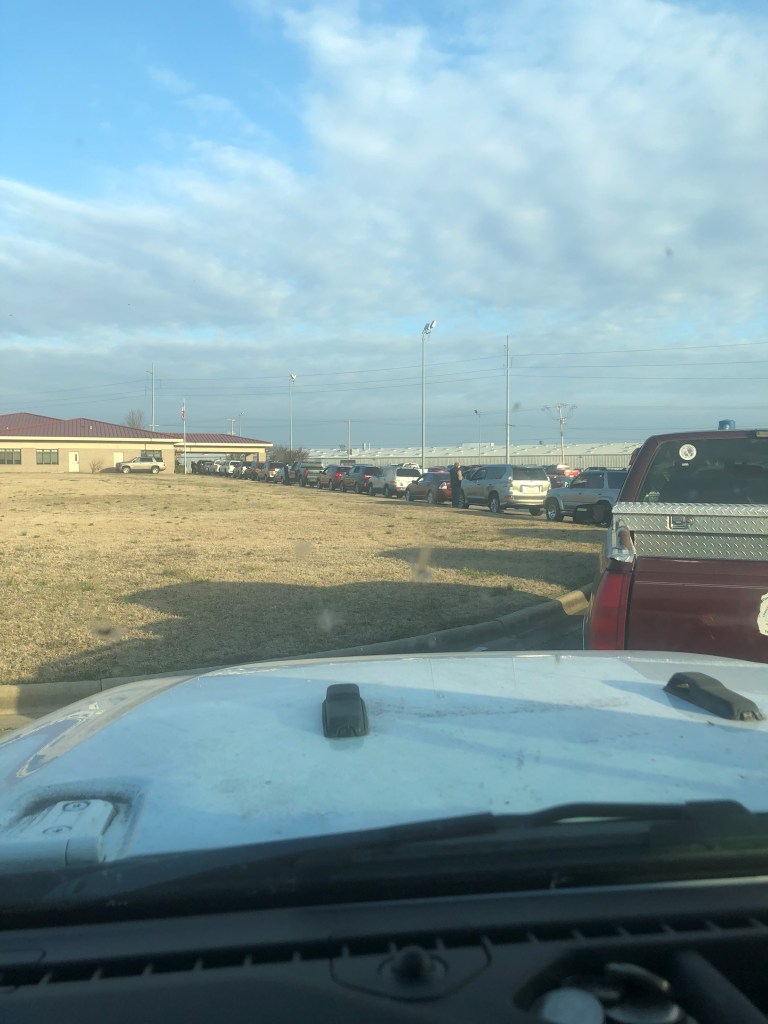
I arrived at the site a little before eight and was surprised to see that while the lot was full, there were only about 30 cars in line.  I guess some preferred the in-person experience rather than drive-through.  I had brought my paper anticipating a long wait.  When I opened the paper, the front-page story was about the growing number of Seniors.  Arkansas’ 50-plus population was expected to grow from 36% in 2018 to 40% by 2050.  We have already grown from 494,000 to 559,000 between 2016 and 2021.  The gist of the article touted Seniors as the next market economy.  According to Herb Sanderson of the Arkansas AARP, Fort Smith has everything seniors are looking for: mild weather, favorable tax base, local attractions, affordable housing, public transportation, parks, and available retirement communities.  When I retired it had what I wanted as well, Melissa.

As I waited in my car to get my shot, I was reminded how age does not improve your manners.  As the line grew behind me there were several cars who purposefully took a different entrance, snaked through the parking lot, and then pulled into the second lane in front of about ten cars that had been waiting patiently (including me).  I was not surprised when these were expensive vehicles.  I have heard stories of similar behavior as people have been able to jump the line to get vaccinated ahead of the essential workers who are at higher risk.  Apparently, wealth means you do not need to wait.

Thoughts:  I was surprised that more people did not show up to receive the vaccine.  I was vaccinated and completed my mandatory 15-minute wait by 8:45 am.  By the time I pulled out of the parking lot there were less than 10 cars in line and no new ones arriving.  Maybe they had already administered the available shots, but when I went to the pop-up, I expected long lines and delays.  While the Senior Center sounded like a good vaccination site, it was in an area that required a vehicle to access.  This emphasizes the difficulty with vaccination across the country.  Many sites are in locations that are hard for the poor to access.  Washington DC is vaccinating by zip code with the vaccination sites in the zip code area to target high risk populations.  Like most things, if you do not purposefully plan to be equitable, you will fail to be so.  Do the work.  Change is coming and it starts with you.

Acknowledge

March 08, 2021

This morning my sister let me know today is International Women’s Day.  The earliest Women’s Day observance was called “National Woman’s Day” and was held on February 28, 1909, in New York City.  It was organized by the Socialist Party of America.  In August 1910, an International Socialist Women’s Conference preceded the general meeting of the Socialist Second International in Copenhagen, Denmark, which proposed establishment of an annual “Women’s Day.”  The following year on March 19, 1911, International Women’s Day (IWD) was marked for the first time.  Women in Europe and America marched and demanded they be given the right to vote and to hold public office, as well as to protest sex discrimination in employment.  In 1914, IWD was held on March 8 in Germany, possibly because that was a Sunday.  The day is now celebrated on March 8 for all countries.

I have been grateful as my birthday has been acknowledged and celebrated across America.  Martin Luther King Jr. Day (January 15th) is a federal holiday in the United States marking the birthday of Martin Luther King Jr.   Acknowledgement of King’s birthday was first suggested soon after his assassination in 1968.  Federal support began to take hold as discussion around the day took place during the 1970’s and 1980’s.  It was finally signed into law in 1993 and was first celebrated in 1996.  Due to the Uniform Monday Holiday Act (effective January 1, 1971), it is observed on the third Monday of January.  While not always on the 15th, it is on the actual date every six years.  I call this David L. Schirer Day. 

UN Women (and IWD) is now sponsored by the United Nations and is dedicated to gender equality and the empowerment of women.  As a global champion for women and girls, UN Women was established (July 2010) to accelerate progress on meeting women’s needs worldwide.  Amid the challenges offered by the world-wide pandemic, the 2021 theme is #ChooseToChallenge.  As stated on the UN Women website, “A challenged world is an alert world.  Individually, we’re all responsible for our own thoughts and actions – all day, every day.  We can all choose to challenge and call out gender bias and inequality.  We can all choose to seek out and celebrate women’s achievements.  Collectively, we can all help create an inclusive world.  From challenge comes change, so let’s all choose to challenge.”  This is a challenge worthy to acknowledge.

Thoughts:  I also received a quote from Serena Williams concerning IWD’s 2021 theme.  “Every woman’s success should be an inspiration to another.  We’re strongest when we cheer each other on.”   The year 2020 brought many challenges.  While some hoped that 2021 would be different, it certainly did not start as such.  The challenges are great and cut across various intersections of American and world culture.  Just as each woman’s success is an inspiration to another, it should also be an inspiration to all.  Great things are accomplished when individuals step forward to face a challenge, and then inspire others to take up the cause.  This year has promise for great accomplishments if we acknowledge and embrace the challenges.  Do the work.  Follow the science.  Change is coming and it starts with you.

Recognition

March 06, 2021

Today there are three Cherokee tribes who are federally recognized.  These are the United Keetoowah Band of Cherokee Indians (UKB) in Oklahoma, the Cherokee Nation (CN) in Oklahoma, and the Eastern Band of Cherokee Indians (EBCI) in North Carolina.  The Cherokee Nation has more than 300,000 tribal members, making it the largest of the federally recognized tribes in the United States.  In addition, numerous groups claim Cherokee lineage, and some of these are state recognized.  More than 819,000 people are estimated to have identified as having Cherokee ancestry on the U.S. census, but most are not enrolled members of any tribe.

I came across an AP article in my paper last week that described how the pandemic has left unrecognized Indigenous tribes in the US at risk.  The problems they face are not much different than the recognized tribes and others, but there are additional roadblocks to financial help.  Since they are not recognized they have no means of applying for federal or state assistance.  The path to federal recognition is long, complicated, and expensive.  In addition to the anthropological and genetic research it requires extensive documentation showing they are distinct from other tribes and have been continuously operated since the 1900’s.

When I looked online, it confirmed the Indigenous peoples in the US are split into recognized and unrecognized groups by the federal government.  Unrecognized tribes in the United States are “organizations of people who claim to be historically, culturally, and/or genetically related to historic Native American Indian tribes but who are not officially recognized as Indigenous nations by the United States federal government, by individual states, or by recognized Indigenous nations.”  That includes hundreds of tribes nationally and 27 Bands or Tribes in Arkansas, with most of the Arkansas Tribes being some variant of Cherokee.  Unrecognized tribes are not eligible for federal or state assistance.  The 574 federally recognized Tribes are eligible for a share of the $8 billion relief package for the virus response approved last March.  While this amount is small given the numbers of tribes and individuals, it helps.

Thoughts:  Of the three federally recognized Cherokee tribes, the Cherokee Nation and the UKB have headquarters in Tahlequah, Oklahoma, and most of their members live in the state.  The UKB are mostly descendants of “Old Settlers” (Western Cherokee) who migrated from the Southeast to Arkansas and Oklahoma about 1817.  They are related to the Cherokee who were forcibly relocated there in the 1830’s under the Indian Removal Act.  The Eastern Band of Cherokee is located on land known as the Qualla Boundary in western North Carolina.  They are mostly descendants of ancestors who resisted or avoided relocation and remained in the area.  Since they gave up tribal membership by escaping relocation, they became state and US citizens.  In the late 20th century, they were reorganized as a federally recognized tribe.  Recognition is a desire held by everyone, not just Indigenous peoples.  We need to recognize the religious and cultural differences that make us unique.  When we recognize others, we also affirm that they matter to the country and to you.  Do the work.  Change is coming and it starts with you.

Voting

March 05, 2021

In the USA Today portion of today’s paper the leading news was the voting rights measure that was passed by the US House of Representatives.  The Resolution touches virtually every aspect of the electoral process, including restricting partisan gerrymandering of congressional districts, removing hurdles to voting, and bringing transparency to the campaign finance system.  The bill is seen as a counterweight to the restrictions advanced by Republican controlled statehouses across the country.  The state restrictions were passed after the past president’s repeated false claims (read, all lost in court) of a stolen 2020 election.  The measure passed on partisan lines, with no Republican votes in favor.

I have proudly voted in every national election (and most local ones) since becoming eligible when I turned 18.  That includes voting legally in the four different states where I have taken residence.  I have staunchly maintained that my vote be cast by secret ballot.  That means I have never claimed a party affiliation and have instead maintained myself as “independent.”  While this preserves my privacy and allows me to vote my conscience rather than party line, it also precludes me from voting in the primaries that choose the candidates who run for election.  Regardless of which party candidate wins election, I have tried to support them as my conscious will allow.  

As House Bill–1 moves to the Senate it appears it will face opposition, and an expected partisan vote.  That means the Democratic controlled (50-50+1) body will face a significant question, what to do if forced to choose between the protection of voting rights and the protection of the filibuster.  Dozens of states with Republican legislators are trying to make voting more difficult.  While the explanation is voter fraud (which has not been found), it comes down to the belief that lower voter turnout helps their party win elections.   The bill seems to have no chance of winning the 60 votes needed to overcome a Senate filibuster.  The bill will only pass if all 48 Senate Democrats and 2 Independents agree to scrap or alter the filibuster, as they have the power to do.  Independents control the vote over partisanship.

Thoughts:  The right to vote is fundamental to the American Revolution and the resulting Constitution.  While this was a just cause for the Founders, it has always meant “my” right to vote rather than yours.  That is obvious by amendments defining who has the right to vote and formation of the Electoral College to make sure the “elite” rather than the “rabble” actually vote for the President.  Responsible voting demands non-partisan action.  What we need are legislators who are willing to vote conscious rather than party line or keeping themselves in power.  If we are “for the people, and by the people,” perhaps “all the people” should be able to vote.  Do the work.  Change is coming and it starts with you.
Restrictions

March 04, 2021

Major League Baseball spring training camps got underway across Florida and Arizona earlier this month.  MLB was unable to convince the MLBPA to agree to a delayed 154-game season and an expanded postseason, so spring training and the regular season will begin as scheduled.  February 17th was the first reporting date for pitchers and catchers for many teams, and most players were in camp by the 25th.  Sunday marked the beginning of pre-season games (Royals are 3-1 so far) and April 1st is opening day.  Many of the restrictions that went in place during 2020 will continue during 2021, but there are notable differences.  This includes allowing fans.

The 2021 season will look a lot like 2020, except the plan for a full 162 games.  Doubleheaders will again be two seven-inning games.  Each offense will get a runner on second to start every extra inning.  There will not be a universal designated hitter as the Players Association and the League could not come to an agreement (yet?).  The playoff field will feature five teams per league, which will be the three division winners and two wild cards, with a one-game play-in between the Wild Card teams, for each league.  There was a decision to deaden the ball this season.  By loosening the initial wind of the ball, it dropped the weight slightly during the 2019 and 2020 seasons.  In 2019, MLB teams swatted a record-smashing 6,776 home runs, compared to the 30 clubs combined total of 4,186 home runs in 2014.  Major League Baseball owns Rawlings, and Rawlings hand makes every baseball used, to “create consistency.”  Sounds like “monopoly” to me.

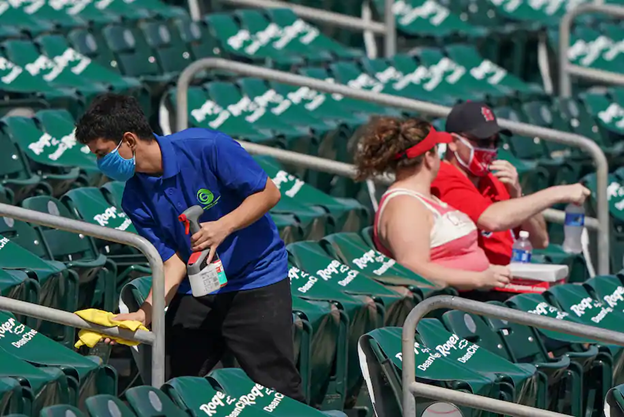
On Sunday fans streamed into the stands at Roger Dean Stadium in Jupiter, Florida, and watched the Nationals play their Grapefruit League opener against the Cardinals.  The stands had green tarps pulled tightly over most seats and masks were worn by most.  The crowd swelled to around 1,500 fans, or about 21 percent of capacity.  Fans and players alike were happy to have live fans.  Nationals starter Erick Fedde was quoted, “There was a little more buzz when you walk out to the field and start playing catch and getting into the bullpen.  It was fun.  It reminded me of older times.”  All 30 major league teams will allow fans to attend spring training games in accordance with local coronavirus ordinances.  All will employ a pod setup, with physical distance built in between occupied pods of seats.  Masks will be required for attendance.  If the opener is any indication, this restriction will be obeyed “by most.”

Thoughts:  On Friday Arkansas’ Governor joined most states in lifting most safety restrictions imposed to curb the spread of the coronavirus.  The mask mandate will remain in place until at least the end of March.  As of today, there are nearly 9 million active cases in the US and just under 532,000 deaths.   The CDC warns that new variants and a plateau in cases make this a critic al time to maintain strict guidelines to ensure the trend continues.  Many only heard what they wanted to believe as businesses opened and masks became optional.  The restrictions that allowed the number of hospitalizations and deaths to go down are being abandoned across the US as the nation clamors for the “right” to go back to business as usual.  While they may not be as fun, obeying the restrictions will save lives.  Follow the science.  Change is coming and it starts with you.
Socks

March 03, 2021

The Ren & Stimpy Show was a popular animated television series created by John Kricfalusi and originally aired on Nickelodeon.  The series premiered on August 11, 1991 and ended on December 16, 1996.   The show follows the adventures of Ren Höek, an emotionally unstable and sociopathic Chihuahua; and Stimpy, a good-natured yet dimwitted cat.  The series was controversial for its dark humor, adult humor, and shock value.  A failure to deliver episodes to the network led to Kricfalusi’s termination from the show in 1992, with Games Animation producing the remainder of the series.  Despite production problems, The Ren & Stimpy Show received positive reviews and quickly developed a cult following.  That would include me.

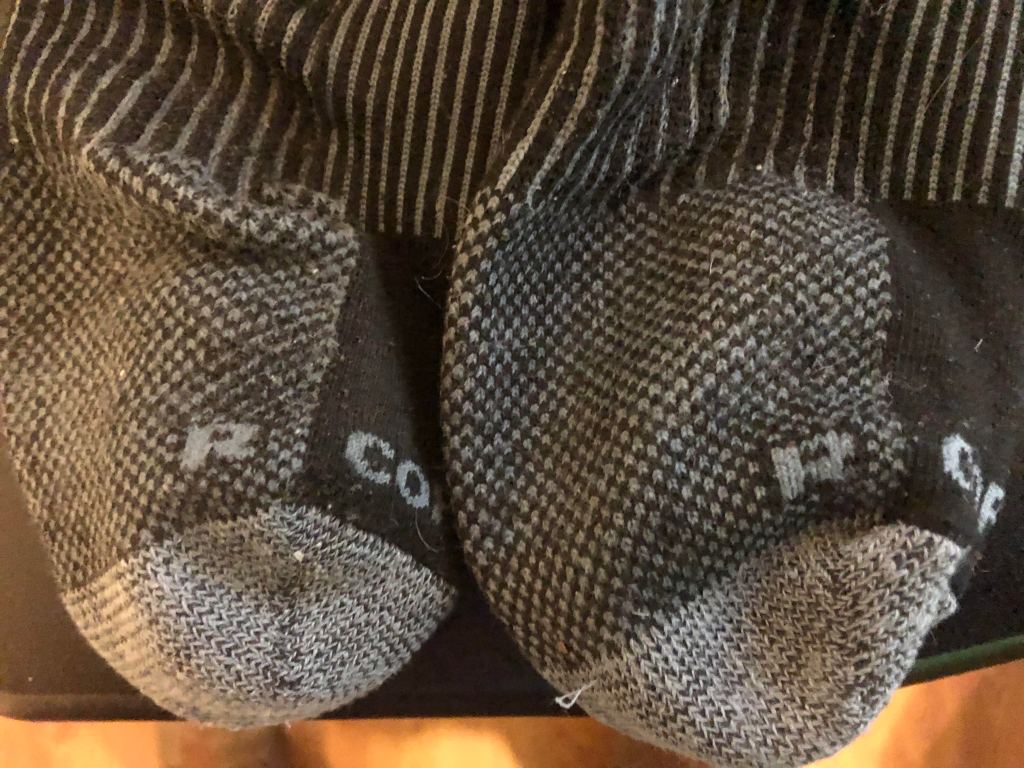
I have mentioned how when I was younger, I pinned my socks together to avoid losing a sock.  When I wore the socks, I would attach the safety pin to the sock to not lose the pin either.  People often made fun of me and asked if the safety pin was used to keep the sock up on my leg.  I endured the ribbing smug in the knowledge that I never lost one of a pair of socks.  When Melissa and I married she also questioned my habit.  I finally stopped pinning my socks together and followed her habit of folding the tops together after they came out of the dryer to make it easy to grab a pair of socks from my drawer.  Last year Melissa bought me three pair of copper infused socks.  It was the classic three-fer, with two pair alike and the third a different color.  They were also marked “R” and “L” to let me know which foot to put them on.  Over the year I have somehow managed to lose two of the darker socks.   When I put on the remaining pair, I noticed they were both marked “R”.  I had managed to lose the two left socks.

One of my favorite episodes of Ren & Stimpy was called Black Hole.  While traveling through space the pair get sucked into the “hideous vortex.”  When they come out the other side of the black hole, they realize they have been teleported to another universe.   As they try to find a way out, they come to a mountain of socks which were all the world’s missing left socks.   Stimpy’s “space-time doohickey” then notifies him that if they do not get to the trans-dimensional gateway by 3:00 pm, they would be trapped there forever.   They end up imploding, and the mountain of lost left socks is regrettably lost forever.

Thoughts:  When I noticed both remaining dark socks were marked “R”, I realized Ren & Stimpy must have been right.  It is only the left socks that mysteriously disappear in the dryer.  I thought my mother had told me to pin the socks together, but when I mentioned this to her, she told me she knew nothing of the practice.  Apparently, it was my father who had convinced me to do it.  He did not like to lose socks, and this was his way to ensure it did not happen.  One of the ways I now adapt to losing one sock is to only buy socks of the same color and type.  If I lose one, it can be matched with another whose mate has worn out.  A willingness to adapt spells the difference for moving forward or staying caught in the same repetitive cycle.  That is true for my socks, but also true for the changes brought by 2020.  While some laughed at countries where people wore masks prior to the outbreak, and now speak wistfully of the time when we no longer need to wear masks, I wonder if that is wise.  Like influenza, covid-19 is an ongoing risk that may never go away.  We will be required to adapt.  Follow the science.  Change is coming and it starts with you.
Spiro

March 02, 2021

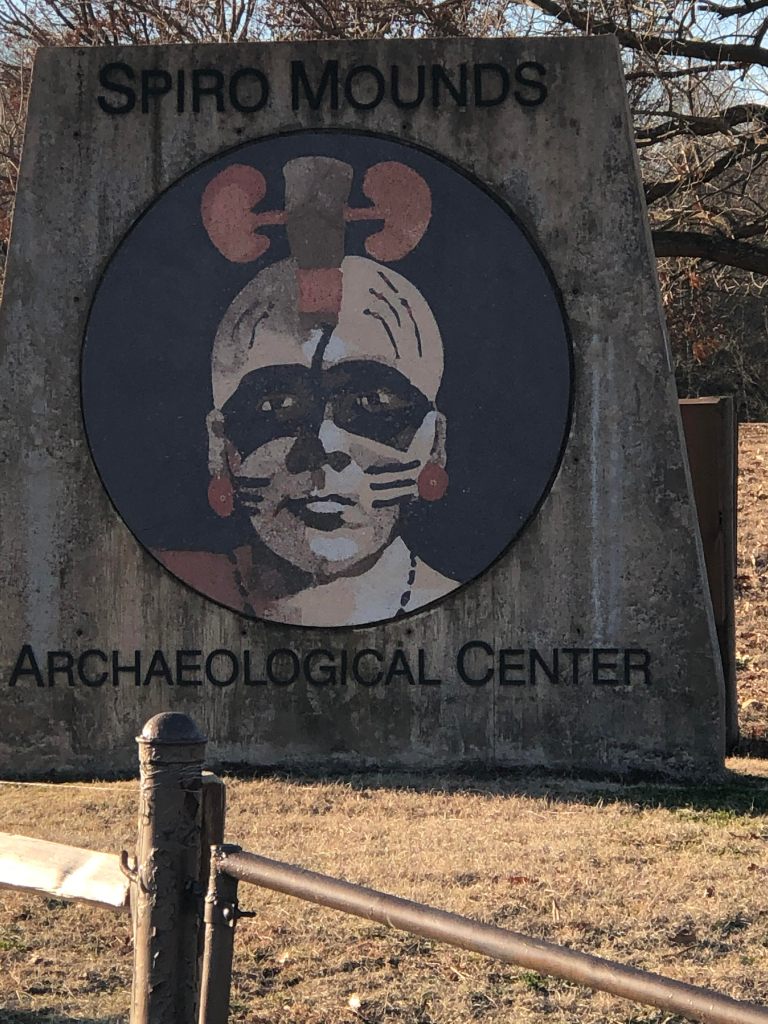
When Melissa and I were driving in southeastern Oklahoma last week we came across the town of Spiro.  Spiro Mounds is a major Northern Caddoan Mississippian archaeological site.  The 80-acre site is located within the floodplain on the south side of the Arkansas River.  The modern town of Spiro developed about seven miles south of the site and is named for the mounds.  Between the 9th and 15th centuries, the Indigenous people created a powerful religious and political center, culturally linked to the Southeastern Ceremonial Complex, also called the Mississippian Ideological Interaction Sphere (MIIS).  Spiro was a major western outpost of Mississippian culture.  

My senior paper as an undergrad in North American Archeology was a 150-page descriptive analysis of the Middle Mississippian complex of sites.  The Mississippian culture reached its greatest extent during the Middle period (1200 to 1350 CE), stretching throughout the Ohio, Tennessee, and Mississippi River valleys.  Although there were regional variations, the cities, villages, and ceremonial centers were all linked together by trade.  The main complexes are known for building large, earthen platform mounds for temples and burial sites, along with other animal and geometric shaped mounds.  The largest city was Cahokia, located in present-day southern Illinois.  Almost all Mississippian sites predate the Spanish expedition by Hernando de DeSoto (1539 to 1543 CE) but few lasted far beyond these devastating intrusions.  The notable exceptions were the Natchez communities which maintained Mississippian cultural practices into the 18th century.

During the 1930’s treasure hunters bought the rights to tunnel into the second-largest mound on the Spiro Mounds site (Craig Mound) to mine it for artifacts.  They exposed a hollow burial chamber inside the mound.  This unique feature contained some of the most extraordinary pre-Columbian artifacts ever found in the United States.  These included fragile, perishable works of textiles and feathers that had been preserved in the conditions of the closed chamber.  The treasure hunters sold the artifacts they recovered to art collectors, some as far away as Europe.  Some of these artifacts were later returned to regional museums and the Caddo Nation, but other artifacts have never been accounted for.  Since the late 20th century, Spiro Mounds has been protected by the Oklahoma Historical Society and is listed on the National Register of Historic Places.

Thoughts:  Laura Croft and Indiana Jones popularized the romantic idea of locating lost artifacts and bringing them back for display in local museums.   Their movie titles illustrate the problem with early forms of “Archeology”, Tomb Raider and Raiders of the Lost Ark.  Rather than conducting scientific research, they were grave robbers.  That is what happened at Spiro Mounds during the 1930’s as well.  For modern archeology, provenience, or where the artifact is found and its association to other aspects of the site, is what makes it valuable.  It adds to the story of the culture.  For collectors, it is the rarity of the artifact that makes it valuable, regardless of where it is found.  The lack of provenience is often seen as a good thing, as most privately collected artifacts are stolen from public lands.  That is why Spiro Mounds and most other sites are now protected.  Follow the science.  Change is coming and it starts with you.
Holly

March 01, 2021

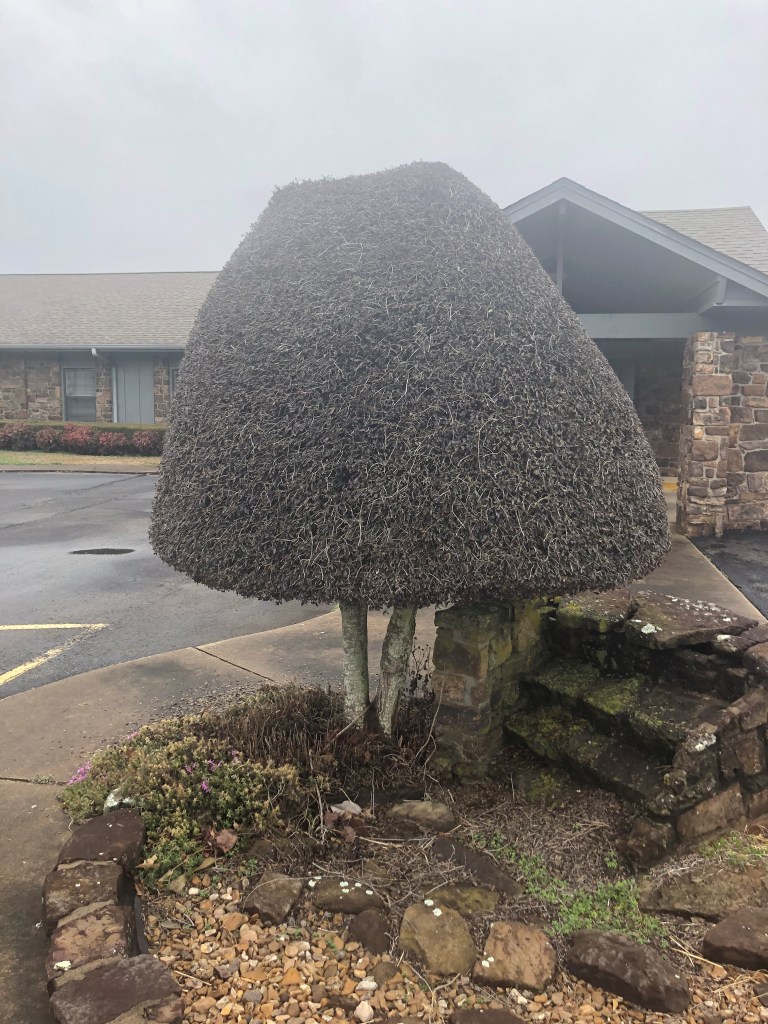
Last week I received word from a friend that the Holly bush that served as the focal point in the turnaround drive where I work may have died.  Following the intense cold of the last several weeks the leaves have all turned black and have begun to fall off.  The yaupon holly (Ilex vomitoria) is an evergreen shrub or small tree with green leaves and red berries that add color throughout the year.  The Yaupon is native to the southeastern US.  While it is often planted as an informal hedge shrub or privacy screen, our bush served as a colorful stand alone, accented by a low rock wall enclosure and three stone steps forming a bench where people can rest and reflect on the day.

When I looked the holly up online, I found it grows native from southern Virginia south to Florida and west to southeast Oklahoma and central Texas.  Each plant produces little greenish-white male or female flowers in the spring, though only the females will bear fruit.  The small berries are usually red but sometimes yellow.  The berries not only provide winter color but provide food for birds and other wildlife.  While our bush had been trimmed to a height of around six feet, it can grow anywhere from 12-45 ft high, but usually no higher than 25 ft.  The Yaupon Holly is common throughout its range, and if the suckers are not trimmed back, it can be trimmed into hedges.

The original popularity for the plant comes from the caffeine found in the leaves and twigs of the Yaupon Holly.  Native American Indians used the leaves to prepare a tea.  The tea was ceremonially consumed in large quantities and then vomited back up, lending the plant its species name, vomitoria.  The vomiting is not a natural result of drinking the tea but was self-induced by adding other ingredients to the concoction.  Tribes from the interior traveled to the coast in large numbers each spring to collect and drink this tonic.  The tea was also a common hospitality drink among many groups.  The Holly and the tea remained popular among southeastern Americans into the 20th century and is still occasionally consumed today.  The flavor is said to resemble another holly drink and practice, the South American Yerba maté (Ilex paraguariensis).  I liked the bush and hope it will recover.

Thoughts:  Caffeine is a naturally occurring alkaloid in some 60 plant species.  While cocoa beans, kola nuts, tea leaves, and coffee beans are the most well-known, other natural sources of caffeine include yerba maté, guarana berries, guayusa, and the yaupon holly.  The use of these plants for invigorating drinks or chewing the leaves and berries seemed to develop independently throughout the lower temperate or tropical areas where the plants thrive.  Most cultures who use the plants have associated myths describing how the plant came to be discovered and is now used.  While myths are used by all cultures to explain the “why” of otherwise unknown behaviors, they are often rooted in fact.  The difficulty is separating the facts from the hyperbole that makes the story resonate with the people.  It seems the opposite effect is driving many of the myths (falsehoods) being spread about ideologies and science today.  If the ideology or science infringes on what I want to believe, I just make up a story to provide a different narrative.  Unlike the ancient stories, these are not rooted in facts and will not last the span of time.  Follow the science.  Change is coming and it starts with you.