Planning

February 28, 2025

It was near or above 70’sF (21C) most of this week, and that after dropping to single digits a week ago.  Warmer temperatures have got me thinking about my garden.  This time last year, I was planning the garden layout and had seedlings under the grow lights.  My main push was trying to collect enough wood, fill, and dirt to create the four Hügelkultur raised beds.  Every step of the process turned out to be more work than I had imagined (and I imagined a lot of work).  This year will be more tweaking the beds and growing methods I already own.  When I started four years ago, I grew everything in container pots.  These were mostly 5-gallon (19-L) buckets, along with several wooden planters left from my mother-in-law and a few large flowerpots.  Now I have moved almost entirely away from my old containers.  This year’s plantings will go into a mix of raised beds and grow bags, along with the three in-ground beds.  I cleaned out the different planting medium when I shut down last fall.  I had also purchased three additional (5 total) rolling, self-watering tomato planters that I put together.   Then it was a matter of planning how to proceed, then cleaning up and placing the different containers along the back fence of my patio.

When I looked online, I found different sites that assured me they could help me with planning the perfect garden.  These ranged from pre-planned gardens (for beginners), to garden guides and layouts, and even complete kits selling seeds and directions for how to plant.  Several of the self-help guides were “old school” and allowed you to draw your plots on lined paper and then add cut-outs of the various plants so you could move them around to ensure the best placement.  Others were high tech with software to walk me electronically through the (same) planning process.  Being trained as an historian I am partial to paper that I could put my hands on, but I was not ready to revert to my elementary school days of cut and paste.  I decided what I needed to start my journey was a planning checklist to walk me through the stages in the proper order.  What I found was literally called, The Ultimate Garden Planning Checklist.  I printed a copy so I could hold it.

The checklist began telling me what to do 3 to 4 months prior to planting.  We are now 6 weeks from the last frost in zone 7, so I missed that part of planning.  I have an excuse as we were in Greece the first three weeks of February, and everything would have died had I started seedlings in January.  There were still some of the later seeds that could be started (6-8 and 2-4 weeks out) but I will have to push to get them going in time for the April 15 target date.  Last year I did not adequately harden off the seedlings and most of them died either on the screened porch or after planting.  I am going to try and do better this year.  It is not subsistence farming if you buy your plants from the greenhouse.  I need to refill parts of the raised beds, put compost and soil in the containers, and decide what I am going to do with the front beds.  I still have lots of planning left to go.

THOUGHTS: Taking time for planning is necessary if I want my garden to produce.  Each year I get a little better at both planning and deciding what and how to plant.  I am challenged as I see the hours spent by Melissa with her succulents.  I have mentioned how Melissa’s mom would spend hours a day working on the flower beds.  I know both are a labor of love.  I am at the stage where my garden is still a labor of like.  Being skilled at anything is a combination of talent and a lot of time spent doing it.  This is true in business, in sports, and especially in interaction with people.  You may get by on a labor of like in dealing with others, but real communication requires you practice until it becomes a labor of love.  Act for all.  Change is coming and it starts with you.

Parthenogenesis

February 21, 2025

undefined

Inside the front section of Monday’s newspaper was a USA Today article on the birth of a baby swell shark (Cephaloscyllium ventriosum).  The swell shark pup hatched on January 3rd after an egg was spotted by the Shreveport aquarium’s animal husbandry team eight months ago.  The birth could be from rare form of asexual reproduction (parthenogenesis), or from delayed fertilization.  The two female sharks present in the tank had not been in contact with a male for more than three years.  A DNA analysis once the pup is big enough for a blood sample to be taken will determine how the birth occurred, but it will take months before the test can be performed.  “This situation is incredible and shows the resilience of this species,” said Greg Barrick, the curator of live animals at Shreveport aquarium. “We are very excited in the coming months to confirm whether this was indeed a case of parthenogenesis or if it was delayed fertilization.”

When I looked online, I found parthenogenesis (Greek parthénos, “virgin” and “génesis, “creation”) is a natural form of asexual reproduction in which the embryo develops directly from an egg without need for fertilization.  In animals, parthenogenesis means the development of an embryo from an unfertilized egg cell.  Parthenogenesis occurs naturally in some plants, algae, invertebrate animal species, and a few vertebrates (some fish, amphibians, and reptiles) and has been induced artificially in animal species that naturally reproduce through sex (fish, amphibians, and mice).  Normal egg cells form in the process of meiosis (division) and have half as many chromosomes as their mother’s body cells (haploid).  Such individuals are usually non-viable, and parthenogenetic offspring usually have a complete number of chromosomes (diploid).  In parthenogenesis, the offspring having all of the mother’s genetic material are called full clones and those having only half are called half clones.

The baby shark has been named Yoko, after the Native American Chumash people’s word for shark (onyoko) and is said to be thriving, although sharks born by such reproduction face significant challenges.  The aquarium staff said she will leave an “unforgettable legacy” to the study of shark reproduction and conservation.  If Yoko was born via parthenogenesis, she would join a small number of invertebrate animals capable of “virgin births”.  Laying eggs without mating is much rarer in vertebrates, but it has been seen in zebra sharks (Stegostoma tigrinum), sawfish (Pristis zijsron) and a handful of reptiles.  This type of birth was first documented in Komodo dragons (Varanus komodoensis) in 2006 in two separate British zoos.  Charlotte, a stingray (Hypanus americanus) in an aquarium in North Carolina, was found to be pregnant in 2024 despite not having been in contact with a male for eight years.  While scientists assume vertebrates turn to parthenogenesis when no mates are present, it is unknown why they occur and what triggers birth. 

THOUGHTS: Whether Yoko was born from delayed reproduction or parthenogenesis, she is an extraordinary birth. The aquarium staff said she will leave an “unforgettable legacy” to the study of shark reproduction and conservation.   While the behavior of domesticated animals has long been studied (ethology) attention has only focused on animals in the wild during the last century.  What we have found is they are far more complex and diversified than we previously believed.  The study has even forced us to reconsider what “makes us human”.  It seems we are not so different after all.  Act for all.  Change is coming and it starts with you.
Seadevil

February 19, 2025

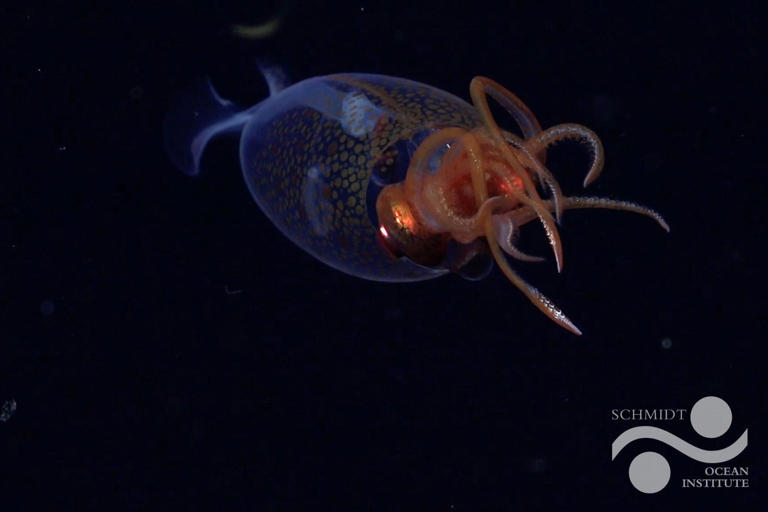
My NY Times feed carried a story about an eerie looking creature from the ocean’s depths that has become an inspiration for intense emotions on social media.  It is easy to believe a fish with a gaping mouth of razor-sharp teeth, a bioluminescent rod sticking out of its head, and lidless eyes to scan the darkest depths of the ocean, might elicit fear.  The freakish looking creature is also moving people to tears of emotion.  Social media has turned the fish into a folk hero after it swam great lengths from its usual home 650 to 6,500 feet (200 to 2,000 m) deep in the ocean to the surface.  Fans of the fish have turned this odyssey (which ended in death) into a version of the hero’s journey, a quest to reach the light.  Hannah Backman, of Minneapolis, who posted about the fish on TikTok, said she succumbed to the poetry of a lone fish approaching the light, “spending her literal last seconds trying to do something beautiful.”  The fish made headlines in late January when it was spotted by a group of researchers off the coast of Tenerife in the Spanish Canary Islands.  The team observed the fish, which was already injured, for several hours and it ultimately died.  Fans of the Black seadevil anglerfish have posted tributes set to ballads, written poems, created fan art, and even gotten tattoos.

When I looked online, I found a Black seadevil (Melanocetus johnsonii) is small, deep-sea fish of the order lophiiform and family Melanocetidae.  There are five known species (only two are given common names) within the genus Melanocetus.  They are found in tropical to temperate waters of the Atlantic, Indian, and Pacific Oceans, with one species known only from the Ross Sea.  The Black seadevils are named for their intimidating appearance and typically pitch-black skin and are characterized by a gelatinous, mostly scaleless, globose body, a large head, and their large, sharp, glassy, fang-like teeth lining the jaws of a cavernous mouth.  These teeth are depressible and present only in females.  Like other anglerfishes, the black seadevil possess a modified dorsal spine “fishing rod” (illicium) and a bulbous, bioluminescent “fishing lure” (esca).  The bioluminescence is produced by symbiotic bacteria thought to enter the esca via an external duct suggesting they originate from the surrounding seawater.  The bacteria are apparently different in each anglerfish species.  There is a strong sexual dimorphism, with females reaching a length of 7 inches (18 cm) or more, and males under 1 inch (3 cm).  Males also lack lures.

It is unclear why the seadevil came to the surface, although scientists speculate it might have been from an illness or an unusual current.  The fans on TikTok have woven a beautiful, albeit fanciful, narrative for the fish.  This is a story of a creature in its final days, desperate to experience a source of light not generated by its own body.  Madison Sharp, a behavioral therapist in Dallas, noticed an outpouring of emotion for the fish in her social media feeds.  “Instead of just seeing a fish reach the surface, they see hope, and meaning, and symbolism,” she said.  She was inspired to draw a picture of the seadevil approaching the surface, adding tears to its eyes, and the word “finally” floating above the waterline.  “I think the most important part was the expression of the fish,” she said. “I added the little eyebrow on top to show the longing of it.”  Well, there you go.

THOUGHTS: Humans often turn charismatic animals into anthropomorphized heroes.  Consider Flaco, the Eurasian eagle-owl that escaped from the Central Park Zoo.  Sadly, neither Flaco nor the seadevil survived.  It seems their death is taken as indicative about our own struggle with life.    Or as sci-fi writer David Gerrold is quoted, “Life is hard.  Then you die.  Then they throw dirt in your face.  Then the worms eat you.  Be grateful it happens in that order.”  Being anthropomorphic about a seadevil does not seems so bad after all.  Act for all.  Change is coming and it starts with you.

Little Sticks

February 17, 2025

I was surprised by the number of aged or impaired travelers on our cruise.  Admittedly, I should have known as much when I took a “no kids” version of travel.  Another giveaway was the cruise sailing in the beginning of February when our kids are in school.  While we did see a good number of French and Greek school groups at every site we visited, they were led by teachers, and we found them doing oratory (critiqued by the teacher) in every theater we encountered.  The kid of course, shot up and down the steps, passing me several times on both ways.  I instead used the Pilgrims Progress approach, slow but steadily working toward my goal. I did not really think much about it until we reached the Acropolis Museum in Athens.  As I stood at the base of a long flight of stairs the guide mentioned there was an elevator available for those who used the “little sticks”.  I was somewhat incensed and took my little sticks up the stairs to the next level.

When I looked online, I found that while walking is one of the best forms of exercise for seniors, it can pose challenges for older adults, such as joint pain, fatigue, and increased fall risk.  Many seniors are turning to walking poles (i.e., little sticks) to minimize these downsides and increase their physical activity so they can enjoy the benefits of walking.  These devices can even enhance your walking experience by utilizing other body parts like your arms and core to stay stable and strong.  Walking canes are primarily used for daily support and provide stability and reduce weight on a weaker or painful leg.  Walking poles are usually used in pairs for activities like walking or hiking and while they do provide balance, they involve the upper body, promoting better posture and evenly spreading the effort between arms and legs, engaging the whole body.  While both canes and walking poles offer support, they cater to different needs and activities.  Knowing the difference can help seniors choose the right tool for their mobility goals.

Nordic walking poles have been around since 1900, but the newer aluminum or carbon fiber sticks really caught on in the 1970’s.  Since then, the popularity of these little sticks has grown to the point where roughly one-third of our excursions carried one or a pair of walking sticks with them.  I purchased my stick 20 years ago as my knee began to deteriorate.  My weak knee has since been replaced, and I now use the stick for my other knee.  My son had given me a collapsible version of a pair of walking sticks for my birthday.  I was unfamiliar with these new sticks and finally decided to bring my cane version.  I was the only one I saw using the cane variety stick and I believe the longer pair of sticks would have helped greatly.  This time my vanity backfired.

THOUGHTS: It was the next day I encountered the challenge of the Oracle of Delphi with the “little sticks” comment still ringing in my ears.  I would like to think that it did not fuel my drive to reach the top, but it probably did.  This is along the line of refusing to accept being called a senior.  If I refuse to define myself as such, I can live out my fantasy.  I have often heard the phrase, “you are as young as you feel”.  This morning, I felt the effects of the hike to the top.  Still, I did not feel as bad as I anticipated.  If I can still push myself, even with the help of little sticks, I can refuse to be categorized as a senior.  Many adjectives we use to define people are seen negatively by the people classified as such.  We need to take care to identify people in ways to choose for themselves, not by what we choose for them.  Act for all.  Change is coming and it starts with you.
Delphi

February 16, 2025

Yesterday I was able to check off another bucket list site with my visit to Delphi.  We left on the bus from Athens and wound 2-1/2 hours through the countryside.  This included navigating the narrow streets of the ski town near the Mainalon ski center.  I was excited to see the site towering 1,640 feet (500 m) above us as we disembarked the bus.  The guide told us we would have a tour for an hour, and then another hour to explore on our own.  The lower third of the tour followed the sacred way, where a series of temples and shrines (Greek and Roman) flanked the path.  This culminated at an insignificant looking bell-shaped reproduction of the Omphalos of Delphi, which had been housed in a small temple of Apoll.  From here we were cut loose to explore.  I had always thought the oracle was housed in a cave, and there was none at the site so far.  I was determined to hike to the top of Delphi and find what I knew to be the original location of the oracle.    

When I looked online, I found the Oracle of Delphi (Greek: Δελφοί) in legend previously called Pytho (Πυθώ), was an ancient sacred precinct and the seat of Pythia.  The major oracle was consulted about important decisions throughout the ancient classical world.  The ancient Greeks considered Delphi to be the center of the world, marked by the stone monument known as the Omphalos of Delphi (navel).  According to the Suda, Delphi took its name from the Delphyne, the she-serpent (drakaina) who lived there and was killed by the god Apollo.  In other accounts the serpent was the male serpent (drakon) Python.  The sacred precinct occupies a delineated region on the south-western slope of Mount Parnassus.  The area is now an extensive archaeological site, and since 1938 a part of Parnassos National Park.  The precinct is recognized by UNESCO as a World Heritage Site in having had a great influence in the ancient world, as evidenced by the various monuments built there by most of the important ancient Greek city-states, demonstrating their fundamental Hellenic unity. 

The guide mentioned Delphi had three significant features that drew crowds.  The first (and most important) was the sacred way leading to the oracle, the second was the walkway leading up to the (5000 person) theater, and the third was the large stadium situated at the top of the hill.  I trudged my way up the path and finally reached the theater.  I figured the stadium could not be much farther, so I kept going.  The path to the stadium wound back and forth across the face of the hill, and I noticed the crowds from below had diminished greatly.  I kept going, telling myself it had to be “just around the next bend”.  I was wrong.  By the time I reached the stadium I was exhausted, and my legs had begun to quiver.  I had expected a cave at the top, but realized the temple ruin at the end of the sacred way was where the Oracle of Delphi had stood.  The stadium was nice, and I now had a story to share, but I still needed to get back down the hill and walk a quarter mile (400 m) to the museum and bus.  At this point perseverance set in.

THOUGHTS: It would have taken great perseverance to traverse the countryside to this remote site to have your questions answered.  A woman of blameless life was chosen from the peasants of the area to serve as the spokesperson for Apollo (Pythia).  She sat alone in an enclosed inner sanctum on a tripod seat over an opening in the earth (the “chasm”).   According to legend, when Apollo slew Python its body fell into this fissure and fumes arose from its decomposing body.  Intoxicated by the vapors, the sibyl would fall into a trance, allowing Apollo to possess her spirit, and giving her the ability to prophesy.  King Leonides had visited Delphi prior to facing the Persians at the Battle of Thermopylae, and was told he would fall.  He went anyway, to preserve the rest of the Greek city-states.  Sometimes you need to persevere.   Act for all.  Change is coming and it starts with you.
Mycenaean

February 14, 2025

When Santorini was canceled the cruise substituted the site of Olympia on the west coast of the Peloponnese peninsula.  Although this was not the bucket list site I had hoped for, it was cool to see the original site of the ancient Olympics, and the location where the Olympic flame is still lit every 2 years (summer and winter).  From there we sailed to Nafplio, a well-preserved coastal town on the eastern coast of the Peloponnese peninsula.  I knew we were going to Mycenae for our extension, so I choose the 19th century fortress of Palamidia and the theater at the site of Epidaurus as our day’s shore excursion.  However, when today’s extension excursion left this morning, the first site we visited was the theater of Epidaurus.  This was a Classical site rather than Mycenean, one I had already seen, and nowhere near the tomb of Agamemnon I was looking forward to.  I guess this is where my manipulations and planning finally caught up with me. 

When I looked online, I found Mycenaean Greece (or the Mycenaean civilization) was the last phase of the Bronze Age in ancient Greece, spanning the period from approximately 1750 to 1050 BCE.  This period represents the first advanced and distinctively Greek civilization in mainland Greece, and included palatial estates, urban organization, works of art, and a writing system.  The Mycenaeans were mainland Greek peoples who were likely stimulated by their contact with Minoan Crete and other Mediterranean cultures to develop a more sophisticated sociopolitical culture of their own.  The most prominent site was Mycenae, after which the culture of this era is named.  Other centers of power included Pylos, Tiryns, and Midea in the Peloponnese, Orchomenos, Thebes, and Athens in Central Greece, and at Iolcos, in Thessaly.  Mycenaean settlements also appeared on the islands of the Aegean Sea at Epirus and Macedonia in Asia Minor, and on Cyprus.  Mycenaean-influenced sites also appeared in Italy and the Levant (Palestine).

It turned out our time at Epidaurus was far from wasted.  I had hiked to the theater on my previous visit and this was not something that interested Melissa.  Instead, we explored the ruins of the city of Epidaurus.  I had previously rushed through this site to make it back to the bus on time.  This time we were able to have a leisurely exploration.  Then it was on to Mycenae, the capital of the Mycenaean kingdom.  Our first stop was the beehive tomb thought to belong to King Agamemnon himself.  Then it was on to the acropolis that loomed high above the tomb.  I entered through the city’s massive walls at the Lion Gate and proceeded to the royal palace at the top of the hill.  The ancient Greeks found this fortress so formable they believed the walls had been built by the mythical one-eyed giants called Cyclops.  Mycenae was among the numerous Aegean sites destroyed as part of the Bronze Age Collapse around 1200 BCE. Unlike many other sites, Mycenae was partly rebuilt after this destruction.  The site remained sparsely populated until the Hellenistic era.  The site was impressive.

THOUGHTS: The cause of the Mycenaean destruction is unknown.  Suggested explanations include enemy attack, internal strife, and natural disasters (earthquakes).  The massive walls at Mycenae did prevent the fall of the city until late in the age.  Each successive chronological age is marked by the improvement of defensive fortifications.  Most also end with destruction layers as new peoples wielding advanced weapons or strategies bring the kingdoms down.  The atomic age saw the rise of weapons that have the potential to annihilate every living thing on the planet (if not the planet itself).  Perhaps the time of war should be replaced with cooperation and peace.  Act for all.  Change is coming and it starts with you.
Acropolis

February 13, 2025

One of the reasons we decided to take our Greek Cruise was because it marked off so many of my bucket list items.  That included the Mycenean Palace of Knossos and the isle of Santorini.  Regrettably we were not able to see the island because of the current earthquakes.  Our follow up tour includes two more of my bucket lists, the Oracle of Delphi (tomorrow) and the Acropolis of Athens (today).  Melissa knew that our visit to the Acropolis meant a good hike uphill, and she was tentative at the least.  On arrival by bus, we began the slow assent that wound from the parking lot to the entrance gate.  By the time we reached the entrance we could see the Parthenon towering 490 feet (150 m) above us.  Melissa looked at the steps up to the Acropolis and then looked at me and said, “Well that ain’t going to happen is it”.

When I looked online, I found the Acropolis of Athens is an ancient citadel located on a rocky outcrop above the city of Athens, Greece.  During ancient times this acropolis was more properly known as Cecropia, after the legendary serpent-man Cecrops, the supposed first Athenian king.  The word Acropolis is from Greek ἄκρον (akron – “highest point” and πόλις (polis – “city”).  The term is generic and there are many other acropolises in Greece.  The site contains the remains of several ancient buildings of great architectural and historical significance, including the Parthenon.  The entrance to the Acropolis was a monumental gateway (the Propylaea) and to the south of the entrance is the tiny Temple of Athena Nike.  The Parthenon or Temple of Athena Parthenos (Athena the Virgin) stands at the center of the Acropolis.  East of the entrance and north of the Parthenon is the temple known as the Erechtheum.  South of the platform that forms the top of the Acropolis there are the remains of the ancient (remodeled) Theatre of Dionysus.  A few hundred meters (320+ yards) away, there is the partially reconstructed Odeon of Herodes Atticus.  All the valuable ancient artifacts are situated in the Acropolis Museum, which resides on the southern slope of the same rock.

Despite her trepidation, Melissa decided to attempt the climb up the steps to the Acropolis.  Our tour guide took off for the top, dragging the climbers along with her.  The program guide stayed behind with the rest of us stragglers.  She told us not to worry, the others would have to wait for us because she was the one who had all the tickets.  We were able to wind our way up to the top, past the huge gateway (Propylaea), and then up the final steps to the top of the Acropolis.  The Acropolis towered over the city of Athens down below and the Parthenon stood dwarfing everything else on the site.  As we marveled at both the size and magnificence of the building, Melissa told me the effort to reach the top had been worth it.

THOUGHTS: The trip to the Acropolis of Athens checked off another of my bucket list items and became an instant favorite for Melissa.  I know when looking back on this day, the struggle will become an integral part of the story for why the trip was worthwhile.  Like most worthwhile things, it required determination and effort to achieve the goal.  Our world faces a monumental struggle to overcome the effects of both climate change and indifference.  The result of our (continued) indifference results in the wild swings in weather patterns (wildfires and record snowstorms, hurricanes and floods along with draughts).  Hopefully we will be able to look back and say the struggle was worth it.  Act for all.  Change is coming and it starts with you.

Buffet

February 11, 2025

When I booked our Greek cruise, I did not figure in that we would be at sea during the Super Bowl.  That would have been bad enough but being one-third of the way around the world there was an 8-hour time difference.  That meant the game was scheduled for 1:30 am Monday (our time), and the predicted length of the game was over 4 hours.  The game was being broadcast live on a special on-board sports channel and would be over in time for an 8:00 am departure for our shore excursion.  We weighed our options.  We could stay up and be too exhausted to make the excursion, but this was a trip to the Palace of Knossos, a bucket list tour.  We could miss the game, but that would mean I was a fair-weather fan, and I had already packed my Chiefs shirt to wear the night before the game.  The bigger disappointment was I always put out a spread for 8 to 10 people as part of the game (even if it was just Melissa and me).  How was I going to watch the game without my buffet?

When I looked online, I found the Super Bowl buffet was not just my obsession.  In fact, football is merely the main course on a menu designed to bring fans together.  There are commercials with their own buildup, the halftime show, parties held in houses and bars, and the rare sense most of the country is watching the same thing together.  More than anything, the event is built around food for everyone (but the players in the game).  Everyone else watches football for more than three hours and will eventually get hungry.  USA Today decided to rank the 10 best super Bowl snacks, and mentioned the “closest thing to a vegetable on this list is a jalapeno”.  This begins with soft pretzels and sliders, a tray with a variety of meats and cheeses (charcutier board), nachos, chili, potato skins, pigs in a blanket (or hot dogs) chips and dip, pizza, and wings.  Many of these favorites have been on my buffet over the years.

Our only choice was to go to bed early and wake up in time for the start of the game at 1:30 am.  This worked, and we woke up in time to see the coin toss.  I made it through the first half (24-0) but refused to watch 45 minutes of half-time extravaganza and went to sleep.  The score was exasperated by the fact we were not getting any of the commercials (soccer and MMA previews only) on the special sports channel.  Melissa lasted through the third quarter then also gave up.  Her sister did inform her of the outcome at the end of the game.  The ship planned their own Super Bowl party for later that evening.  The game was broadcast in the theater on the movie screen.  Most had not stayed up late and were not aware of the score.  For them it was great, for me knowing the score was another form of torture.  There was a bright spot.  The cruise made hundreds of bags of popcorn and there were two lines of tables placed in the hall.  One was held basic football food (nachos, wings, chips and dip) while the other was filled with a wide assortment of finger desserts.  I did not partake of the food and only lasted a quarter rewatching the game, but I complemented them on their buffet.

THOUGHTS: The all-you-can-eat buffet has become an integral part of dining culture worldwide, offering a lot of different foods at a fixed price.  This dining experience dates to ancient times and has evolved through different cultures until it is now a staple across the world.  That said, it stands in opposition to the 733 million people and women and children who are the most vulnerable around the world.  Clean air, water, and sufficient nutrition should be a right, not a privilege.  Act for all.  Change is coming and it starts with you.

Medieval

February 09, 2025

When we arrived in Rhodes I was not prepared for the abrupt shift in focus (time and culture).  The Greek sites we had been touring dated from the Classical – Hellenistic – Roman eras, or the 1000-year period from 600 BCE to 400 CE.  Rhodes seemed to jump forward another 1000 years to concentrate on the later times of the Crusaders (14th and 16th centuries CE) and the Ottomans who controlled the island and city until the early 20th century.  Our tour of Rhodes featured this Medieval history. 

When I looked online, I found the history of Europe known as the medieval period, or Middle Ages, lasted from the 5th to the late 15th centuries, and was similar to the post-classical period for global history.  The medieval period began with the fall of the Western Roman Empire and transitioned into the Renaissance (Age of European Discovery).  The period is marked by population decline, counter-urbanization, the collapse of centralized authority, invasions, and mass migrations of tribes, which began in late antiquity and continued into the Early Middle Ages.  The large-scale movements of the Migration Period, including various Germanic peoples, formed new kingdoms in what remained of the Western Roman Empire.  Although there were substantial changes in society and political structures, the break with classical antiquity was incomplete. The Byzantine Empire (Eastern Roman) survived in the Eastern Mediterranean and remained a major power.  The Roman Empire’s law code (Corpus Juris Civilis) was rediscovered in Northern Italy in the 11th century and most western kingdoms incorporated the few extant Roman institutions.  Monasteries were founded as campaigns to Christianize the remaining pagans across Europe continued.  The Franks, under the Carolingian dynasty, briefly established the Carolingian Empire during the latter 8th and early 9th centuries. I The medieval period covered much of Western Europe but later succumbed to the pressures of internal civil wars combined with external invasions from the Vikings (north), Magyars (east), and Saracens (south).

The island of Rhodes stands at a crossroads between Europe, the Middle East, and Africa, which has given the city and the island many different identities and cultures.  The island itself has been inhabited since the Neolithic (stone) Period (4000 BCE), but Rhodes became an important trading post for shipping between Constantinople and Alexandria during the Byzantine Period and the European Crusades to the Holy Land.  The Knights Hospitallers captured and established their headquarters on Rhodes when they left Cyprus in 1307 and remained on the island for the next two centuries.  The Ottoman Empire expanded rapidly after the fall of Constantinople in 1453, and the Knights defense of the island in 1480 halted Sultan Mehmed the Conqueror from the invasion of the Italian peninsula by Ottoman forces.  Sultan Suleiman the Magnificent led a second Ottoman Siege of Rhodes in 1522 but after a spirited defense the Knights were allowed to depart on January 1, 1523.  New buildings were constructed during the Ottoman era, including mosques, public baths, and mansions, while the Greeks were forced to abandon the fortified city and move to new suburbs outside its walls.  The tours of Rhodes were not like the ruins we had visited, but of intact buildings for continuous occupation for the last 1000 years.  A different tour, but very interesting.

Thoughts: Disembarking our ship, we approached the Medieval city through one of the smaller side gates.  We then wound our way up hill from the harbor to the Palace of the Grand Masters(fortress) at the top of the citadel.  The stone-lined streets were the same as the crusaders and Ottomans trod for the last 1000 years as they wound toward the top.  You find a sense of longevity and continuity in Europe that does not exist in the US.  This also illustrates the transitory nature of human rulers and kingdoms.  Both are good reminders.  Act for all.  Change is coming and it starts with you.
Ephesus

February 08, 2025

Today I was able to visit Ephesus, one of my bucket list sites.  I studied Old World Archaeology and New Testament Church History, so it is natural to be drawn to this site.  Ephesus was founded as an Attic-Ionian colony in the 10th century BCE on a hill 1.9 miles (3 km) from the current center of ancient Ephesus.  The Greek goddess Artemis and the Anatolian goddess Kybele were identified together as Artemis of Ephesus and venerated in the Temple of Artemis (550 BCE), one of the Seven Wonders of the Ancient World and largest building of its time.  Ephesus has intrigued archaeologists because there is no definite location during the Archaic Period.  The silting up of the natural harbor along with the movement of the Kayster River meant the location never remained the same.  During the Hellenistic period the city was again forced to move to its present site, as the silted in marshes caused malaria and death.  During the Classical Roman period (129 BCE to 395 CE) Ephesus became part of the kingdom of Pergamon.  Deforestation, overgrazing (goats), erosion, and soil degradation, means the coast is now 2 miles (3 to 4 km) away from this once port city.

When I looked online, I found Ephesus was a city in Ancient Greece on the coast of Ionia, 1.9 miles (3 km) southwest of present-day Selçuk, Turkey.  During the Classical Greek era (5th and 4th centuries BCE), it was one of twelve cities that were members of the Ionian League.  The city later came under the control of the Roman Republic in 129 BCE.  The city was famous in its day for the nearby Temple of Artemis and the many monumental buildings, including the Library of Celsus (12,000 reported volumes) and a theatre capable of holding 24,000 spectators.  Ephesus was a recipient of a Pauline epistle, and one of the seven churches of Asia addressed in the Christian Bible in the Book of Revelation.  The Gospel of John may have been written there, and it was the site of several 5th-century Christian Councils (Council of Ephesus).  The city was destroyed by the Goths in 263CE, and although later rebuilt, its importance as a port and commercial center declined as the river continued to slowly silt up the harbor.  The present-day ruins of Ephesus are a favorite local and international tourist attraction accessible from the resort town Kuşadası, Turkey.  The city ruins were designated a UNESCO World Heritage Site in 2015.

Our Ephesus tour guide led us through the gates and past the upper theater along the stone paved road.  While most of the groups continued to follow this road, our guide took us off to the left to see some of the servant houses.  Even this area had sewers, water pipes, and a fountain used to cool the air and stone blocks during the heat of the summer.  The stone side street we found led back to the main street leading down through the city toward the Celsus library.  Another tour could have taken me through the excavated houses of the rich with their mosaic tile floors and muraled walls.  Half-way down the street was the (small) temple of Hadrian, dedicated by the emperor to his companion whom he had killed for infidelity (remorse?).  Then it was down to the library, a truly impressive building whose style I recognized from Petra and other ancient sites.  We passed the Plaka (market) and proceeded out of the city, pausing to look back at the larger theater.  This area is currently under excavation using a lift crane and dump trucks to remove the dirt to be sifted for artifacts (not the trowel and hand baskets I was used to).  Ephesus stood at the eastern end of the silk road to Persia.

Thoughts: Arriving at Ephesus we went through the metal checks and turnstiles and gathered around our tour guide.  Seeing the well-fed stray dog upside down and spread eagle in the middle of the path I noticed she had a clip tag in her ear.  The tags mean they’ve been neutered/spayed and vaccinated. Like the strays of Greece, these dogs (and cats) are fed by the community, but life outside is still hard.  The same is true for unhoused people.  Act for all.  Change is coming and it starts with you.