Crab

January 31, 2025

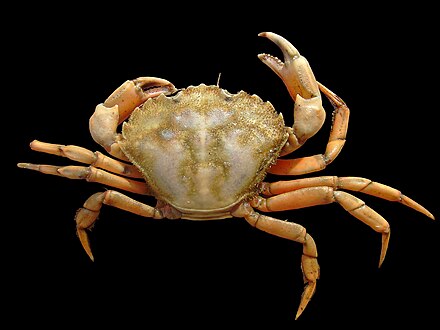
One of my NY Times feeds suggested a unique approach to stemming the advance of an invasive species which has taken over New England.  The invasion is aided by the species being omnivores, scavengers, and cannibals, meaning they sustain themselves on almost any organic food.  They have a high fecundity, with females releasing as many as 185,000 eggs a year.  They survive in water temperatures from freezing (32F/0C) to 86F (30C) and tolerate sweet water zones where salt meets fresh.  An adult can live more than 10 days out of water.  Taken together, these characteristics explain why they were first documented along the United States coast in 1817 and continue their tour of the temperate world.  The suggested remedy to control the European green crab was to eat them.

When I looked online, I found the European green crab (Carcinus maenas) is a common near shore (littoral) crab known by different names around the world.  In North America and South Africa, it is called the European green crab, while in the British Isles it is referred to as the shore crab, or green shore crab.  The crab is a widespread invasive species and is listed among the 100 of the World’s Worst Invasive Alien Species.  The green crab is native to the north-east Atlantic Ocean and Baltic Sea, but has colonized similar habitats in Australia, South Africa, South America, and both Atlantic and Pacific coasts of North America.  The adult crab grows to a carapace (back shell) up to 2.4 inches (60 mm) long and 3.5 inches (90 mm) wide.  It can grow larger outside its native range, reaching 3.9 inches (100 mm) wide in British Columbia.  The color of the green crab varies greatly, from green to brown, grey, or red.  While this variation has a genetic component, it is largely due to local environmental factors.  The crab feeds on a variety of mollusks, worms, and small crustaceans, and has affected the fisheries where it spread.  The crab has been dispersed in a variety of ways, including on ships’ hulls, sea planes, packing materials, and bivalves moved for aquaculture.

In its native range, European green crab is mostly used as an ingredient in soups and sauces.  Italian fisher people cultivate soft-shell green crabs (moeche in Venetian, moleche in Italian) and sell hard-shell crabs for their roe (masinette).  Several groups in New England have successfully adapted these methods to produce soft-shell green crabs from the invasive species.  Various groups have looked at using green crabs in cuisine.  The Green Crab Cookbook (2019) was released and included recipes for soft-shell green crab, green crab roe, green crab stock, and green crab meat.  Researchers at the University of Maine have actively been developing green crab products with the goals of driving business interest, stimulating a commercial green crab fishery, and alleviating predation effects.  The same researchers developed a patty product made from minced green crab meat using restructuring additives (transglutaminase, dried egg white, isolated soy protein).  Americans consume enormous amounts of seafood, and several favorites (like scallops, lobster, and salmon) can be too expensive for many households.  The low-cost crabs are abundant, easy to catch, and are delicious, especially as a full-bodied stock that becomes the basis for ramen.

Thoughts: Some invasive species do not lend themselves to eating, but the European green crab is an exception.  The one obstacle comes with the small size of the carapace. The tiny claws, legs and segmented body chambers people typically eat are difficult to pick.  The small size is the one that has protected this crab from human consumption.  The smaller make an excellent stock and seasoned and dried can be a crunchy hand food eaten whole, much like a potato chip.  In the US, invasive species like the Asian carp (Family, Cyprinidae) and green crab are often seen as fertilizer, while they are eaten as a delicacy elsewhere.  Climate change and invasive species might force a reassessment.  The trick calling them something else and learning how to fix them.  Act for all.  Change is coming and it starts with you.

Lunar

January 30, 2025

Listening to the radio yesterday I was inundated by references to the start of the Lunar New Year on January 29th.  I was somewhat surprised as there is not a large Asian population in our state.  As of 2022 there were 47,413 (1.7%) Asian Americans living in Arkansas.  This was a national broadcast, but again it was a country music station.  Still, the references got me hankering for dumplings and egg rolls.  I texted Melissa on my way home and she agreed this sounded like a good dinner.  Not having a “go to” Asian restaurant in town I decided to buy a frozen variety from the market and cook them in the air fryer.  I realized this was not the same as dim sum (small bites) but it was the closest I could come to it on short notice.  I came home excited by the prospect of a tasty meal to kick off our unofficial celebration of the Lunar New Year.

When I looked online, I found there is a difference between Chinese New Year and Lunar New Year.   While they are can be used interchangeably, Chinese New Year is primarily celebrated in China, where it is a public holiday and one of the biggest celebrations of the year.  Countries like Vietnam, Malaysia, Indonesia, Brunei, Singapore, South Korea, and parts of southeast Asia instead celebrate this as Lunar New Year.  Traditionally, the celebration begins with a large family meal on Lunar New Year’s Eve and continues for the next 15 days, or until the following Lantern Festival (the next full moon).  Symbolic traditions include eating fish (associated with wealth) or noodles (for longevity).  People may also give red envelopes with money inside (hóngbāo) to express good wishes, set off fireworks and dragon dances to ward off evil spirits (Nian, the monster afraid of red), offer sacrifices to their ancestors for protection, and reunite with family to enjoy the celebrations.  In China and Vietnam, the event correlates with the start of spring so floral arrangements adorn houses, streets, and businesses.  In South Korea, bird decorations like paper cranes are hung up for longevity and good fortune.  In Tibet, children bring gifts to their elders, and in Mongolia, a pastry tower is made to represent Mount Sumeru (a holy mountain).  Many people with Asian heritage living in other parts of the world still participate in the Lunar celebrations.

Lunar New Year is a time to look towards a new year and good fortune but there are also plenty of superstitions around this time.  In preparation, people will “sweep out” the misfortune of the old year from their home and hang up poems on red paper (couplets) for good luck and prosperity.  It is widely believed you should avoid any washing or sweeping on the New Year to avoid “washing” the good fortune away, to avoid unlucky words like “illness” or crying, and to avoid colors associated with mourning such as black and white.  Door Gods (mén shén) are hung up in entranceways facing each other to ward off evil spirits.  Red is known as a lucky color and symbolizes happiness, prosperity, luck, and good fortune, and appears on envelopes, clothing, lanterns, and decorations especially during this time.

Thoughts: Our celebration of Lunar New Year was derailed by a major thunderstorm that repeatedly knocked out the power.  We did not want to risk a power surge on our new air fryer and decided to go to the local Chinese buffet instead.  The power was back on when we arrived, and I anticipated the egg rolls and pork dumplings.  To my dismay they had no dumplings, and the egg rolls were soggy.  The power flickered several more times before finally going out completely.  Several local police had also come for the buffet, and they turned on their flashlights and placed them around the restaurant so we could see to eat.  We left paying cash to the delight of the cashier (register was out).  Although the food did not rival the dim sum I experienced in the Bay Area, it was memorable.  I hope this inauspicious start will lead to a good year.  Act for all.  Change is coming and it starts with you.
Holla Bend

January 27, 2025

The intense cold (highs below freezing) that has stricken most of the south began to lessen over the weekend and Melissa thought it a good time to get out of the house with the kids for a drive.  While the motivation was to “just go”, we also wanted to see a birding site.  The Sequoya Wildlife Refuge is only about 90 minutes west, but we have not had much luck finding birds in the winter.  Lake Fort Smith is an hour north and has good fishing in the cove, but we have never caught much from the shore.  I put in a little work while Melissa searched for a new birding site.  What she found was about 2 hours away near where she spent her college years.  This sounded like a possibility (and promised a trip to her favorite burger joint).  We packed up the kids, got gas and aired up the tires that had been deflated by the cold, and took off for Holla Bend National Wildlife Refuge.

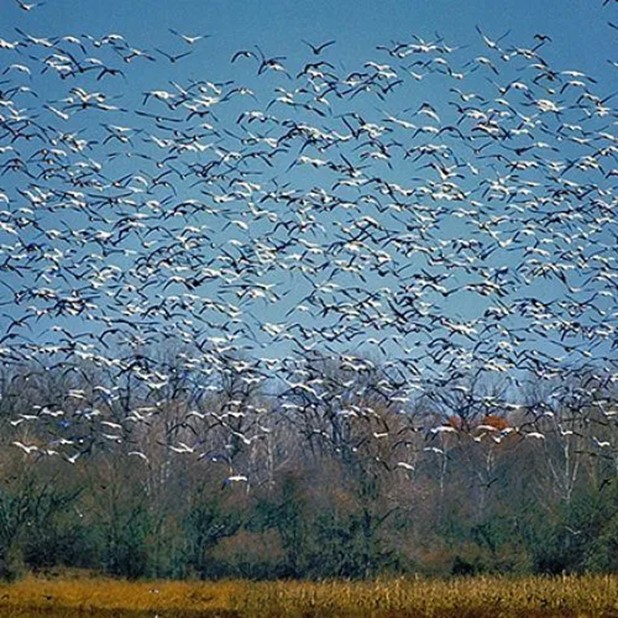
When I looked online, I found Holla Bend National Wildlife Refuge is a 7,055-acre (28.6 km2) site located 5 miles (8 km) south-east of Dardanelle, Arkansas.  The refuge is bounded on one side by the Arkansas River and on its others by an oxbow lake that was formed in 1954 by the Army Corps of Engineers during efforts to straighten the river navigation channel.  The resulting island was transferred to the US Department of the Interior in 1957 for a wildlife refuge.  The refuge provides habitat for migratory waterfowl, indigenous endangered species, other resident wildlife, and offers interpretation and recreation to the public.  The area is a year-round sanctuary for the 236 species of birds, tree frogs, and the American alligator.  Migratory fowl following the Central and Mississippi flyways stay in the refuge during the winter months, including 14 species of ducks and 4 kinds of geese, with as many as 100,000 there at once.  Winter migratory neotropical songbirds use the refuge as a rest stop during their long journey to and from Central and South America and during the spring and summer migratory birds use the refuge for breeding and nesting.  I anticipated birds.

Last year I purchased an Interagency Lifetime Pass from the US National Park Service so we cruised past the Holla Bend information center without stopping.  We turned around realizing we did not know where we were going without a flyer.  As we got into the refuge, we saw large flocks of American Robin (Turdus migratorius) on the road between the trees and European starling (Sturnus vulgaris) passing among the harvested grain fields.  Along the oxbow we found a flock of mallards (Anas platyrhynchos) and a flock of ring-billed gull (Larus delawarensis) along the river.  The best find however, was totally unexpected.  We stopped to admire a herd of 20 does and fawns racing across the far end of a harvested field.  Then I noticed what I thought was a group of black vultures (Coragyps atratus) about 300 yards (274 m) out.  When I focused my camera, I realized this was a flock of wild turkey (Meleagris gallopavo) feeding in the field.  It turned out to be a great day.  And we topped it with a great burger.

Thoughts: When we stopped at the Holla Bend information office a sign listed the daily hours along with the caveat of “Closed when we are not here”.  They were not there.  The Wildlife Refuge System is the US’s largest network of lands and waters dedicated to wildlife conservation, but it is facing a staffing crisis.  The Refuge System has lost over 800 permanent positions since fiscal year 2011, resulting in a 27% loss in capacity.  No national wildlife refuge is fully staffed, and more than half have zero staff on-site.  Much of the system is unprotected due to the lack of law enforcement officers.  This shortage impacts critical volunteers by a lack of staff supervision or infrastructure.  We need to invest in this system and prioritize staffing to ensure the future of this network and the wildlife it protects.  Act for all.  Change is coming and it starts with you.
Traction

January 14, 2025

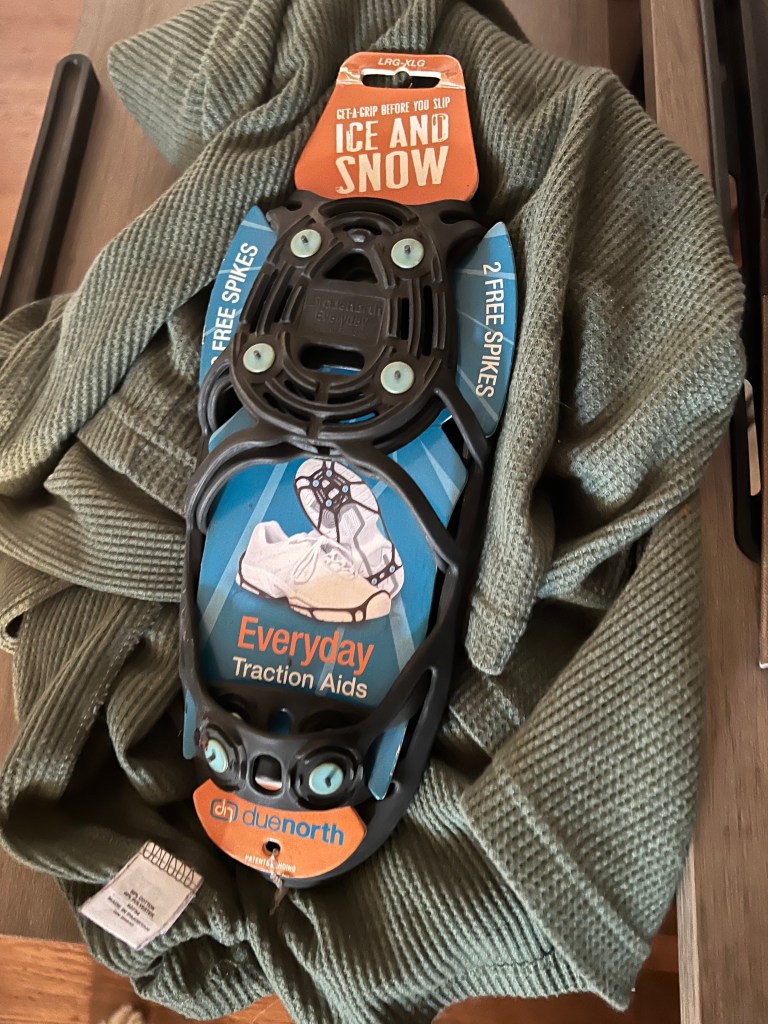
Yesterday I decided it was time to get out into the weather and take the kids for a walk.  I decided to go to the lake as it was more open and had a better probability for the parking lot to be cleared by road crews.  The temperatures in the morning were below freezing (-0C) but were set to warm up to 40F (4.5C) by the afternoon.  I did have two concerns.  The first was the possibility for windchill which would negate any increase in temperature.  I decided to dress for the cold.  That meant a pair of long johns under my sweatpants.  Then a tee shirt, a long sleeve undershirt, and a long-sleeved thermal undershirt.  I topped this off with a light ski jacket.  The first concern was covered.  The second concern was the potential for ice and snow on the spits we walk at the lake.  The kids have been romping in the snow in the side yard, and I knew this would not be their concern.  That is different for me and was my reason to shovel over the weekend.  Melissa was a runner when we met and one of her first Christmas presents was cold weather gear for running in Kansas.  That meant running gloves, hand and foot warmers, and a set of spikes in a rubber harness.  The spikes were billed as “everyday traction aids”.  The spikes should provide the traction I needed to walk the kids.   

When I looked online, I found Merriam-Webster defines traction in several ways.  The first definition (and applicable for me) is “the adhesive friction of a body on a surface on which it moves”.  A variation of this meaning says traction can refer to “a pulling force exerted on a skeletal structure (as in a fracture) by means of a special device” (splint).  A second definition is “the force exerted in the act of drawing or being drawn”.  The third meaning took a different approach with “the support or interest that is needed for something to make progress or succeed”.  This indicates something “gains traction” as people begin to accept and/or adopt an idea or methodology.  Finally, traction refers to “the drawing of a vehicle by motive power”.  Here a tractor is something that pulls something else.  This is often a piece of farm machinery or the part of a big truck that includes the engine and the cab.  The word tractor comes from the Medieval Latin “traction”, or from the Latin “trahere”.  The first known use of traction in English occurred in 1608, in the meaning defined by the second sense.

I was intrigued by the spikes guarantee to provide traction as I walked the kids.  After I bought them, Melissa had never had an occasion to use them.  They sat (in the original package) in my closet along with our shoes for 15 years.  When we pulled into the lake for our walk, I found the parking lot was generally clear of ice and snow.  Even the roads leading out to the end of the spits were clear, even though the grass on either side was snow covered.  I left the traction spikes (still in their packaging) in the car and started on our hike.  The temperature was higher than forecast at 45F (7C) and my decision to bundle against the cold seemed unnecessary.  Neither of my concerns were warranted.  I was toasty in my layers and the snow and ice were gone.  However, I was not anticipating the mud.  The ground was mostly frozen, but my four-wheeler buddies had been taking laps in the snow and over the roads.  As we walked the spits, Loki’s legs and underbelly quickly became covered in mud.  We took most of our laps circling the parking lot.  Luckily there was enough snow on the grass to wash Loki off before I let him back into the car.

Thoughts: This was one of the (rare) occasions where I over planned for the cold and loss of traction.  Even though I did not need all the extra layers, it was nice to be warm and snug while we walked.  The traction aid I bought for Melissa went back into the closet next to my shoes to wait for another day.  I do not know if my over planning can be accredited to experience or unwarranted caution as I age.  As a Boy Scout our motto was “Be Prepared”.  That is still a good motto for hiking, camping, and even for life in general.  Act for all.  Change is coming and it starts with you.
Shovel

January 13, 2025

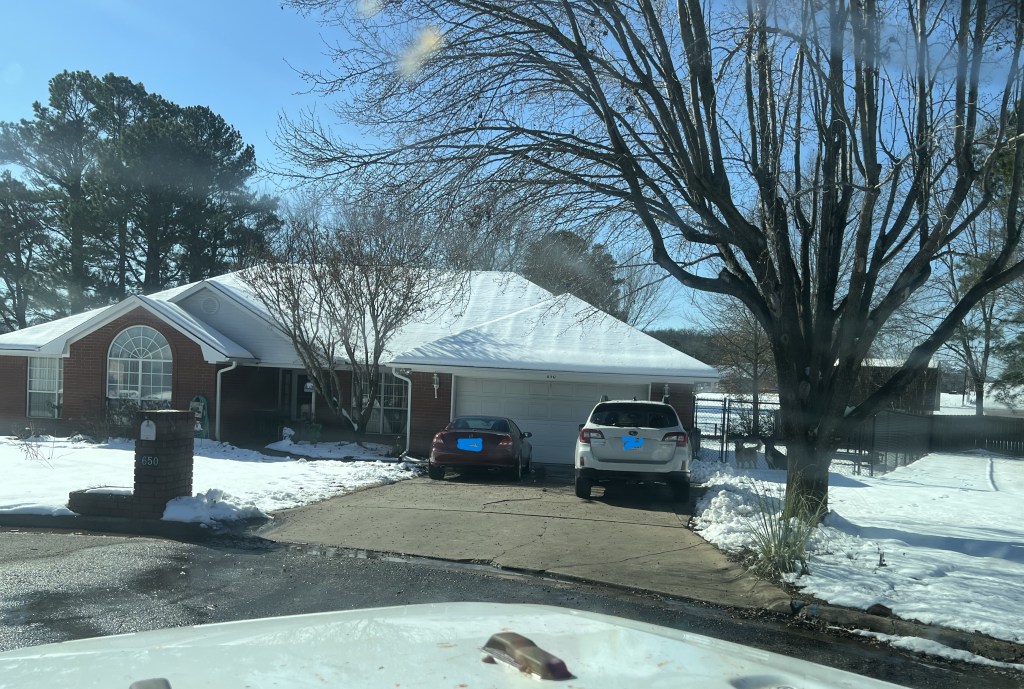
We are now well into recovery from the snowstorm that dumped 9 inches (23 cm) of snow on our town before the weekend.  That gave me a day to recoup as I had no intention of getting out in the snow.  I did take time Saturday afternoon to shovel the portion of the patio that was being trampled by the kids at play and myself as I stocked the feeders.  It was in the 30’sF (0’sC) during the day and I knew if I did not remove the snow, it would become a sheet of ice.  That would make it harder to remove and slicker as I walked (it did not seem to bother the kids either way).  I always had a snow shovel when I lived in Kansas and used it several times over the winter.  The shovel was something I did not bring when we moved to Arkansas.  While it usually snows once over the winter, it is rarely deep enough to worry about shoveling.  Since we got deep snow, that meant I got to dig out using a square 8-inch (20cm) shovel rather than the 18-inch (46 cm) snow shovel I am used to.  If you do the math, you know it took twice as long to shovel my patio than if I had the proper equipment.        

When I looked online, I found whether to shovel the snow or not is one of the biggest questions for homeowners.  Questions arise about who is responsible, how much you should shovel, and what to do with the snow you shovel.  This was a moot point as I began to shovel my patio.  The city could care less if I shoveled my back yard or not, but the front yard is a different situation.  The news stations all suggested you move your vehicles off the street to allow access for the street crews.  They also suggested if you did not move them you may end up buried in the drift the plows create as they scoop the snow onto the easement.  I knew I had responsibility for my sidewalk when we lived in Kansas, but we do not have a sidewalk in our cul-de-sac, so I was free from any responsibility there.  Like my patio, I knew clearing my drive was more for my personal convenience than for others.  What I found online is that the rules and regulations on whether you shovel snow vary from state to state, and some cities, towns, and homeowners’ associations (HOA) have their own rules about how to shovel snow.  Like most US states in the south, Arkansas currently has no laws on snow removal.

Knowing it was not my responsibility to shovel snow did not help with maneuvering my driveway and front walk.  We had several packages delivered after the snow let up and the mail and delivery people had forced their way through the snow.  On Sunday I took on the larger task and prepared to shovel the front of our house.  The winds had died down and the temperatures were now comfortably in the high 30’sF (0’sC) so it was ideal weather to shovel.  I took my little flat shovel and scooped the snow into my yard on both sides of the sidewalk and driveway.  I was glad I decided to shovel when I did because the snow was sitting on an inch (2.5 cm) of slush.  The temperatures were predicted to again drop into the low 20’sF (-0’sC) and the slush was going to freeze.  This would be compounded by the footsteps that compact the snow and aid in the freezing.  When I woke up this morning the snow was completely gone and the cement dry.  I am glad I decided to shovel.

Thoughts: As I continued to shovel my driveway, I noticed I was the only one on my cul-de-sac who was doing so.  The snow was only on their drives and streets, and once you got out of our subdivision the roads were clear.  I was not required to shovel, but I felt better knowing I was protecting myself and any delivery people that might venture onto our property.  Every time I shovel snow (Kansas or Arkansas) the same thing happens.  As my neighbor struggled to get out of the cul-de-sac, he stopped and jokingly asked if I would shovel his drive next.  I declined.  While major climate events can be devastating, they seem to bring people together.  Surviving a climate event gives humans a sense of camaraderie that may not have been there previously.  It would be better to connect prior to an event rather than because of one.  Act for all.  Change is coming and it starts with you.

Snowstorm

January 10, 2025

Our first snowstorm of the new year started yesterday and continues this morning.  The kids have come a long way since their first snowstorm 2 years ago.   Zena had moved tenuously through the flakes giving them their sniff evaluation before finally deciding they were ok to play in.  Loki missed that storm, and this was his first real opportunity to snuffle.  We let them outside as the flakes were coming down yesterday.  Zena immediately went on patrol prancing up and down the perimeter of the fence.  Loki was more discriminating.  Sensing “something” beneath the inches of snow he began to snuffle and dig.  This morning brought on the “zummies”.  Both dogs raced through the snow, only stopping long enough to get into a quick fight before getting back to zooming.  Since it is below freezing (32F or 0C) I did not keep them outside too long.  I also felt obligated to stand and watch to see how they were doing.  That probably limited their time, as I get cold fast.

When I looked online, I found the snowstorm that moved through Arkansas overnight dumped nearly 15 inches (38 cm) of snow in some parts of Arkansas, roughly 8 inches (20 cm) across the Little Rock metro area, and 7 to 10 inches (18 to 25 cm) in the areas around my town, according to the National Weather Service in Little Rock.  We average around 1 inch (2.5 cm) of snow annually.  Entergy reported 8,496 customers without power as of 7:30 am, with most outages in southwest Arkansas.  The Electric Cooperative of Arkansas reported 5,390 customers without power.  Bill and Hillary Clinton National Airport/Adams Field (east of Little Rock) reported there had been 36 flight cancellations as of 8:30 am Friday.  Airlines are challenged by deicing planes in the snowfall, delaying morning departures.  Airfield crews worked all night and into the morning to plow and sweep the snow from the main runway, taxiways, and air carrier ramp, airport spokesman Shane Carter said in Friday’s news release.  Other parts of north-central Arkansas are expected to receive 8 to 12 inches (20 to 30.5 cm) and Northern Arkansas is forecast for 5 to 7 inches (13 to 18 cm) of snow, and some in the area could get more.  We still have flurries expected to last until the afternoon. 

Another reason to let the kids out in the snowstorm this morning is the combined group of red-winged blackbirds (Agelaius phoeniceus), common grackle (Quiscalus quiscula), and a few brown-headed cowbirds (Molothrus ater) that descended.  I do not mind feeding these birds, but when they descend, they quickly devour everything and drive the smaller passerines off by their presence.  The blackbirds are skittish and just letting the kids into the yard makes them retreat to the surrounding trees.  The smaller birds return despite the kids’ presence.  Collectively, blackbirds may be described as a “murder” when they are seen flying together or perched on a tree branch.  A “cloud” is a poetic term used as they fly together in formation.  A “merle” is an older term used to describe the group as they forage for food on the ground while a “colony” is used to describe a group nesting together.  Finally, a “congregation” is used to describe a group of blackbirds gathered in one area.  The different names indicate the level of human interest in their various activities.

Thoughts: As the snowstorm winds down, I begin to reflect on getting out.  Tad Sours, director of communications for Washington County said, “All that we really ask from the public is if you don’t have to get out in it, don’t . . . give plenty of room to our road crews.”  Still, I did not make the pre-snowstorm dash for milk, bread, and toilet paper like most of the area’s residents.  Global warming means extremes of both heat and cold, and opposite events at the same time (like a snowstorm and wildfire).  Make a difference NOW, not later.  Act for all.  Change is coming and it starts with you.

Birds 2024

January 04, 2025

I am a little later than usual, but it is again time to recap my annual birder list. Once more I saw a number of red-tailed hawks (Buteo jamaicensis) on the power lines going to and from town but this year I was unable to actually get a picture, so they were not added to my count. I was unable to take my usual trip to the wildlife area this year and so missed out on any of the birds I might have seen there. The end of year presence on my feeders was good as the cold weather brought the small Passerines (sparrows and finches), although the larger birds (cardinals and jays) were mostly absent. I cleaned out the bluebird (Sialia sialis) house last week. One of the squirrels who frequent the feeders has taken to gnawing on the entrance, so I opened it to check if everything was ok. It was fine but I cleaned the nest and debris in preparation for the next nesting season. BTW: for those who read last week’s blog (Gaggle) a group of squirrels is called a “dray” or a “scurry”.

All that said leads up to the “great reveal” concerning my birder totals for 2024. You may recall I recorded 26 species in my first year (2020). I got off to a great start in 2021 with 29 species by the end of January and a total of 52 species for the year. During 2022 the sightings were slower, with 44 different species, not counting the six European sightings (50 total?). During 2023 I recorded my lowest number of sightings since my first year, with only 30 species. During 2024 the numbers rose slightly to 39 documented species. Building a fence in the side yard helped as the kids no longer play near the feeders and the birds feel free to come and go more frequently. Still, early morning and early evening are the best times to watch. We also added three new feeders that attach to the glass on the bay window next to where Melissa works. This allows her to watch as the American gold finch (Spinus tristis) and Dark-eyed junco (Junco hyemalis) as they battle for feeding rights.

As I pulled onto the entrance road to the lake to take the kids for a walk yesterday, I caught sight of a large bird perched in the trees. I drove by as the bird turned and flashed the unmistakable white head of a bald eagle (Haliaeetus leucocephalus). I slowed and then pulled over as soon as I (no shoulders). I walked back the 1/4 mile (400m) scanning the trees and hoping to be able to get a photo for my birding list. Unfortunately, the eagle had moved on and was now out of sight. When we began our walk out onto the first spit of land, I heard the call of a red-bellied woodpecker (Melanerpes carolinus). I scanned the trees along the road and caught sight of the bird high among the branches. I pulled out my phone to take a photo but again, by that time the bird was gone. That made two birds I usually only see a couple of times a year and I had missed documenting them both. These were part of the many birds I have seen but not photographed over my last five years of birding. The official Cornell Lab of Ornithology bird list guide does not require documentation with a photo to count as a sighting, although that has been my criteria. Perhaps I should rethink.

THOUGHTS: I acquired several new feeders (now 13, plus 9 hummingbird feeders) during 2024. Melissa asked about the cost as she watched me buying seeds and filling the feeders on a daily basis. I tend to buy seeds in bulk, and I only have to restock two or three times a year. Watching the birds (and squirrels) gives us both pleasure. Like my garden and Melissa’s succulents, the expense to feed the birds is well spent. Be sure to mark your calendars for the Great Backyard Bird Count 2025 (February 14 to February 17, 2025). As I mentioned last year, birds are the (literal) canary in the mine shaft (earth) when it comes to gauging the health of our ecosystems. Act for all. Change is coming and it starts with you.
Bigfoot

January 03, 2025

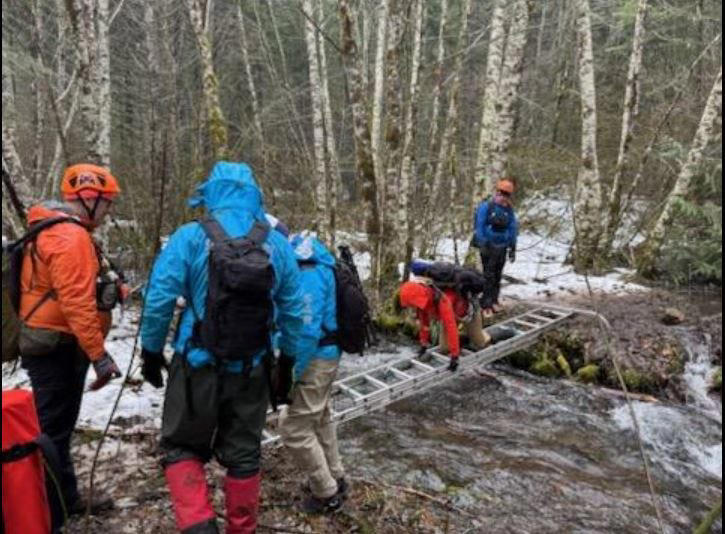
© Provided by the Skamania County Sheriff’s Office

Inside the front section of my local newspaper was a USA Today article on the recovery of two men who had gone missing in a remote forested area of southwest Washington State. The bodies were found on December 28 following a three-day search-and-rescue mission that involved 60 people along with the US Coast Guard. The families of the two Portland, Oregon men had reported them missing around 1 am on December 25th. The Facebook page for the Skamania County Sheriff’s Office (SCSO) wrote a post honoring the rescuers who answered the call on Christmas morning. “Creeks had to be crossed, obstacles climbed, and frozen ground navigated, all while maintaining the safety and well-being of the entire team.” SCSO officials said that both deaths appeared to be due to exposure, and that the men were ill-prepared for the weather conditions they faced. The identities of the two men, aged 37 and 59, have not been released. Officials with the SCSO say the two men had gone into the Cascade Range hunting for Sasquatch, or Bigfoot.

When I looked online, I found Sasquatch, also referred to as Bigfoot, is a large, hairy mythical creature said to inhabit forests in the Pacific Northwest. The creature is featured in both American and Canadian folklore, and since the mid-20th century has grown into a cultural icon. Enthusiasts within the pseudoscience of cryptozoology offer various forms of evidence to prove the existence of Bigfoot, including sightings, photographs, video and audio recordings, hair samples, and casts of large footprints. Scientific consensus is that this is a combination of misidentification, folklore, and hoax, rather than a living animal. Sightings often describe Bigfoot as a large, muscular, and bipedal human or ape-like creature covered in black, dark brown, or dark reddish hair. The estimated height is roughly 6 to 9 feet (1.8 to 2.7 m), but some descriptions have Bigfoot standing as tall as 10 to15 feet (3.0 to 4.6 m). Common descriptions include broad shoulders, no visible neck, and long arms, which skeptics attribute to the misidentification of a bear standing upright. Folklorists trace Bigfoot to a combination of factors and sources, including folk tales and indigenous cultures. Examples of similar folk tales of wild, hair-covered humanoids exist throughout the world.

The origin of the name Bigfoot began in 1958, when a bulldozer operator (Jerry Crew) for a logging company in Humboldt County, California, discovered a set of large, 16 inches (41 cm) human-like footprints in the mud in the Six Rivers National Forest. When Crew informed his coworkers many also claimed to have seen similar tracks on previous job sites and the men began using the word “Bigfoot” to describe the creature. After observing more of these footprints, Crew contacted Andrew Genzoli of the Humboldt Times newspaper. Genzoli interviewed lumber workers and wrote articles about the mysterious footprints, introducing the name “Bigfoot” in relation to the tracks and the local tales. A plaster cast of the footprints was made, and Crew appeared holding one of the casts on the front page of the newspaper on October 6, 1958. The story spread rapidly as Genzoli was contacted by major media outlets including the New York Times and Los Angeles Times, and Bigfoot became the widespread reference to the creature leaving massive footprints in Northern California.

THOUGHTS: While Northern California is arguably the most popular locale for Bigfoot Lore there have been countless sightings up and down the Cascade Range. Skamania County where the two bodies were found has its own Bigfoot tradition. By the 1960’s, there had been so many Bigfoot sightings that Skamania County commissioners passed a law making it illegal to kill, harm, or shoot at a Sasquatch. The act of searching for the creature is referred to as “Squatching”, popularized by the Animal Planet series, Finding Bigfoot. Whether reality, myth, or hoax, Bigfoot is alive and well in the American Northwest. Act for all. Change is coming and it starts with you.
Gaggle

December 30, 2024

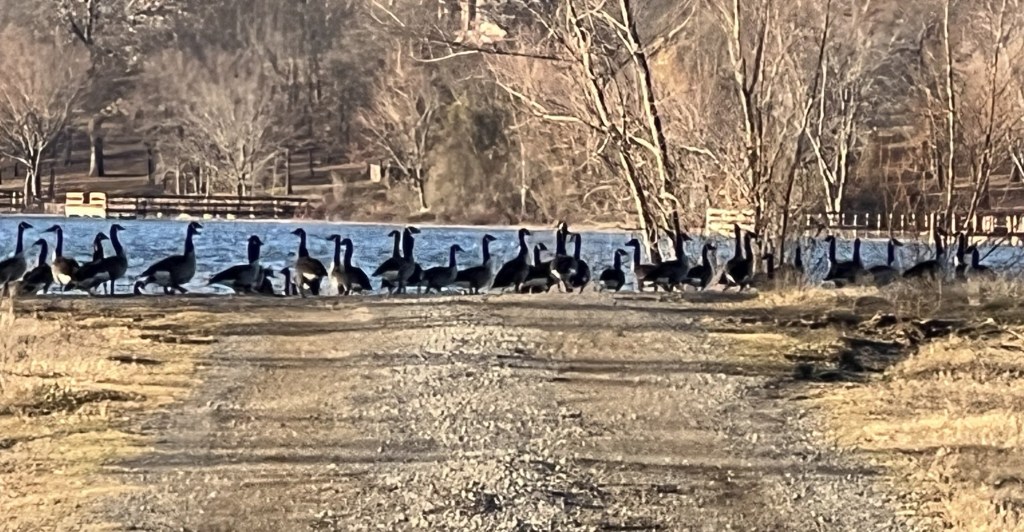
The kids were overwhelmed as we took our walk at the lake last week. They had been intrigued in the past by the occasional greater egret (Ardea alba) or great blue heron (Ardea herodias) that spend time in the shallows at the end of the two spits we walk. The kids will stop and even strain on their leash trying to get a better look at these large solitary birds. They were not prepared for the mass of birds we encountered on this occasion. The herons had flown away as the kids approached, but the Canada geese (Branta canadensis) stood their ground. Both Zena and Loki hesitated in the face of this loud and raucous group of birds. It was not until the kids composed themselves and began to move forward that the group decided they wanted no part of these two large dogs (Canis familiaris). This gaggle of geese took flight and moved to the safety of the water.

When I looked online, I found a gaggle of geese occurred in English print in Julia Berners book, “The Book of Hawking, Hunting and Blasing of Arms” in 1486. Geese are called a “gaggle” because together they are noisy and rowdy. Little is known of Berners, and much of what is known cannot be verified with certainty, but she is thought to be the earliest female author writing in the English language. Based on her last name, scholars suggest that she was either the daughter of the courtier Sir James Berners or wife to the lord of the manor of Julians Barnes, and she was high-born and well-educated. Since she was most likely brought up at court, she would have hunted and fished with the other fashionable court ladies. It is generally believed that she entered the monastic life and became the prioress of Sopwell Nunnery near St Albans. Berners seemed to retain her love of hawking, hunting and fishing, and her passion for field sports, leading her to write her treatise on hunting and others. These treatises are some of the earliest extant writings of their kind and include remarks on the virtues of environmental conservation and on etiquette for field sports. These concepts would not become commonly accepted for hundreds of years after the publication of these treatises. She is also remembered as one of the first authors (of either sex) to write on angling.

A gaggle is just one of the 165 collective nouns (a “naming word for groups of things) for groups Berners defines in her publication. A group of owls (Order: Strigiformes) is called a parliament, possibly attributed to the idea that owls are considered intelligent and wise. A group of wildebeests (Genus: Connochaetes) is called a confusion. This could be due to the huge numbers of animals that in the annual Great Migration and the resulting confusion and noise that happens when the animals migrate. A group of lemurs (Superfamily: Lemuroidea) is called a conspiracy. Lemurs are social animals and live in communities of around 10 to 25 members who often work together (conspire) to outwit predators using a technique called “mobbing”. A group of hippopotamuses is called a bloat. Hippos live in groups of 10 to 20 females and one male, and bloat may refer to their large, bloated bellies. Finally, a group of wild cats is called a destruction. Feral cats can be territorial and fight to protect their territory, and when a group of feral cats get together, they can become destructive.

THOUGHTS: Canada geese thrived around the golf courses I played in Salt Lake City and would form into a large gaggle around the water hazards. The geese were generally docile as they sat on the lawn or swam in the ponds. The problem came when you hit your ball in their midst, when they cackled and blustered a warning. One even decided my ball was her egg and made an aggressive defense. Animals form groups for protection and defend their territory against predators. Humans use the same tactic and form resistance movements against tyrants or marauders. Like a gaggle of geese, we are stronger together. Act for all. Change is coming and it starts with you.
Cute

December 26, 2024

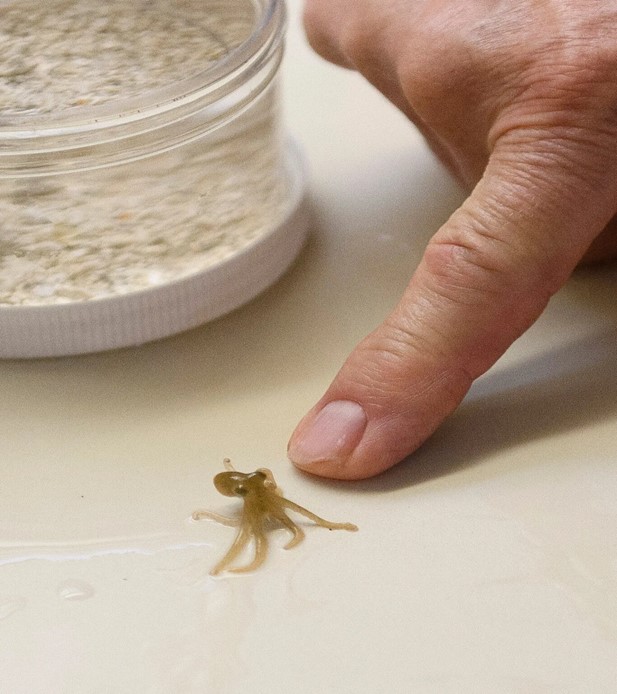
It is the end of the year and that means the internet is barraging us with stories of “The Best” and “The Worst” of everything from sports (Pommel Horse Guy) to music (Gabriela Ortiz, “Kauyumari”) to food (Sour Patch Oreos) . . . (ad nauseum). One story that caught my attention was about the animals that filled 2024 with sadness, intrigue, and delight. Sadness came with the tragic end of Flaco, the escaped Eurasian eagle owl who appeared to die in a building collision in February. Our intriguing was piqued by the Governor boasting of killing her misbehaving dog and a presidential nominee who deposited a dead bear cub in Central Park and cut the head off a dead whale found of the beach. The delight was the previously mentioned slippery potato named after a pork meatball (Moo Deng) who rocked the internet and drove cosmetic influencers for several months. Then there was Terrance the octopus who had been identified as male until “he” laid 50 fertilized eggs. The online audience watched the heroic efforts to keep the fragile hatchlings alive, even as there is only about 1% chance of survival for the hatchling to grow to .4 inches (10 mm) in the wild. It seemed what held media interest best was stories of cute baby animals learning to survive in the world.

When I looked online, I found there are two ways (of course) to answer why we find baby animals so cute. The proximate answer requires you to single out the features of animals that make them cute versus ugly, and often merge them into a general explanation. Why are baby ducks cute and baby parrots ugly? A proximate answer might involve fur, size of the head or the eyes, length of the limbs, all of which help us define cute. The ultimate answer is perhaps an evolutionary one. Is there an evolutionary reason why we find some features attractive and others repugnant? Answering these sorts of questions is the foundation of evolutionary psychology, and while the answers may be elusive (or even beyond our grasp), we still like to think about them. The reasons we find animals cute or ugly come from criteria that have evolved to help us evaluate members of our own species. Baby animals are cute because natural selection has given babies of some species traits that remind us of a human infant.

Some of these ideas could be tested to determine whether there is a commonality between features we see as ugly or cute in animals and compare them with similar features in humans. Regardless, it is important to remember things are not innately ugly or cute. Features humans find ugly may be exactly what attracts the female to the male of another species. As Darwin recognized, our tastes may be no less evolved than our brains or our bodies. For humans, there is no reason for why the signs of age make someone innately less attractive than the freshness of youth. It may be that our standards of beauty have evolved to reflect candidates for mates and older people are seen as less attractive because they are near or past the age of reproduction. This is a preference that could have been instilled in our ancestors by natural selection. Still, beauty in nature is not innate but evolved and our biology co-evolves with our tastes. Only in animal breeding is this reversed, where human desires allow us to sculpt the features and appearance regardless of the environment.

THOUGHTS: There are some babies (animals and humans) that are so ugly that they are cute. In Planet of the Apes, astronaut George Taylor is preparing to leave and thanks the chimpanzees who help him escape. He overcomes his repulsion and turns to Doctor Zira (female) saying, “Doctor, I’d like to kiss you goodbye.” Zira responds, “All right, but you’re so damned ugly.” Humans need to look beyond the traits that make one superficially cute and find the inner beauty that is only revealed when we get to know each other. Act for all. Change is coming and it starts with you.