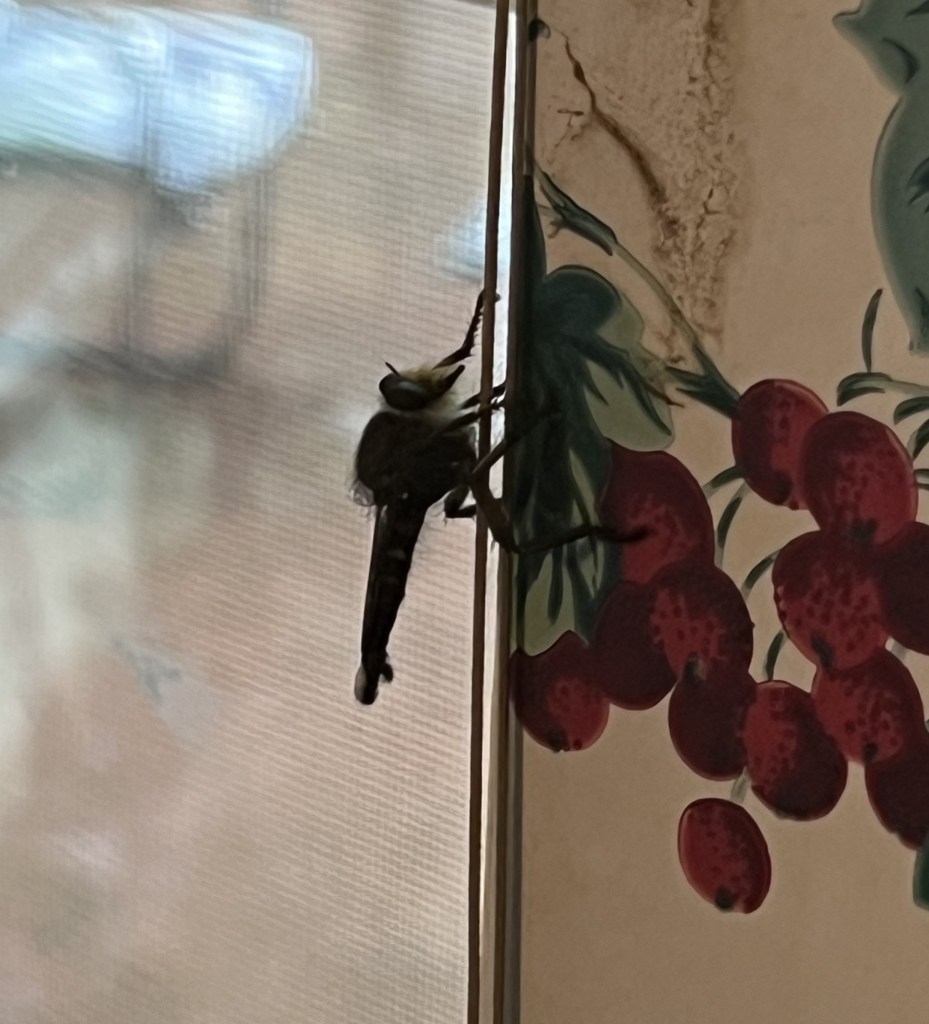
Robber

June 03, 2024

With the overcast days filled with intermittent rains we have been inundated by house flies (Musca domestica) and lately fruit flies (Drosophila melanogaster).  Melissa likes to keep the patio windows open along with the kitchen door to take advantage of the breeze.  While this still provides a barrier from the outside, the kids put a kink in the system.  Melissa works in our bay window to watch the action as the birds (and squirrels) come to the feeders.  During the morning the kids tend to run in and out the door between the kitchen and outside fence where Melissa is working.  That means Melissa must either keep the patio door open (allowing flies), keep the kitchen door shut (depriving of breeze), or get up and down every time the kids decide they want to go outside after coming in 5 minutes ago.  That means the doors are often open and inviting the flies to enter.  We occasionally get other visitors who take advantage of the open doors, like the paper wasps (Polistes fuscatus) and black and yellow mud daubers (Sceliphron caementarium).  Melissa is highly allergic to bee and wasp stings, so when she saw something that looked like a wasp land on the windowsill next to her head, she called me into the kitchen to investigate.  I later found out this was actually a robber fly.    

When I looked online, I found the Fan-bristled robber fly (Dysmachus trigonus), or assassin fly, are part of the larger robber fly family.  They are powerfully built, bristly flies with a stout proboscis enclosing the sharp, sucking mouth parts (hypopharynx).  The name “robber flies” reflects their predatory habits as they feed on other insects by waiting in ambush to catch their prey in flight.  The Asilidae are a family in the order Diptera (true flies) and are cosmopolitan (around the world) with over 7000 described species.  French zoologists Pierre Andre Latreille established the family in 1802.  Robber flies have stout, spiny legs and three simple eyes (ocelli) in a characteristic depression on the tops of their head between two large compound eyes.  They also usually have a dense moustache of stiff bristles on the face (mystax).  The mystax is suggested to afford protection for the head and face when the robber fly deals with struggling prey.  The family of flies attack a wide range of prey, including other flies, beetles, butterflies and moths, various bees, ants, dragonflies and damselflies, ichneumon wasps, grasshoppers, and some spiders.  Many Asilidae when attacked do not hesitate to defend themselves and may deliver intensely painful bites to humans if handled.

When I saw the robber fly sitting on the sill, I was at a loss for how to deal with it.  I could tell this was not a wasp, so that danger was alleviated.  Still, I did not know what it was, and I am not too fond of large insects (or spiders) having free range of my house.  With all of the succulents, pots, and potting material there are too many places for such critters to hide and thrive.  I could see the large mouth parts (probosces) on the fly and knew even the bite of the common house fly hurt if it chose to bite.  I finally just gave in and whacked it with a fly swatter.  It was only after I researched the photo of the fly that I learned one of the robber fly preys is the house flies we were trying to get rid of.  I felt a little better when I learned the robber fly was also aggressive and would bite humans if handled.  I had no idea how I could have gotten it outside the house.

THOUGHTS:  My whacking the robber fly is typical of most human reaction to an unknown.  If something is unfamiliar and appears threatening, it is best to “whack now and ask questions later”.  I would have been better off trying to move the robber fly outside and allow it to control its prey (and my pests).  Human evolution created an innate tendence to practice “fight or flight” when facing the unknown, but neither is always the best approach.  Positive interactions with the environment (and other humans) often require “stop, wait, and learn” before proceeding.  This does well for us, and for whatever we were going to whack.  Act for all.  Change is coming and it starts with you.

First Fruits

June 01, 2024

When I decided to build my hügelkultur beds I knew it was going to take large amounts of branches and debris for the first layer.  I had purchased my electric chainsaw to prune my trees, so I had this covered, even though I did not anticipate the amount of work involved.  I also knew it would still take 3 yards3 (2.25 m3) of compost and an additional 1 yard3 (0.75 m3) of potting soil to fill the raised beds.  Looking at the price of compost and potting soil in my local hardware store told me it would be cost prohibitive to buy the small bags offered (1 or 2 feet3, .03m³ or .06m³).  However, I did find several locations which provide bulk amounts of both types of fills.  The problem was I did not own a trailer or even a pickup to transport the fill to my yard.  That was when Melissa reminded me our friend had a trailer that he used to transport his motorcycle.  I called him and he was more than willing to let me use the trailer for as long as I needed.  Several (long) days later the beds were full, and the trailer was washed and returned.  My friend did not expect payment, but I felt I could provide some sort of renumeration.  Since his gift enabled me to finish my containers, I thought the best way to respond was to provide them with some of the “first fruits” from my garden.

When I looked online, I found First Fruits is defined as a religious offering of the first agricultural produce of the harvest.  In classical Greek, Roman, and Hebrew religions, the first fruits were given to priests as an offering to deity.  In Classical Athens the First Fruits offering (aparche) was a major source of funds for the temples of the mystery (Eleusinian) goddesses, Demeter and Kore.  Much of the agricultural offering was sold by the temple with the proceeds being used to pay for the daily upkeep of the temple complex.  In Rome the first fruits of the field were offered to Priapus, a minor fertility god from Greek mythology who became a popular figure in Roman erotic art and literature due to his permanent erection (priapism).  In ancient Judaism, first fruits (bikkurim) were a sacrificial offering, and the first grown fruits in each agricultural season were brought to the Temple and laid by the altar as commanded by the Torah (Exodus 23:19 and Deuteronomy 26:1–11).  The Hebrew Torah became the Christian Old Testament and the practice continued.  The Teachings of the Twelve Apostles (Didache) instructed first fruits be given of “money, clothes, and all of your possessions” (13:7).  Having the First Fruits blessed at the church has been celebrated through the feast of Lammas (Loaf Mass Day) in Western Christianity and the Feast of the Transfiguration in Eastern Orthodox Christianity (August 6).  It is still practiced by other cultures (by other names) today. 

While I have begun collecting the first fruits from my raised beds, the only thing ready is radishes.  While my friends may enjoy some (8) radishes, this did not seem like a proper dedication.  I have other fruits that should provide a proper gift that should be ready (?) shortly (cauliflower, beans, peas, carrots, and brussels sprouts).  I have also received the first fruits from my container crops as the cilantro and jalapenos are producing, but my friends have a large garden that will produce tomatoes and jalapenos.  Instead, I made my first Pico of the season.  I am looking forward to more.   

THOUGHTS:  Beginning in 1966 a unique “First Fruits” celebration brought the Ancient African harvest festivals to the US with Kwanzaa, celebrated from December 26 to January 1 and culminating in a communal feast called Karamu on the sixth day.  This is based on traditions from various parts of West, Eastern, and Southeast Africa.  A 2019 poll in the US by the National Retail Federation found 2.6% of people who planned to celebrate a winter holiday would choose Kwanzaa.  First fruits celebrations are a reminder to be thankful for the earth’s bounty and for our willingness to share that bounty with others.  Whatever you call it, it is a good reminder.  Act for all.  Change is coming and it starts with you.
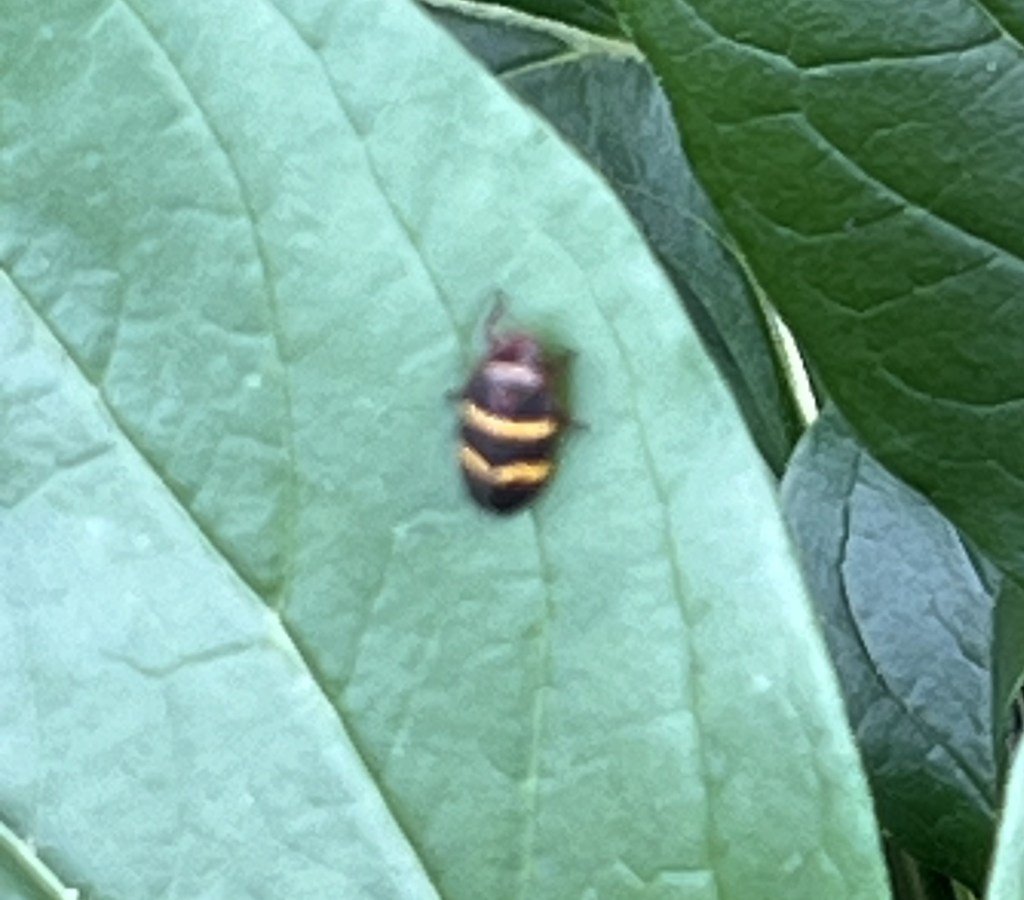
Spittlebug

May 29, 2024

Today I went to my raised beds to check on them and give them a drink.  I knew I needed to thin the radishes (Raphanus sativus) and carrots (Daucus carota).  The seeds of both had been tiny (pen point) and had tumbled out of the packet as I carefully tried to space them in the one inch (2.5 cm) furrow.  They were now massed together and would never provide enough room for the root vegetables to grow.  While the carrots remained clustered, the radishes had grown and bullied the other plants aside and pushed out of the soil.  I thinned the carrots and thinned the radishes by harvesting eight radishes that were around 1-1/2 inched across (3.75 cm).  On my way back to the house I noticed a small beetle crawling along a leaf of the Garden Phlox (Phlox paniculata) my mother-in-law had planted in the front flower bed.  I assumed it was a type of ladybug (Family, Coccinellidae) that I was unaware of.  When I checked on my phone ID, I found it was actually a spittlebug.  

When I looked online, I found the two-lined spittlebug (Prosapia bicincta) is a species of insect in the family Cercopidae that is widespread in the eastern half of the US.  Adults are black with two red or orange lines crossing the wings and reach a length of 0.3 to 0.4 inches (8 to 10 mm).  Nymphs feed on various grasses, including centipedegrass (Eremochloa ophiuroides, bermudagrass (Cynodon dactylon) both common in lawns, and corn (Zea mays).  Nymphs progress through five instars where they feed from within foam (consisting of their own spittle, hence the name) produced from juices of their host plant.  Adults feed on the leaves of both native and introduced species of holly, as well as on the leaves of the eastern redbud tree.  Spittlebug is a pest of forage (pasture) and turf (lawn) grasses and consumption of these plants causes economic damage throughout the southeastern US. 

While I had been happy to see a ladybug on my phlox, my mood changed when I identified this as a spittlebug.  Ladybugs have been valued in biological pest control (they prey on agricultural pests like aphids and scale insects) as far back as 1814 in England.  Several species have been introduced to areas outside their native range, beginning with the vedalia beetle (Novius cardinalis) introduced to California in 1887 from Australia to protect citrus trees.  Ladybugs have been used in 29 countries with great success due to their high prey specificity, fast development, multiple generations each year, efficient discovery of host patches, and larval development completed on a single host insect.  The two-lined spittlebug is just the opposite.  Both the nymph and adult spittlebug use their needle-like stylet mouthparts to penetrate the plant tissue and suck out sap.  Adult feeding can cause ‘froghopper burn’ (phytotexemia) of the plant tissue.  Turfgrasses with froghopper burn will gradually wilt, followed by the blade turning brown and dying.  Turfgrass damage is usually sporadic and patchy, and the infestations more often causes aesthetic damage in the US mainland.

THOUGHTS:  While my one spittlebug is not a problem, an infestation like what happened on the pastures on the island of Hawaiʻi in 2022 is.  Spittlebug infestation reached more than 172,973 acres (70,000 ha) and caused serious, long-term damage to large areas of the island’s rangelands and pastures.  There are no known natural predators in the eastern US, much less when the species is introduced into a new environment.  Invasive species control is imperative if we are to preserve the natural ecosystems to also help ensure human survival.  Act for all.  Change is coming and it starts with you.
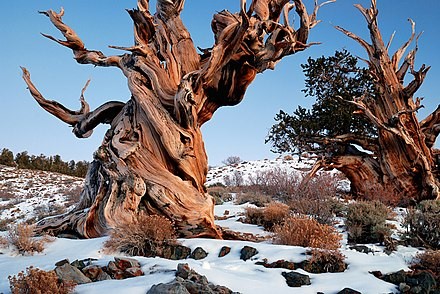
Bristlecone

May 27, 2024

Memorial Day (originally Decoration Day) is a federal holiday to commemorate military personnel who died serving in the US Armed Forces.  This began in 1868 and was observed on May 30th until Congress standardized federal holidays in 1971, and it is now observed on the last Monday of May.  Many have taken to decorating the graves of family on this day as well.  As a contrast USA Today also published an article today commemorating tree longevity.  Scientists use dendrochronology (tree ring count) to determine age and the size of the rings is a sign of the tree’s endurance in the face of change.  Trees that survive through extreme weather, pests, diseases, and human interactions provide lessons that may protect future forests.  One Florida southern live oak (Quercus virginiana), named “Big Tree,” is over 400 years old.  It was struck by lightning at least three times and survived multiple hurricanes and yet remains healthy.  According to Guinness World Records, the oldest tree species in the world are the bristlecone pines, found in the White Mountains in California.

When I looked online, I found the bristlecone pine (genus, Pinus) covers three species of pine tree.  All three species are long-lived and resilient to harsh weather and bad soils, but Pinus longaeva is among the longest-lived life forms on Earth with examples more than 4,800 years old.  As the oldest known individuals, scientists study the trees to find how they live so long.  One study found bristlecone has higher levels of telomerase activity, which slows or prevents the attrition rate of telomeres, or the repetitive nucleotide sequences associated with proteins at the ends of linear chromosomes.  The Bristlecone is a “first succession” species and rapidly occupy newly opened ground (fires) but compete poorly in less-harsh environments.  Bristlecone grows in scattered subalpine groves at high altitude in arid regions of the Western US.  The three related species are the Great Basin bristlecone (Pinus longaeva) in Utah, Nevada, and eastern California, the Rocky Mountain bristlecone (Pinus aristata) in Colorado, New Mexico and Arizona, and the Foxtail pine (Pinus balfouriana) with two disjunct populations found in the Klamath Mountains (subspecies balfouriana) and the southern Sierra Nevada (subspecies austrina).  The species can hybridize in cultivation, but the ranges of wild populations do not overlap and they do not do so in nature.

Bristlecone pines are known to scientists as “extremeophiles” because they are slow-growing and can endure harsh environmental conditions, including cold temperatures, high winds, dry soils, and short growing seasons.  The world’s oldest living tree is “Methuselah.” The tree’s exact age is unknown, but the US Forest Service (USFS) experts believe it is around 5,000 years old.  Dendrochronologist Edmund Schulman found and named the tree in 1957.  The tree is named after a biblical figure who is said to have lived to 969 years.  The ancient tree dubbed “Prometheus” was cut down in 1964 (with USFS permission) that they later realized was an estimated 4,900 years old.  Methuselah is alive as of May 2024.  Officials do not provide photos or exact location of this oldest living tree to protect it from damage and human vandalism.

THOUGHTS:  Climate change is threatening the longevity of the Bristlecone along with many of the world’s oldest trees.  The Rocky Mountain population is severely threatened by an introduced fungal disease (white pine blister rust) and by mountain pine beetles (Dendroctonus ponderosae).  Climate change may also affect the species as temperatures have increased 0.9 to 1.8F (0.5 to 1C) over a 30-year period in the southern Rocky Mountain range, especially affecting trees in higher elevations.  Old specimens of bristlecone pine have survived previous warmer periods, but the loss of younger trees will affect genetic diversity.  Even the old trees will not survive increased forest fires.  Act for all.  Change is coming and it starts with you.

Nests

May 24, 2024

It is not surprising that with the bird feeders I have along the patio fence we would also have a number of bird nests in our yard. This included the bluebird (Sialia sialis) house situated above the container tomatoes.  We have several nests in the trees in the front yard.  The one in the Japanese maple (Acer palmatum) was hidden until I pruned the tree while making my hügelkultur beds (I kept the branch with the nest).  For the last several years the Northern mockingbirds (Mimus polyglottos) have made nests in the cover of the snowball bush (Viburnum macrocephalum) and the rose bush (genus, Rosa) that I have cleared out along with an annual pruning.  As I rounded the corner to check on my raised beds yesterday, I was startled as an American robin (Turdus migratorius) flashed by my head.  When I looked up, I saw a cup nest resting atop the curvature of the drain spout.  While I do not want this to be a permanent nest, I thought I would wait until the eggs hatch and the fledgling leave before I take it down.  That makes at least four nests from three (known) species of birds.

When I looked online, I found the study of birds’ nests is known as caliology and defines nests as the spot where the bird lays and incubates its eggs and raises its young.  While the term generally refers to a specific structure made by the bird this definition is too restrictive.  BirdChronicle describes 14 different types of bird nests, ranging from a shallow depression in sand, a burrow in the ground, a chamber drilled into a tree, a rotting pile of vegetation and earth, a shelf made of dried saliva, or a mud dome with an entrance tunnel.  The smallest are hummingbirds (genus, Trochilus) nests at 0.8 inches (2 cm) across and 0.8 to 1.2 inches (2 to 3 cm) high.  These nests are dwarfed by the mounds built by scrubfowl (genus, Megapodius) found on the Pacific Islands which can measure 36 feet (11 m) in diameter and 16 feet (5 m) tall.  Some species do not build nests and use the empty nests or burrows of other birds.  Pygmy falcons (Polihierax semitorquatus) and red-headed finches (Amadina erythrocephala) move into sociable weavers’ (Philetairus socius) nests while the brown-headed cowbird (Molothrus ater) lay their eggs in other birds’ nests and then abandon the eggs.  Birds like the White tern (Gygis alba) and emperor penguin (Aptenodytes forsteri) never build a nest and lay their eggs on the open ground.  Nest diversity has a function and purpose specific to the species.

While I have not seen any nests, we have a house sparrow that flies off when I exit the front door.  On inspection I found a 2-1/2 inch (10 cm) hole in the overhang.  My immediate thought was how to get rid of this intrusion.  While researching bird nests, I found US federal law makes it illegal to remove or destroy any active nest (a nest with eggs or brooding adults) from a native bird species.  If the nest has been abandoned or has no eggs, it can be removed or destroyed.  It is also illegal for anyone to keep a nest taken from a tree or found on the ground unless you have a permit issued by the US Fish and Wildlife Service.  Migratory birds (and native species) are protected, and tampering with or removing a nest or eggs can lead to fines or other penalties.  Nests of invasive birds, like house sparrows (Passer domesticus) or European starlings (Sturnus vulgaris), are not protected at any time.  Interestingly, starlings and sparrows are commonly found building house nests.

THOUGHTS:  I had different reactions to the nests around my house.  I placed the bluebird house to attract a nesting pair, avoided the nests in the tree and on the downspout, and left the nests of the mockingbirds until pruning.  I felt different about the house sparrow, perhaps as it made a hole and caused damage.  Humans often invite and embrace nature until we are faced with a negative impact.  Then we allow economics or expedience to dictate our actions.  Protecting the environment is both a global and individual response.  I can legally remove any sparrow nests, but should I do so morally?  Act for all.  Change is coming and it starts with you.

Thwaites

May 22, 2024

Inside the front section of my local newspaper, I found a USA Today article on a new study released Monday about the rapid melting of an Antarctic glacier.  The Thwaites Glacier is part of the West Antarctic Ice Sheet and is the most unstable and fastest changing glacier in the world.  New research for the first time showed visible evidence of the warm sea water pumping under the glacier.  Lead author Eric Rignot, of the University of California, Irvine, said there is more seawater flowing into the glacier than was previously thought, making it “more sensitive to ocean warming, and more likely to fall apart as the ocean gets warmer.”  As the glacier melts it could cause ocean levels to rise as much as 2 feet (60 cm).  Even more, the glacier serves as a natural dam for other glacial ice in West Antarctica which if released could raise ocean levels as much as 10 feet (3 m).  A rise of this magnitude would place many of the world’s coastal cities underwater.  According to the study, it “will gravely impact populations in low-lying areas like Vancouver (British Columbia), Florida, Bangladesh, and low-lying Pacific Islands”.  The study on the Thwaites Glacier was published in the journal Proceedings of the National Academy of Sciences.

When I looked online, I found Thwaites Glacier is an unusually broad and vast Antarctic glacier located east of Mount Murphy, on the Walgreen Coast of Marie Byrd Land.  It was initially sighted by polar researchers in 1940 and mapped between 1959 to 1966.  The glacier was officially named in 1967 after the late American glaciologist Fredrik T. Thwaites.  The glacier flows into Pine Island Bay in the Amundsen Sea at surface speeds which exceed 1.2 miles (2 km) per year at its grounding line.  Like many other parts of the of the Earth’s surface where water is in solid form (cryosphere), Thwaites has been adversely affected by climate change and provides one of the more notable examples of the retreat of glaciers since 1850.  Since the 1980’s, Thwaites and Pine Island Glacier have been described as the “weak underbelly” of the West Antarctic Ice Sheet, in part because they seem vulnerable to irreversible retreat and collapse even under relatively little warming.  Theoretical studies of the stability of marine ice sheets and observations of large changes on these two glaciers suggest that if they were to go, the entire ice sheet is likely to eventually follow.

On March 15, 2002, the National Ice Center reported a major calving event took place when an iceberg named B-22 broke off from the Thwaites Glacier.  This iceberg was about 53 miles (85 km) long by 40 miles (65 km) wide with a total area of 2,120 miles2 (5,490 km2), or comparable to the US state of Rhode Island.  While most of the iceberg broke up quickly, the largest piece (B-22A), with an area of around 1,158-1⁄2 miles2 (3,000 km2) or “twice the size of Houston, Texas”, drifted near the glacier even as the rest of the glacier tongue continued to break up.  In 2012, the iceberg got stuck on seafloor, 33 miles (53 km) from the ice tongue, where its presence had some stabilizing impact on the rest of the glacier.  The iceberg started moving again in October 2022 and rapidly drifted to the northwest.  Lasting 20 years, it is likely to end up as one of the longest-lived icebergs in history.

THOUGHTS:  When I blogged about the Thwaites Glacier last year, I mentioned it has been dubbed the Doomsday Glacier by some.  Since 1947 the members of the Bulletin of the Atomic Scientists have maintained The Doomsday Clock as a symbol that represents the likelihood of a human-made global catastrophe.  The clock is a metaphor (not a prediction) for the threat to humanity from unchecked scientific and technological advances.  These predictions are now mostly driven by climate change.  I can imagine a T-Rex looking up 66 million years ago and saying, “Oh look, another pretty comet!”  Act for all.  Change is coming and it starts with you.

Green Beans

May 21, 2024

I decided I could no longer wait to see what might sprout from my corn.  I originally planted seven corn kernels in each of my four beds (28 total).  I had purchased the seed several years ago and never gotten it into the ground.  I do not know if the seed was still good, but the package said they should still be viable.  Even after soaking the seeds (as directed) for five hours, only nine of the kernels sprouted.  Two weeks ago, I decided to replant the corn that did not sprout (another 19 seeds) and five of the seeds have now sprouted.  Since it is getting on in the season, I decided I needed to move on and get the second stage of the three sisters in the ground, so I planted the beans.  I spaced four pole bean seeds (Kentucky Wonder var.) around each of the standing corn seedlings.  The second sister of my experiment is in the ground.  I am hoping for a great crop of green beans.

When I looked online, I found green beans are the young, unripe fruits of various cultivars of the common bean (Phaseolus vulgaris).  The immature or young pods of the runner bean (Phaseolus coccineus), yardlong bean (Vigna unguiculata subsp. sesquipedalis), and hyacinth bean (Lablab purpureus) are used in a similar way as green beans.  Green beans are known by various common names, including French beans (French, haricot vert), string beans (although most modern varieties are “stringless”), and snap beans or “snaps.”  Green Beans are a summer crop that needs warm temperatures to grow.  Maturity is typically 55 to 60 days from planting to harvest.  As the bean pods mature, they turn yellow and dry up, and the beans inside change from green to their mature color.  Green beans are distinguished from other varieties of beans in that they are harvested and consumed in their pods before the seeds have fully matured, similar to the harvest and consumption of unripe pea pods like snow peas or sugar snap peas.  Many green beans are vines that need external support of cages or poles (or the corn stalks of the Three Sisters).  Recently, the “bush bean” has been developed which does not require support and has all its pods develop at once rather than the gradual maturation of pole beans.  This makes the bush bean more practical for commercial production.

It turns out I inadvertently planted both types of green beans.  The pole beans I planted today (“Kentucky Wonder”) should coil their way up the corn stalks and provide fruit over a period of weeks as they continue to grow.  Several weeks ago, I planted a variety of bush bean (“Contender”) in one of my raised beds.  These do not need a trellis and need to be spaced farther apart.  Not knowing the difference, I had spaced them around a trellis.  It will be interesting to see the difference, and which has better production.  I replanted several other vegetables in my planters while I was planting my green beans.  An entire section of beets (Ruby Red var) grown indoors from seed had not sprouted so I replaced them with iceberg lettuce (Lactuca sativa).  The row of rutabagas (Brassica napus) had really taken off and needed to be thinned.  Rather than discarding the roots, I decided to try and transplant them to another area in the row.  Hopefully they are far enough along, and I got enough of the root system to allow them to survive.  We will see.    

THOUGHTS:  Even though I was able to raise over 70 plants from seed with my grow lights and warming mats, few of them survived long enough to move (or flourish) outside.  Many of those are now struggling alongside the seeds planted directly into the ground or the tomato plants I purchased from the nursery.  This tells me I need to be more selective in what I start indoors.  I have also realized I need to grow fewer varieties and more of what grows well.  It is still a “work in progress”.  Finding the right mix/diversity will be the key to sustainability.  The same could be said about human interaction.  It is our mix of diversity that creates a sustainable society and allows it to thrive.  Act for all.  Change is coming and it starts with you.

Fob

May 20, 2024

Our Jeep is equipped with a keyless entry and ignition system.  I always thought this was an asset, especially running across the parking lot in the rain when I can open my door without fumbling for my key.  We also have another feature that refuses to allow the car to lock if I left the keys in the car and will beep a warning to tell me I need to retrieve my keys.  This is not an absolute failsafe.  Three months ago, I hopped out of the car and locked it, missing the warning beep.  When I returned an hour later the vehicle had locked itself while I was gone, and I called for a locksmith to retrieve my key.  Last week I found another problem with my keyless ignition.  I had taken the kids to the lake for a walk and started the car and drove home.  I turned the vehicle off and took the kids inside.  When I returned to the car to lock it, it gave me a warning beep.  I made a thorough search of the vehicle, but my keys were nowhere to be found.  When Melissa came to help, we thought we saw the red button on the fob lodged under the center console.  We knew the key had to be in the car.  After all, how could I drive home if the key was not in the vehicle?

When I looked online, I found there have also been a number of injuries and even deaths from carbon monoxide poisoning when victims leave their cars running in the garage.  This is easier with modern keyless ignition systems which allow drivers to start and shut off their vehicle with the press of a button, especially with quiet, hybrid cars.  The engine might not be running when the car is parked but comes on as the batteries run down.  Keyless entry systems are a standard feature on many new cars and at least an option on even the least expensive models.  Some allow the driver to lock and unlock the car by touching the door handles without using the key fob, and then start the vehicle with the press of a button or the twist of a knob.  Some automakers have audible notifications when the key leaves the running vehicle.  Others have designed cars to automatically shut off after a certain period of time once the driver has left the vehicle or to automatically turn off whenever the driver exits with the key fob.  Lieutenant Athony Mancuso of the New York City Fire Department said, “When we do see a carbon monoxide death the people don’t have a carbon monoxide detector.”  Every home should have working carbon monoxide detectors, not in the garage but in the home’s living areas where it can be heard. 

I also found a YouTube share that discussed being able to drive your running Jeep without a key in the car.  Knowing this was possible, I drove back to the lake to see if my fob was lying on the ground.  It was not.  That left the possibility of their falling into the console.  I researched (YouTube again) how to remove the center console and found it was basically four bolts.  I removed the bolts and lifted the console enough to assure myself the key fob was not there.  I do not know if it was lost elsewhere (?) or if someone had decided to pick it up (?).  It was ironic when we walked the next day that I found a fishing pole lying in the road leading to the end of the jetty.  All I could think of was someone picking up my fob before I could retrieve it.  I left the pole propped against a fence post at the entrance of the road.  It was gone the next day.  I hoped it was the owner who had returned.

THOUGHTS:  When I told my sister about my key fob troubles she told me of a similar experience.  My brother-in-law was driving, and she hopped out of their Jeep (with the fob) to go shopping.  He drove the car to the other end of the shopping center to another store.  She had the fob, and he had the car.  I cannot imagine this is a good feature since Jeep is a 4-wheel designed to travel back roads.  I hope I never lose my key in Desolation Canyon.  Fore warned is fore prepared.  Act for all.  Change is coming and it starts with you.
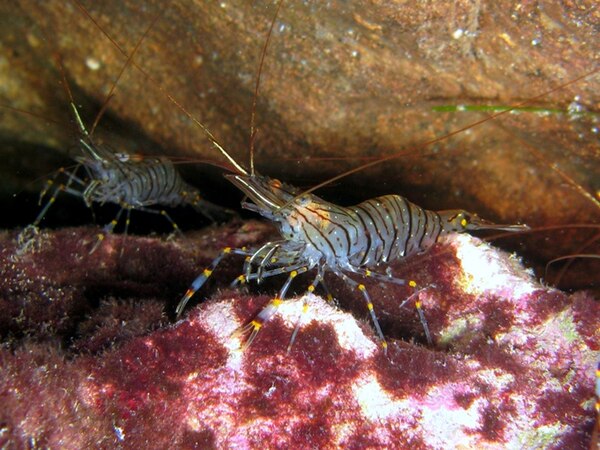
Shrimp

May 16, 2024

In today’s Business Section of my local newspaper, I found a USA Today article on an abundant harvest in Florida.  Homegrown Shrimp is an indoor aquaculture farm on Florida’s Treasure Coast.  According to the National Fisheries Institute, the US consumes 5.9 pounds (2.7 kg) of shrimp per person per year.  The US imports 1.7 billion pounds (771,000,000 kg).  Jake Dietzel served as a federal observer on shrimp boats in the Gulf of Mexico for the National Marine Fisheries Service and saw the bycatch rate in wild-caught shrimp.  This can be as high as 80%, meaning for every pound (.45 kg) of shrimp four pounds (1.8 kg) of other fish and marine life are thrown overboard.  These dead waste products are discarded because they are not the “target” species.  Dietzel now works as hatchery manager for Homegrown Shrimp which is owned by CPF Foods of Thailand.  The 20-acre (8 hectare) farm was opened in 2018 and has plans to expand into an adjacent 20 acres.  Homegrown currently produces 275 tons (249.5 mt) of shrimp per year, and when fully operational, they will produce from 600 to 1,000 pounds (544 to 907 mt) of shrimp.

When I looked online, I found shrimp is a crustacean (shellfish) typically belonging to the Caridea or Dendrobranchiata suborders of the order Decapoda, although some crustaceans outside of this order are also referred to as “shrimp”.  Under a broader definition, shrimp may be synonymous with prawn, covering stalk-eyed swimming crustaceans with long, narrow muscular tails (abdomens), long whiskers (antennae), and slender legs.  Any small crustacean which resembles a shrimp tends to be called one.  There are thousands of shrimp species adapted to a wide range of habitats, and they can be found feeding on most coasts and estuaries, as well as in rivers and lakes.  Shrimp are often solitary, though they can form large schools during the spawning season.  Shrimp are an important food source for larger animals ranging from fish to whales, and the tails of many shrimps are widely caught and farmed for human consumption.  Commercial shrimp species support an industry worth US$50 billion a year.  In 2010 the total commercial production of shrimp was nearly 77 million tons (70 million mt).  Shrimp farming became more prevalent during the 1980’s in Asia, and by 2007 the harvest from shrimp farms exceeded the capture of wild shrimp.  

Shrimp sold in the US are from shrimp farms or natural habitats.  Farm-raised shrimp are cultivated in large tanks or ponds, whereas wild-caught shrimp are caught in their natural habitat (Gulf of Mexico or Atlantic coast).  Wild-caught shrimp has a robust flavor that is oceanic and often sweeter than farm-raised shrimps from its natural diet, and the texture is firmer and snappier from the rigors of the wild.  However, overfishing leads to depletion of shrimp numbers and an increase in bycatch.  Shrimp farming in coastal estuaries in Southeast Asia and Latin America has resulted in the clearing of Mangrove forests to make way for shrimp farms, and reports of human trafficking, child labor, and subpar working conditions in Asian shrimp farms have caused concern.  US shrimp farmers have recently begun to adopt sustainable shrimp aquaculture practices like recirculating aquaculture systems (like Homegrown) that use large tanks and ensure that water is filtered and recycled to minimize the environmental impact.  Shrimp farming done right is profitable and sustainable.

THOUGHTS:  Last year Red Lobster promised customers an endless supply of shrimp for US$20, using what the industry calls a “loss leader”, or selling a product that is not profitable to bring in customers and other sales to make it worthwhile.  The offer became a Tik Tok challenge for shrimp eaten and was the key reason the chain had an operating loss of US$11 million during the third quarter.  One woman boasted she ate 108 shrimp during a 4-hour meal.  Food challenges in times of scarcity may not be the best marketing idea.  Act for all.  Change is coming and it starts with you.
Bird Egg

May 12, 2024

When I looked online, I found the approximately 10,000 bird species all lay a bird egg that comes in different shapes, sizes, and colors, and no two eggs are exactly alike.  The average egg size is 2.2 inches (5.6 cm) long and 1.5 inches (3.8 cm) wide, but they can range from a pea-sized hummingbird egg to an ostrich (Struthio camelus) egg over 6 inches (15.25 cm) long.  Most bird eggs are either white or a light creamy color, but some species lay vivid blue, green, brown, or brightly speckled eggs.  The main elements of an egg are the shell, albumen (egg white), yolk, membranes, and chalazae (ropey strands that anchor the yolk).  The hard shell is made of calcium carbonate and has tiny pores for air exchange.  Egg incubation ranges from 11 to 80 days depending on the species as the embryo develops.  Egg ID starts by noting the appearance of the egg, including the color, size, markings, texture, and shape.  Next, note where the egg is found as different bird species nest in different habitats and locations.  Identifying the habitat will also provide clues as birds nest in environments that meet their needs for food, shelter, climate, and protection.  Once you have this information you can go to a field guide or reference to find egg images and descriptions that match the bird egg you want to identify.  There are a number of good guides available, but I use the National Geographic Field Guide to the Birds of North America.  Finally, ask an expert for help.

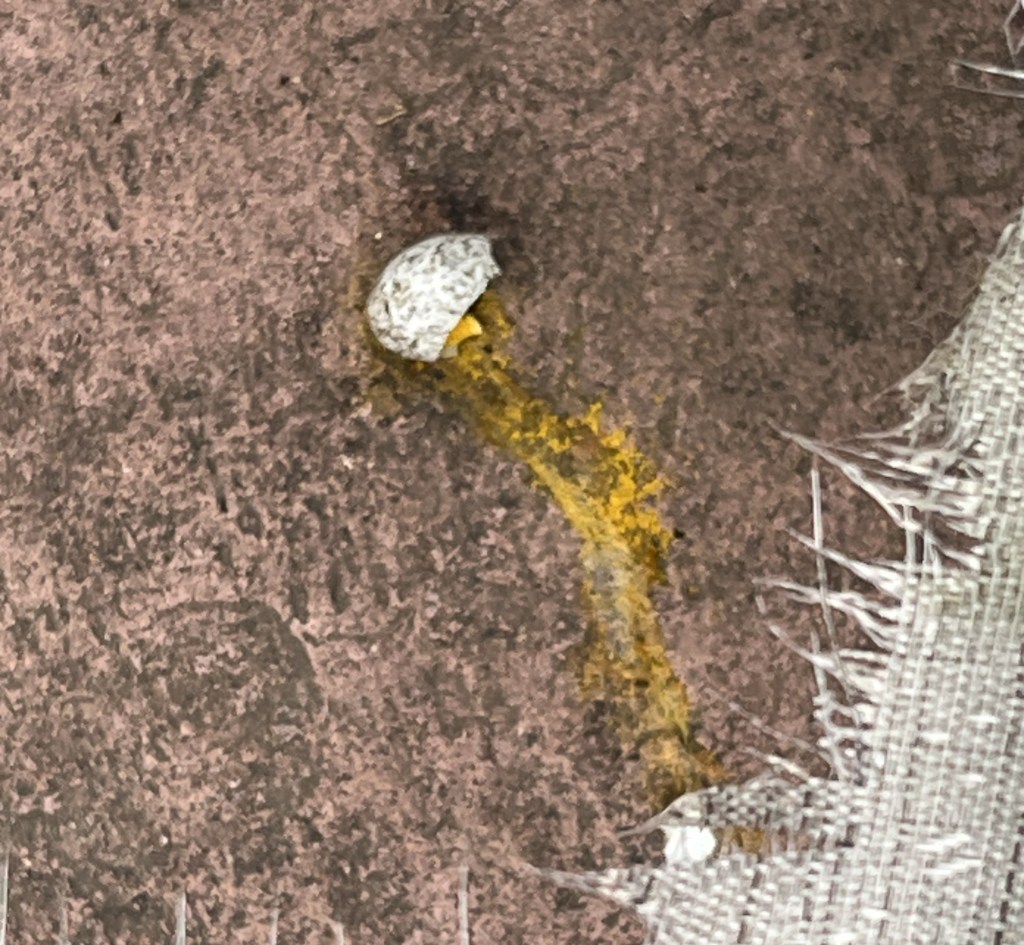
As I continued to check for damage, I found an unhatched (broken) egg under one of our lawn chairs.  This egg had probably also blown out of the nest.  While the half robin egg was basically intact, the white and brown speckled egg had impacted on the cement deck and broken.  When I checked my bird chart it IDed the egg as from a Northern Cardinal (Cardinalis cardinalis).  While I was saddened by the loss of the egg, cardinals are another one of the prolific birds that frequent my feeders.  I have not noticed any nests in the tree line, but I admit I have not been looking.  Identifying a bird egg is another item in a long list of things I need to do to become a competent birder.

THOUGHTS:  While a bird egg of each species may be unique, that does not make it any easier for a novice (me) to identify.  Like most skills this takes time studying field guides and observing details and habitats.  During the Western Renaissance, the Humanists seemed to be masters of the sciences, art, architecture, and even religion.  I tried this eclectic approach in graduate school and was booed down because I refused to “take a side”.  If I did not agree with a specific philosophy or methodology (theirs), I was wrong.  We seem to be employing a similar tact in our current relationships.  It was the diversity employed by the humanists that sparked the modern era.  Diversity generally creates a stronger outcome in science and relationships.  Act for all.  Change is coming and it starts with you.