3rd Sister

August 28, 2024

While the puny ears of corn (Z. mays var. rugosa) have been harvested and the stalks have begun to wilt and dry, they are still staked and perform well as a trellis for my pole beans (Phaseolus vulgaris), the 2nd sister.  I was surprised by the amount of grass that popped up out of nowhere after I mulched the troughs between the beds with straw.  When we went to Maine my sister mentioned she placed straw as mulch for her vegetables and it was also producing copious amounts of grass.  Whether this was wheat grass of some other form, it was growing well in both gardens.  The butternut squash had finally decided to take off and the leaves were fighting fiercely to overcome the groundcover that is still thriving beneath the compost and soil I had placed on top of the beds.  For the last several weeks I have been waiting to harvest this 3rd sister. 

When I looked online, I found Butternut squash (Cucurbita moschata) is a type of winter squash grown on a vine and is part of the same squash family as ponca, waltham, pumpkin, and calabaza.  The word “squash” comes from the Narragansett (an Algonquian language) word askutasquash, meaning “eaten raw or uncooked”, and butternut comes from the squash’s nutty flavor.  Although American native peoples may have eaten some forms of squash without cooking, today most squash is eaten cooked.  Before the arrival of Europeans, winter squash had been carried through out North America where it could be grown.  Butternut is a modern variety developed in 1944 by Charles Leggett of Stow of Massachusetts, who crossed pumpkin (Cucurbita pepo) and gooseneck squash varieties.  Butternut squash has a sweet, nutty taste similar to that of a pumpkin.  It has tan-yellow skin and orange fleshy pulp with seeds contained in a compartment in the blossom end.  When ripening, the flesh turns increasingly deep orange due to its rich content of beta-carotene (vitamin A).  Although botanically a fruit (a berry), butternut squash is a culinarily vegetable that can be roasted, sautéed, puréed for soups, or mashed to be used in casseroles, breads, muffins, and pies. 

Once I saw my 3rd sister producing large 8 to 10 inch fruits I needed to know when they were ripe and how to harvest.  I watched several YouTube videos that came to the consensus that the first way is to look at the skin.  According to the horticulture experts at Iowa State University, “butternut squash are mature (ready to harvest) when the skin is hard (cannot be punctured with the thumbnail) and uniformly tan in color.”   While that was good information, I knew there had to be something more.  One of my videos suggested rather than the squash itself, look at the stem.  When the stem turns from green to brown and dry it is time to harvest.  I also learned that if I “accidentally” picked my squash prematurely, not to worry.  Rhoda Burrows, professor and horticulture specialist at San Diego State, says “in weeks, and even months, after harvest winter squash slowly convert starch to sugars, increasing their appeal to our taste buds.”  I have harvested the 7 squash fruits produced by my 3rd sister and have stored them on the porch to continue to mature.  While I could have wished for a larger harvest, I am looking forward to some squash soup this fall.

THOUGHTS:  While my 3rd sister did not produce to abundance, I was happy with the fruit I got.  Two of the small fruits were damaged by worms.  The US Department of Agriculture says billions of pounds (453.5 kt) of fruits and vegetables go to waste every year, or about 30 to 40 percent of the food supply chain in the US.  The beauty of growing your own vegetables is I cut out the bad spots, peeled and roasted the flesh, and now have squash ready to sauté in a stir fry.  While this will not solve the problem of waste (food loss) or garbage (methane pollution), it is a start.  Act for all.  Change is coming and it starts with you.
1st Sister

August 27, 2024

Since I confessed my cantaloupe (Cucumis melo, honey melon variety) and cucumbers (Cucumis sativus) have been overrun with squash bugs, I may as well begin a final report on the 3 Sisters (i.e., corn, beans, and squash).  I was excited when I put the four mounds of 3 Sisters along the back bed of our house.  Melissa supervised as I moved some of the flower bulbs that had been transplanted from her grandmother’s flower beds by her mom so they would not be overwhelmed by the new mounds.  I cleared the tangled mess of ground cover and laid down a 4 inch (20cm) layer of compost and an additional 1 inch (2.5 cm) of garden soil I had purchased in bulk.  I planted 7 corn seeds in the center of each of the 4 hills.  Even though I had presoaked the seed as suggested, only a total of 7 seeds sprouted.  I replanted the corn knowing this would throw the timing off for planting the other sisters, but it felt good to know the 1st sister was in the ground.

When I looked online, I found the Iroquois had planted maize/corn (Zea mays) for grinding as their 1st sister.  I chose another variation known as sweet corn (Z. mays var. rugosa), sugar corn, or pole corn.  This variety is grown for human consumption with a high sugar content.  Sweet corn is the result of a naturally occurring recessive mutation in the genes which control conversion of sugar to starch inside the endosperm of the corn kernel.  The secret to a good sweet corn, is to pick it when it is still immature (milk stage) and can be prepared and eaten as a vegetable.  Field corn is grown for consumption by livestock and is harvested when the kernels are dry and mature (dent stage).  Since the process of maturation involves converting sugar to starch, sweet corn stores poorly and must be eaten fresh, canned, or frozen, before the kernels become tough and starchy.

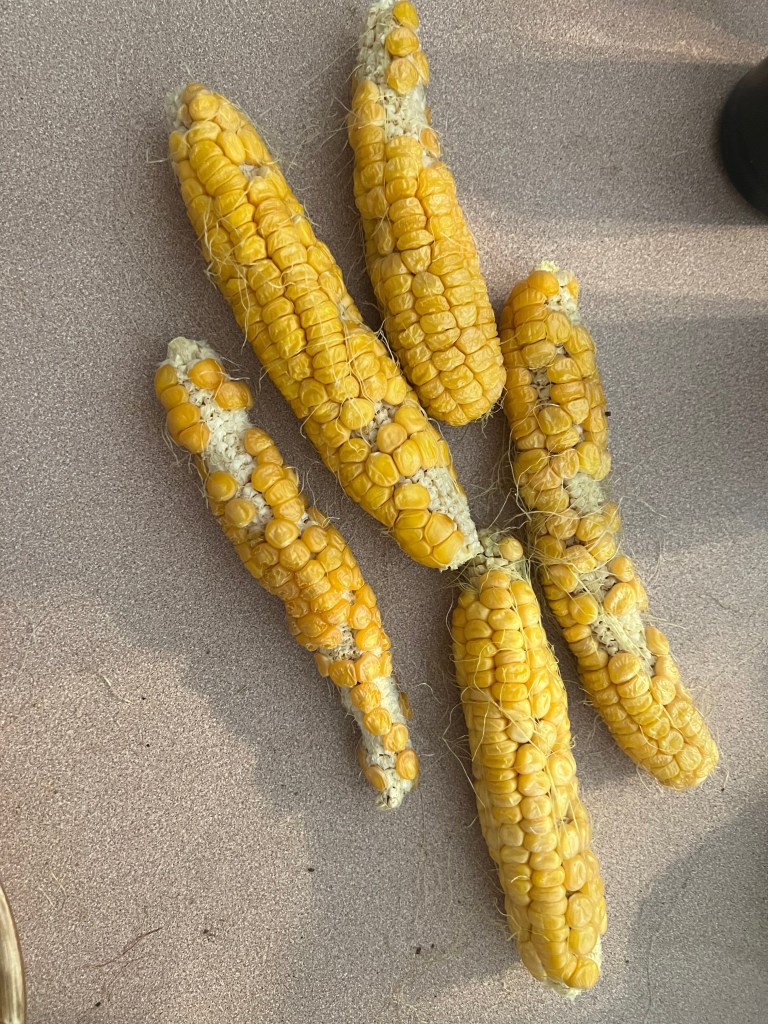
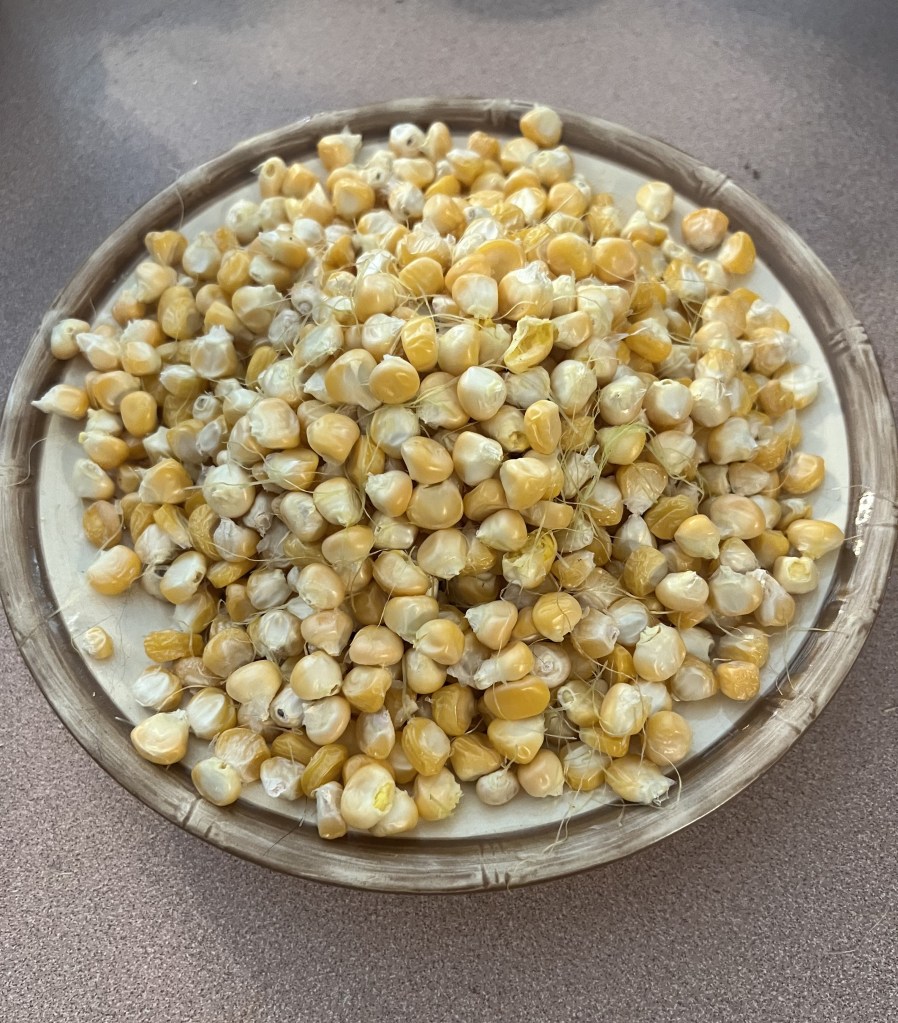
My problems continued with the 1st sister in July when most of the corn stalks suffered from leaning.  This is usually caused by high winds that topple the stalks.  While they are “said” to re-right on their own, mine never did and I ended up staking them to provide support.  I could tell the ears were maturing on the stalks, but they were also being obscured by the voracious leaves of the Kentucky pole beans (Phaseolus vulgaris) which they were designed to support.  I finally picked one of the small ears to see if they were ripe.  Unfortunately, I had allowed them to mature too long on the stalk and they were beginning to dry out.  I went ahead and picked them, and the result was only 15 ears of corn from all of my stalks.  When I shucked the husks, I saw the ears had not completely filled out.  Even that would have been enough for a meal or two for Melissa and me, if it had not become tough and starchy.  If I had been relying on this corn for subsistence, I would have ground the kernels into meal.  Since I am not near to that point yet, it will become bird seed.  If I plant corn next year I will use a fresh pack of seed.       

THOUGHTS:  I was disappointed with the harvest of this year’s 1st sister.  I had been dreaming of ears of sweet corn that I could eat and share with friends and neighbors.  I had put many hours into the preparation and care of the beds.  I had protected them from Loki (fence), nature (leaning), and the heat (daily water).  Once again, I learned (hopefully) the lesson of hard knocks.  I still have expectations of the other 2 sisters coming to maturity.  Hope is defined as” an optimistic state of mind based on an expectation of positive outcomes with respect to events and circumstances in one’s life or the world at large”.  While there are times when events seem (or are) against you, there are always ways to alter the circumstances to try and produce a positive result.  I could have ground the corn into a meal.  The outcomes often rely on your attitude and willingness to persevere in order to succeed.  Humans are a world community and as such we can overcome the challenges before us, when we act together.  Act for all.  Change is coming and it starts with you.
Squash Bugs

August 26, 2024

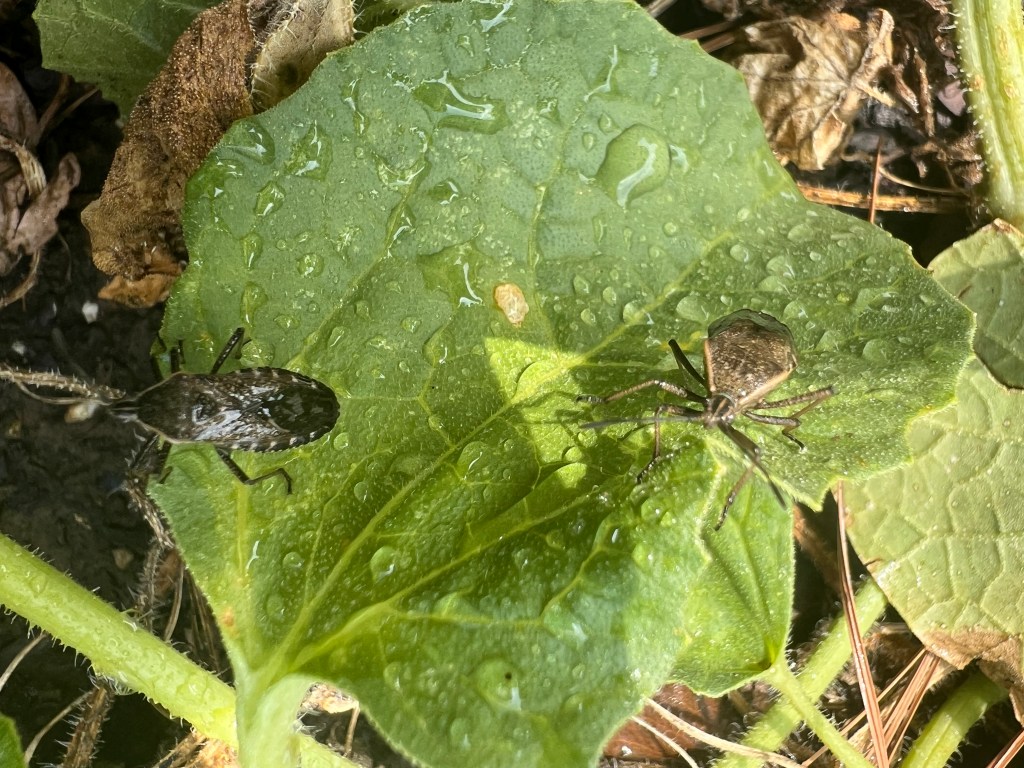
It has been difficult to keep up with the cantaloupes (Cucumis melo, honey melon variety) my plants have been producing.  I have taken to eating these fruits as a snack most afternoons when I do not eat some of the watermelon (Citrullus lanatus, rattlesnake variety) I have also grown.  This has been a healthy and delicious way to get a cool treat in the middle of a hot summer day.  Several weeks ago, I noticed the leaves and vines of both the cantaloupe and cucumbers (Cucumis sativus) were beginning to wilt and die.  I assumed it was from a combination of the heat and a natural occurrence of the vines end of life, especially since they were prolific producers.  However, this morning I took a closer look and saw the vines were infested with large bugs crawling all over the plants.  I learned they are aptly called squash bugs.

When I looked online, I found Squash Bugs (Euthochtha galeator), also known as the squash beetle, are common throughout the eastern US.  The adult squash bug is a flat-backed insect that is fairly large (0.6 inches/1.5 cm) and usually dark gray to dark brown.  The edges and undersides of the abdomen have orange stripes.  Although they can fly, they often simply walk around on plants.  Young squash bugs (nymphs) may be gray or light brown and have black legs.  They move quickly and often congregate in groups on the undersides of leaves.  As the name implies, squash bugs mainly feed on pumpkins and summer and winter squash plants.  However, you will also find squash bug eggs and adult bugs on zucchini, cucumbers, cantaloupe melons, and watermelons.  Squash bugs emit a foul stench when crushed and are sometimes mistakenly called stink bugs.  Although squash bugs and stink bugs look the same and smell awful when you crush them, they are unrelated.  A squash bug can do considerable damage by sucking the sap from leaves, causing them to wilt and die.

As any gardener knows, while the key is identifying your pest (my squash bug), the real question is how to get rid of them.  The best way is early detection to allow you to eliminate them before they grow to be adults (too late for me), otherwise they are very difficult to get rid of completely.  It is suggested to pick the bugs off the plant and flick them into a bucket of soapy water.  Once the bugs are dead you can dump them anywhere.  The egg masses should be picked off the leaves of the plants in the morning and later in the day.  You can scrape the eggs off the leaves with a butter knife and let them fall onto the ground, where other beetles will eat them.  Eggs hatch in about ten days, so you need to check for them at least weekly.  Another method is to place a board or shingle in the garden at night (or pieces of newspaper) and both adults and nymphs will congregate underneath the cover.  You can then squash them between two hard surfaces in the morning and dispose of them.  Again, keep checking your plants daily for more eggs and bugs.  Finally, remove any plant debris during the growing season to reduce sites where the squash bugs can hide.  Looks like I have some work to do.

THOUGHTS:  While I prefer using organic methods to control my pests, insecticides are not effective in managing squash bugs once they are adults.  Since it is late in the season, I can salvage what is left of my plants and then compost the debris to keep them from overwintering.  Since it is just this one bed that is affected, I can also try crop rotation when I plant next year.  It is hard to believe I am already considering what to do differently with next year’s garden.  Once again, I have learned a lot, but there is still so much to know.  Some believe high school or college graduation is the end of your training.  In truth, it has only just begun.  We need to commit to being a life-long learner.  Act for all.  Change is coming and it starts with you.
Sourdough

August 20, 2024

During the pandemic Melissa’s IT job transformed like many others and went to remote work.  As the pandemic continued it was decided that many of the in-person jobs were being accomplished remotely, and eventually her job status was changed to 100% remote.  This saves wear and tear of the long (1.5 hours) commute back and forth through rush hour traffic.  Over the last three years she has also found if she logs to her work site between 7 and 8 am she is able to get a head start before most of the other workers begin their day and start peppering her with queries and requests for “fixes”.  She generally logs on without breakfast and has also gotten into the habit of stopping around 9 am to prepare a quick snack of peanut butter on sourdough toast.  Since I provide the grocery shopping, I am always on the lookout for a sliced loaf for her snack.  Sourdough keeps well and I have often found these loaves in the “day old” section of the markets.  For some reason, I have not been able to find the store baked sliced sourdough at any of our local markets for the last two weeks.

When I looked online, I found sourdough bread is by the fermentation of dough using wild lactic acid bacteria (lactobacillaceae) and yeast.  The fermenting lactic acid imparts a sour taste and improves preservation qualities of the bread.  The Encyclopedia of Food Microbiology tells us one of the oldest sourdough breads was excavated in Switzerland and dates from 3700 BCE and suggests the origin of sourdough fermentation likely relates to the origin of agriculture in the Fertile Crescent and Egypt several thousand years earlier.  This was later confirmed by another archeological find in the Middle East.  In contrast, baker’s yeast has only been used as a leavening agent for the last 150 years.  French bakers brought sourdough techniques to Northern California in 1849 during the Gold Rush, and it remains a part of the culture of San Francisco today.  The sourdough tradition was carried into Alaska in the US and the Yukon Territory in Canada during the Klondike Gold Rush of 1898 as conventional leavenings like yeast and baking soda were less reliable in the cold conditions faced by the prospectors.  Experienced miners and settlers frequently carried a pouch of starter either around their neck or on a belt, and came to be called “sourdoughs”, a term that is still applied in the region.

Finding Melissa sourdough bread has turned from “something on the list” to an obsession.  When her supply was running low, I put it on my list.  I went to our town market and although there was a price tag indicating sourdough, there was no bread.  No problem.  I drive to the next town frequently, so I waited a couple of days and then went to the market there.  This market usually makes too much sourdough and there are always several loaves on the “day old” rack.  I checked both locations in the store and neither had any bread.  Later that week I went to the big box store that is associated with the two markets to check for sourdough.  There were several loaves, but none of them were sliced.  I have found by experience that I am not a good bread-slicer (I squish it), so I decided to forego the purchase.  Afterall, it should arrive at one of my stores shortly, right?  That was two weeks and four visits (often going to both stores on the same day) to the markets without finding any sourdough.  I have switched to another variety of bread.  Melissa is still holding out.

THOUGHTS:  The sourdoughs of the Yukon were said to go to great ends to keep their sourdough starter (Hermon) from freezing.  We now know the starter is not affected by cold but can be killed by heat.  My mom always kept her Herman frozen and once when she was gone dad was clearing out the old frozen items.  Finding the Herman, he thought it was spoiled ice cream.  I took him over a week to finish it off.  My dad was persistent in eating the Herman, just as I am still looking for the sourdough bread.  Human behaviors are learned and passed on.  Most of us are “just like my father/mother.”  Act for all.  Change is coming and it starts with you.
Migratory

August 12, 2024

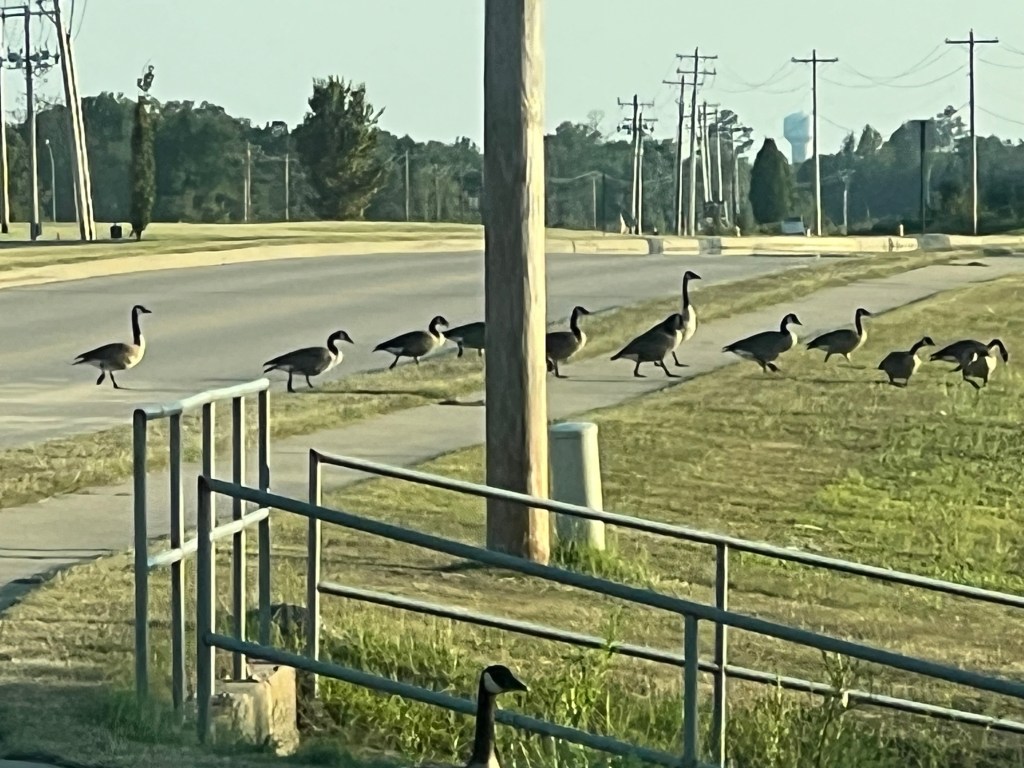
Last week Melissa and I went to eat with friends at a restaurant located in an area that used to be Camp Chaffee.  Camp Chaffee was established in 1941 as part of the US Army’s training and readiness program during World War II.  From 1942 to 1943 Chafee trained and equipped three armored divisions that deployed to Europe.  The camp continued to train armored divisions after the war and in 1956 officially became Fort Chaffee.  In 1958, Elvis Presley was inducted into the army and received the most famous military haircut in the world in Building 803, now part of the Fort Chaffee Museum.  The Fort was opened to migratory groups three times as a humanitarian housing center.  In 1975 to 1976, 50,809 Vietnamese and Cambodian refugees processed through on their way to US resettlement.  In 1980, 25,000 Cuban refugees passed through Chaffee awaiting US resettlement.  In 2005, several thousand victims of Hurricanes Katrina and Rita found refuge at Fort Chaffee for disaster relief assistance.  Fort Chaffee was recommended for closure in 1995, and 7,192 acres were declared surplus and turned over to the local community.  The acreage is managed as a mixed use community which now retains industrial, medical, commercial, and housing sites (and our restaurant) creating wide lawns and groomed roadsides.  As we left the restaurant we were stopped (along with others) by a flock of non-migratory Canada geese strolling across the road.

When I looked online, I found the Giant Canada goose (Branta canadensis maxima) is the largest subspecies of Canada goose, on average weighing 11 pounds (5 kg), and are found throughout central North America.  The subspecies was declared extinct in the 1950’s, but a small population was rediscovered in Rochester, Minnesota in 1962.  Recently, the subspecies have been increasing and are now commonly found in parks and other urban areas in the US.  It is thought that introduced Canada geese in Europe are derived from “maxima” in addition to the subspecies “canadensis”.  The Giant Canada goose was once kept and bred in captivity for use as food and hunting decoys to lure the migratory Canadas close enough to be taken.  The Giant Canada is larger and prefer not to migrate, so many do not.  If adults do not migrate and teach their offspring the migratory route, youngsters will not be migratory, resulting in flocks of urban geese who do not know how to migrate.

The calls of Canada geese flying high overhead in long, awkward V-formation is one of the most lasting signs of the change of seasons.  The southern migration peaks in October as the geese that bred in summer in Canada and Alaska move south to the US.  However, there are other Canada geese who prefer to remain in warmer climes throughout the year.  The birds we call “Canada Geese” comprise a range of geographic populations and subspecies.  Some are larger, some smaller, and most subgroups have distinct breeding ranges north in Canada.  However, other Canada Geese are non-migratory and stay year round.  These are the descendants of birds introduced by management authorities in an effort to revive some of the original wild populations that had been decimated by the 1900’s.  While some Canada geese are migratory and fly thousands of miles each year between nesting and wintering sites, others are non-migratory and thrive on the acres of delectable grass on lawns, parks, and golf courses.  These were the geese who blocked our path as we drove home.

THOUGHTS:  Canada geese have the same problem as other migratory populations in the US.  They are exhilarating as the vast V formations fly overhead, but cause problems as they can overwhelm the limited resources of a particular area when they stop.  Economists tell us it is the population of migratory workers who have (and do) already made America great.  Rather than freeing up jobs, expulsion could result in economic collapse.  Accommodating everyone is not easy, but neither is the mess left behind if we fail to do so.  Act for all.  Change is coming and it starts with you.

Cicada Killer

August 11, 2024

When I took the kids out for their constitutional after feeding this evening, I noticed a large insect on the inside of the porch nestled between the window and screen.  I have recently been battling the paper wasps (Polistes major) and the black and yellow mud daubers (Sceliphron caementarium) that nest under the eaves or in secluded places and I was not pleased to see this larger version inside the porch window.  I tried to slide the window back to allow the wasp to escape but it just moved back to resist the sliding glass.  This wasp intrigued me as it was three times the size of any of the wasps I had been battling.  I googled a picture of the insect and found out this was an eastern cicada killer.

When I looked online, I found the eastern cicada killer (Sphecius speciosus), or the cicada hawk, is a large, solitary digger wasp species in the family Crabronidae.  The name cicada killer may be applied to any species of crabronid that preys on cicadas, but in North America it is typically applied to this species.  It is called the eastern cicada killer to further differentiate it from the multiple examples of related wasp species.  The species can be found in the Eastern and Midwest US and southwards into Mexico and Central America.  Adult wasps are large (0.6 to 2.0 inches/1.5 to 5.0 cm) and robust with hairy, reddish, and black areas on their middle parts (thoraces), and black to reddish brown rear (abdominal) segments that are marked with light yellow stripes, and with brownish wings, somewhat resembling yellowjacket and hornet species.  The females are a little larger than the males, and both are among the largest wasps in the Eastern US.  The males are smaller because they are not given as much larval food.  Since females carry the cicada prey to the nesting burrow, they benefit from being larger.  Cicada killers exert a measure of natural control on cicada populations and may directly benefit the deciduous trees on which the cicadas feed.

The eastern cicada killer is a solitary wasp and had very different behavior from the social wasps such as hornets (genus, Vespa), eastern yellowjacket (Vespula maculifrons), or paper wasps.  Cicada killer females use their stings to paralyze their prey (cicadas) rather than to defend their nests.  While social wasps and bees will sting to protect their nests, the cicada killer does sting humans unless it is handled roughly.  While the larva feeds on the cicada carcass, adults feed on flower nectar and other plant sap exudates.  While males will aggressively defend the areas around nesting sites against rival males, they have no stinger.  Although they appear to attack anything that moves in their territories, males are actually investigating anything that might be a female cicada killer ready to mate.  They are generally not aggressive towards humans and usually fly away when swatted at, rather than attacking.  Although I do not mind the cicadas, I am glad I did not whack the cicada killer wasp.

THOUGHTS:  It is interesting that while I have yet to find any appreciable numbers of cicadas (genus, Magicicada) during this super hatch, I did find a cicada killer.  While the insect appeared to be a massive wasp (which it is) it will rarely sting humans.  I was wary of approaching the aggressive looking wasp until I read it was fairly docile.  Even knowing it would not attack, I still kept my distance to allow the wasp to go about its day.  Looks are often deceiving, and we instinctively see a scarry personae (yellowjacket) to avoid confrontation.  Humans are known to do the same with our own projections, trying to look scarry so others may leave us alone.  It is only when we move beneath the projection that we are able to understand the worth (and reasons) behind the projections.  Act for all.  Change is coming and it starts with you.
Backhoe

August 07, 2024

Last year I blogged how our city’s street department picked up limbs and yard waste on the first Tuesday of the month.  They have guidelines governing length, diameter of limbs, and placement, but the service is free.  At the time I suggested reducing the amount of waste by composting or mulching your grass clippings to keep them out of the overtaxed landfills.  Limbs are a different challenge.  One reason I opted for hügelkultur to fill my raised beds this year was because I had two trees that needed serious pruning.  The raised beds took care of most of the pruning debris, and I stacked the remainder by the curb as I had done the year before.  While I am not actively pruning the trees in my yard this summer, branches do fall or get in the way (i.e., grow) and I stack them by the curb and wait for them to disappear.  I had always wondered about the process for removing the tree limbs but assumed they were collected along with the trash.  As the kids and I returned from our walk this morning I found I was wrong.  A backhoe loader was parked along the curb picking up the limbs from my neighbor’s yard and loading them onto two dump trucks.

When I looked online, I found a backhoe loader, also called a loader/tractor excavator, or just a backhoe, is a heavy equipment vehicle that consists of a tractor-like unit fitted with a loader-style shovel/bucket on the front and a backhoe on the back.  It’s relatively small size and versatility allow the backhoe to be used in urban engineering and small construction projects.  The machine is similar to a Tractor-Loader-Backhoe (TLB), which is a larger agricultural tractor fitted with a front loader and rear backhoe attachment.  The development of the backhoe began with the inventors at the Wain-Roy Corporation of Hubbardston, Massachusetts.  Wain-Roy developed and tested the first backhoes in 1947.  In April 1948 Wain-Roy sold the first all-hydraulic backhoe, mounted to a Ford Model 8N tractor, to the Connecticut Light and Power Company for US$705.  Digging while on tires causes the machine to rock and the swinging weight of the backhoe could cause the vehicle to tip, so most use hydraulic outriggers or stabilizers at the rear when digging and lower the loader bucket for additional stability.  Raising and lowering the outriggers to change position reduces efficiency and many offer small, tracked excavators (skids).  These sacrifice the loader function but increase digging efficiency.

When the kids and I pulled off the main street one of the city trucks was leaving full of tree limbs.  When we pulled into our subdivision the backhoe was parked along the curb picking up limbs and depositing them in the back of another truck in the lane beside it.  The backhoe had its stabilizers down, so I knew there was no way it was moving.  The workers continued to load the limbs.  I thought about going around to the other entrance to the subdivision, but I was in no hurry and watched them work.  Shortly after, the backhoe stopped loading, and the dump truck backed out of the lane to let us pass.  As I pulled into the other lane, I noticed there was another car stopped and waiting on the other side of the workers.  Technically he had the right-of-way, but I had not seen him before I proceeded.  I waved thanks as I drove through the work zone, but everyone ignored me.  I guess I was just another obstacle in their day’s work.

THOUGHTS:  I had the opportunity to watch a backhoe when I was director of a camp in Kansas.  We had bought a used tractor with bucket and mower attachments which we used often.  A volunteer owned a newer small tractor equipped with a backhoe.  He brought it out and quickly dug a trench and replaced the culvert under the road between two of our small ponds, something we had been unable to do.  Having the right tool for the job makes a tremendous difference.  The secret is knowing what you can do and doing it well.  Act for all.  Change is coming and it starts with you.
Clearwing

August 06, 2024

Everything began to die off in my front flower bed with the hot summer temperatures (95F+/– or 35C+/–) while we were on vacation.  I had contracted the neighbor kids to water my vegetables, but the flowers were on their own.  When we returned, I decided to begin watering the beds to try and maintain the garden phlox (Phlox paniculata), elephant ears (Philodendron giganteum), and hasta (Hosta plantaginea) we had planted there.  Now they are all doing well in spite of the summer heat.  When I went out to water the raised beds this morning, I noticed something flitting from flower to flower on the phlox.  It was moving so fast it was hard to get a good look at it, but it was clearly collecting nectar from the flowers that are now in full bloom.  On closer inspection I knew I had seen this creature before.  It was a hummingbird clearwing moth.

When I looked online, I found the Hummingbird Clearwing (Hemaris thysbe) is a moth of the hawkmoth family (Sphingidae).  Coloration of the clearwing varies between individuals, but typically the moth is olive green and burgundy on its back, and white or yellow and burgundy on the underside.  Its wings are transparent (i.e., “clearwing”) with a reddish-brown border.  Its legs are light-colored, which combined with the lack of striping on the underside is a diagnostic for the species.  The clearwing range extends from Alaska to Oregon in the west and from Newfoundland to Florida in the east.  It is a migratory species and is most common in the eastern US and southern Ontario, Canada.  The moth beats its wings quite rapidly and has a wingspan of 1.6 to 2.2 inches (4 to 5.5 cm).  The clearwing has two broods a year in the southern portion of its range, but only one in the north.  The clearwing lives in second-growth forest, in meadows, and is commonly found in the cultivated gardens of suburbia (like mine).  It has minimal economic impact to humans, being neither a crop pollinator nor pest.  The moth does pollinate several cultivated flowers and is the primary pollinator for some species of orchid.  The species is not endangered or threatened.

The Hummingbird Clearwing has often been mistakenly identified as multiple distinct species for its color variation.  The species was first described by Johan Christian Fabricius in 1775 as Sesia thysbe in his Systema Entomologiae.  The species name (thysbe) is likely a reference to Thisbe, half of a pair of ill-fated lovers in Ovid’s Metamorphoses and associates the blood-stained scarf of Thisbe to the reddish-brown coloration of the moth.  Due to the variable coloration and wing patterning of the clearwing, it and other members of Hermaris were described as different species during the 1800’s.  The various forms of clearwing were examined in detail by entomologist Ronald Hodges in 1971.  He dissected a number of specimens representing the range of coloration and geographic scope and found no differences in their reproductive organs and concluded the many variations represent a single species.  The nine defined species were all collapsed into the single species of clearwing.

THOUGHTS:  The common name for the Hummingbird clearwing comes as it closely resembles a hummingbird as they hover over flowers, sipping nectar with their long proboscis during the heat of the day.  The clearwing also resembles several species of bumblebee (genus, Bombus) in both appearance and behavior.  This is an example of convergent evolution where analogous structures are established that have similar form or function in different species but were not present in the last common ancestor of either group.  Analogous traits arise when different species live in similar ways and/or a similar environment.  When occupying similar ecological niches similar problems can lead to similar solutions.  This can explain why dispersed human cultures come up with similar stories and technological solutions.  It does not have to be the result of alien contact.  Act for all.  Change is coming and it starts with you.
Monitoring

August 01, 2024

When we were in Maine, we were amused with stories of the odd behaviors caught on the video cameras surrounding our niece and nephew’s house.  They purchased an abandoned restaurant situated on a lake and for the first several years they were constantly visited by folks thinking the restaurant was still open.  Since the property is on a secluded dead end road anyone who makes it past the fence and onto their yard has no business being there.  Still, there have been several visitors (mostly intoxicated) who have arrived while they have been at work.  That prompted my nephew to install video cameras on the property to alert them if anything happens while they are both gone.  Since their monitoring service records and saves the activity, we were able to watch the antics.

When I looked online, I found the smart home monitoring and security market is one of the most important smart home market segments and was expected to reach approximately US$32.5 billion in 2024 in the US, before nearly doubling in size by 2029.  In 2023, smart home monitoring and security devices constituted the second largest segment of the smart home market in terms of shipments, estimated at around 252 million units.  Connected cameras and doorbells are the most common home security products.  These products are usually designed as part of an integrated smart home ecosystem and are able to generate ongoing revenues for the manufacturer in the form of a subscription fee to access saved recordings.  In 2023, the market for smart doorbells worldwide was valued at around US$16 billion.  In 2024, global spending on information technology is forecast to exceed US$200 billion, with the largest segments being security services, infrastructure protection, and network security equipment.  Artificial intelligence (AI), particularly generative AI, presents an immense potential to improve analytic accuracy, reduce processing in the cloud, and make the system more reliable.

It was somewhat ironic that after we returned home, we had our own home incident.  Melissa had noticed a man lurking around the shop in our back yard and asked me to go see what he was up to.  Our yard backs up onto a large fee space that is lightly forested on one side.  I let the dogs our back and then went with them to see if I could find anything.  I did not.  The next day Melissa heard the front door rattling and went to check.  She opened the door just as the same man was reaching to open the screen.  By this time the kids had arrived and were providing a “friendly” greeting.  She asked if she could help him, and he mumbled something and left.  Melissa began to research camera monitoring systems and reached out to our nephew to see what he recommended.  We now own four cameras for monitoring our two entrance doors, my raised beds and the shop, and our living room.  The living room is for monitoring the kids when we leave them on their own.  A pig’s ear will only keep them occupied for so long.

THOUGHTS:  Between the kids and our new monitoring system we both feel safer, but some warn about how the stored information from the cameras is potentially used.  Shoshana Zuboff, the author of “The Age of Surveillance Capitalism,” warned passing laws that allow police to access stored video creates an environment that fuses government power and private power.  As long as the government depends on the tech companies for access, there will be no laws to stop unwanted data collection.  A security camera can act as a useful deterrent to prevent property crime (break-ins and porch thefts), but will do little to prevent violent crime, although it could help a police investigation.  Both the cameras and the audio alerts can be turned off or set for specific hours.  This allows you to choose when you want to be online and how you are monitoring.  Every advance in technology can be both a bane and a blessing.  Act for all.  Change is coming and it starts with you.

Immersion

July 25, 2024

I have tried to learn (and struggled) a number of different languages during my academic career.  It started with German as an undergrad in an attempt to pursue a Bachelor of Arts degree.  I took German 101 three times over the next three years and got no higher than a C.  I ended up taking Statistics and settled for a Bachelor of Science.  As a graduate student I took Spanish (several times) to fulfill the language requirement for my Master of Arts.  After getting a D on the mid-term during my second try I threw myself at the mercy of the TA (a fellow grad student) and asked what I had to do to pass.  He saw my pain and suggested if I came to class every day, turned in my homework, and tried to interact as best I could, I “might be able to pass”.  While I will never know how well I actually did, I received the required B to pass my language requirement.  My Doctorate required a second language “proficiency”, and this time I struggle through French.  The only time I did passably well was when I studied Arabic during a semester in the Middle East.  That was when I realized as many do, immersion creates a necessity to survive.   

When I looked online, I found language immersion is a technique used in language education where two languages are used for instruction in a variety of topics, such as math, science, or social studies.  The languages used are referred to as the L1 and the L2 for each student, with L1 being the student’s native language and L2 being the second language to be acquired through the immersion program.  The type of immersion will depend on the age of the students, the class time spent in L2, the subjects that are taught, and the level of participation by the speakers of L1.  While these programs differ by country and context, most language immersion programs have the goal of promoting bilingualism between the two different sets of language-speakers.  Biculturalism is often another goal for speakers of the majority language (spoken by the surrounding population) and the minority language (not the main language).  Research has shown that bilingual education gives students greater comprehension and teaches the secondary language in a native-like manner.

I still periodically dabble in learning another language, especially when I am considering a trip to another part of the world.  When we went to Europe several years ago, I attempted to learn French (again).  I gave up after a month when I realized my hearing kept me from comprehending what the on-line tutorial was saying.  Now that we are considering a trip to Greece, I was again bitten by the language bug.  Knowing that immersion is the best way for me to learn, I decided to see if I could use my iPhone to help.  I went to Settings and found one of the features would allow me to change the language of the phone.  Without (careful) thought, I changed the phone settings to Greek.  Everything on the phone shifted to Greek as the primary language.  It was not even transliterated but used the Greek alphabet.  I did not know what the settings on the phone were or how to change them back, especially as my phone had Latin alphabet symbols while the instructions were now in the Euclide alphabet.  I was finally able to switch back by comparing Melissa’s settings placement to mine.

THOUGHTS:  Another language course I took was English as a Second language (ESL).  This was offered to teach English speakers how to work with non-English speakers to help them with their language proficiency.  I did complete this course, but it was probably good that I was transferred from California to Kansas.  Who knows what damage I might have done to the students (lol).  It is said once you learn a second language it is easier to learn another.  That is not the case when you fail to learn the first one.  Language is central to understanding the ethos and culture of others.  Without knowing the underlying vocabulary of another, you will never truly communicate with them.  Act for all.  Change is coming and it starts with you.